 Verbamor
Learn Spanish with your kid without sharing a study system
Run two systems and share only the material: the child gets something they open unasked, you get a dull scheduler at eight new cards a day, and the household shares one song or episode a week plus four Spanish lines at bedtime. A shared review queue models a learner who doesn't exist.
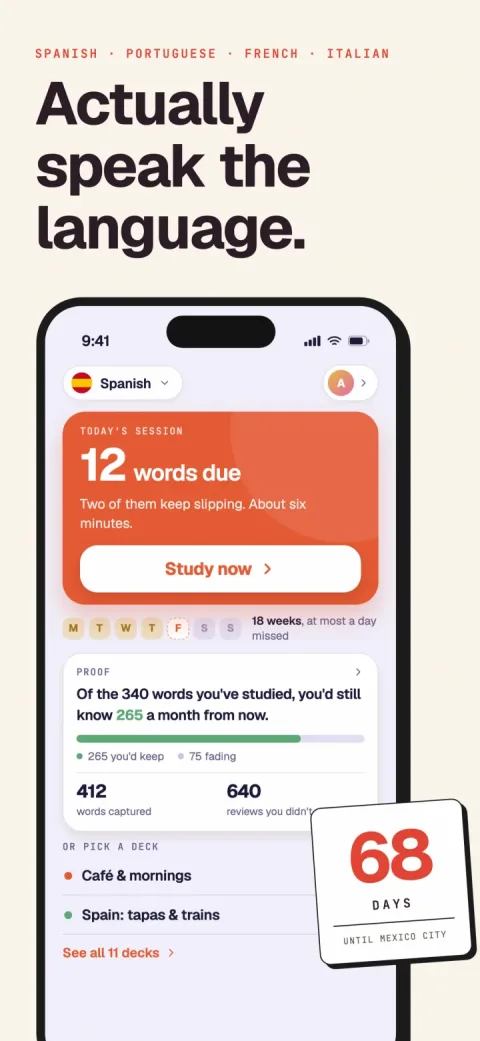
Verbamor opens on one short session a day: the words that are due, and about how long they’ll take.

A parent buys a language app for their eight-year-old and decides to learn too, so the kid has company. Six weeks later the kid has a 40-day streak and can say nine colours. The parent stopped in week two, because their version of the app was a cartoon aimed at somebody a third their age.
Split it in two, sharing only material, and it holds for years.
Buy the child something they open unasked; buy yourself something dull
The child's system has to pass one test: they open it without being asked. Options, priced 24 August 2026:
- Gus on the Go: Spanish, US$3.99 once on the App Store, rated 4+. About 90 words across animals, food, numbers and colours. Right for ages 3 to 6; an eight-year-old finishes it in a week.
- Dinolingo, US$19.99 a month or US$199.99 a year with a 7-day trial. Its own pricing page aims it at ages 2 to 14. Games rather than a course, and the fit for a six-to-ten-year-old.
- A weekly half-hour with a tutor. italki's Spanish directory page states a range of $4 to $60 an hour across the 2,346 teachers it lists, read 23 August 2026. Half an hour is roughly half that, and works from about age seven.
Now the pass mark for the child's system. Count the times in fourteen days your child opens the app, or asks for the lesson, unprompted. Eight or more is a pass; four or fewer is a fail, as is any fortnight where you reminded them twice in one week.
On a fail, stop paying and move to the option with a human in it: the tutor, a Saturday class, or a grandparent on a video call. The adult's system can be dull, because it runs on a schedule.
Your own system can be Anki, free on desktop and US$24.99 once on iPhone, checked August 2026. The setting that matters is the daily new-card limit.
Anki's FAQ states its default plainly: "By default, Anki will show you a maximum of 20 new cards each day." For a parent with twenty minutes, that's too many. Set it to 8.
Anki ships SM-2, an older fixed scheduling formula, and makes FSRS (a newer scheduler that learns from your own grades) a deck-options switch. So check which you run.
Quote one study at a sceptical partner. Snow and Hoefnagel-Höhle (1978) followed 51 English speakers learning Dutch, testing them three times in a year.
At first the adults beat every child group under 12. By the second testing, the 8-to-10s had passed them on sentence repetition, story comprehension and three other measures.
Your head start is spent within the year. So don't read your child's better accent in month six as proof you started too late.
One queue, two memories: the card you just failed doesn't come back for eight weeks
Share the material: a song, a cartoon episode, a picture book, a Saturday plate of scrambled eggs everyone calls huevos revueltos. You meet the same words in the same context, so "the word from the octopus book" means something to both of you.
Keep the review queue separate. FSRS fits a memory model to one person's grading history and picks the next review date for when that person is about to forget. Grade two memories into one queue and it models a learner who doesn't exist.
Here's the shared-queue problem on one card, la tela de una araña, from the song below. Install fsrs==6.3.2, the reference Python implementation, and run this:
from datetime import datetime, timezone
from fsrs import Scheduler, Card, Rating

s = Scheduler(desired_retention=0.9, enable_fuzzing=False)
t0 = datetime(2026, 9, 1, tzinfo=timezone.utc)

def run(name, grades):
    c, days = Card(due=t0), []
    for g in [Rating.Good, Rating.Good] + grades:
        c, _ = s.review_card(c, g, max(c.due, t0))
        days.append((c.due - t0).days)
    print(name, days)

run("child ", [Rating.Easy, Rating.Easy])
run("adult ", [Rating.Hard, Rating.Hard, Rating.Hard])
run("shared", [Rating.Easy, Rating.Hard, Rating.Easy])
It prints exactly this:
child  [0, 2, 21, 157]
adult  [0, 2, 10, 29, 65]
shared [0, 2, 21, 77, 335]
Both day 0 learning steps are graded Good, putting the card into review at 2 days. After that the child answers Easy and the adult Hard.
In the shared run, whoever's turn falls on that date answers it: the child takes day 2, the adult is next at day 21, the child takes day 77.
- The child's queue alone. Due at 2, 21, then 157 days.
- The adult's queue alone. Due at 2, 10, 29, then 65 days.
- The shared queue. The child answers Easy on day 2. The adult answers on day 21, blanks, and grades it Hard, which pushes it 56 days to day 77. That extension is real FSRS behaviour. FSRS raises stability (its estimate, in days, of how long the memory lasts) on any successful recall, and Hard still counts as a success, just a small raise. The child's Easy had already set stability near 19 days. So a small raise from there lands further out than the adult's own queue ever reaches, where Hard on a 10-day card tops out at 65. Sharing halves the adult's first-month reviews, and the card they just failed doesn't return for eight weeks.
Fuzz (the small random jitter FSRS can add to due dates) is off, so these are single deterministic runs: the same code returns the same days every time.
Pick one thing a week; do the studying after they're asleep
- Pick one shared thing a week. A ten-minute episode you both finish beats a series you abandon in week three.
- The adult mines the week's shared thing alone, near their own bedtime. After the child is asleep, pull the words you didn't know into your review system. Gais, Lucas and Born (2006) taught high-school students English-German vocabulary and tested them 48 hours later. Those who slept within a few hours of learning recalled more than those kept awake, and stayed ahead after a recovery night. Study last, then sleep.
- Play the song or episode again. No note-taking, no vocabulary list, no quiz. Horst, Parsons and Bryan (2011) read storybooks to sixteen three-year-olds, holding each new word's frequency constant. Those who heard the same story every time retained the words a week later. Those who heard three different stories carrying the same words did not beat chance. Those children are five years younger than the one in this piece, so I'm extrapolating, and the honest check cuts against me. Rice, Huston, Truglio and Wright (1990) tracked 160 children watching Sesame Street at home from ages 3 to 5, and 166 from ages 5 to 7. Viewing at 3 to 3.5 predicted vocabulary at age 5; viewing at 5 to 5.5 did not predict it at age 7. For an eight-year-old, treat repetition as cheap and pleasant, with step 4 and a person doing the real work.
- Run one shared ritual a day, two minutes, at bedtime. Same slot, same script.
Step 2 is the one people skip, so here's a full pass on Un elefante se balanceaba, which Mamá Lisa's World lists under Spain. It opens sobre la tela de una araña, on a spider's web. Three items:
- se balanceaba, the imperfect of balancearse, to sway: the tense for a past scene in progress.
- la tela de una araña, a spider's web. Keep the whole phrase, because tela alone means fabric.
- sobre, on top of. You probably knew it only as "about".
A ten-minute episode gives you eight to twelve items like these. Here's why the limit is 8, and why 20 is too many. Add this to the code above; it adds cards daily for 30 days and grades everything Good:
from datetime import timedelta
from collections import defaultdict

def load(new_per_day, horizon=30):
    due = defaultdict(list)
    for day in range(horizon):
        now = t0 + timedelta(days=day)
        batch = due.pop(day, []) + [Card(due=now) for _ in range(new_per_day)]
        for c in batch:
            while True:
                c, _ = s.review_card(c, Rating.Good, now)
                if (c.due - now).days >= 1:
                    break
            due[day + (c.due - now).days].append(c)
        if day == horizon - 1:
            print(new_per_day, "new/day ->", len(batch), "cards on day", day)

load(8); load(20)
It prints 8 new/day -> 24 cards on day 29 and 20 new/day -> 60 cards on day 29. Sixty a day is what people quit.
Ninety seconds a night, never corrected, never conditional
Four lines at bedtime, unchanged for a month:
- ¿Qué hiciste hoy? What did you do today. They answer in English at first, and that stays fine for months.
- ¿Cuál fue la mejor parte? What was the best part.
- Mañana vamos a... Tomorrow we are going to. You finish it, badly, with whatever is happening.
- Buenas noches, que sueñes con los angelitos. Goodnight, may you dream of little angels. The standard Spanish goodnight to a child, and the one your kid will still say back at fifteen.
The ritual takes roughly ninety seconds, and the third line teaches the ir a future by using it 365 times a year.
When they answer in English, say your next line; when they say nothing, answer in Spanish yourself; when they refuse, say the goodnight line and stop. Never ask twice, and never ask them to repeat you.
Don't correct your child's Spanish. Not the gender, not the verb, not the accent. A corrected child says less next time. Say it back correctly in your turn.
Never make the ritual conditional on behaviour. The moment Spanish becomes the thing that gets taken away, it's over.
Set a floor. One review session for the adult, however short, and the four bedtime lines for the household.
How long does Spanish take at twenty minutes a day?
Spanish takes roughly five years at twenty minutes a day, probably more, and that's the number to give the other adult first. The US Foreign Service Institute puts Spanish and French in Category I, its easiest group, at 552 to 690 class hours, Spanish at the 30-week end.
Twenty minutes a day is 122 hours a year, so that range takes four and a half to five and a half years. Even that is optimistic: an FSI hour is a taught hour with 17 hours of homework behind each week.
A partner told "roughly five years, probably more" in week one doesn't quit in month three.
Now year one. Eight items a day, five days a week, is 2,080 a year.
Nation and Waring report that about 2,000 word families cover close to 80% of written text and around 96% of informal speech. (A word family is a word plus its forms, like play, plays and played.) They treat 95% as enough for comprehension.
Speech aimed at you clears that bar. A picture book doesn't, because at 80% coverage one word in five is unknown. Year one buys you listening.
Nation (2006) puts unassisted comprehension at 98% coverage: 6,000 to 7,000 word families for speech.
An app and two minutes a night won't make a child fluent; a person might
For the child, the honest version is worse. A child who only meets the language through an app and a two-minute ritual won't become fluent. Children who do get hours of it, usually from a person.
If fluency is the goal, this supplements a school or a relative, and the money belongs there.
Skip the setup if the child doesn't want it: a language a parent wants and a child doesn't is a fight you lose slowly. Do the ritual yourself and let them join when they want. Skip it too if one parent speaks the language natively.
One product limit, since people ask. The adult system I build is Verbamor, US$19.99 a month with no free tier.
It does nothing for children: no kids mode, no family plan, no shared decks, no second seat. Two adults, two accounts. Anki does the job described here for free on desktop.
Copy this, change the language, send it tonight.
I want to do Spanish properly and it works better if the house is in on it. Every Sunday we pick one thing in Spanish, a book or an episode, and it plays that week. I do my own study after bedtime, twenty minutes. You do whatever you want or nothing. The only shared part is two minutes at bedtime, every night, the same four sentences. We do not correct her, ever. Want to pick this week's book?
Pick this week's thing before you send the note. Queue the episode on the living-room TV, or leave the book on the kitchen table where breakfast happens, and say the four lines tonight.
Two learners, two private queues.
Verbamor keeps a separate FSRS schedule for every account, so your pace never gets diluted by someone else's answers, whether that's a partner, a study group, or a kid learning beside you.
Start 7 days freeThe 7-day free trial is on the yearly plan.