 Verbamor
How to explain spaced repetition to a friend in 2 minutes
To explain spaced repetition to a friend in 2 minutes, open with the problem: everyone forgets, on a schedule. Then give the mechanism, gaps that expand each time you get a word right, and the half most explanations drop: answer out loud before you check. Those three quoted lines are 139 words, about a minute of talking.
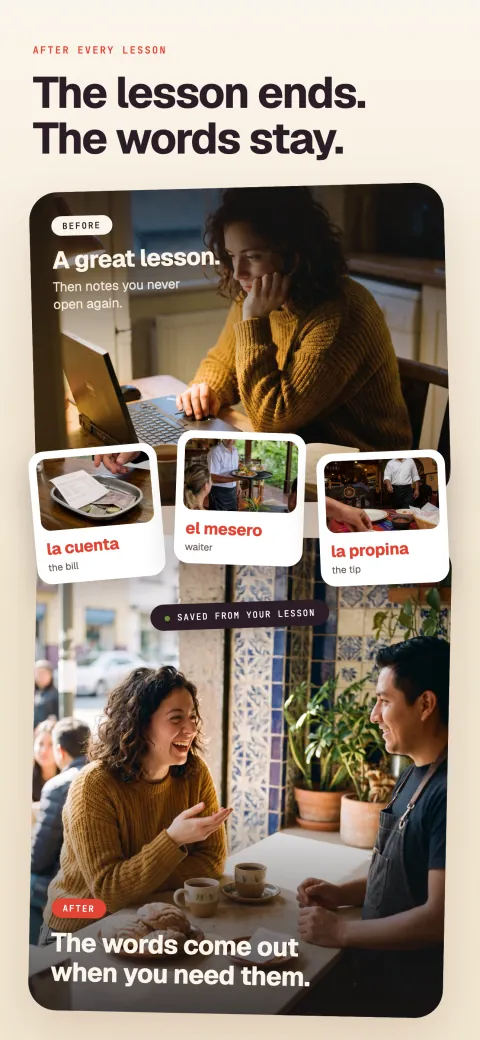
Verbamor records your lesson and turns what your tutor taught into cards that come back on schedule.

A friend watches you tap through cards on your phone at the table and asks what you're doing. You say "spaced repetition." They nod politely.
The conversation moves on, and nothing you know has moved across.
Here's a script that fits in about two minutes of talking. It comes with the five questions people ask back, and one thing you can set up with your friend the same day.
Open by telling them the forgetting is normal
Open with the problem the method solves, because your friend already has that problem and doesn't know it has a fix.
Say this, which runs about 20 seconds out loud:
"You know how you look up a word, use it once, and it's gone by Thursday? Every brain does that with anything it meets once. Yours is working correctly. And the forgetting happens on a schedule, which means you can get in front of it."
Normalising the forgetting is the part that earns you the next ninety seconds. Most people carry a private theory that they personally have a bad memory for languages. Telling them the loss is normal and timed makes them curious instead of defensive.
Then give them the mechanism, another 20 seconds:
"So instead of reviewing a word every day forever, you review it right before you'd forget it. Get it right, and the next gap gets longer: two days, then five, then two weeks, then two months. Get it wrong, and the gap shrinks back down."
The mechanism is expanding gaps, driven by whether you got the word right. Now ask them to say it back to you in their own words.
If they can, they have it. If they stall, the sentence they stall on is the one to say again.
Add the half everyone drops: answer out loud first
Almost everyone explains the spacing and stops. The missing half is the half that does the work.
Say this, about 22 seconds:
"The other half is that you have to actually pull the word out of your head. Say it out loud, from memory, before you see the answer. Recognizing a word on the page feels exactly like knowing it, and the two come apart the moment you have to speak."
If they look sceptical, name the study. This takes eight seconds:
"Researchers ran this on real school classes for a whole term. The facts students got quizzed on came back better months later than the facts they only sat through in class."
Background on the 2011 study, if your friend wants more than the eight-second version. Roediger, Agarwal, McDaniel and McDermott published three experiments in the Journal of Experimental Psychology: Applied in 2011.
The setting was a sixth-grade social studies course in a suburban middle school. The material was the real course material. The measures were the real chapter exams and semester exams the students were graded on.
In the 2011 study, some facts got short low-stakes quizzes during the term. Other facts got the same class coverage with no quiz. Quizzed facts scored higher on the chapter exams and again on the semester exams at the end of the term.
One experiment went further and compared quizzed facts against facts the students were simply shown a second time. Being quizzed still won. The second look at the page didn't do what the act of answering did.
The three quoted lines above are the whole two minutes: 139 words, roughly a minute of talking, and the rest is the pauses where your friend reacts.
The five answers below aren't part of the two minutes. Say them only if asked, one at a time.
Have a line, a source and a paste-ready reply for each objection
People push back in the same five ways. That count is my own observation from having this conversation, not a survey finding.
Each objection below gets three parts, and they're for three different moments. The first is the line you say out loud. The second is one sentence naming where it comes from, for when they ask how you know.
The third is a longer version to paste into a message if they ask you to send it to them in writing. Keep the third one under fifty words, because nobody reads a paragraph on a phone.
"Isn't that just flashcards?"
Say: "Same cards, different timing. Paper flashcards make you review the whole stack at one rate, so you spend most of your time on the ones you already know. This sorts the stack by what is about to fade."
If your friend wants the evidence, say: "This one is arithmetic about how the two stacks get ordered, so there is no study to point at."
In writing: with 200 paper cards you turn all 200 or none. With the same 200 scheduled, the ones you know sit months out, so maybe 15 come due today. Same words, five minutes instead of an hour, and the five minutes land on the shaky ones.
"How long does it take, and how much of my day?"
Say, about 20 seconds: "The US government's own language school takes about seven months of full-time classes to get a diplomat to working Spanish, with a teacher, every day. So months, not weeks. The daily part is small though, and it depends entirely on how many words you add. Anki's manual says twenty new cards a day settles at about two hundred reviews a day. Add five a week and you are nowhere near that."
If your friend wants the evidence, say: "The seven months is the Foreign Service Institute's own published figure, and the card ratio is written in the Anki manual."
In writing: the Foreign Service Institute puts Spanish and French at 30 weeks, 552 to 690 class hours, on 23 hours of class and 17 of homework a week. Anki's manual says 20 new cards a day settles at 200 reviews a day. The project is long, the day is short.
"Does it actually work, or is it just a thing people say?"
Say: "Yes, and it is one of the better-tested findings in memory research. Hundreds of experiments, going back decades, and they point the same way: the same study time spread out beats the same study time piled up."
If your friend wants the evidence, say: "There's a 2006 review of over 300 experiments. The spacing effect is not controversial."
In writing: Cepeda and colleagues reviewed 839 assessments across 317 experiments in 2006. Their 2008 paper taught over 1,350 people. It found the best gap shrinks with the horizon (how far off the test is): 20 to 40% of a one-week delay, 5 to 10% at a year.
"I already tried Anki and quit."
Say, about 18 seconds: "You almost certainly added too many cards in the first week. Twenty new cards a day compounds to about two hundred reviews a day, roughly ten reviews for every card you add. Start again with five cards a week and cap new cards at two a day, and let the backlog you already have run itself out."
If your friend wants the evidence, say: "The Anki manual warns about exactly this. It says more than one user has excitedly studied hundreds of new cards over their first few days and then become overwhelmed by the reviews."
In writing: the fix is one setting. Lower new cards per day and leave the old cards alone, and the review count falls on its own as they get scheduled further out. Two a day settles near 20 reviews, about four minutes.
"What if I keep getting them wrong?"
Say: "Missing a card is the machine working. Guessing wrong and then seeing the answer beats being handed the answer."
If your friend wants the evidence, say: "Kornell, Hays and Bjork showed that across six experiments in 2009."
In writing: that 2009 paper found failed retrieval attempts (tries to recall that come up empty) still improved later learning. It used trivia questions and word pairs, not foreign vocabulary, so don't stretch it. It's enough to say a missed card isn't a sign you're doing it wrong.
Will spaced repetition teach your friend to hold a conversation?
No. Spaced repetition builds recall of specific items. It doesn't build the ability to hold a conversation.
A person with 800 well-scheduled words can read a menu, follow a slow sentence, and name what they want. Put them in a real exchange and they stall. They've practised producing one word on cue, and they haven't practised stringing words together while somebody waits.
Tell your friend the cards sit underneath conversation practice and feed it. They still have to go and talk to somebody.
Then tell your friend who should ignore spaced repetition entirely. Somebody going to Lisbon in nine days doesn't need a review schedule. They need forty phrases and a phrasebook.
The method pays off over months, and the payoff is that words stop leaking away between lessons. If your friend has no months to spend, hand them a phrasebook and let it go.
Close with five cards, on paper or in Anki
Close with a specific action, and pick the one that fits them.
If your friend wants to try the method with no software and no money, give them these six steps:
- Take five words from whatever they are learning.
- Write each on an index card: the word on one side, a full sentence using it on the other.
- Test the stack tomorrow, saying each word out loud before turning the card.
- Test it again at three days, then at a week.
- Move any missed card to the front and test it again the next day. Any card they get right three times running goes to a second pile they test once a month.
- Stop hand-running the stack at four weeks, because past that the gaps get too long to track on paper. That is the moment to move to software.
If your friend already uses software and wants the scheduling done for them, point them at Anki and give them these four steps:
- Install Anki, which is free on desktop, Android and the web, and US$24.99 one-time on iOS.
- Make one deck. One is enough. More decks now just gives them something to tidy instead of study.
- Add five cards through the Add window using the Basic note type, which has two fields, Front and Back.
- Open that deck's options and turn on FSRS, in a section near the bottom of the page. Anki ships the older SM-2 formula as its default scheduler. FSRS, an open-source algorithm that predicts when you're about to forget each card, is opt-in, so this step won't happen by itself.
Warn your friend about the content before they start: Anki ships no language material of its own, so every card is one they build or download.
Make it a pact: five words each, every Sunday
Agree on a pact with your friend: each of you picks five words a week from something real you met, a lesson, a show, a conversation. Each Sunday you send each other your five, in a sentence, not as a bare list. Then during the week, when either of you uses one of the other person's words, you say so.
Slamecka and Graf's 1978 work on the generation effect found that material a person generates is remembered better than the same material read.
Writing your own sentence for a friend is generation. So is having to produce their word later in the week. The social part earns its place mechanically: it adds two more retrieval events per word, two more times you pull each word from memory.
Writing five sentences takes about six minutes, and reading your friend's five takes two. Eight minutes a week is the whole cost of the pact.
Set the day now. A weekly exchange with no named day is a weekly exchange that starts never.
So send them your first five tonight, each one inside a sentence, and ask for theirs by Sunday.
If your friend is starting from zero rather than already learning, what to tell someone starting from scratch covers the first month in a message they can paste.
Skip the pitch. Start with five words.
Verbamor turns the words you actually meet in a lesson or conversation into scheduled cards automatically, so getting started is picking five words, not building an index-card system by hand.
Start 7 days freeThe 7-day free trial is on the yearly plan.