Verbamor
What to tell someone starting from zero
A friend finds out you've been learning Spanish for a year and asks how to start. You have about ninety seconds before their attention moves on, and naming an app is the least useful thing you could say. What actually matters is four decisions they'll make in the first month without noticing they're making them.
Someone finds out you've been learning Spanish for a year and asks how they should start. You have about ninety seconds before their attention moves on.
Most of us spend those ninety seconds naming apps, which is the least useful answer available. The app they pick matters far less than the four decisions they'll make in the next month without noticing they're making them.
Here's what to say instead. Every number below is checkable, and the last section is a plan short enough to paste into a message.
Give them the real timeline first: 24 to 30 weeks, full time
Beginners quit because the progress they get doesn't match the progress they expected. No one told them what to expect, so they invented a number, and the invented number is always too small.
Give them a real one. The US Foreign Service Institute (FSI) publishes how long its own training takes to reach professional working proficiency in speaking and listening.
For Spanish and French it lists 30 weeks. Italian and Portuguese are 24 weeks. The whole Category I group, the group closest to English, runs 552 to 690 class hours.
Then give them the part of that page almost no one quotes, because it's the part that makes the hours make sense. FSI describes a typical week as 23 hours in class plus 17 hours of self-study.
That's 40 hours a week, full time, taught by professionals, with the student doing nothing else.
Say the conclusion out loud. At 20 minutes a day, they aren't on that schedule and never will be. That's fine, because they aren't trying to take a diplomatic posting.
What they're trying to do is order dinner, follow a conversation at a table, and understand their partner's grandmother. That takes a fraction of the hours. It still takes more than six weeks.
A beginner who knows this stays. A beginner who expected fluency by spring quits in March and decides they're bad at languages.
Tell them to pick one source of input and stay with it
The second decision is where the words come from. Beginners collect apps. Four weeks in they have five accounts, five streaks, and no single place where their own words live.
The advice to give is to pick one source of real input and keep returning to it. A weekly lesson with a tutor. One podcast made for learners. One show with subtitles in the target language.
The source matters less than the fact that it repeats. A source you return to teaches you the same words twice, and the second meeting is where the word starts to stick.
The reason is worth explaining in one sentence, because it's the sentence that makes them trust the rest. Cepeda, Pashler, Vul, Wixted and Rohrer reviewed 317 experiments on spacing in 2006.
The finding that matters here: the best gap between two meetings with the same material gets longer as the delay before the test gets longer. Spreading the same total study time out beats piling it into one sitting.
So a beginner who watches one show slowly, three episodes a week, learns more of it than a beginner who watches twelve episodes of twelve shows. Tell them that.
It gives them permission to go narrow, which is the opposite of what every app store front page tells them.
Tell them to write down what they meet
The third decision is the one that separates the people still learning at month twelve from the people who aren't. Beginners meet good words constantly and keep none of them.
The instruction is simple: after any lesson, episode or conversation, write down five to ten things you met. Not fifty.
Write the whole phrase instead of the bare word, because the phrase is what you'll actually say. Write it in a sentence you heard, so it comes with a context.
Then tell them the thing almost no one knows, and cite it, because a cited claim survives being repeated and an uncited one doesn't.
Roediger, Agarwal, McDaniel and McDermott ran this in a real sixth-grade social studies course and published it in the Journal of Experimental Psychology: Applied in 2011. Some facts got short no-stakes quizzes during the term. Other facts got the same class coverage with no quiz.
On the unit exams, and again on the exam at the end of the semester, students scored higher on the quizzed material.
One experiment added a condition where students saw some facts a second time instead of being quizzed on them. Quizzed facts beat those too. The act of pulling an answer out is what leaves the mark.
So the beginner doesn't need a clever card design. They need to answer from memory before they look.
And they need the list of words to sit on paper or in an app. No one can feel the difference between a word they know and a word they recognise.
One more instruction, if they'll take a third: do the writing the same evening.
Gais, Lucas and Born tested high-school students on vocabulary. They found declarative memory (memory for facts and words) is stronger when sleep follows within a few hours of learning, independent of the time of day.
In that study, students who slept within a few hours of learning recalled more 48 hours later than students kept awake the first night. So write the phrases down the same evening and sleep on them, rather than leaving the lesson to sit until Saturday.
Set a floor small enough to survive a bad week
The fourth decision is what happens in a bad week, and beginners never plan for it, so a bad week ends the whole project.
Tell them to set a floor instead of a goal. A goal is 30 minutes a day, which they'll miss on a Tuesday when a work thing runs long. Missing it feels like failing, and two missed days feel like proof.
A floor is the smallest thing that still counts: five cards, or one page, or two minutes of listening. The floor is deliberately too easy. Its job is to be done on the worst day of the month, so the habit survives the month.
Give them the exact sentence to write on a note: "On a bad day I do five cards and that counts."
Beginners won't invent this rule for themselves. Every app they've used has been telling them about streaks, and a streak makes a missed day into a loss.
A deadline, a reading goal or a child changes the advice
Some of this is wrong for some people, and saying so is what makes the rest credible.
If your friend has a hard deadline, a move in eight weeks or a wedding in Rome in May, tell them to drop the slow build and buy tutor hours.
Speaking is a separate skill from knowing words, and it only improves by speaking. Eight weeks isn't enough time to grow into it sideways. Spend the money.
If they're learning a language mainly to read it, they can skip most of the audio advice. Reading and listening pull apart faster than people expect.
And if they're a child, ignore all of it. This is advice for adults who have a job, a limited hour, and a memory that needs help.
Send them this six-step plan today
Here's the artifact. Paste it, change the language, send it.
- Pick your language and write down why, in one sentence, somewhere you'll see it. "So I can talk to Ana's parents" survives a bad month. "Spanish would be useful" doesn't.
- Pick one source of input for the next four weeks. One podcast for learners, one show, or one weekly tutor lesson. Don't add a second one until week five.
- After each session, write down five to ten phrases you actually met. Whole phrases, in a sentence you heard, the same evening.
- Test yourself on them the next day, from the English side, before looking. Say the answer out loud first. Looking at the answer and thinking "yes, that one" is rereading, and in the classroom study above, quizzing beat a second look.
- Set your floor. Five phrases on a bad day. Write the sentence down.
- At week four, count how many of the phrases from week one you can still produce cold. That number is your real progress. It's the only measurement that won't flatter you.
If they want a tool for step 4, tell them the truth about the two shapes it comes in.
Anki is free on desktop and Android, US$24.99 once on iOS, and it ships no content at all, so they build every card themselves. Its scheduler defaults to the older SM-2 algorithm. The newer FSRS, an open-source algorithm that predicts when you're about to forget each card, is an option they have to switch on in deck options.
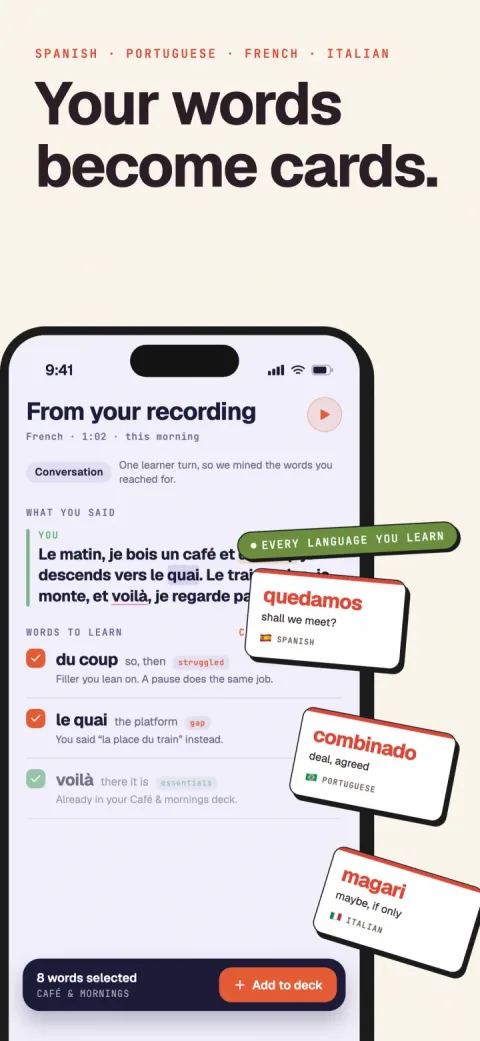
Verbamor takes the recording of a real lesson or conversation, pulls out the words and phrases that were in it, and builds the cards from those, on FSRS by default.
It costs US$19.99 a month, or US$129.99 a year with a 7-day trial on the annual plan. It covers Spanish, French, Italian, Portuguese and Russian, and it's iPhone only.
Send them the six steps first. Let them ask about the tool at week two, once they have something worth putting in one.
The words come from what you actually meet.
Verbamor takes a recording of a real lesson or conversation and turns it into cards built from those exact words, which is the third decision this post says beginners skip.
Start 7 days free