 Verbamor
Keep six words from your next forty minutes with a tutor
To remember words from a conversation, record it and pick your cards from the transcript, keeping only the words you struggled with, got corrected on, or reached for and never found. Six from forty minutes is a good night's work. A word you couldn't find leaves no event behind to remember, so the recording has to keep it.
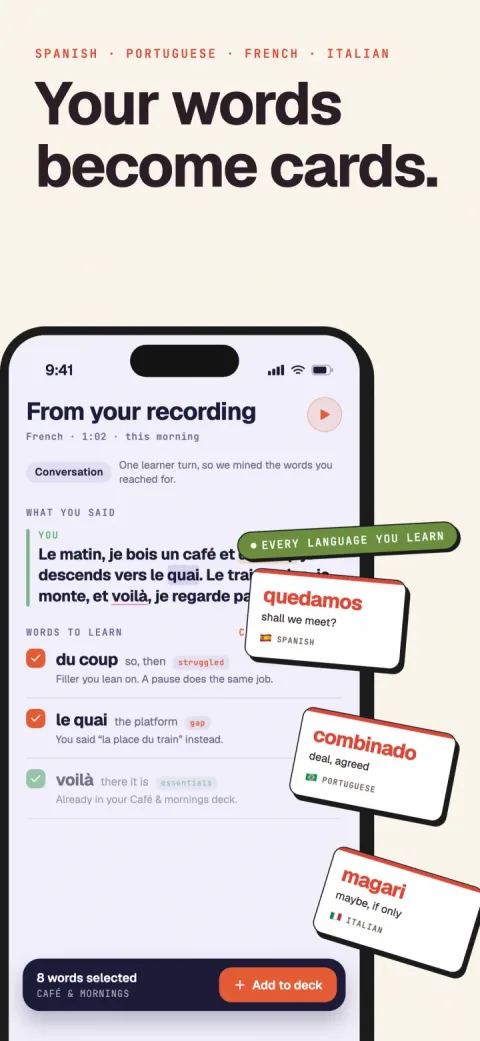
Verbamor turns the words from your own lessons and recordings into flashcards, and brings each one back before you’d forget it.

There are four seconds in your last lesson where you wanted to say "I meant to" and said nothing at all. You won't remember them.
Twenty minutes after the call you can still recall the word for greenhouse, because it was funny. The four seconds are gone, because nothing happened in them.
A recording keeps them. That's the whole recommendation: six words from forty minutes, chosen from the tape instead of from memory.
A word you avoided doesn't feel like an event worth noting
Write down what you want to remember right after a lesson and you get a list biased in one direction. You write the words your tutor announced. You write the one that made you laugh. You don't write the word you avoided, because avoiding a word doesn't feel like an event.
Your sense of what you've learned is a poor instrument too. Karpicke and Roediger's 2008 study in Science had students learn 40 Swahili-English word pairs under four conditions, then tested them a week later.
Students in every condition predicted they would recall about 50%. The group that kept testing itself on all the pairs recalled about 80%. The group that dropped items once it had got them right recalled 36%.
Their predictions didn't differ between conditions.
Castel, McCabe and Roediger found in 2007 how far judgements of learning can drift. (A judgement of learning is your own rating of how well you've learned something.) Students studied word pairs and rated how well they'd learned each one.
They rated the easiest-looking pairs highest, and later recalled those same pairs worse than pairs they had rated lower.
The rating was made while both words sat on the screen. So it measured how smoothly the pair read, and said nothing about whether either word could be produced later.
A conversation runs the same way, with the answers supplied by another person.
Record the whole lesson, then pick from the transcript
Verbamor's Record tab captures up to 90 minutes in one go, and imports an existing audio file up to the same length. These are the app's limits, not a research result. Start it, put the phone face down, and have the conversation. If you'd rather transcribe the lesson yourself, here's what the tools cost and how long the card-making takes.
The audio is transcribed with speaker turns and timestamps. Then Claude reads it in roughly 8,000-character passes, up to 10 of them for a full-length lesson.
A 90-minute two-speaker transcript runs about 75,000 characters. An earlier version read only the first 8,000, so the last seventy minutes of every long lesson were never looked at.
The extractor's output is a list of words and multi-word phrases, capped at 60 words and 30 phrases per recording. It's grouped into sections that follow the timestamps, so a 90-minute lesson arrives in parts instead of one long list.
You pick from it. Nothing becomes a card until you tap it.
Keep the struggled, corrected and gap words first
Every candidate word comes back tagged with why it's on the list. The tags are ordered by how much the word earned its place:
- struggled. You reached for it and couldn't produce it cleanly. You hesitated, self-corrected, mangled the form, or audibly groped for it.
- corrected. The other speaker supplied it or fixed it after you got it wrong.
- gap. You needed it and never produced it at all. You said it in English, talked around it, described it, or trailed off. The model infers the word you were reaching for.
Struggled, corrected and gap are the three you can't self-report. A gap card is a word you never said out loud in any language, reconstructed from the shape of the sentence you abandoned. No notebook method produces that card.
The app also tags four lower-value categories (taught, used, related and personal). Skip all four on a first pass.
If you got a verb form wrong, and only then, the card teaches that exact form instead of the dictionary form. Say fui when the sentence needed fuera and you get a card for fuera, noted as the past subjunctive of ir.
Use a verb correctly and you get the plain infinitive, because there's nothing there to fix.
You're 25 minutes into a Spanish lesson, talking about a flat you nearly rented. This exchange is constructed, but it's the shape of what the extractor sees.
You: Sí, pero el... el, cómo se dice, the landlord? no quería.
Tutor: El casero. El casero no quería.
You: El casero no quería. Y yo... yo iba a firmar pero...
Tutor: Ibas a firmarlo. Pero no lo firmaste.
You: No lo firmé. Estaba muy... pequeño.
Four candidates come out of the flat exchange, in this order. El casero is tagged corrected: you asked for it in English and your tutor handed it over. Firmarlo is corrected too, the attached pronoun you dropped.
Iba a is struggled, because you produced it and then stalled.
And estrecho is a gap. You said pequeño, which is true of a small flat. You meant a narrow one, and the model infers the word you were missing.
El casero you'll remember without help. It was a small event: you asked a question in English, you got an answer, it landed. The other three leave no trace by dinner.
Iba a felt like something you already knew. That's precisely why the stall doesn't register as a failure worth writing down.
Firmarlo was your tutor repairing you gently enough that you barely noticed the repair. And estrecho was never in the room at all.
Take estrecho through the build and here's the specimen. The card writes one cloze sentence, meaning a sentence with the target word removed: El pasillo es muy \_\_\_\_ y la maleta no pasa. The corridor is very narrow and the suitcase doesn't fit.
The image is generated from a description of that same scene, and the two have to match. So you get a narrow hallway with a suitcase wedged in it.
The blank is always the headword, so the answer here is estrecho itself.
Then the estrecho sentence is recorded twice. The front of the card plays the corridor sentence with a soft tone spliced in where estrecho goes.
The tone is scaled to the syllables of the answer, so the gap is the right length to say the word into. The back plays the complete read, estrecho spoken.
The review asks you to produce a word into a spoken gap. That's closer to the thing you failed at than reading "narrow, estrecho" off a list.
How many cards do two lessons a week make?
Between 48 and 80 in a month, if you keep 6 to 10 cards from each lesson, and all of them come from your own mouth.
The queue is scheduled by FSRS, an open-source scheduler. It fits a memory model to each card from your own review history, and sets the next review for the day it predicts you're about to forget.
Run the estrecho card through the FSRS-6 defaults and answer it correctly every time, and the schedule is short.
The reference implementation is py-fsrs 6.3.2, at its default 90% desired retention (the recall odds it aims for). It puts the first review on the day you make the card, the next two days later, and the third about fourteen days after that.
That's four sightings by day 28, counting the day you made it, and the fifth isn't due until roughly day 73. Four, and nowhere near forty.
Cepeda and colleagues tested more than 1,350 people in 2008. With a test one week away, the best gap between studies was about 20 to 40% of that delay. With the test a year out, it fell to about 5 to 10%.
The ratio shrinks as the horizon grows. FSRS is doing that same widening on its own, per card, from your answers.
After three cold reviews, estrecho is a word you can produce when something cues you for it. That much has been tested directly.
Kang, Gollan and Pashler found in 2013 that learners who tried to say a Hebrew word from memory before hearing it beat learners who just repeated it aloud. That held on a spoken production test two days later, with no loss of pronunciation quality. Their test was naming a picture, one word at a time.
Will the word also arrive inside a live sentence, at conversational speed, while you're also handling tense and word order? That's a further step the schedule doesn't guarantee.
The cards make the word available. Getting it into a sentence is what the next conversation is for.
Skip the gap words you never meant, and the English lessons
The gap tag is the least reliable of the three, and you should treat it that way. Nothing verifies it.
The model reads an abandoned sentence and proposes the word it thinks you were reaching for. No second pass checks that guess against anything. I delete some gap candidates on every first pass.
In one of my own recordings I stalled describing a rental contract and said "the thing you sign at the end". The extractor offered firma, the signature. The word I actually wanted was fianza, the deposit.
Both fit the sentence. Only one was in my head.
A wrong guess plants a card for a word you never wanted. So read the note on every gap item before you tap it, and drop the ones that don't match what you remember meaning.
Record a lesson conducted mostly in English and you get very little, because there's barely any target language in the transcript to mine.
This method rewards conversations where you're already struggling in the language. So it fits an A2 learner and up (A2 is the second of six levels on the European scale) better than an absolute beginner in week two.
Recording a lesson also means recording other people. Say so first. A tutor will almost always agree, and most are pleased about it, but recording a family dinner without telling anyone is a bad trade for eight flashcards.
And if you already keep a careful post-lesson notebook and review it, you have most of the benefit already.
So weigh the gap category and the failed verb forms against the price. It's US$19.99 a month, or US$129.99 a year, about $10.83 a month, which you can try free for 7 days first. There's no free tier, and the notebook you keep is free.
Do the pass tonight, then go and use the six
Record the next conversation you have in your target language. Then sit down with the extracted list and keep only the words tagged struggled, corrected or gap. Ignore everything below them the first time. Six cards from one conversation is plenty.
Do the first tagging pass before you sleep. Gais, Lucas and Born studied high-school students learning English-German vocabulary in 2006.
Those who slept within a few hours of learning recalled more at a 48-hour test. The sleep-deprived group was still behind after a night of recovery sleep.
Then go and have the next conversation, and find out which of those six you can now say.
Build cards from what you actually said.
Verbamor records your lessons, transcribes them, and flags the words you struggled with, got corrected on, or reached for and never found, so every card comes from a real moment instead of a guess at what you learned.
Start 7 days freeThe 7-day free trial is on the yearly plan.