 Verbamor
A one-hour lesson costs 36 cents to transcribe and 90 minutes to use
A one-hour Spanish lesson holds about 7,000 spoken words, and maybe 30 of them are worth keeping. You can't see the 30 while you're busy talking, so the recording gets made, feels good, and never gets opened again.
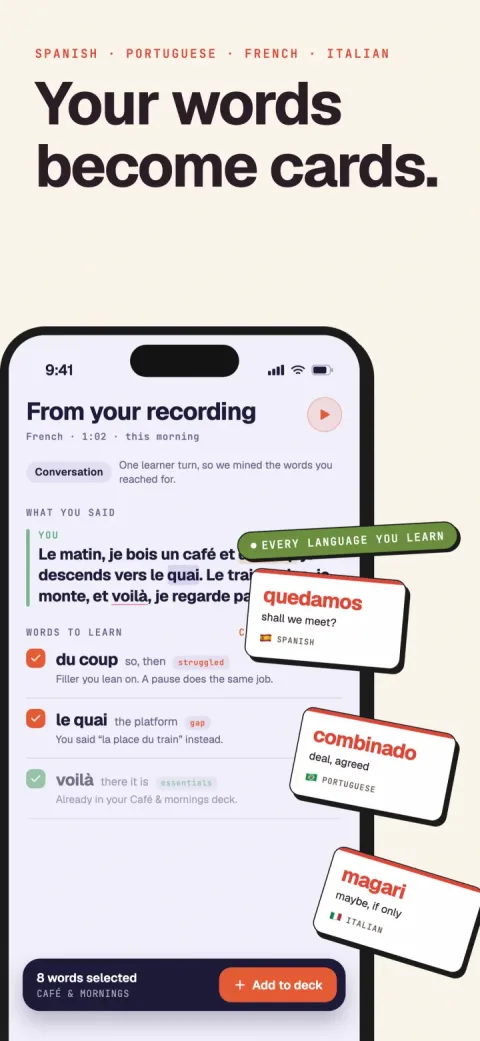
Verbamor turns the words from your own lessons and recordings into flashcards, and brings each one back before you’d forget it.

A one-hour Spanish lesson holds about 7,000 spoken words. Maybe 30 of them are worth keeping. The other 6,970 are words you already own, filler, and your own English.
The problem is that you can't see the 30 while you're talking. You're busy speaking.
So people record the lesson, feel good about having it, and never open the file again. A recording you don't read is a recording you didn't make.
Transcribing an hour-long lesson costs from $0 to about $120
The market splits by who does the work, and the price gap between the ends of it is about 300 times.
Raw API, about $0.006 a minute. An API is a paid service you call from your own code. OpenAI's pricing page lists Whisper transcription at $0.006 per minute, and gpt-4o-mini-transcribe at an estimated $0.003 per minute.
A one-hour lesson is 36 cents. You need to be willing to call an API or run a script.
Free and local, $0. The Whisper model is open source and runs on your own machine. The repository lists six model sizes. They run from tiny, at 39M parameters and about 1 GB of VRAM (graphics memory), to large, at 1550M parameters and about 10 GB.
A turbo model at 809M parameters needs about 6 GB and runs roughly 8 times faster than large. On a recent laptop, an hour of audio takes a few minutes. You pay in setup time and disk space.
Consumer subscription, $16 to $30 a month. Otter's Basic plan is free with 300 transcription minutes a month, capped at 30 minutes per conversation. Pro is $16.99 per user per month, or $8.33 per user per month billed annually, with 1,200 in-app recording minutes. Business is $30 per user per month, or $19.99 billed annually, with unlimited minutes.
Descript's free plan gives 1 hour of media a month. Hobbyist is $24 a month, or $16 a month billed annually, with 10 hours. Creator is $35 a month, or $24 billed annually, with 30 hours.
Human transcription, about $2 a minute. Rev charges $1.99 a minute for human transcription and claims 99%+ accuracy with delivery in 12 hours or less.
A one-hour lesson is about $120. Rev's automated tier is sold by subscription instead: a free plan with 45 AI minutes a month, Essentials at $25.49 per seat per month billed yearly for 5,000 AI minutes.
Weekly lessons come to roughly 4 hours of audio a month. At that volume the human option costs about $480 a month and the API option costs about $1.44.
Whisper gets 3.0% to 8.3% of Romance-language words wrong, and more of yours
The honest number depends on the language, and OpenAI published it. Table 13 of the Whisper paper reports word error rate on the FLEURS benchmark, a standard set of read speech, for every language the model handles.
Word error rate is the share of words the system gets wrong, counting substitutions, deletions and insertions. So 5% means one word in twenty.
For large-v2, the four Romance languages sit low. Spanish is 3.0%. Italian is 4.0%. Portuguese is 4.3%. French is 8.3%. German is 4.5% and English is 4.2%, for comparison.
Smaller models are much worse. Whisper small scores 5.6% on Spanish and 15.0% on French, and Whisper tiny scores 15.9% and 41.4%. Model size matters more than anything else you can control.
Read those numbers as a floor. FLEURS is clean, read speech recorded on purpose.
Your lesson is two people talking over each other through a laptop microphone, and one of them has an accent the model has heard less of.
That last part is measured. Graham and Roll (2024), in JASA Express Letters, evaluated Whisper across native and non-native English accents.
They found better performance on native than non-native accents, and better performance on read speech than on conversational speech. Both conditions describe your lesson recording.
So expect the transcript of your own half of the lesson to be the worse half. Your tutor, a native speaker on a good microphone, transcribes well. You, mid-sentence, hunting for a verb, don't.
This matters less than it sounds, because of what you're using the transcript for. You're only scanning it for 30 words.
A 92% accurate transcript of your tutor's speech still shows you every word you didn't know, because those words are in your tutor's half.
Turning the transcript into cards takes 75 to 100 minutes
Getting the transcript is the cheap part, and no transcription tool does any of the expensive part after it.
Here's the full path for a one-hour lesson. Only one step has a published number behind it, the reading rate. The lookup and card-writing times are my own estimates, and I've marked them so you can weigh them accordingly.
- Record the lesson. Phone on the table, voice memo app, or your video call's own recording. 0 minutes of extra work.
- Get the transcript. Upload, wait. 2 to 5 minutes of waiting, 30 seconds of your attention.
- Read it and mark what you didn't know. Here the reading research gives you a floor you can compute. Brysbaert (2019), in Journal of Memory and Language, pooled 190 studies and 18,573 participants. He put the average adult silent reading rate for English non-fiction at 238 words per minute, with most adults between 175 and 300. A 7,000-word transcript at 238 wpm is 29 minutes to read once, straight through, in your first language. Two things pull against each other from there. You skim instead of reading every word, which is faster. You're reading a second language, and Brysbaert reports lower rates for readers with English as a second language. And you're stopping to mark items. Both of those are slower. Call it 15 to 25 minutes with skimming. That's a derived estimate, not a measurement of this task.
- Look each one up and check it. Confirm the meaning, and check the form: is that a reflexive verb, does that noun take a different article. My estimate is 30 to 60 seconds a lookup, so 15 to 30 minutes for 30 items. No one has published a figure for this, and my sample is my own lessons, so treat the range as the honest width of it.
- Write the card. Front, back, and an example sentence you actually met it in. Anki's own manual describes adding a note as typing the front, typing the back and pressing Add. It puts no time on it, because there's no published rate to cite. My estimate is about 90 seconds a card when the example sentence has to be copied and trimmed from the transcript. That's 45 minutes for 30 cards. If you skip the example sentence, it drops to about half that, and the card gets worse.
- Review it. Tonight, and on the schedule after that.
Steps 3 through 5 total roughly 75 to 100 minutes for a one-hour lesson. That's why the recording stays unopened. The transcription cost 36 cents, and it isn't the bottleneck.
Two ways to shrink it work. Cut to 10 items instead of 30. That takes the tail down to about 30 minutes and loses you the 20 words you were least likely to remember anyway.
Or mark items during the lesson, by typing a single word into a notes app the moment it happens. That moves step 3 out of your evening and into a second you were half using already.
Verbamor does the card-making steps, and gives up the clean transcript
Verbamor is an iPhone and iPad app for Spanish, French, Italian, Portuguese and Russian, and it's built around steps 3 to 5, not step 2. You record or import the lesson, it transcribes the audio, and it mines the words and the multi-word phrases that were in it.
You get a list to pick from, so step 3 is tapping items in a list instead of reading a transcript with a pen.
For each one you keep, it builds the card: an example sentence, an image, and two recordings of that sentence. One is complete. The other has the answer replaced by a tone, so you have to produce the word out loud.
Those go into a queue scheduled by FSRS, an open-source algorithm that predicts when you're about to forget each card.
The tradeoff is the one every bundle makes. The transcript is a means to the cards, so you don't get a clean editable document to keep, and there's no human-verified 99% tier.
It handles five languages. If you're learning German or Japanese, it does nothing for you and Whisper does.
Doing it yourself costs less money and more time
It costs more than the parts. Explorer is US$19.99 a month. Native is US$129.99 a year, about $10.83 a month, with a 7-day trial on the annual plan only. There's no free tier.
Local Whisper plus Anki is the floor to beat: $0 for the model, $0 for Anki on desktop and Android, and a US$24.99 one-time purchase for AnkiMobile on iPhone. Over a year that's $24.99 against $129.99.
The parts will always be cheaper. What the $105 difference buys is steps 3 to 5, which I estimate at 75 to 100 minutes a lesson.
If you're comfortable running a script and you enjoy writing cards, the parts are better value and more configurable. Picking them is a reasonable decision.
Tonight, read one recording for 15 minutes and keep 10 words
Take the last lesson you recorded and didn't open.
Upload it to Descript's free plan, which gives you 1 hour of media a month and takes a full lesson in one file. Otter Basic gives you 300 minutes a month but caps each conversation at 30 minutes, so an hour-long lesson has to go up in two halves.
If you'd rather not upload it at all, install Whisper locally and use the medium or large model. Tiny and base aren't accurate enough to be worth the read.
Then set a timer for 15 minutes, read the transcript once, and write down 10 words. Not 30. Ten. Make those 10 into cards tonight, on paper with the word on one side, or in Anki with the example sentence pasted from the transcript.
If the 15 minutes felt fine, you have a routine and you don't need to buy anything.
If you got 6 minutes in and closed the laptop, the reading step is your real problem. The tool you need is one that removes it.
Transcribing was never the expensive part.
Verbamor transcribes your lesson and mines it for the words worth keeping, turning the reading and card-writing that eats 75 to 100 minutes into a list you just tap through.
Start 7 days freeThe 7-day free trial is on the yearly plan.