 Verbamor
If you already have a tutor, most language apps are the wrong tool
If you already pay a tutor, pick the app that does something with your lesson material: Anki if you'll build the cards by hand, Verbamor if you've proven you won't, and no app at all if your tutor sets homework and checks it. Course apps like Duolingo, Babbel and Pimsleur teach their own syllabus while your lesson fades.
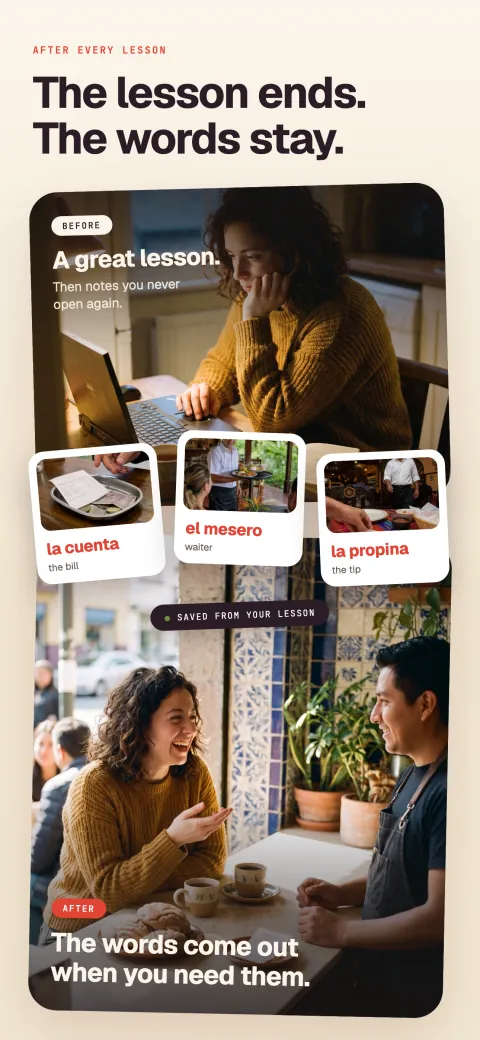
Verbamor records your lesson and turns what your tutor taught into cards that come back on schedule.

I've watched this go wrong the same way for years. Someone books a weekly hour with an italki tutor, has a genuinely good lesson, and then downloads Duolingo because it seems like the responsible thing to do between sessions.
Six weeks later the learner has a 42-day streak and still can't produce the subjunctive their tutor drilled in week 2.
Both things were happening. They just weren't happening to each other.
The only test that matters is whether it touches your lesson
Every roundup I read grades apps on features, price and how fun the lessons are. For a tutored learner, all of that is beside the point, because you already have the expensive part.
Here's the only test I'd apply: does this app do anything with the material from my lesson?
Whether an app teaches Spanish well is a question for someone with no teacher. You have one. Your problem is the 6 days between seeing them.
An app that can't see your lesson is competing with your lesson for the same 20 minutes.
The lesson test cuts the field hard. Most of the apps on any "best language apps" list are course apps: fixed syllabus, their content, their order.
They fail the test by design. A few of them are still worth running, for reasons I'll get to.
Do you need an app if your tutor sets homework and checks it?
Probably not, and the honest version of this page has to start there, before any of the apps.
Say your tutor assigns homework and then actually checks it at the start of the next lesson. That tutor has already closed most of the gap every app on this page sells against.
The homework makes you produce the material instead of reading it, and the check creates a real deadline. The material is also the right material, which is the thing no course app can offer.
If checked homework describes your lessons, do the homework and close this tab. I'd rather say that than pretend a subscription improves a system that's working.
The gap checked homework leaves is timing, and it's narrower than app marketing suggests. Homework tends to get done in one sitting, usually the night before.
Cepeda and colleagues put numbers on the timing in 2008. Across more than 1,350 people, the gap that produced the best retention was about 20 to 40% of a 1-week test delay.
On a 7-day lesson cycle, that points at a first review 1 or 2 days after you walk out. But a week sits at the very short end of what they actually tested, so read it as a direction. It isn't a prescription.
So I'd split the homework across 3 short sittings instead of one. That number is mine, and it costs nothing.
Plenty of tutors don't set homework, or set it and never look at it again. That's when the week goes quiet, and that's the reader the rest of this page is for.
The full routine is in what to do after a language lesson.
Pimsleur fails the test and is still worth running, for the commute
Pimsleur fails my test and I'd still recommend it to a lot of tutored learners, because it does one job nothing else on this list does well.
Pimsleur is audio-first. You can run it driving, walking the dog, or doing dishes, with no screen and no hands.
If you commute, that's found time that was never going to go to your lesson notes anyway. So it isn't competing with anything.
Pimsleur's method also has real spaced-repetition ancestry, and I'll concede that plainly. Its four named principles are anticipation, graduated interval recall, core vocabulary and organic learning.
Graduated interval recall means learners "are reminded of new words at gradually increasing intervals." That's the same idea a modern scheduler automates. Pimsleur was doing it on tape decades before the apps.
Pimsleur has two tiers, Premium for one language and All Access for all 50+ languages, both with a 7-day free trial.
Pimsleur's subscriptions page shows no dollar figure. The plan data on its own product pages does, and on 21 September 2026 it listed Premium at $19.95 a month. Its blog rounds both tiers to "around $20 per month." Every Pimsleur price is here.
Pimsleur's limit is fixed content. When your tutor corrects the way you're using por and para, Pimsleur has no idea that happened and never will.
You have commute time and no screen
Audio drilling in the car is a real job, it's the one job Pimsleur does better than anything here, and it costs you no lesson-review time because you couldn't have reviewed notes while driving anyway. Run it alongside whatever handles your actual lesson material.
Babbel is worth it for the one grammar point that keeps eating your lessons
Babbel is the other genuine concession, for a different job: structured grammar you keep getting wrong.
Say your tutor has flagged the imperfect versus the preterite 3 lessons running. They can explain it again, but explaining it a fourth time is an expensive use of an hour with a native speaker.
Babbel has a course unit on exactly that, and its lessons "most take around 10-15 minutes." It'll walk you through it as many times as you need, without checking a clock or charging by the hour.
Babbel's Review feature does use spaced repetition, with vocabulary from completed lessons added automatically and sessions scheduled for you.
Babbel doesn't publish the interval ladder, so I can't tell you how it compares to FSRS (an open-source algorithm that predicts when you're about to forget each card). Anyone who tells you they can is guessing.
On price, Babbel offers 1, 3, 6 and 12-month plans plus lifetime. The annual works out around $9 a month.
I'd take that with salt. The figure comes from Babbel's own coupon page, so it's a discounted rate with no promise it stands, and Babbel discounts constantly.
One thing worth knowing if you found Babbel while shopping for lessons: Babbel Live is no longer available to individual consumers. If you want live teaching, that's italki, Preply or a local tutor.
One grammar point keeps eating your lessons
Working through a structured explanation on your own time is cheaper than a fourth explanation from a person you pay by the hour, and Babbel's units are short enough to finish. Use it for the specific thing, not as a parallel course.
Duolingo has a real published scheduler and still the weakest case here
Duolingo is the app tutored learners actually download, and it's the one with the weakest case.
Let me be fair first, because a lot of roundups I read are stale about Duolingo, and stale is how you lose an argument.
Duolingo published and open-sourced a real spaced repetition scheduler: half-life regression, in Settles and Meeder's ACL 2016 paper. That's peer-reviewed work, which is more than most competitors on this list can claim.
And the old line that Duolingo only gets you to A2 is now out of date. On 22 April 2026, Duolingo said its Spanish course teaches content through CEFR B2, across 9 courses. (CEFR is the European scale of language levels, from A1 up to C2.)
That's a claim about what the course contains. It says nothing about learner outcomes. But repeating the A2 line in 2026 is just wrong.
Duolingo is also genuinely free. The core course is there, ad-supported, gated by Energy, which replaced hearts as the free-tier limiter.
Super Duolingo removes that. It has a 14-day free trial on the US listing, and App Store prices run from $9.99 to $119.99 depending on term and plan.
Duolingo is built to be your whole course, which is exactly what you don't need. It has no mechanism for learning that your tutor spent 20 minutes on se me olvidó, so it can't put that back in front of you on Thursday.
Duolingo's streak is the sharper issue. It's very good at making you show up, and the 15 minutes it collects each night are the 15 minutes your lesson material needed.
Doing Duolingo feels like language study, so the itch gets scratched and the notebook stays shut.
If you enjoy Duolingo, keep it. Just put it in the same drawer as a crossword, and don't let it be the reason you skipped the review.
Quizlet takes your material, and may only schedule it at a desk
Quizlet at least passes my test in principle. You type your lesson vocabulary in, and it's your material.
Updated 21 September 2026. This section used to say Quizlet had no schedule at all. When I wrote it, a full-text scan of all 164 English articles in Quizlet's help centre returned zero hits for "spaced repetition".
Ten days later, on 21 August 2026, Quizlet published an article documenting one. So the old claim is dead, and this is the correction.
Quizlet's new scheduler gives you four rating buttons inside Flashcards. Depending on which you press, a card comes back "within minutes", "soon", "about a day" or "four or more days".
It still doesn't give you a named algorithm or any published parameters. A re-scan of all 165 articles on 21 September 2026 returns zero hits for "forgetting curve", "memory score", "scheduled review" and "interval".
And Quizlet's help centre says it "is currently only available on the Quizlet website". But the App Store listing for version 10.56 of the iPhone app (13 October 2026) lists Spaced Repetition as a feature, so Quizlet's own pages disagree. If your review happens on a phone between other things, check the app before you count on it. The full Quizlet comparison works through what that costs a language learner.
Beside the scheduler sits Progress, a paid feature per Quizlet's help centre, and it's worth understanding precisely. It buckets terms by how often you got them right (Not Studied, Still Learning, Mastered), with no time dimension at all.
There are no due dates and no next-review calculation. You decide when to come back.
For a tutored learner, Progress is the wrong shape, because deciding when to come back is the exact task that fails. By week 3 you've got 3 lessons of vocabulary in one place and nothing tells you which 9 items are about to go.
Worth conceding: Learn and Test are both paid for individuals. But students in a teacher-created class get unlimited ad-free Learn and Test on sets added to that class page. If your tutor runs a Quizlet class, that's real and it's free.
Quizlet's audio is also free in Flashcards mode. It's machine text-to-speech, with no native recordings, and Quizlet warns some languages have no TTS at all.
Anki is the honest recommendation, if you will actually build the cards
Anki is the honest recommendation for most tutored learners, and I'd rather send you there than oversell what I've built.
Anki ships no language content of its own. For anyone else, that's the weakness. For you, it's the whole point: an empty scheduler is what you want when the content should come from your lessons.
Building the cards yourself has its own effect, too. Slamecka and Graf named the generation effect in 1978: material you generate is remembered better than the same material read. Typing up your lesson items is itself study.
One correction to something you'll read everywhere. Anki's default scheduler is SM-2, the 1987 SuperMemo algorithm, not FSRS.
FSRS has been built in since Anki 23.10 in October 2023, and it's excellent. But you have to switch it on yourself, in the last section of the deck options screen.
SEO blogs claiming FSRS became the default in 23.10 are wrong, and it matters here. If you install Anki expecting a modern scheduler and never touch the settings, you're running a 1987 formula.
Turn FSRS on and you get FSRS-6, which fits 21 parameters to your own review history. It lets you set a desired retention target, the share of cards you want to still remember when they come due (the default is 90%). More on the mechanics in the FSRS post.
Cost: desktop is free on Windows, macOS and Linux, AnkiDroid is free, and AnkiWeb sync is free.
AnkiMobile on iOS is US$24.99 one time, which funds development. Regional prices differ.
You'll actually build the cards
Anki is free, the scheduler is as good as anything shipping once you enable FSRS, and it does exactly the job a tutored learner needs. The only question is whether you'll type up 9 items after every lesson for a year. Some people will, and they should not pay me a subscription to do it for them.
Anki's failure mode is specific. Card-making happens after the lesson, when you're tired, and a good card takes a couple of minutes to write. Skip 2 weeks and the backlog is what kills it.
I've written up the manual system and where it breaks in Verbamor vs notes and Anki.
Verbamor costs about one lesson a month, and I have no retention number of my own
Verbamor exists for one narrow case: you keep paying for lessons and keep losing them, and you've already proved to yourself you won't build the cards by hand.
Verbamor records the lesson and picks out every word or phrase you got wrong. Those become the cards, scheduled with FSRS so each one comes back near the day it would have gone.
The material is your tutor's material. That's the entire pitch.
Now the part I'd want to read if I were you, and the part Anki wins on. Anki publishes a scheduler you can inspect: FSRS-6, 21 parameters, a 90% retention default.
I can tell you Verbamor runs FSRS too, and there my evidence stops. I have no retention number of my own to show you.
Verbamor hasn't been in enough hands for long enough to produce one that would mean anything. And a percentage invented for a comparison page is worth less than nothing.
So hold me to the bar I set below instead of a statistic. Everything measured on this page was measured by Karpicke, Cepeda and Slamecka.
It's evidence that retrieval and spacing work. It doesn't prove my app executes them well, so judge that part on the trial.
Since I've published everyone else's prices, here's mine. Explorer is $19.99 a month. Native is $129.99 a year, which works out at about $10.83 a month.
The 7-day free trial is on that annual plan. Prices are USD, and the App Store converts regionally.
The comparison I'd actually make is against the thing you're already buying. A full hour on italki commonly lands somewhere in the $10 to $30 range. Tutors set their own rates and trial lessons run cheaper, but a month of Verbamor costs roughly what one lesson costs.
That's the bar I'd hold it to. If it doesn't save you at least one lesson's worth of material a year, it isn't worth the money, and you should cancel it.
The evidence underneath Verbamor is the same evidence I'd cite for doing this on paper. Karpicke and Roediger had students learn 40 Swahili-English pairs, then varied what happened after the first correct answer.
Items that kept being tested came back at about 80% a week later. Items that were only restudied came back at about 36%.
The flat 50% guess is the uncomfortable detail. The students couldn't feel which method was working. That's why "I'll just review my notes, it feels fine" survives contact with reality for so long.
Any of these is true
Your tutor sets homework and checks it. Or there's an Anki deck from your lessons on your phone that's still alive after 3 months, in which case you've already solved this for free. If you aren't paying for lessons yet, none of this applies and Duolingo is a better place to start. And if what you want is conversation practice rather than retention, that's a tutor's job, not an app's.
Two things I won't claim. Verbamor won't make you fluent, and it does nothing about the fact that speaking is frightening. That's a separate problem with its own research and its own post on speaking anxiety.
It also won't move you off an intermediate plateau on its own. Plateaus are usually about the kind of input you're getting, more than how many words you've retained.
You've already quit the manual version at least once
The trial is 7 days on the annual plan and you can see the whole mechanism first on the how-it-works page. If you've never tried building the cards by hand, try that first. It's free, and a month of it tells you which of these two people you are.
Nothing here is a ranking, because the answer turns on a fact about you
| App | Uses your lesson material | Worth running alongside a tutor for |
|---|---|---|
| Pimsleur | No | Hands-free audio drilling in time you couldn't have used anyway. Around $20/mo per Pimsleur's own figure, 7-day trial. |
| Babbel | No | Grinding one grammar point you don't want to spend a paid hour on. 10-15 minute lessons, around $9/mo annually, heavily discounted. |
| Duolingo | No | Keeping a daily habit alive, if you accept it's a separate hobby. Free tier is real; Super has a 14-day trial. |
| Quizlet | Yes, if you type it in | A quick word list. A scheduler since August 2026, with no algorithm named, and website only per its help centre. |
| Anki | Yes, if you build it | The whole job, free, provided you'll write the cards. Enable FSRS yourself; SM-2 is the default. |
| Verbamor | Yes, automatically | The same job when card-building is the step you keep skipping. $19.99/mo, or $129.99/yr with a 7-day trial. |
Nothing here is a ranking. The right answer depends on a fact about you: whether the manual version survives past week 3.
The six questions people actually ask, answered short
What is the best app to learn a language with a tutor?
Whichever one puts your tutor's material back in front of you during the week. That rules out most course apps, because Duolingo, Babbel and Pimsleur teach their own syllabus and can't know what came up in your lesson. The realistic shortlist is Anki, if you'll build every card by hand, or Verbamor, which builds them from the lesson. If your tutor assigns and checks homework, that already does most of this job.
Should I use Duolingo if I have a tutor?
Use Duolingo next to a tutor only if you treat it as a separate hobby. It's built to be your entire course, so it has no way to know what your tutor taught you on Tuesday. It's free, the streak genuinely keeps people showing up, and Duolingo published and open-sourced a real spaced repetition scheduler (half-life regression, Settles and Meeder, ACL 2016). But every minute in it is a minute not spent on material you paid for.
Is Pimsleur worth it alongside lessons?
Yes, for hands-free audio practice when you can't look at a screen. Its method rests on four named principles including graduated interval recall, where learners are reminded of new words at gradually increasing intervals, so the spacing idea is genuinely in the design. Around $20 a month by Pimsleur's own figure, with a 7-day free trial. It won't drill the phrase your tutor corrected, because the course is fixed.
Do I still need an app if my tutor gives me homework?
Probably not. Homework that gets assigned and checked makes you produce the material rather than reread it, and the check gives you a real deadline. What's left to fix is when you do it, since most people do all of it the night before.
The 2008 Cepeda spacing study found the best-performing gap sat at roughly 20 to 40% of the delay you're aiming at, which on a weekly cycle means touching the material a day or two after the lesson rather than six. A week is at the short end of the delays they measured, so treat it as a direction. Do the homework. Just don't do all of it at once.
How much does Verbamor cost?
Explorer is $19.99 a month. Native is $129.99 a year, about $10.83 a month, and the 7-day free trial is on that annual plan. The comparison that matters is against lessons: italki tutors set their own rates and a full hour commonly lands in the $10 to $30 range, so a month of Verbamor costs roughly what a single lesson costs. If it doesn't stop you losing at least one lesson a year, it isn't worth the money.
Is Anki good for italki lessons?
Anki is the strongest free option, with one cost: it ships no language content, so every card is one you type. That's an advantage for a tutored learner, since generating the material yourself encodes it. Note the default scheduler is SM-2. FSRS has been built in since 23.10 but you enable it in the deck options. Desktop and Android free; AnkiMobile on iOS is US$24.99 one time.
Every measured claim above traces to one of these
Retrieval beats restudying
- Karpicke, J. D., & Roediger, H. L. (2008). The critical importance of retrieval for learning. Science, 319(5865), 966–968.
How long the gap should be
- Cepeda, N. J., Pashler, H., Vul, E., Wixted, J. T., & Rohrer, D. (2006). Distributed practice in verbal recall tasks: A review and quantitative synthesis. Psychological Bulletin, 132(3), 354–380. Across 317 experiments, the gap producing maximal retention got longer as the retention interval got longer.
- Cepeda, N. J., Vul, E., Rohrer, D., Wixted, J. T., & Pashler, H. (2008). Spacing effects in learning: A temporal ridgeline of optimal retention. Psychological Science, 19(11), 1095–1102.
Writing the card yourself
- Slamecka, N. J., & Graf, P. (1978). The generation effect: Delineation of a phenomenon. Journal of Experimental Psychology: Human Learning and Memory, 4(6), 592–604.
What the apps themselves publish
- Settles, B., & Meeder, B. (2016). A trainable spaced repetition model for language learning. Proceedings of ACL 2016, 1848–1858.
- Anki manual. Deck options: FSRS. ("Enable FSRS under the FSRS section, at the bottom of the deck options page.")
- Pimsleur. The Pimsleur Method. Anticipation, graduated interval recall, core vocabulary, organic learning.
Prices were checked on 11 August 2026 and change often, so verify before you buy.
The lesson was the expensive part.
Verbamor records the lesson, builds the cards from what your tutor actually taught, and puts each one back in front of you near the day it would have gone. $19.99 a month, or $129.99 a year with a 7-day trial.
Start 7 days freeOr run the routine on paper first: the post-lesson debrief in the free handbook is a printable page with nothing to buy.