Verbamor
Is Quizlet good for language learning?
Quizlet is good for language learning if you want to hold and drill a word list, and since August 2026 it schedules reviews too, though only on the website and with no named algorithm. If you review on a phone or want to tune the schedule, that's where it runs out.
I checked the page currently ranking for this query. It prints Quizlet's price twice, to the cent, on an annual plan, and cites nothing for either figure.
I couldn't verify the ranking page's prices from anything Quizlet publishes, so this page doesn't have a price on it. What it has instead is a list of what Quizlet gates, taken from Quizlet's own help centre with the last-updated dates attached. That's less satisfying and it's checkable.
Everything below is written by someone selling a competing app, which you should factor in. The concessions are real, and the first one is that Quizlet does several things better than we do.
Is Quizlet any good for learning a language?
Quizlet is good for the part of language learning that looks like a vocabulary quiz. Type the list, drill it, pass Friday's test. Thousands of people have done exactly that and it worked.
Quizlet got better at the part that runs for months. In August 2026 Quizlet added spaced repetition inside Flashcards, and this page said the opposite until 21 September 2026, so the correction is mine to make.
Two things about Quizlet's spaced repetition decide whether it helps you. It is website only, by Quizlet's own statement, so the app on your phone does not have it. And Quizlet names no algorithm and publishes no parameters, so what you get is four buttons and a promise.
The two limits above are the whole comparison. The rest is detail.
Where Quizlet wins, plainly
Putting this near the top rather than burying it under a table.
Quizlet's shared library is enormous, and we have nothing like it. Whatever textbook chapter you're on, somebody has already typed that word list into Quizlet. For a course with a set syllabus that's a genuine head start, and Verbamor doesn't compete with it.
Quizlet does subjects that aren't languages. Anatomy, case law, the periodic table. Verbamor does Spanish, French, Italian, Portuguese and Russian and nothing else. If your Spanish flashcards live next to your biology flashcards, moving one of them out is a downgrade to your habit, and habits are the fragile part.
Quizlet's free tier is genuinely usable if you want a word list to drill. Flashcards mode with text-to-speech costs nothing. You can build a set, flip through it and hear the words without paying anybody. Plenty of comparison pages describe Quizlet's free tier as barely functional, and I don't think that's fair.
And there's a real free bypass most pages miss. Students in a class a teacher created get unlimited ad-free Learn and Test on the sets added to that class page. So "Learn is paid" is true for individuals and false for classroom students. If you're a student whose teacher runs a Quizlet class, most of the criticism about gating below simply doesn't apply to you.
Quizlet will now pick your next date on the website, and it will not tell you how. Four buttons, no published rule, and nothing at all on the phone in your pocket.
Quizlet has a clock now, and it won't show you the movement
Here's the claim I want to be precise about, because it's the load-bearing one, and because I got it wrong for five weeks.
On 11 August 2026 I scanned all 164 English articles in Quizlet's help centre and found zero hits for "spaced repetition". I wrote that Quizlet had no scheduler. On 21 August 2026 Quizlet published Studying with Spaced Repetition, updated again on 19 September. I re-scanned on 21 September 2026: 165 articles now, and the new one does what it says.
Here is the whole feature, in Quizlet's words. Spaced repetition "helps you review flashcards based on how well you remember them." You open a set in Flashcards, pick it as your study method, flip a card, and rate yourself.
- Repeat returns the card "within minutes".
- Hard returns it "soon".
- Okay "typically returns in about a day".
- Easy "in four or more days".
There's a "New cards per day" setting, and you review "until no more are due". That is a scheduler. Crediting it costs me the argument this page was built on, and it's still the honest reading.
Two limits survive, and both are Quizlet's own words or Quizlet's own silence.
The first limit is a sentence Quizlet's article prints three times, once for web, once for iOS and once for Android: spaced repetition "is currently only available on the Quizlet website." So the thing that decides when you see a word again is missing from the app you actually carry. If you review on a phone, which is where most reviewing happens, you're still on the old behaviour.
The second limit is what a re-scan of all 165 articles on 21 September 2026 still does not contain. Zero hits for "forgetting curve". Zero for "memory score". Zero for "scheduled review". Zero for "interval".
No algorithm is named, no parameters are published, and no retention target appears anywhere. "About a day" and "four or more days" are the entire published specification.
Compare Quizlet's four glosses with Anki, whose manual tells you which scheduler is running, what to click to change it, and what the parameters do. One of those companies is describing a mechanism, the other is describing a feeling. That sentence was true in August and it is still true, which is the part of the criticism that survived.
Alongside the new scheduler sits Progress, which sorts every term into Not Studied, Still Learning, or Mastered based on how often you've answered it correctly. Useful, and unchanged by any of this: it has no time dimension, no due date, no next-review calculation. A word you mastered in February and a word you mastered this morning sit in the same bucket, looking equally safe. On a phone, where spaced repetition doesn't reach, Progress is still the whole of what you get.
February's word and this morning's aren't equally safe, and the size of that gap is measured. Karpicke and Roediger had students learn 40 Swahili-English pairs and then varied what happened after the first correct answer. Items that kept being tested came back a week later at about 80%. Items that were only restudied came back at about 36%.
Read the "Mastered" label against Karpicke and Roediger's result. Mastered means you answered it right several times in a row during one sitting, which is the state the study calls "after the first correct answer." What happens next decides whether you're in the 80% column or the 36% one, and Progress doesn't participate in that decision. More on the mechanism in the testing effect.
Then there's the spacing itself. Cepeda and colleagues reviewed 317 experiments on distributed practice and found the interval producing maximum retention grows as the delay before your test grows. A later paper by the same group put numbers on it, across more than 1,350 people: the optimal gap runs about 20 to 40% of a 1-week test delay, falling to about 5 to 10% at a year.
Cepeda's numbers mean the right gap changes over the life of a word. Tracking it by hand across 400 terms is not something anybody does. That's the job a scheduler exists for, and it's covered properly in spaced repetition for language learners.
If you study on a phone, you can still bolt a schedule on by hand. Put the set in your calendar, revisit on day 1, day 3, day 7, day 21. It works. It's also 20 manual decisions a week that Anki would make for you for free, on the phone, without asking.
Here's what a published clock looks like, for contrast. A scheduler running FSRS keeps 3 numbers per card. Retrievability is the probability you could recall it right now. Stability is how many days it takes that probability to fall from 100% to 90%. Difficulty is how stubborn this particular card is for you. Every grade updates all 3, and the next date is computed from them: the card surfaces when your predicted recall has decayed to the retention you asked for, 90% by default.
Quizlet's four buttons may well be doing something similar underneath. The point is that you cannot tell, and you cannot change it. "About a day" is a description of behaviour; stability measured in days is a number you can inspect, tune and argue with. Anki gives you that once you switch FSRS on, Verbamor does it without the switch, and the full mechanism is written up here if you want the arithmetic. If you only ever study at a desk and don't care what's under the hood, Quizlet's version may be all the scheduling you need, and the Anki and Quizlet comparison works through that choice in detail.
What's actually gated, and why no price appears here
Quizlet blocks automated fetching, so I couldn't read its pricing page directly. Its App Store listing shows in-app purchase names without billing periods attached, which makes a term-to-price mapping guesswork. Every specific annual figure I found on comparison pages traced back to other comparison pages.
So I'm not printing one. A wrong price is worse than no price, and this is the page most likely to get fact-checked.
The gating is documented, though, and it comes straight from Quizlet's help centre with dates on it.
| Feature | Who gets it |
|---|---|
| Flashcards mode | Free |
| Text-to-speech audio | Free. Machine voice, and Quizlet warns some languages have no TTS at all |
| Learn mode | Quizlet Plus and Quizlet Plus for teachers. Free users get a taster session |
| Test mode | Paid, with one free practice test per set |
| Recording your own audio | Quizlet Plus only |
| Learn and Test in a teacher's class | Free and ad-free for students, on sets added to that class page |
Five subscription types exist by name: Quizlet Plus, Quizlet Plus Unlimited, Quizlet Plus for teachers, a Family Plan, and group subscriptions. Plus carries monthly usage limits and Plus Unlimited doesn't, per Quizlet's own help centre, re-checked 21 September 2026.
Verbamor is an iOS subscription, billed monthly or yearly; only the yearly plan opens with a 7-day trial, and there's no free tier. I'm not printing our figures either, for the same reason: App Store prices move with region and promotion, and a number typed into HTML today is wrong for somebody by October. It's on the listing, current by definition.
Audio, and what text-to-speech can't do
Quizlet's free TTS is a real feature and I'd rather have it than nothing. It reads the term in a machine voice, and Quizlet is upfront that some languages don't get it.
Recording custom audio needs Plus, and that recording is a person speaking into a phone, usually a student. Professional native-speaker recordings of your example sentences aren't something Quizlet offers at any tier.
For a written quiz, Quizlet's audio gaps don't matter. For understanding a native speaker at speed it matters a lot, partly because the written form keeps shaping how you say a word longer than you'd expect. Bassetti and Atkinson found orthography still influenced pronunciation in learners with years of instruction behind them. Reading mesa off a card and hearing it said are different inputs, and we wrote that up in why native audio changes what you learn.
Verbamor generates two recordings of each example sentence. The front plays a version with the answer word replaced by a tone, so you have to produce it. The back plays the full read. Both are synthetic voices, alternating male and female across cards, and I'd rather say "synthetic" plainly than let you assume we've hired voice actors.
Somebody else's word list
The shared library is Quizlet's strongest asset, and it has one limit that no size fixes: a shared set contains a stranger's words.
The words that actually hold you back in a conversation are specific and slightly embarrassing. The gender you get wrong every time. The connector your tutor corrected twice last month. The verb you understand fine and can't produce. None of those are in set number 40 of chapter 7.
There's also a measured cost to studying material you didn't produce. Slamecka and Graf's work on the generation effect found material you generate yourself comes back better than the same material read. Typing your own set into Quizlet gets you that benefit. Downloading someone else's doesn't, which is a fair trade for the 40 minutes you saved, as long as you know you made it.
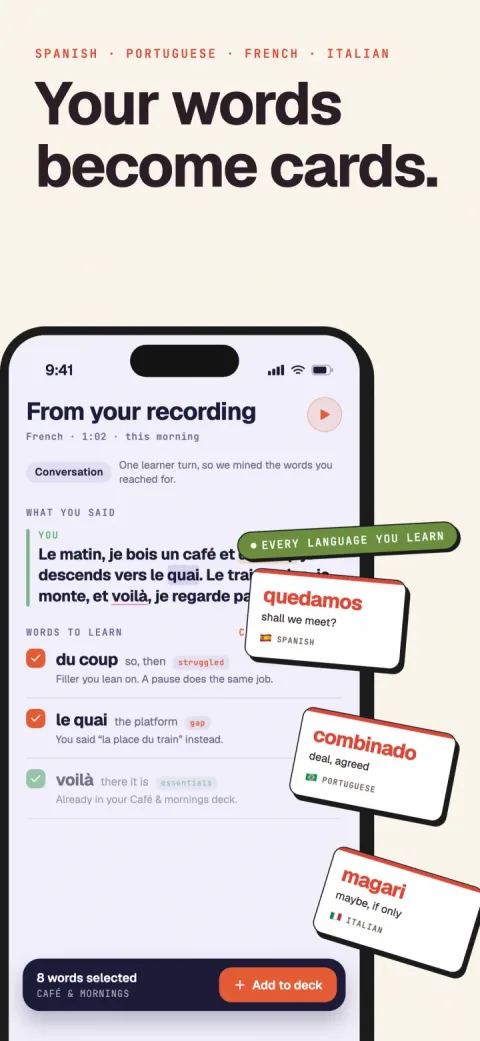
Verbamor's answer is to mine the lesson. It records your tutor session, pulls out of the transcript each word or phrase you actually got wrong, and builds the cards from those. The trade there is obvious: you get a smaller, sharper deck, and you get nothing at all for your biology exam.
The comparison, side by side
| Axis | Quizlet | Verbamor |
|---|---|---|
| What it is | A general study tool, used for everything from anatomy to Spanish | A language app for Spanish, French, Italian, Portuguese and Russian |
| Review scheduling | Yes, since August 2026, but website only and no algorithm named. Progress still has no due dates | FSRS, on by default, with a per-card due date |
| Where cards come from | You type them, or you use one of an enormous number of shared sets | Generated from your lesson transcript or a translation |
| Audio | Free machine TTS. Custom recording is Plus-only and user-recorded | Two generated recordings per card, cloze and full |
| Free tier | Yes. Flashcards and TTS free; Learn and Test gated, free for students in a teacher's class | None. Hard paywall, with a 7-day trial only if you choose yearly billing |
| Other subjects | Anything you can put on two sides of a card | Languages only |
| Platforms | Web, iOS, Android | iOS |
Which one you should pick
Stay on Quizlet if you're a student with a syllabus, if your teacher runs a class (that free unlimited Learn is a genuinely good deal), if you study several subjects and want them in one place, or if you just want a word list you can drill for free. Add one more now: if you study at a desk on the website, the new spaced repetition is free inside Flashcards and it closes the gap this page spent a year complaining about.
Move to Anki if the drilling is fine and the forgetting is the problem, and you don't mind building every card yourself. Its desktop and Android versions cost nothing, its scheduler is documented down to the parameter, and it'll outlast every app in this comparison. Our Anki comparison is honest about where it beats us too.
Try Verbamor if you're paying for tutor lessons and losing most of them by Friday. That's the narrow case we're built for, and it's narrow on purpose.
Quizlet is already working for you
If you open your set most days and the words are sticking, you have the habit that matters, and nothing here will improve a system that works. The failure this fixes is specific: sets that get built, mastered once, and never opened again, while the words quietly leave.
Questions people actually ask
Is Quizlet good for language learning?
Quizlet is good at holding a word list and drilling it, and that's a real job done well. Since August 2026 it also schedules reviews, which closes the biggest gap it used to have, though only on the website and without naming what runs underneath. It still gives you machine text-to-speech rather than recordings of the sentence, and it still has no idea what your tutor corrected you on last Tuesday. If your goal is to pass a vocabulary quiz on Friday, Quizlet is a fine tool. If you review on a phone, or you want to see and tune the schedule, that's where it runs out.
Does Quizlet use spaced repetition?
Yes, since August 2026, and this page said no until 21 September 2026. Quizlet's help article "Studying with Spaced Repetition" was created on 21 August 2026 and updated on 19 September. You open a set in Flashcards, pick spaced repetition as the study method, and rate each card Repeat, Hard, Okay or Easy; Quizlet's own glosses put those at "within minutes", "soon", "about a day" and "four or more days", with a "New cards per day" setting and a queue you work "until no more are due". Two caveats that still matter. Quizlet states it "is currently only available on the Quizlet website", so the phone apps don't have it. And a re-scan of all 165 English help articles on 21 September 2026 still returns zero hits for "forgetting curve", "memory score", "scheduled review" and "interval", so no algorithm is named and no parameters are published.
Is Quizlet Learn free?
For an individual, no. Quizlet's help centre says Learn is available to Quizlet Plus and Quizlet Plus for teachers subscribers, and free users get a taster session rather than the full mode. Test is also paid, with one free practice test per set. There's one real exception worth knowing: students in a class a teacher created get unlimited ad-free Learn and Test on the sets added to that class page. So if your teacher runs a Quizlet class, Learn is free for you. If you're an adult learning Spanish on your own, it isn't.
Does Quizlet have audio for language learning?
Quizlet has free machine text-to-speech in Flashcards mode, and Quizlet warns that some languages have no TTS at all. Recording custom audio is a Quizlet Plus feature, and that audio is you or another user speaking, not a professional native recording. Native-speaker recordings of your example sentences aren't a Quizlet feature. For a written quiz that's fine. For learning to hear a word at conversational speed it's thin, which matters more than most flashcard comparisons admit.
What does Quizlet Plus cost?
We won't print a number, because we couldn't verify one from a Quizlet-owned page. Quizlet blocks automated fetching, its App Store listing shows in-app purchase names without billing periods attached, and every specific annual figure circulating on comparison pages traces back to other comparison pages. Several pages ranking for this query quote prices to the cent with no source at all. What is documented, from Quizlet's own help centre, is the gating: Learn is paid, Test is paid with one free practice test per set, text-to-speech is free, custom audio recording is Plus-only. Five subscription types exist by name, and Quizlet Plus carries monthly usage limits while Plus Unlimited doesn't. Check the current price in your own app store.
What is the best Quizlet alternative for learning a language?
Your pick should follow whichever part of Quizlet is failing you. If you like the drilling but the words keep slipping, you want a real scheduler, and Anki is the free answer there once you accept that you'll be building every card yourself. If the card building is what stalls, Verbamor generates cards from your tutor lesson or a translation and schedules them with FSRS. If you're studying biology alongside your Spanish, stay on Quizlet: nothing built for language learners will handle your other subjects, and juggling two apps for one habit is how habits die.
Sources
What Quizlet gates, and what it documents
- Studying with Spaced Repetition, Quizlet help centre, article 48324742264077, created 21 August 2026 and updated 19 September 2026. Source for the four rating buttons and Quizlet's own glosses on each, the "New cards per day" setting, reviewing "until no more are due", and the sentence "Spaced repetition is currently only available on the Quizlet website", which the article prints three times.
- Quizlet help centre, on Learn being capped at "a limited number of rounds per study set" for free users, the one free practice test per set, free text-to-speech with language gaps, Plus-only and website-only custom audio recording, unlimited ad-free Learn and Test for students in a teacher-created class, and the five named subscription types. Full-text scan of all 164 English articles on 11 August 2026, re-scanned across all 165 on 21 September 2026.
- The re-scan of 21 September 2026 returned zero hits for "forgetting curve", "memory score", "scheduled review" and "interval" across all 165 English articles, which is the basis for saying Quizlet names no algorithm and publishes no parameters or retention target.
- No Quizlet price appears on this page because none could be verified against a Quizlet-owned source. The App Store listing shows in-app purchase names without billing periods attached, so a term-to-price mapping would be a guess.
Why mastered-once isn't mastered
- Karpicke, J. D., & Roediger, H. L. (2008). The critical importance of retrieval for learning. Science, 319(5865), 966–968.
Spacing, and how the right gap changes
- Cepeda, N. J., Pashler, H., Vul, E., Wixted, J. T., & Rohrer, D. (2006). Distributed practice in verbal recall tasks: A review and quantitative synthesis. Psychological Bulletin, 132(3), 354–380.
- Cepeda, N. J., Vul, E., Rohrer, D., Wixted, J. T., & Pashler, H. (2008). Spacing effects in learning: A temporal ridgeline of optimal retention. Psychological Science, 19(11), 1095–1102.
Audio, and typing your own cards
- Bassetti, B., & Atkinson, N. (2015). Effects of orthographic forms on pronunciation in experienced instructed second language learners. Applied Psycholinguistics, 36(1), 67–91.
- Slamecka, N. J., & Graf, P. (1978). The generation effect: Delineation of a phenomenon. Journal of Experimental Psychology: Human Learning and Memory, 4(6), 592–604.
Mastered once isn't mastered.
Verbamor builds cards from what your tutor corrected, then puts each one back in front of you near the day it would have gone.
Start 7 days free