Verbamor
Keeping your italki lessons: Verbamor vs notes and Anki
Test yourself from your italki notes 4 times before the next lesson: within the hour, that night, on day 2 or 3, and the day before. A notes doc works if you retrieve from it. Anki works if you'll spend 2 to 3 hours building cards per lesson hour. Verbamor suits people who've already quit the manual version once.
Say your tutor spent 10 minutes on me da igual versus no me importa, and you finally got the difference. You typed it into your notes. The lesson ended.
Seven days later you're in the next lesson, reaching for me da igual, and out comes a flat no me importa. Your tutor corrects it. Gently. Again.
The lesson worked. The 6 days after it didn't, and that gap is what this page is about.
Where the money actually leaks
An hour with a good tutor surfaces a pile of items worth keeping: words, a correction to a verb you've been mangling for months, an idiom, the reason a preposition changed.
Every one of those lesson items got exactly one exposure. You understood it in the moment, with your tutor's face and gestures and the whole sentence propping the meaning up. That is a long way from producing the word cold, on Thursday, with none of that scaffolding in the room.
Every item in that lesson got exactly one exposure, propped up by a sentence and a face that won't be there on Thursday.
italki tutors set their own prices. Community tutors advertise roughly $4 to $20 a lesson, and professional teachers cost more. Whatever your number is, multiply it by the fraction of each lesson you can still produce a week later. That fraction is the thing worth fixing. More on the mechanism in the forgetting curve post.
What italki already gives you in 2026
The best-known guide on this question was written when lessons happened on Skype and you kept notes in whatever app you had open. That's out of date, and it matters, because italki has quietly closed part of the gap itself.
Lessons now run in italki Classroom. Your teacher can leave notes that save to your account, the Classroom has audio recording, and italki generates an AI Lesson Summary from the session: an overview of what you covered, the key words and definitions, and the sentence structures that came up. When a recording fails, italki can build the summary from the notes and messages in the Classroom instead.
Read the pricing carefully, because it's changed. italki describes the richer parts of that summary, the error corrections and the idioms, as an italki Plus feature, and Plus is listed at $5.99 a month, or $4.99 a month billed annually. Plenty of pages still describe the summaries as simply free.
Take the AI Lesson Summary seriously anyway. Capture used to be the hard part of this workflow, and italki has largely solved it. If you've been avoiding a notes habit because typing during a lesson breaks your concentration, that objection is gone.
What none of italki's tools do is make you produce those words again on the days they're fading. A summary is a document. Documents sit there. The gap that's left is review, and review runs on a calendar.
The notes doc, judged fairly
The manual system works. I want to be plain about that up front, because the honest version of this comparison starts there.
A person who writes up their lesson within the hour, turns the items into self-test prompts, and reopens them 4 times before the next lesson will keep almost everything. That person doesn't need my app, or Anki, or anything else. Paper and something like 18 minutes a week is a complete system.
And the reason the manual system works is measurable. Karpicke and Roediger ran the cleanest version of this in Science in 2008. Students learned 40 Swahili-English pairs, and then the researchers varied what happened after the first correct answer. Items that kept being tested came back at about 80% a week later. Items that were only restudied came back at about 36%.
So the doc's fate is decided by one thing: whether you read it or test yourself from it. Reading it is the 36% column.
Students in Karpicke and Roediger's study also predicted they'd recall about 50% regardless of which condition they were in, and the paper's own phrase is that their predictions were "uncorrelated with actual performance." Worth sitting with if you've been judging your progress by how familiar the notes feel. That's the same bias covered in the post on grading yourself honestly.
Why do people drop their lesson notes in week 3?
People drop their lesson notes in week 3 because by then the doc is long and stops telling you which items are fading. Almost nobody quits the notes habit in week 1. They quit in week 3, and the reason is specific enough to be worth naming.
The numbers in this section are my own working estimates from my own notes, not measured results, so treat them as the shape of the problem rather than a finding. In my notes, week 3 holds 3 lessons and sixty-odd items, all sitting at the same visual weight, with no signal about which of them are about to go. So manual review collapses into one of two moves: review everything, which eats something like 40 minutes and feels like homework, or review nothing.
Both moves lose to reviewing the handful of items that are actually fading today. And there's no way to know which ones those are by looking at a document, because a document records what was taught and never records when you last pulled it out of your head.
The second failure is timing. Left to your own devices you'll do the review the night before the next lesson, in one go, which is cramming. Cepeda and colleagues reviewed 317 experiments on distributed practice and found the same total study time holds better when it's spread out. A later paper from the same group put numbers on the gap: across more than 1,350 people, the optimal spacing was about 20 to 40% of a 1-week test delay, dropping to about 5 to 10% at a year. Note the study's gaps ran up to 3.5 months, so a 7-day lesson cycle sits at the very short end of what was tested.
The practical read is unglamorous. Four short touches beat one long one, and the last touch should land close to the next lesson.
The Anki route, and its real price
The classic answer to all of this is to build an Anki deck from each lesson. It's a good answer, and Anki has been doing this well since 2006.
Two things people get wrong about Anki. First, Anki ships SM-2 as its default scheduler, the 1987 SuperMemo algorithm. FSRS, the modern one, has been built in since version 23.10 in October 2023 but it's opt-in: you have to switch it on yourself, down in the last section of the deck options. Plenty of people have run Anki for years on the legacy scheduler without knowing there was a switch. Flip it.
FSRS-6 fits 21 parameters to your own review log and lets you set a target retention, and Verbamor's scheduler is the same family, so this isn't a point of difference between us. Details in the FSRS post.
Second, Anki ships no language content at all. It's an empty engine. Everything in it is something you typed or downloaded, which is exactly right for lesson notes, and it means the work is all yours.
The card-building work has a published number attached, and it comes from Anki's own camp rather than mine. Gabriel Wyner's italki guide estimates 2 to 3 hours of card-building per hour of tutoring, and he shows his arithmetic: he takes one Spanish sentence, Estoy volando sobre la Tierra, and turns it into 14 flashcards. Fourteen, off one sentence. Multiply that by everything a tutor says in an hour and the estimate stops sounding pessimistic.
Some people love card-building, and it isn't wasted. Slamecka and Graf showed in 1978 that material you generate yourself is remembered better than the same material read, so hand-writing each card genuinely buys you something. It's just expensive in the one currency most learners are short of.
Pricing, since it comes up: Anki costs nothing on a desktop or an Android phone, AnkiWeb sync is free, and iOS is US$24.99 one time, which funds development. Regional prices differ. There's no subscription.
| Notes doc | Anki, built by hand | Verbamor | |
|---|---|---|---|
| Capturing the lesson | You type it, or italki's AI summary does | You type it, then retype it as cards | Records the lesson and mines it |
| Time cost per lesson hour | 10 to 20 min if you do the write-up | 2 to 3 hours, per Fluent Forever's estimate | A few minutes of picking what to keep |
| Knows what's due today | No. You decide, from a long document | Yes, per card, once FSRS is switched on | Yes, per card, scheduled for you with no setup |
| Native audio of the sentence | Only if you recorded the lesson | Only if you add it yourself | Built in, two recordings per card |
| Cost | Free | Free, except US$24.99 once on iOS | US$19.99/mo or US$129.99/yr; the 7-day trial is yearly-only |
| Survives a bad week | Rarely. Nothing asks for you | Yes, though the backlog can bite | Yes, and the queue is capped |
What Verbamor changes, and what it doesn't
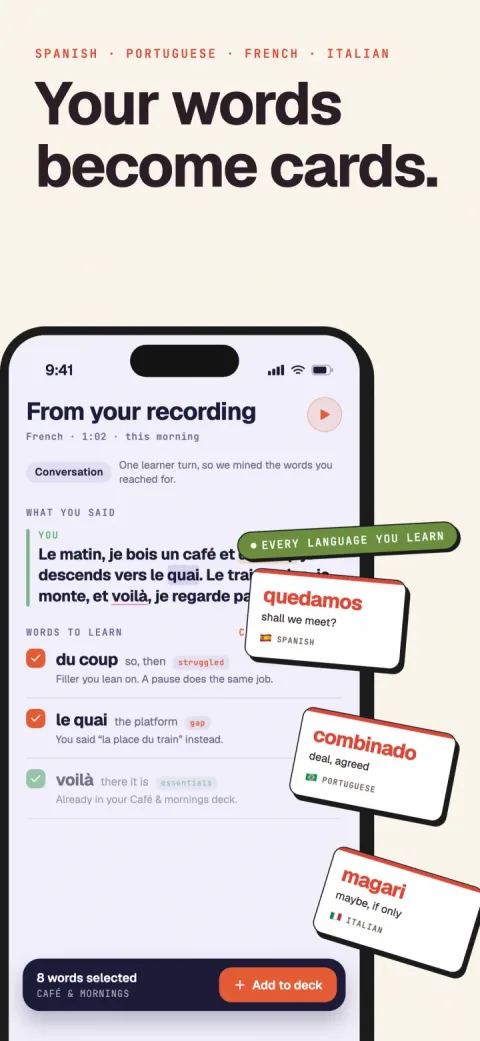
Verbamor records the lesson, mines the transcript, and builds cards from what it finds. Since "mines the transcript" is the kind of phrase that could mean anything, here's what it actually does.
The transcript arrives with speaker labels, so the first job is working out which speaker is you. It picks the less fluent one: the participant who hesitates, asks what a word means, reaches for an English word mid-sentence, or gets corrected. Then it tags every candidate item with a reason, and the reasons are ranked.
Struggled means you reached for it and couldn't produce it cleanly. Corrected means your tutor supplied or fixed it after you got it wrong. Gap means you needed the word and never produced it at all: you said it in English, talked around it, or trailed off, and the word you were reaching for gets inferred. Below those sit taught, used and personal, which earn a card less strongly.
So take the me da igual exchange from the top of this page. You produced no me importa, your tutor offered me da igual and explained when each one lands differently. That's a corrected item, near the top of the ranking, and it becomes a card with the sentence your tutor actually said, the answer blanked out, and two recordings: one with the word replaced by a tone for the recall test, one with it spoken for the answer. It comes back the next day, then further out each time you get it.
Verbamor's mining gets things wrong. If you and your tutor talk over each other the speaker split degrades, and a word you said perfectly well can get tagged struggled because you paused to think. You review the mined list and pick what to keep before anything becomes a card, which is a few minutes rather than Wyner's 2 to 3 hours.
So the thing Verbamor removes is the card-building time, and the decision about what's due. That's the honest scope of the claim.
What Verbamor doesn't change: the review still has to happen, and you still have to grade yourself honestly when a card comes up. No scheduler survives a user who taps Good on words they half-knew. The algorithm is the same family Anki runs once you enable FSRS, so anyone telling you the scheduler is the differentiator is selling you something.
One more limit worth stating. Cards with pictures on them are not automatically better. Carpenter and Olson found in 2012 that for Swahili vocabulary, pictures did not initially beat native-language translations, and learners were more overconfident recalling from a picture. Only once that overconfidence was corrected by retrieval practice did the pictures help. So the images earn their place through the testing.
Which one you should pick
You reopen it and test yourself from it
If your write-up happens within the hour and gets reopened 4 times before the next lesson, and you produce the words from memory instead of reading them, you have the complete system already. A subscription won't improve it. Come back if the habit lapses, because that's the specific failure software fixes.
You enjoy making cards, or you want total control
Anki is free almost everywhere, the scheduler is excellent once you switch FSRS on, and hand-writing each card encodes it a little better than accepting one. Budget the 2 to 3 hours per lesson hour honestly. If that number made you wince, it's the number that ends most Anki decks.
You've already quit the manual version at least once
The case for paying for Verbamor is narrow and it's this: the capture and the queue stop being your job, so the only thing left to keep doing is the few minutes of review. If you've never tried the manual system, try it first. It's free, and a month of it will tell you which of these two people you are.
If you'd rather run the routine on paper before deciding anything, the post-lesson debrief in the free handbook is a printable page and there's nothing to buy. The full method is in the guide on remembering what your tutor teaches, and the card-writing details are in how to turn lessons into flashcards.
Questions people actually ask
How do I remember what my italki tutor teaches me?
Write the items down during the lesson, then retrieve them from memory 4 times before the next one: within the hour, that night, on day 2 or 3, and the day before your next lesson. The retrieval part is what does the work. Items that kept being tested came back at about 80% a week later in Karpicke and Roediger's Swahili study, against about 36% for items that were only restudied. Reading your notes is the 36% column.
Are italki's AI lesson summaries enough on their own?
italki's AI summaries solve the capture problem, which used to be the hard part of this workflow. What a summary doesn't do is make you produce the words again on the days those words are fading. A summary is a document, and a document helps only if you reopen it and test yourself from it rather than reading it. Capture and review are two separate jobs, and italki has now closed the first one. Note that italki describes the richer parts of the summary, the error corrections and idioms, as an italki Plus feature, and Plus is listed at $5.99 a month or $4.99 a month billed annually.
Should I use Anki for my italki lessons instead?
Yes, Anki works for italki lessons if you'll actually build the cards. Anki is US$24.99 one time on iOS and free everywhere else, and the scheduler is genuinely good. Note that Anki ships SM-2 by default and FSRS is opt-in, so flip FSRS on in the deck options, where it's the final section. The real cost is card-building time. Gabriel Wyner's italki guide estimates 2 to 3 hours per hour of tutoring, and he shows the arithmetic by turning one Spanish sentence into 14 flashcards. That's the number to be honest with yourself about.
Why do I stop doing my lesson notes after a few weeks?
The notes habit breaks because the doc got long and stopped telling you what to do. By week 3 the document holds 3 lessons' worth of items and gives you no signal about which are fading today. Manual review then defaults to reviewing everything or reviewing nothing, and both lose to reviewing the handful of items about to go.
Do I need an app if my notes system is working?
No, you don't need an app if your notes system is working. If you reopen your notes on a schedule and test yourself from them rather than reading them, you already have the thing that matters, and a subscription won't improve a working system. Stay where you are. The honest reason to switch is that the habit lapsed, because a lapsed habit is the specific failure software fixes.
How long after an italki lesson should I review?
Start within the hour, while the lesson is still in your head, and again the same night. Sleep matters here: Gais, Lucas and Born found in 2006 that high-school students learning English-German vocabulary recalled more at a test 48 hours later when they'd slept within a few hours of learning, and the sleep-deprived group was still behind after a recovery night. After that, spacing out matters more than any exact schedule.
Sources
Testing beats rereading
- Karpicke, J. D., & Roediger, H. L. (2008). The critical importance of retrieval for learning. Science, 319(5865), 966–968.
Spacing beats one long session
- Cepeda, N. J., Pashler, H., Vul, E., Wixted, J. T., & Rohrer, D. (2006). Distributed practice in verbal recall tasks: A review and quantitative synthesis. Psychological Bulletin, 132(3), 354–380.
- Cepeda, N. J., Vul, E., Rohrer, D., Wixted, J. T., & Pashler, H. (2008). Spacing effects in learning: A temporal ridgeline of optimal retention. Psychological Science, 19(11), 1095–1102.
Sleep and the same-night review
- Gais, S., Lucas, B., & Born, J. (2006). Sleep after learning aids memory recall. Learning & Memory, 13(3), 259–262.
Writing your own cards, and pictures on them
- Slamecka, N. J., & Graf, P. (1978). The generation effect: Delineation of a phenomenon. Journal of Experimental Psychology: Human Learning and Memory, 4(6), 592–604.
- Carpenter, S. K., & Olson, K. M. (2012). Are pictures good for learning new vocabulary in a foreign language? Only if you think they are not. Journal of Experimental Psychology: Learning, Memory, and Cognition, 38(1), 92–101.
Anki's default scheduler and the FSRS opt-in are verified against the Anki manual's deck options page. The 2 to 3 hour estimate and the 14-cards-per-sentence example are Fluent Forever's own figures. The AI Lesson Summary description and its italki Plus gating come from italki's help centre. The week 3 figures in this post are my own estimates and are labelled as such.
The lesson was the expensive part.
Verbamor records the lesson, builds the cards from what your tutor actually taught, and puts each one back in front of you near the day it would have gone.
Start 7 days free