Verbamor
Verbamor vs Duolingo: they barely compete
Verbamor and Duolingo barely compete: Duolingo is a free beginner course that runs on a streak, and Verbamor is a memory layer for words you've already met. If you're starting from nothing, stop reading here and use Duolingo, because it's free and we'd be a bad purchase.
Search "duolingo alternative serious learners" and you get roundups. The best of them, by a long way, is Olly Richards' page at StoryLearning. He speaks 8 languages, he's written 30-odd books, and he states plainly that there are no affiliate links on it. I can't out-credential that and I'm not going to try.
What I can do is be accurate. That page ranks for the Spanish version of this query while containing nothing Spanish-specific, and it puts Duolingo's ceiling at A2 to low B1, which stopped being true in April.
So here's the version with dates and sources on it, written by someone selling something, who's going to tell you in the next paragraph when not to buy it.
Where Duolingo wins, up front
If you're starting from nothing, Verbamor is the wrong purchase. That's the single most important sentence on this page, and I'd rather it be near the top than buried under a feature table. Verbamor's whole job is holding on to words you've already met. A tutor gives it the most to hold, and the Translate tab saves any word or phrase without one, but it can't teach you your first thousand words.
Duolingo is free and the free tier is real. The core course, ad-supported and energy-gated, and as far as I can tell that's the whole thing. You can learn a genuine amount of Spanish without ever handing over a card. Nothing we do competes with free.
For an absolute beginner, Duolingo is better than we are. It has a curriculum. It knows what to teach you on day one and day forty, it introduces grammar in an order somebody thought about, and it never asks you what you want to study. Verbamor has no curriculum at all. It's an empty room until a lesson fills it.
And Duolingo's habit mechanics work. The streak and the notifications. People sneer at those, and meanwhile the streak is the reason a lot of learners open a language app 400 days running, which is 400 more than most good intentions manage. Getting somebody to show up daily is the hardest problem in this category and Duolingo solved it better than anyone.
Two of those are things Verbamor will never do. I'd rather say so than pretend the comparison is close.
Verbamor works best on words you met somewhere real. A lesson is the richest source. It isn't the only one.
Does Duolingo use spaced repetition?
Duolingo does use spaced repetition, though you'll read, on page after page, that it has no real spaced repetition and it's all gamification. That's false, and it's the easiest fact to check in this whole comparison.
Two Duolingo researchers, Burr Settles and Brendan Meeder, published a trainable spaced repetition model at ACL 2016. It's called half-life regression. It estimates the half-life of your memory for each individual word from your own practice history and schedules the next exposure off that estimate. It's peer-reviewed, and the code is open.
Half-life regression is a more serious piece of published memory research than any other consumer language app has put its name to, including ours.
Here's the honest caveat, in both directions. Whether half-life regression is still the live production scheduler in 2026 isn't something anyone outside Duolingo can verify. Secondary sources say it was folded into a later system. Those claims don't appear on any Duolingo-owned page I could find, so I'm not going to repeat them as fact, and neither should the pages that do.
What's defensible: Duolingo published and open-sourced a real spaced repetition scheduler. If a comparison page tells you otherwise, it hasn't read the paper, and you should discount the rest of what it says about algorithms. If you want the mechanics of how these schedulers work at all, we wrote up spaced repetition for language learners.
The A2 ceiling line is now out of date
The other claim you'll see everywhere is that Duolingo tops out around A2, so it can't take you past tourist Spanish.
On 22 April 2026, Duolingo announced that its Spanish course now carries content through CEFR B2, at a Duolingo Score of 129, and that the expansion covered 9 courses. That's a real change and a large one.
One wrinkle if you go checking: an older Duolingo page puts the top of the B2 band at 120 rather than 129. I'm using 129 because it's the number in the April announcement, which is the newer of the two, but the disagreement is Duolingo's own and worth knowing about before you catch it yourself.
Read the April announcement precisely, though, because the wording matters. It's a claim about how far the course content reaches. Where learners actually land is a different number, and Duolingo hasn't published that one. But "Duolingo only gets you to A2" is now wrong on its own terms, and it's sitting on a lot of alternatives articles that were written in 2023 and never rechecked.
The gap between a course that covers B2 material and a learner who can hold a B2 conversation is where tutors live, and it's why the interesting question here has never been about levels.
Hearts are gone. Energy replaced them
Half the comparison pages on this query still describe the hearts system, which tells you when they were written.
The current free-tier gate is energy, a learning battery. Lessons spend it, correct answer streaks earn it back, and you top it up by watching an ad or spending gems. Super Duolingo gives you unlimited energy, along with no ads and a monthly streak repair.
Duolingo doesn't publish the starting amount, so I'm not printing one. You'll see a specific number quoted confidently on several sites. It isn't sourced.
The gap, and it's narrow
Assume you've got both: Duolingo most mornings, and an italki tutor on Tuesday nights. That's a good setup. It's the setup I'd recommend to most people, and Verbamor competes with neither half of it.
What Verbamor competes with is the thing that falls in the crack between the two.
Your tutor spends 20 minutes on se me olvidó and why it isn't lo olvidé. She fixes the gender on el problema, gives you a lo mejor for "maybe," and corrects your preterite about six times. Call it 20 items worth keeping, each of which you produced exactly once, propped up by her face and her gestures and the sentence around it.
None of that enters Duolingo's queue. It can't. Duolingo doesn't know the lesson happened, and its scheduler, however good, can only schedule words that are in its course.
So the material you paid the most for is the only material with nothing reviewing it. By the following Tuesday the tutor is correcting the same preterite, and you're paying her hourly rate to do it twice.
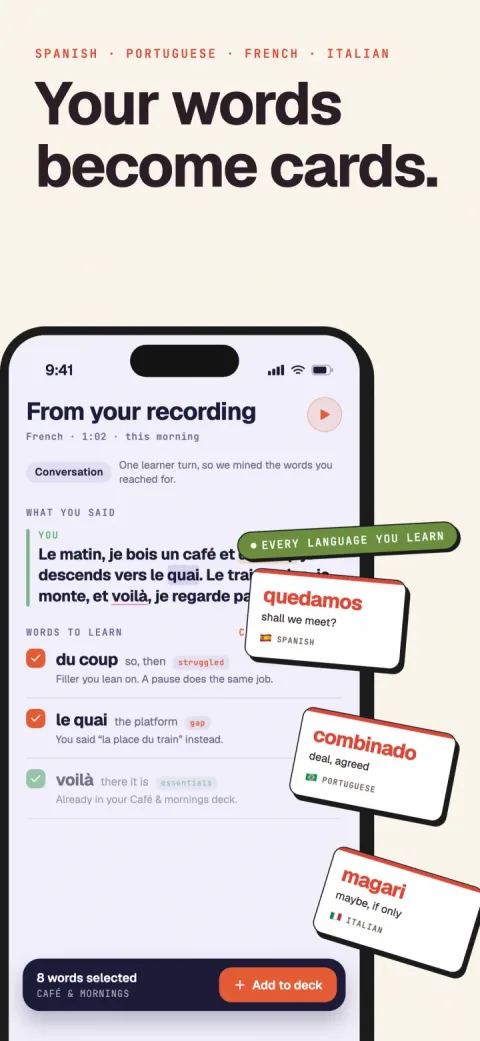
Verbamor sits in that crack. It records the lesson and reads the transcript, which comes with speaker labels. You're identified as the less fluent speaker, the one who hesitates or asks what a word means or gets corrected, and then each candidate item is tagged with a ranked reason: struggled if you reached for it and couldn't produce it, corrected if your tutor fixed it after you got it wrong, gap if you needed the word and talked around it instead. You pick what to keep from that list, and each one becomes a card carrying the sentence it appeared in, scheduled back for around the day you'd have lost it. It's one job.
Verbamor's transcript reading gets things wrong, too. Talking over each other degrades the speaker split, and a pause for thought can read as a struggle when you knew the word fine.
Now the part most comparison pages skip. I have no retention study on Verbamor users, no before-and-after from a named learner, and no published number showing our cards beat a notebook. The "20 items" above is my working estimate from my own lessons, not a measurement, and I've written it as an estimate everywhere it appears on this site. Anyone quoting you a hard retention percentage for a consumer language app is quoting something they didn't measure.
What I can point at is the mechanism, which is checkable rather than promised. The transcript screen and the cards it produces are on the homepage, so you can see what the thing actually does before paying for it. Whether it holds vocabulary better than the notebook you'd otherwise keep is the open question, and I'd be overselling if I answered it here.
So here's how you'd catch me overselling, and you can run it without buying anything. Keep your tutor's corrections in a notebook for a month. Then cold-test yourself on them, no looking, producing each one from the English side. If you can produce them, you don't need us. You already have the habit, and the habit is the part that works.
I'd expect most people to fail that test somewhere in week 3, when the notebook holds three lessons' worth of items and nothing tells you which ones are fading today. But that's my expectation, not a finding. Run it on yourself and you'll have better evidence about your own memory than any comparison page can hand you, including this one.
Karpicke and Roediger had students learn 40 Swahili-English pairs, then varied only what happened after the first correct answer. Items that kept being tested came back at about 80% a week later. Items that were only restudied came back at about 36%.
Rereading your lesson notes is the 36% column. So is scrolling back through the italki chat log, which is the version most people do.
There's a second point worth separating out, because it applies to Duolingo's exercise formats rather than to its scheduler. Picking a word from four tiles is recognition. Producing it cold, from nothing, is retrieval, and retrieval is what the Karpicke result is measuring. That distinction is the subject of input versus cards, and it's also most of the answer to why a long streak and a stalled ability to speak coexist so often. More on that pattern in why progress plateaus.
You're starting from zero
Verbamor holds words you've already met and teaches none of its own. On day one that's very little, and Duolingo's free tier will teach you more Spanish this month than we will. Come back when you're meeting words in lessons or conversations and losing them.
What each one costs
Duolingo's core course is free, with ads, energy-gated. Super Duolingo carries a 14-day free trial on the US listing, and its App Store prices run from $9.99 to $119.99 depending on term and plan.
I'd love to tell you which of those is the monthly and which is the annual. The App Store listing doesn't label them, prices vary by region, and Duolingo discounts the annual plan heavily, so any mapping I typed here would be a guess dressed as a fact. Check your own store. Duolingo Max sits above Super and I'm leaving its price out, because there's no first-party figure for it, and Verbamor's own prices are out for the same reason: read them on the App Store listing, which is current by definition.
Compare us against the tutoring you're already buying, not against Duolingo. italki tutors set their own rates, split between community tutors and formally qualified teachers, so the hourly cost swings widely. Whatever your number is, you're paying it weekly, and most of what it bought is gone by Friday.
Side by side
| Axis | Duolingo | Verbamor |
|---|---|---|
| What it is | A self-contained beginner-to-intermediate course | A memory layer for lessons you take elsewhere |
| Where the content comes from | Duolingo's curriculum, same for everyone | Your tutor's lesson, your translations, your errors |
| Needs a tutor | No | No. Translate a phrase or save a word and it becomes a card |
| Scheduler | Published half-life regression (Settles & Meeder, ACL 2016). Current production model not publicly confirmed | FSRS, on by default |
| Stated course ceiling | Spanish through CEFR B2 (Duolingo Score 129) since April 2026 | No ceiling and no curriculum. It goes wherever your tutor goes |
| Free tier | Yes, full course, ads, energy-gated | None. Hard paywall; only the yearly plan has a 7-day trial |
| Habit mechanics | Streaks, leagues, notifications. Best in the category | A daily queue and nothing else |
| Languages | Dozens | Spanish, French, Italian, Portuguese, Russian |
| Platforms | iOS, Android, web | iOS |
| Price | Free tier. Super Duolingo App Store prices $9.99 to $119.99 depending on term and plan, 14-day trial | Subscription, monthly or annual. Current prices on the App Store listing |
The other alternatives, and when they beat us
Verbamor answers one question and most people arriving on this query are asking a different one. So here's the shortlist I'd give a friend, with the case for each over us.
- Babbel, if you want structured grammar with the rules actually explained. Lessons run around 10 to 15 minutes and its Review feature does use spaced repetition. Beats us for anyone who wants a taught curriculum rather than a way to keep what they've already met.
- Busuu, if you want your writing corrected by native speakers. That's a human reading your paragraph, which no scheduler on this page does. Beats us if what you're missing is feedback rather than retention.
- Anki, if you'll build your own decks. It costs US$24.99 once on an iPhone and nothing on a desktop computer or an Android phone, and it ships no language content of its own. It's an empty engine, and it beats us outright if you enjoy making cards, because you'll never pay us again.
- italki, for the tutor itself. If you're choosing between a tutor and a review app, buy the tutor. We're the thing you add afterwards.
- Pimsleur, if you learn by ear and want something to do while driving. Around $20 a month, per Pimsleur's own figure. Its Graduated Interval Recall is real spaced repetition ancestry, dating back decades.
Four of those five beat Verbamor for someone studying alone. We only win in one situation, which is the next section.
Which one you should pick
Pick Duolingo if you're starting from zero, if you want to spend nothing, if you're learning a language we don't cover, or if you just want to be told what to study next. Also pick it if you're studying alone and happy that way. It's a good product and the free tier is not a trap.
Pick Verbamor if you're already paying a tutor and watching the lessons evaporate. That's the whole customer. If your Tuesday corrections keep coming back as Tuesday corrections, the problem is that nothing is reviewing them, and no amount of Duolingo will fix it because Duolingo has never seen them.
Run both if you like. The morning streak and the post-lesson queue don't overlap at any point, which is the most honest thing I can say about the comparison.
If you'd rather do the post-lesson review with a pen, the free handbook has the routine as a printable page and there's nothing to buy. And if you want the full field with the tradeoffs written out, we lined the options up in language apps for tutored learners.
These solve different problems
Duolingo answers "how do I learn Spanish from nothing, for free, every day." Verbamor answers "how do I stop losing the Spanish my tutor already taught me." If the first question is still yours, ours is the wrong app and the wrong price.
Questions people actually ask
What is the best Duolingo alternative for serious learners?
The right Duolingo alternative depends on which part of Duolingo stopped working for you. Babbel if you want structured grammar with the rules explained, lessons run around 10 to 15 minutes and its Review feature does use spaced repetition. Busuu if you want writing corrected by native speakers, which no algorithm does.
Anki if you'll build your own decks: nothing to pay outside iOS, where it's US$24.99 one-time, and it ships no language content at all, so you supply everything. italki for the tutor itself, where the corrections come from a person watching you specifically. Pimsleur for audio you can do while driving, around $20 a month per Pimsleur's own figure.
Verbamor is the narrow one: it only helps if you're already taking lessons and losing them. Duolingo teaches well. What it can't do is respond to your errors, because you only ever answer what the course puts in front of you.
Does Duolingo use spaced repetition?
Yes, and this is worth correcting because a lot of pages claim otherwise. Duolingo researchers Burr Settles and Brendan Meeder published half-life regression at ACL 2016, a trainable spaced repetition model that estimates the half-life of a learner's memory for each word and schedules practice from it. The paper is peer-reviewed and the code was open-sourced. What isn't verifiable from Duolingo's own sources is whether that exact model is still what runs in production in 2026, so nobody outside the company should state that either way. Anyone telling you Duolingo has no spaced repetition hasn't read the literature.
Does Duolingo only get you to A2?
Not anymore, and any page still saying so is out of date. On 22 April 2026 Duolingo announced that its Spanish course now teaches content through CEFR B2, reaching a Duolingo Score of 129, with the expansion covering 9 courses. That's a claim about how far the course content goes, not a measurement of what learners actually reach, and the two are different things. But the old A2 ceiling line is now a factual error, and it appears on a lot of Duolingo alternative articles that were written years ago and never rechecked.
Is Duolingo free, and what does Super Duolingo cost?
The core course is genuinely free, with ads, and gated by energy rather than the old hearts system. Energy is a learning battery: lessons spend it, correct answer streaks earn it back, and you can refill it by watching an ad or spending gems. Duolingo doesn't publish the starting amount, so treat any specific number you read as unverified. Super Duolingo removes ads, gives unlimited energy and adds a monthly streak repair, with a 14-day free trial on the US listing. Its App Store prices run from $9.99 to $119.99 depending on term and plan, and the store doesn't label which price maps to which term, so we won't guess.
Should I use Duolingo and a tutor together?
Plenty of people use Duolingo and a tutor together, and it works fine. Duolingo covers the daily contact and the beginner scaffolding, the tutor supplies the corrections and the speaking practice, and the two barely overlap.
The gap in that setup is the lesson itself: an hour with a tutor can surface around 20 items you retrieved exactly once each, and none of them enter Duolingo's queue because Duolingo doesn't know they happened. That's my own rough count rather than a measured one. That gap is the entire reason Verbamor exists.
Here's how to check whether you have the gap at all, without buying anything: keep your tutor's corrections in a notebook for a month, then cold-test yourself on them without looking. If you can produce them, you don't need us.
Why does my Duolingo streak not translate into speaking Spanish?
A Duolingo streak doesn’t turn into speaking because recognizing a word in a multiple-choice tile is a much easier task than producing it cold in a conversation. A streak measures how many days you showed up, which is a third thing again. Karpicke and Roediger's 2008 Science study on 40 Swahili-English pairs found that items which kept being tested after the first correct answer came back at about 80% a week later, against about 36% for items that were only restudied. Effortful production is what moves a word into long-term memory. Keep Duolingo. Add something that makes you produce the words instead of picking them.
Sources
Duolingo's own research and product pages
- Settles, B., & Meeder, B. (2016). A trainable spaced repetition model for language learning. Proceedings of the 54th Annual Meeting of the Association for Computational Linguistics, 1848–1858. This is the paper behind half-life regression.
- Duolingo (22 April 2026). Duolingo course content can take you to B2 proficiency. The source for CEFR B2, a Duolingo Score of 129, and the 9 courses covered. Checked 11 August 2026.
- The Duolingo App Store listing for the in-app purchase price points ($9.99 to $119.99), the 14-day Super Duolingo trial, and the Super perks. The listing does not attach a billing term to any individual price. Checked 11 August 2026.
Retrieval beats restudying
- Karpicke, J. D., & Roediger, H. L. (2008). The critical importance of retrieval for learning. Science, 319(5865), 966–968. The 80% and 36% figures are from the paper's results section; the 36% condition is the one where items were repeatedly studied and dropped from testing.
The alternatives shortlist
- Babbel for the 10 to 15 minute lesson length and the Review feature's use of spaced repetition, both stated on Babbel-owned pages. Its plan prices move with promotions, so none are quoted here.
- AnkiMobile for the US$24.99 one-time iOS price. Desktop, Android and sync are free. Regional App Store prices differ.
- Pimsleur for the two consumer tiers and the 7-day trial. The "around $20 per month" figure is Pimsleur's own approximate wording on its blog, not a listed price.
- italki for the two tutor categories, community tutors and professional teachers, and for tutors setting their own rates.
What I'm deliberately not claiming
- That Verbamor is measurably better at holding vocabulary than a notebook. I have no retention study on our own users, so this page doesn't claim one. The "around 20 items" figure is my estimate from my own lessons, not data. The month-long notebook test above is there so you can check the claim yourself rather than take my word for it.
- Which scheduler Duolingo runs in production today. The 2016 paper is public; what replaced or absorbed it is not documented on a Duolingo-owned page, so this page says nothing about it.
- Duolingo Max pricing, and the starting amount of energy. Neither has a first-party source I could verify.
- Which App Store price corresponds to which Super Duolingo billing term. The store publishes the prices without the terms.
- An hourly rate for italki lessons. Tutors set their own, the advertised span is wide, and any single number would be my estimate rather than a published figure.
- Verbamor's own prices. They're App Store prices that move with region and promotion, and the listing is the honest place to read them.
Keep the streak. We're after the other thing.
Verbamor records your tutor lesson, pulls out what you got wrong, and schedules it back before it goes. Duolingo can keep the mornings.
Start 7 days free