 Verbamor
The best way to learn French, priced honestly
The best way to learn French is a tutor for speaking plus one cheap app you open every day. French takes 690 FSI class hours, close to 2 years at an hour a day, and over 2 years the apps here cost $25 to $450 while two tutor lessons a week cost $832 to $8,320. For what the first 1,000 words take on cards, see French flashcards.
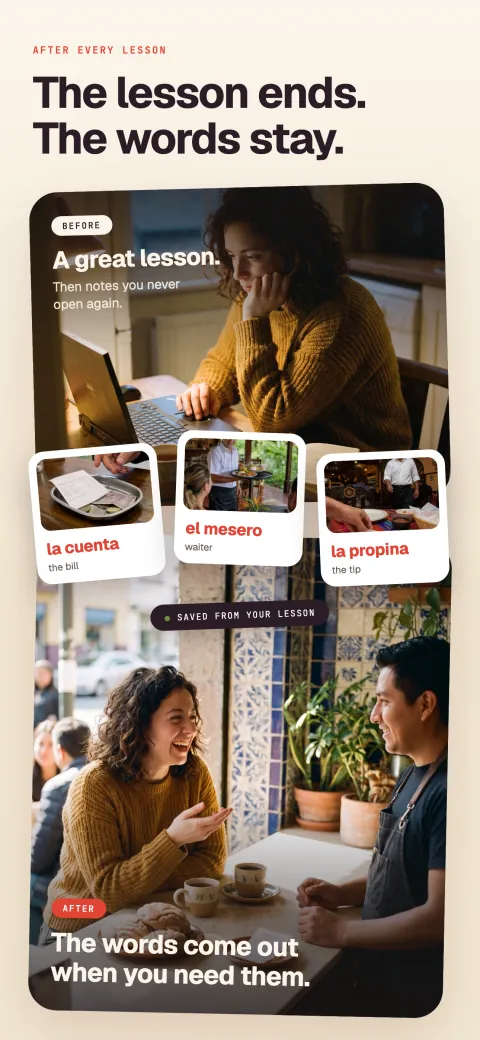
Verbamor records your lesson and turns what your tutor taught into cards that come back on schedule.

French has a problem the other Romance languages don’t have as badly. You can read it long before you can follow it out loud.
Ils parlent and il parle sound the same. Whole endings are written and never said, and words run together where one ends in a consonant and the next starts with a vowel. So a learner who’s done a year of an app can often read a menu and still lose the waiter in 4 words.
That gap decides how you should spend money on French, and most price comparisons don’t mention it. Here’s the whole bill, with dates on every number.
What I sell, before the table
I build Verbamor, an iPhone and iPad app that turns the French from your own lessons and conversations into flashcards. It costs $19.99 a month or $129.99 a year, US prices read off the app’s own plan definitions on 21 September 2026; the App Store may show a different figure in your country. It’s in the table below in the same format as everyone else.
I haven’t used Rocket French, FrenchPod101, Pimsleur or Babbel myself. Every price below was read on the company’s own page or App Store listing, mostly on 13 October 2026, and each row says where it came from.
What French costs, route by route
Annual cost, because you’ll be at this for a couple of years whichever route you take.
| Route | Cost per year | What you’re buying |
|---|---|---|
| Duolingo | Free tier. Super Duolingo runs $9.99 to $119.99 on the US App Store | A full French course, which Duolingo says now teaches through CEFR B2. The App Store puts no billing term next to any Super price |
| Anki | US$24.99 once on iPhone and iPad. Free on desktop, Android and sync | A scheduler with no French in it. You add the cards, or download a free shared deck |
| Babbel | $107.40 for 12 months, or $299.99 lifetime | Structured lessons. Babbel prices the 12 months against a reference of $215.40, which is 12 payments of $17.95 |
| Rocket French | $149.95 Level 1, $299.90 Levels 1-2, $449.85 all three. Paid once | 138, 262 or 385 hours of lesson time, a 60-day guarantee and lifetime access |
| FrenchPod101 | Basic $2.20/mo, Premium $5.50/mo, Premium PLUS $12.58/mo during a 45% sale ending 23 October. List prices $4, $10 and $23 | Audio and video lessons by level. The asterisk says the monthly rate assumes a 24-month subscription |
| Pimsleur | Premium $19.95 a month or $149.95 a year in its own plan data. Every Pimsleur price | 30-minute audio lessons where you answer out loud. Good for the ear, light on reading and grammar |
| italki tutoring | Community tutors $4 to $20 a lesson, professional teachers $10 to $40. italki’s French page says $4 to $60 an hour | A person who hears your French and corrects it. Pay per lesson |
| Verbamor (mine) | $129.99 a year or $19.99 a month. The 7-day trial comes with the yearly plan only | Cards from your own lessons, plus about 650 starter words. No course, no free tier, iPhone and iPad only |
Missing on purpose: Memrise, Busuu, Clozemaster and Duolingo Max. None of them showed me a price I could read on their own page, and a number from someone else’s roundup isn’t one I’ll print.
How many hours French takes, and what that costs
French takes about 690 class hours, according to the Foreign Service Institute. Its current page puts French at 30 weeks, the top of Category I, which runs 552 to 690 class hours. Italian and Portuguese sit at 24 weeks. French and Spanish are the two at 30.
The number most guides quote, 600 to 750 hours, is from the older State Department page, archived since 2021. The FSI figure everyone quotes is the old one, and the current page is the one to cite.
Two things make 690 bigger than it looks. FSI’s week is 23 hours in class and 17 of self-study, so a diplomat also puts in 510 hours of homework over those 30 weeks. And the target is a working professional level, scored 3 on the government’s ILR scale, which is well past holiday French.
Now put money on that span. Two years of Babbel’s 12-month plan is $214.80. Rocket French’s full set is $449.85, paid once. Pimsleur Premium on the annual plan is $299.90 over 2 years. Anki is $24.99 once. Verbamor is $259.98. Over the whole time it takes to learn French, the apps differ by about $425.
Tutoring is the big number. Two italki lessons a week for 2 years is 208 lessons: $832 at the $4 community floor, $8,320 at the $40 professional ceiling. One $20 lesson a week is $2,080.
Over 2 years the apps differ by about $425. The tutoring decision is 2 to 20 times that. Spend your thinking where the money is.
Four things that actually move French
Here’s what I judge every product against, in the order I’d put money on it.
Listening you can mostly follow. For French this comes first, because of the gap between how it’s written and how it sounds. Nation’s 2006 coverage study puts unassisted listening at 6,000 to 7,000 word families, so pick audio you enjoy: you’ll need a lot of it.
Pulling words out of memory. In Karpicke and Roediger’s 2008 study, students who kept testing themselves recalled about 80% of their word pairs a week later. Students who kept restudying instead recalled 36%. A recall card is the cheap way to get that, and rereading a list isn’t.
Spacing it out. Cepeda and colleagues reviewed 317 experiments: the same study time spread over days beats the same time in one block. 15 minutes a day for a week beats an hour and 45 on Sunday.
Speaking to someone who corrects you. Saito and Akiyama’s 2017 study had learners do weekly video calls with trained native speakers. The group that got corrective feedback improved in comprehensibility, speech rate and grammatical accuracy, and the comparison group didn’t. No app on the table does that part.
Which route fits which learner
Starting from zero, no budget. Duolingo’s free tier. Its French course claims B2 content now, it costs nothing, and you’ll learn whether you like French before you pay for it. When words start slipping, add free Anki.
Starting from zero, want a syllabus. Rocket French Level 1 at $149.95, once, or Babbel at $107.40 a year. Rocket suits people who hate subscriptions, and it comes with a 60-day guarantee. Babbel is cheaper for year 1.
You read French but can’t follow it spoken. This is the common French problem, and it calls for audio. Pimsleur makes you listen and answer out loud; FrenchPod101 is cheaper during its sale, but read its asterisk, because the low rate assumes you buy 24 months. Add French TV with French subtitles once you can follow a little.
You want to speak. A tutor, sooner than feels comfortable. Even 2 lessons a month at $20 is $480 a year, and it’s the only line on the table that corrects you.
Travelling in a month. Skip the course. Learn the 100 phrases you’ll actually say and rehearse them with a tutor. How many words a trip needs is a smaller question than learning French.
You like building things. Anki, free on a laptop and US$24.99 once on iPhone. Turn on FSRS at the bottom of the deck options; Anki still ships the older SM-2 scheduler by default. Make your own cards from what you read and hear. For this person Anki is the right answer, and it’s $105 a year cheaper than my app in year 1 and $129.99 cheaper every year after.
What none of these products keep
Every course on the table teaches French someone else picked. That’s how you get your first thousand words, and it works.
What they can’t hold on to is the French you met yourself. Your tutor says il faut qu’on y aille, you understand it in the moment, and on Friday it’s gone, because nothing wrote it down where you’d see it again.
That’s what I built Verbamor for. Record a lesson or paste a transcript, and it finds the words and phrases, then makes each one into a card with the word gapped out of the sentence you heard, with native-accent audio and an image. FSRS schedules them. It covers French, Spanish, Italian, Portuguese and Russian.
The limit is real. Verbamor has no course and no grammar lessons, and past its starter deck of about 650 words it can only hold what you’ve already met. If you’re starting from nothing, Duolingo’s free tier and a library card will do more for your first 6 months, and I’d tell a friend exactly that.
Questions people actually ask
How long does it take to learn French?
About 690 class hours, by the Foreign Service Institute’s current page, which lists French at 30 weeks in Category I. That’s on a week of 23 hours in class plus 17 of self-study, and the target is professional working proficiency, ILR level 3. At an hour a day, 690 hours is about 23 months; at 30 minutes a day it’s nearly 4 years.
What does it cost to learn French?
Over 2 years the apps run from $24.99 (Anki on iPhone, once) to $449.85 (all three Rocket French levels, once), with Babbel at $214.80 and Verbamor at $259.98 in between. Tutoring is the large cost: two italki lessons a week for 2 years is 208 lessons, about $832 at $4 a lesson and $8,320 at $40.
Is Duolingo enough to learn French?
Duolingo is enough to start French, and its French course now claims content through CEFR B2, per its April 2026 announcement. That describes what the course covers, and says nothing about the level learners actually reach. The usual gap shows up in listening and speaking, where French is hardest, so add real audio and a person to talk to once the free course stops feeling hard.
Should I pay for a French tutor?
Yes, if you want to speak, and earlier than feels comfortable. A tutor is the only route on this page that corrects your own sentences, which is the mechanism behind Saito and Akiyama’s 2017 result. italki’s own French page puts tutors at $4 to $60 an hour, so one $20 lesson a week is about $1,040 a year.
What is the best free way to learn French?
The best free way to learn French is Duolingo’s free tier for structure, free Anki on a computer or Android for review, and French audio you enjoy for listening. A free shared deck such as 5000 most frequently used French words gets you the common vocabulary. The cost is your time, and it’s a real plan.
Sources
Hours
- U.S. Department of State, Foreign Service Institute. Foreign Language Training. Read 13 October 2026: “24-30 weeks (552-690 class hours)” for Category I, “French (30 weeks)”, and “A typical week is 23 hours per week in class and 17 hours of self-study.”
- Nation, I. S. P. (2006). How large a vocabulary is needed for reading and listening? The Canadian Modern Language Review, 63(1), 59–82.
What builds memory and speech
- Karpicke, J. D., & Roediger, H. L. (2008). The critical importance of retrieval for learning. Science, 319(5865), 966–968.
- Cepeda, N. J., Pashler, H., Vul, E., Wixted, J. T., & Rohrer, D. (2006). Distributed practice in verbal recall tasks. Psychological Bulletin, 132(3), 354–380.
- Saito, K., & Akiyama, Y. (2017). Video-based interaction, negotiation for comprehensibility, and second language speech learning. Language Learning, 67(1), 43–74.
Prices, each read on its own page
- Rocket Languages. Rocket French pricing. Read 13 October 2026: $149.95, $299.90 and $449.85, one-time, with 138, 262 and 385 hours of lesson time and a 60-day guarantee.
- FrenchPod101. Pricing. Read 13 October 2026: $2.20, $5.50 and $12.58 a month during a 45% sale ending October 23, list $4, $10 and $23, with “Price in USD based on the cost of a 24-month subscription”.
- Babbel. Prices, read in a browser 13 October 2026: 12 months $107.40 against a $215.40 reference, lifetime $299.99.
- Pimsleur. Plan data on its product and FAQ pages, re-checked 12 October 2026: Premium $19.95 a month, $149.95 a year. Details on the Pimsleur cost page.
- italki. How much does italki cost? Read 13 October 2026: community tutors “$4-$20 per lesson”, professional teachers “$10-$40 per lesson”. French teachers: “between $4 to $60 per hour”.
- Apple App Store, US. AnkiMobile $24.99, and Duolingo Super entries from $9.99 to $119.99 with no term attached. Both read 13 October 2026.
- Duolingo. Duolingo course content can take you to B2, 22 April 2026, naming French among the courses that teach through B2.
The French from your own lessons, kept.
Verbamor turns what you heard in a lesson or a conversation into fill-in-the-blank cards, scheduled so you still have them next month.
Start 7 days freeThe 7-day free trial is on the yearly plan.