 Verbamor
Italian phrases for travel
- 162 phrases
- 162 real examples
- 13 topics
- 1 free PDF
The Italian phrases a traveller uses most are buongiorno (good morning), per favore (please), grazie (thank you), scusi (excuse me), quanto costa? (how much is it?) and il conto, per favore (the bill, please). Below are 160 travel phrases in the order a trip goes, each with a real exchange and what people say back.
Your Italian for travel guide is ready
Save it to your phone so it's there when you need it.
Greetings and polite basics 16
Say hello when you walk into a shop, a bar or a train compartment. It sets the tone.
| # | Phrase | Meaning | Example | When to use |
|---|---|---|---|---|
| 1 | Buongiorno | Good morning / Good day | Buongiorno! Due biglietti per Firenze, per favore. Good morning! Two tickets to Florence, please. | Everyday Use it until mid-afternoon, in shops, bars and offices. |
| 2 | Buonasera | Good evening | Buonasera, avete un tavolo per due? Good evening, do you have a table for two? | Everyday From mid-afternoon on. Some people switch after lunch. |
| 3 | Ciao | Hi / Bye | Ciao! Come stai? Hi! How are you? | Casual For friends, kids and people your age. With staff and older people, say buongiorno. |
| 4 | Salve | Hello | Salve, posso chiedere un'informazione? Hello, can I ask something? | Everyday A neutral hello, safe any time of day with anyone. |
| 5 | Arrivederci | Goodbye | Grazie, arrivederci! Thanks, goodbye! | Everyday The polite goodbye. ArrivederLa is very formal. |
| 6 | Buonanotte | Good night | Buonanotte, a domani! Good night, see you tomorrow! | Everyday Only when someone goes to bed or you leave late at night. |
| 7 | Per favore | Please | Un'acqua naturale, per favore. A still water, please. | Everyday Per piacere and per cortesia mean the same. |
| 8 | Grazie / Grazie mille | Thank you / Thanks a lot | Grazie mille, molto gentile. Thanks a lot, very kind. | Everyday Mille means a thousand. Very common. |
| 9 | Prego | You're welcome / Go ahead | Grazie! Prego! Thanks! You're welcome! | Everyday Also go ahead, after you, or what can I get you. Context tells you which. |
| 10 | Scusi | Excuse me (formal) | Scusi, dov'è la stazione? Excuse me, where's the station? | Everyday To get a stranger's attention. Scusa is for friends. |
| 11 | Mi scusi | I'm sorry | Mi scusi, non l'avevo vista. I'm sorry, I didn't see you. | Everyday A full apology. Sounds warmer than scusi. |
| 12 | Permesso | Excuse me, can I get by? | Permesso, scendo alla prossima. Excuse me, I'm getting off at the next stop. | Everyday To pass someone on a bus or in a narrow street. Also said when you enter someone's home. |
| 13 | Sì / No | Yes / No | Sì, grazie. No, grazie. Yes, thanks. No, thanks. | Everyday Add grazie to soften either one. |
| 14 | Va bene | OK / Fine | Alle otto va bene? Is eight OK? | Everyday The everyday OK. Also d'accordo (agreed). |
| 15 | Come sta? | How are you? (formal) | Buongiorno signora, come sta? Good morning madam, how are you? | Formal Come stai? is the casual version. Answer Bene, grazie, e Lei? |
| 16 | Piacere | Nice to meet you | Piacere, sono Anna. Nice to meet you, I'm Anna. | Everyday Said with a handshake when you meet someone. |
Getting understood 8
| # | Phrase | Meaning | Example | When to use |
|---|---|---|---|---|
| 17 | Parla inglese? | Do you speak English? | Scusi, parla inglese? Excuse me, do you speak English? | Everyday Try a little Italian first. People warm up when you do. |
| 18 | Non parlo bene l'italiano. | I don't speak Italian well. | Mi scusi, non parlo bene l'italiano. Sorry, I don't speak Italian well. | Everyday People slow down and help. |
| 19 | Non ho capito. | I didn't understand. | Scusi, non ho capito. Sorry, I didn't understand. | Everyday More natural than non capisco for a single moment. |
| 20 | Può ripetere, per favore? | Can you repeat, please? | Può ripetere più lentamente, per favore? Can you repeat more slowly, please? | Everyday Più lentamente means more slowly. |
| 21 | Come si dice...? | How do you say...? | Come si dice receipt in italiano? How do you say receipt in Italian? | Everyday The quickest way to learn a word on the spot. |
| 22 | Cosa vuol dire? | What does it mean? | Coperto, cosa vuol dire? Coperto, what does that mean? | Everyday Point at a word on a menu or sign. |
| 23 | Me lo può scrivere? | Can you write it down for me? | Me lo può scrivere, per favore? Can you write it down for me, please? | Everyday Handy for addresses, prices and times. |
| 24 | Un momento | Just a moment | Un momento, cerco il biglietto. Just a moment, I'm looking for the ticket. | Everyday Also un attimo, very common. |
What they'll ask you 14
The questions you'll hear in shops, stations and hotels. Knowing them is half of every exchange.
| # | Phrase | Meaning | Example | When to use |
|---|---|---|---|---|
| 25 | Mi dica. | What can I do for you? | Buongiorno, mi dica. Good morning, how can I help? | Everyday Staff say it to invite your order or question. |
| 26 | Desidera? | What would you like? | Buongiorno, desidera? Good morning, what would you like? | Formal Shops and bars. Just say what you want. |
| 27 | Altro? | Anything else? | Ecco il pane. Altro? Here's the bread. Anything else? | Everyday Answer Basta così, grazie (that's all, thanks). |
| 28 | Le serve una busta? | Do you need a bag? | Le serve una busta? Do you need a bag? | Everyday Shops charge a little for bags. Say no, grazie if you have one. |
| 29 | Contanti o carta? | Cash or card? | Paga in contanti o con carta? Paying cash or card? | Everyday Contanti is cash. |
| 30 | Ha spiccioli? | Do you have small change? | Ha spiccioli? Non ho resto. Do you have small change? I have no change. | Everyday Small shops often ask for coins. Spiccioli are coins and small notes. |
| 31 | Vuole lo scontrino? | Do you want the receipt? | Ecco, vuole lo scontrino? Here, do you want the receipt? | Everyday Take it. Shops hand one over with every purchase. |
| 32 | Ha prenotato? | Do you have a booking? | Buonasera, ha prenotato? Good evening, do you have a booking? | Everyday Answer Sì, a nome di... or No, non abbiamo prenotato. |
| 33 | Quanti siete? | How many of you? | Quanti siete? Due? How many of you? Two? | Everyday Just say the number: Siamo in tre. |
| 34 | Il documento, per favore. | Your ID, please. | Il documento, per favore, per il check-in. Your ID, please, for check-in. | Formal Hotels must register every guest, so they ask for a passport or ID card. |
| 35 | Di dove sei? | Where are you from? | Di dove sei? Sei americano? Where are you from? Are you American? | Casual Di dov'è? is the formal version. Answer Sono di Londra, sono inglese. |
| 36 | È la prima volta in Italia? | Is it your first time in Italy? | È la prima volta in Italia? Is it your first time in Italy? | Everyday A friendly opener. Answer Sì, è la prima volta or No, è la terza. |
| 37 | Tutto bene? | Everything OK? | Tutto bene con la camera? Everything OK with the room? | Everyday Answer Tutto perfetto, grazie. |
| 38 | Biglietto, prego. | Ticket, please. | Biglietti, prego. Grazie. Tickets, please. Thanks. | Everyday The conductor on the train. Have your ticket or phone ready. |
Key words on signs 12
| # | Phrase | Meaning | Example | When to use |
|---|---|---|---|---|
| 39 | Entrata / Uscita | Entrance / Exit | L'uscita è da quella parte. The exit is that way. | Everyday Ingresso also means entrance. |
| 40 | Aperto / Chiuso | Open / Closed | Il museo è chiuso il lunedì. The museum is closed on Mondays. | Everyday Many museums close one weekday. Check before you go. |
| 41 | Spingere / Tirare | Push / Pull | C'è scritto spingere, non tirare. It says push, not pull. | Everyday On doors. Spingere is push. |
| 42 | Vietato... | ...is not allowed | Vietato fumare. No smoking. | Everyday Vietato l'ingresso means no entry. |
| 43 | Bagno / Toilette / WC | Toilet | Scusi, dov'è il bagno? Excuse me, where's the toilet? | Everyday Signori is men, Signore is women. Mind the last letter. |
| 44 | Guasto / Fuori servizio | Out of order | L'ascensore è guasto. The lift is out of order. | Everyday You'll see it on ticket machines and lifts. |
| 45 | Orario | Opening hours / timetable | Qual è l'orario del museo? What are the museum's hours? | Everyday On a station board it means the timetable. |
| 46 | Saldi | Sale | Ci sono i saldi in centro. There are sales in the centre. | Everyday Shops hold big sales in winter and summer. |
| 47 | Lavori in corso | Works in progress | C'è un cartello: lavori in corso. There's a sign: road works. | Everyday Road works or building works. |
| 48 | Attenzione | Caution | Attenzione al gradino. Mind the step. | Everyday Also on station speakers before an announcement. |
| 49 | Riservato | Reserved | Questo tavolo è riservato. This table is reserved. | Everyday On restaurant tables and parking spaces. |
| 50 | Suonare | Ring (the bell) | Per entrare suonare il campanello. Ring the bell to come in. | Everyday Small shops and B&Bs often have a buzzer. |
Trains and buses 20
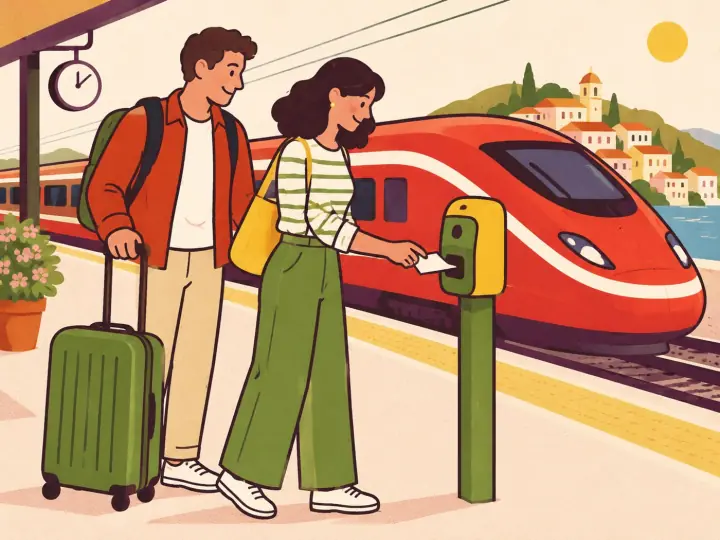
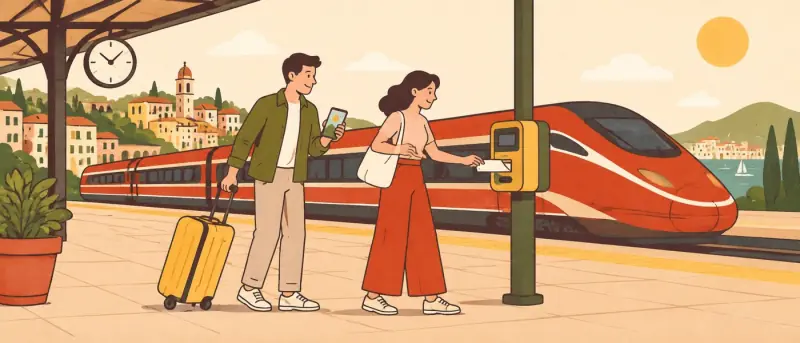
Trains are the easiest way round Italy. Paper regional tickets usually need stamping before you board.
| # | Phrase | Meaning | Example | When to use |
|---|---|---|---|---|
| 51 | la stazione | the station | Dov'è la stazione centrale? Where's the central station? | Everyday Big cities have several. Roma Termini and Milano Centrale are the main ones. |
| 52 | il biglietto | the ticket | Un biglietto per Bologna, per favore. A ticket to Bologna, please. | Everyday Buy at the biglietteria (ticket office), a machine or the app. |
| 53 | solo andata / andata e ritorno | one way / return | Andata e ritorno per Pisa, per favore. A return to Pisa, please. | Everyday Solo andata is one way. |
| 54 | il binario | platform | Da che binario parte il treno per Napoli? Which platform does the Naples train leave from? | Everyday The board shows it shortly before departure. |
| 55 | convalidare il biglietto | to validate the ticket | Devo convalidare il biglietto? Do I have to validate the ticket? | Everyday Paper regional tickets need a stamp in the small machine on the platform before you board. Without the stamp you can be fined. |
| 56 | il treno regionale | regional train | Il regionale ferma in tutte le stazioni. The regional train stops at every station. | Everyday Slower and cheaper. High-speed trains need a seat booking. |
| 57 | il treno ad alta velocità | high-speed train | Prendo l'alta velocità per Roma. I'm taking the high-speed train to Rome. | Everyday Frecciarossa and Italo are the names you'll see. Your ticket has a set seat. |
| 58 | la carrozza / il posto | carriage / seat | Carrozza 6, posto 12A. Carriage 6, seat 12A. | Everyday Printed on high-speed tickets. Find your carriage on the platform display. |
| 59 | È libero questo posto? | Is this seat free? | Scusi, è libero questo posto? Excuse me, is this seat free? | Everyday On regional trains seats aren't numbered. |
| 60 | Questo treno va a...? | Does this train go to...? | Questo treno va a Verona? Does this train go to Verona? | Everyday Ask on the platform when in doubt. |
| 61 | in ritardo | late | Il treno è in ritardo di dieci minuti. The train is ten minutes late. | Everyday On the board as RIT. or ritardo. |
| 62 | soppresso / cancellato | cancelled | Il treno delle nove è stato soppresso. The nine o'clock train has been cancelled. | Everyday Soppresso is the word on boards and speakers. |
| 63 | la coincidenza | connection | Ho una coincidenza a Firenze. I have a connection in Florence. | Everyday Perdere la coincidenza is to miss your connection. |
| 64 | Devo cambiare? | Do I have to change? | Per Siena devo cambiare? Do I have to change for Siena? | Everyday Cambiare treno is to change trains. |
| 65 | la fermata | the stop | Qual è la prossima fermata? What's the next stop? | Everyday Bus and tram stops. Prenotare la fermata means press the stop button. |
| 66 | l'autobus | the bus | Questo autobus va al centro? Does this bus go to the centre? | Everyday Buy bus tickets before you get on in many cities, at a tabaccheria or a machine. |
| 67 | la tabaccheria | tobacconist | I biglietti dell'autobus si comprano in tabaccheria. Bus tickets are sold at the tobacconist. | Everyday Look for a big T sign. They sell bus tickets, stamps and phone top-ups. |
| 68 | la metropolitana | the metro | Prendiamo la metro fino al Colosseo. Let's take the metro to the Colosseum. | Everyday La metro for short. Rome, Milan, Naples and Turin have one. |
| 69 | la biglietteria | ticket office | La biglietteria è chiusa, uso la macchinetta. The ticket office is closed, I'll use the machine. | Everyday Macchinetta is the ticket machine. Most have English. |
| 70 | il traghetto / il vaporetto | ferry / water bus | Prendiamo il vaporetto per San Marco. Let's take the water bus to San Marco. | Regional The vaporetto is Venice's water bus. A traghetto is a ferry to the islands. |
Taxis and driving 8
| # | Phrase | Meaning | Example | When to use |
|---|---|---|---|---|
| 71 | Mi chiama un taxi? | Can you call me a taxi? | Scusi, mi chiama un taxi? Excuse me, could you call me a taxi? | Everyday Hotels and restaurants will call one. In many cities you can't hail one on the street; go to a taxi rank. |
| 72 | Alla stazione, per favore. | To the station, please. | All'aeroporto, per favore. To the airport, please. | Everyday Show the address on your phone too. |
| 73 | Quanto costa fino a...? | How much is it to...? | Quanto costa fino al centro? How much is it to the centre? | Everyday Ask before you set off. Some routes, like airports, have fixed fares. |
| 74 | Può fermarsi qui? | Can you stop here? | Può fermarsi qui, per favore? Can you stop here, please? | Everyday Qui is here, lì is there. |
| 75 | la ZTL | limited traffic zone | Non entrare nella ZTL, ci sono le telecamere. Don't drive into the ZTL, there are cameras. | Everyday Many old town centres ban cars without a permit. Cameras send fines to rental cars. |
| 76 | il parcheggio | car park / parking | C'è un parcheggio vicino? Is there a car park nearby? | Everyday Blue lines mean paid parking, white lines are often free, yellow lines are reserved, often for residents. |
| 77 | il distributore | petrol station | Dov'è il distributore più vicino? Where's the nearest petrol station? | Everyday Self is self-service, servito means staff fill up for you. |
| 78 | benzina / gasolio | petrol / diesel | Il pieno di gasolio, per favore. Fill it up with diesel, please. | Everyday Gasolio is diesel. Check your rental car before you fill up. |
At the hotel 14
| # | Phrase | Meaning | Example | When to use |
|---|---|---|---|---|
| 79 | Ho una prenotazione. | I have a booking. | Buonasera, ho una prenotazione a nome Smith. Good evening, I have a booking under Smith. | Everyday A nome di means under the name of. |
| 80 | una camera doppia / singola | a double / single room | Avete una camera doppia per stanotte? Do you have a double room for tonight? | Everyday Matrimoniale is one big bed. Doppia can mean two single beds. |
| 81 | con bagno | with a bathroom | La camera è con bagno privato? Does the room have its own bathroom? | Everyday Small hotels sometimes have shared bathrooms. |
| 82 | La colazione è inclusa? | Is breakfast included? | La colazione è inclusa? A che ora? Is breakfast included? What time? | Everyday Italian hotel breakfasts are often sweet: pastries, coffee, juice. |
| 83 | la tassa di soggiorno | tourist tax | La tassa di soggiorno si paga in contanti? Is the tourist tax paid in cash? | Everyday Many Italian cities charge one per night, paid at the hotel. |
| 84 | A che ora è il check-out? | What time is check-out? | A che ora è il check-out domani? What time is check-out tomorrow? | Everyday Italians use the English words check-in and check-out. |
| 85 | Posso lasciare i bagagli? | Can I leave my bags? | Posso lasciare i bagagli fino alle tre? Can I leave my bags until three? | Everyday Most hotels will keep them for you. |
| 86 | la chiave | the key | Mi dà la chiave della 24? Can I have the key to room 24? | Everyday Some small hotels want the key back at the desk when you go out. |
| 87 | Qual è la password del wifi? | What's the wifi password? | Scusi, qual è la password del wifi? Excuse me, what's the wifi password? | Everyday Italians say wifi as wee-fee. |
| 88 | Non funziona... | ...doesn't work | Non funziona l'aria condizionata. The air conditioning doesn't work. | Everyday Put the thing after: non funziona la doccia (the shower). |
| 89 | Manca... | ...is missing | Manca la carta igienica. There's no toilet paper. | Everyday Mancano gli asciugamani: the towels are missing. |
| 90 | C'è troppo rumore. | It's too noisy. | C'è troppo rumore, posso cambiare camera? It's too noisy, can I change rooms? | Everyday Ask for una camera sul retro (a room at the back). |
| 91 | Mi può chiamare alle sette? | Can you wake me at seven? | Mi può svegliare alle sette, per favore? Can you wake me at seven, please? | Everyday Svegliare is to wake up. |
| 92 | Vorrei pagare il conto. | I'd like to pay the bill. | Vorrei pagare il conto, parto oggi. I'd like to pay the bill, I'm leaving today. | Everyday The same phrase works for a hotel or a restaurant. |
Restaurants and bars 20
Lunch runs from about one, dinner rarely before eight. The bill comes when you ask for it.
| # | Phrase | Meaning | Example | When to use |
|---|---|---|---|---|
| 93 | Un tavolo per due, per favore. | A table for two, please. | Buonasera, un tavolo per due, per favore. Good evening, a table for two, please. | Everyday Wait to be seated in a restaurant. |
| 94 | Vorrei prenotare. | I'd like to book. | Vorrei prenotare per stasera alle otto. I'd like to book for tonight at eight. | Everyday Popular places fill up. Call or book the same morning. |
| 95 | Il menù, per favore. | The menu, please. | Ci porta il menù, per favore? Could you bring us the menu, please? | Everyday Menù turistico is a set tourist menu. |
| 96 | Cosa mi consiglia? | What do you recommend? | Cosa mi consiglia oggi? What do you recommend today? | Everyday Ask about piatti del giorno (today's dishes). |
| 97 | Per me... | For me... | Per me gli spaghetti alle vongole. Clam spaghetti for me. | Everyday The easy way to order. |
| 98 | l'antipasto / il primo / il secondo | starter / first course / main course | Prendiamo un antipasto e due primi. We'll have one starter and two pastas. | Everyday Primo is pasta, rice or soup. Secondo is meat or fish. No one has to order all of them. |
| 99 | il contorno | side dish | Il secondo è senza contorno? Does the main come without a side? | Everyday Vegetables and potatoes are often ordered apart. |
| 100 | la carne / il pesce | meat / fish | Avete pesce fresco oggi? Do you have fresh fish today? | Everyday Fish is often priced by weight (all'etto, per 100 g). |
| 101 | Sono vegetariano / vegetariana. | I'm vegetarian. | Sono vegetariana, cosa c'è senza carne? I'm vegetarian, what's there without meat? | Everyday Ask about brodo (stock) and guanciale (pork cheek) in pasta sauces. |
| 102 | Sono allergico a... | I'm allergic to... | Sono allergico alle noci. I'm allergic to walnuts. | Everyday Women say allergica. Restaurants must list allergens; ask for the list. |
| 103 | senza glutine | gluten-free | Avete pasta senza glutine? Do you have gluten-free pasta? | Everyday Many places offer it. Look for the AIC sign in windows. |
| 104 | acqua naturale / frizzante | still / sparkling water | Una bottiglia d'acqua frizzante. A bottle of sparkling water. | Everyday Water usually comes in a bottle. Acqua del rubinetto is tap water. |
| 105 | il vino della casa | house wine | Un quarto di vino rosso della casa. A quarter litre of house red. | Everyday Ordered by the carafe: un quarto, mezzo litro, un litro. |
| 106 | Buon appetito! | Enjoy your meal! | Ecco i piatti, buon appetito! Here are your dishes, enjoy! | Everyday Reply grazie, altrettanto (same to you). |
| 107 | Era buonissimo. | It was delicious. | Complimenti, era buonissimo. Compliments, it was delicious. | Everyday Complimenti is a nice word for the cook. |
| 108 | Il conto, per favore. | The bill, please. | Scusi, il conto, per favore. Excuse me, the bill, please. | Everyday The server won't bring it until you ask. |
| 109 | il coperto | cover charge | Nel conto c'è il coperto. There's a cover charge on the bill. | Everyday A charge per person for bread and the table setting. It's normal and listed on the menu. |
| 110 | il servizio | service charge | Il servizio è incluso? Is service included? | Everyday Some places add it. Tipping is not expected; rounding up is kind. |
| 111 | Possiamo pagare separatamente? | Can we pay separately? | Possiamo pagare separatamente? Can we pay separately? | Everyday Fare alla romana means split it evenly. |
| 112 | l'aperitivo | pre-dinner drink | Facciamo un aperitivo alle sette? Shall we have a pre-dinner drink at seven? | Everyday Early evening drinks, often with snacks on the side. A spritz is the classic. |
Shops and markets 12
| # | Phrase | Meaning | Example | When to use |
|---|---|---|---|---|
| 113 | Quanto costa? | How much is it? | Scusi, quanto costa questo? Excuse me, how much is this? | Everyday Quanto costano? for more than one. |
| 114 | Sto solo guardando. | I'm just looking. | Grazie, sto solo guardando. Thanks, I'm just looking. | Everyday The reply when staff offer help. |
| 115 | Posso provarlo? | Can I try it on? | Posso provare questa giacca? Can I try on this jacket? | Everyday Il camerino is the fitting room. |
| 116 | Avete una taglia più grande? | Do you have a bigger size? | Avete una taglia più piccola? Do you have a smaller size? | Everyday Taglia is clothes size, numero is shoe size. |
| 117 | Lo prendo. | I'll take it. | Va bene, lo prendo. OK, I'll take it. | Everyday La prendo for a feminine word like la borsa. |
| 118 | un etto | 100 grams | Un etto di prosciutto crudo, per favore. 100 grams of cured ham, please. | Everyday Delis sell by the etto. Mezzo chilo is half a kilo. |
| 119 | Posso assaggiare? | Can I taste it? | Posso assaggiare il pecorino? Can I taste the pecorino? | Everyday Delis and markets often say yes. |
| 120 | Non tocchi, la servo io. | Don't touch, I'll serve you. | Non tocchi la frutta, la servo io. Don't touch the fruit, I'll serve you. | Everyday At many markets the seller picks the produce for you. Point and ask. |
| 121 | il mercato | the market | Il mercato c'è il sabato mattina. The market is on Saturday mornings. | Everyday Most towns have a weekly market day. |
| 122 | il supermercato | the supermarket | C'è un supermercato qui vicino? Is there a supermarket near here? | Everyday In supermarkets you weigh and label fruit yourself and wear a plastic glove. |
| 123 | la farmacia | pharmacy | Dov'è una farmacia? Where's a pharmacy? | Everyday Look for the green cross. |
| 124 | È troppo caro. | It's too expensive. | È un po' troppo caro per me. It's a bit too expensive for me. | Everyday Bargaining is rare in shops, but possible at some markets. |
Money 6
| # | Phrase | Meaning | Example | When to use |
|---|---|---|---|---|
| 125 | il bancomat | cash machine | C'è un bancomat qui vicino? Is there a cash machine near here? | Everyday Also the word for a debit card. Banks' own machines are often cheapest. |
| 126 | Accettate carte? | Do you take cards? | Accettate carte di credito? Do you take credit cards? | Everyday Most places do. Keep a little cash for small bars and markets. |
| 127 | in contanti | in cash | Pago in contanti. I'll pay cash. | Everyday Contanti is cash. |
| 128 | il resto | the change | Ecco il resto. Here's your change. | Everyday Tenga il resto: keep the change. |
| 129 | lo scontrino | the receipt | Mi dà lo scontrino, per favore? Can I have the receipt, please? | Everyday Shops hand it over with every purchase. |
| 130 | il cambio | currency exchange | Dov'è un ufficio cambio? Where's a currency exchange? | Everyday Airport exchanges give poor rates. A bank card at a bancomat is usually better. |
Directions 12
| # | Phrase | Meaning | Example | When to use |
|---|---|---|---|---|
| 131 | Dov'è...? | Where is...? | Scusi, dov'è il Duomo? Excuse me, where's the cathedral? | Everyday Dove sono...? for plural things. |
| 132 | Come arrivo a...? | How do I get to...? | Come arrivo a Piazza Navona? How do I get to Piazza Navona? | Everyday Per andare a...? means the same. |
| 133 | È lontano? | Is it far? | È lontano a piedi? Is it far on foot? | Everyday A piedi means on foot. |
| 134 | È vicino. | It's close. | È vicino, cinque minuti a piedi. It's close, five minutes' walk. | Everyday Vicino a means near to. |
| 135 | a destra / a sinistra | on the right / on the left | Giri a destra al semaforo. Turn right at the traffic lights. | Everyday Destra is right, sinistra is left. |
| 136 | sempre dritto | straight on | Vada sempre dritto fino alla piazza. Go straight on to the square. | Everyday You'll hear this in every set of directions. |
| 137 | la prima / la seconda | the first / the second | Prenda la seconda a sinistra. Take the second on the left. | Everyday Strada (street) is understood. |
| 138 | all'angolo | on the corner | La farmacia è all'angolo. The pharmacy is on the corner. | Everyday Dietro l'angolo means just round the corner. |
| 139 | di fronte a | opposite | È di fronte alla chiesa. It's opposite the church. | Everyday Accanto a is next to. |
| 140 | Mi sono perso / persa. | I'm lost. | Scusi, mi sono persa. Dov'è il mio albergo? Excuse me, I'm lost. Where's my hotel? | Everyday Women say persa. |
| 141 | Me lo può far vedere sulla mappa? | Can you show me on the map? | Me lo può far vedere sulla mappa? Can you show me on the map? | Everyday Hold out your phone. People are happy to point. |
| 142 | la piazza / la via | square / street | Ci vediamo in piazza alle sei. See you in the square at six. | Everyday Via comes before the name: Via Roma, 12. |
Sightseeing 8
| # | Phrase | Meaning | Example | When to use |
|---|---|---|---|---|
| 143 | Un biglietto intero / ridotto | full / reduced ticket | Due interi e un ridotto, per favore. Two full and one reduced, please. | Everyday Ridotto is for children, students or seniors. Ask who qualifies. |
| 144 | Qual è l'orario? | What are the hours? | Qual è l'orario di apertura? What are the opening hours? | Everyday Many churches close at lunch. |
| 145 | Bisogna prenotare? | Do you need to book? | Per il Cenacolo bisogna prenotare? Do you need to book for the Last Supper? | Everyday The big sights often need tickets booked in advance. |
| 146 | Si possono fare foto? | Can you take photos? | Si possono fare foto dentro? Can you take photos inside? | Everyday Senza flash: without flash. |
| 147 | la visita guidata | guided tour | C'è una visita guidata in inglese? Is there a guided tour in English? | Everyday Audioguida is an audio guide. |
| 148 | il guardaroba | cloakroom | Lo zaino va lasciato al guardaroba. The backpack must go in the cloakroom. | Everyday Museums often make you leave big bags. |
| 149 | Spalle e ginocchia coperte | Shoulders and knees covered | In chiesa servono spalle e ginocchia coperte. In church you need shoulders and knees covered. | Everyday Many churches turn away bare shoulders and short shorts. Carry a scarf. |
| 150 | Dov'è l'ingresso? | Where's the entrance? | Scusi, dov'è l'ingresso per i musei? Excuse me, where's the entrance to the museums? | Everyday Big sites have separate lines for people with tickets. |
Health and emergencies 12
In Italy, as across the EU, 112 is the emergency number for police, ambulance and fire.
| # | Phrase | Meaning | Example | When to use |
|---|---|---|---|---|
| 151 | Aiuto! | Help! | Aiuto! Chiamate un'ambulanza! Help! Call an ambulance! | Everyday Shout it. Chiamate is the plural you, to everyone around. |
| 152 | Chiami il 112! | Call 112! | Chiami il 112, per favore! Call 112, please! | Everyday 112 works from any phone, across Italy. |
| 153 | Ho bisogno di un medico. | I need a doctor. | Ho bisogno di un medico, mi sento male. I need a doctor, I feel ill. | Everyday Mi sento male: I feel ill. |
| 154 | il pronto soccorso | emergency room | Dov'è il pronto soccorso più vicino? Where's the nearest emergency room? | Everyday The hospital department for emergencies. |
| 155 | Mi fa male qui. | It hurts here. | Mi fa male qui, alla pancia. It hurts here, in my stomach. | Everyday Point to the spot. Mi fa male la testa: I have a headache. |
| 156 | la farmacia di turno | duty pharmacy | Qual è la farmacia di turno stanotte? Which pharmacy is open tonight? | Everyday Pharmacies take turns staying open at night. Closed ones post the list on the door. |
| 157 | Ho perso il passaporto. | I've lost my passport. | Ho perso il passaporto, cosa devo fare? I've lost my passport, what should I do? | Everyday Report it to the police, then call your embassy. |
| 158 | Mi hanno rubato... | My...was stolen | Mi hanno rubato il portafoglio in metro. My wallet was stolen on the metro. | Everyday Pickpockets work busy trains and buses. Keep bags in front. |
| 159 | la denuncia | police report | Devo fare una denuncia per l'assicurazione. I have to file a police report for the insurance. | Formal Fare denuncia is to report a crime. Go to the Carabinieri or the Polizia. |
| 160 | Sono diabetico / diabetica. | I'm diabetic. | Sono diabetica, ho bisogno di zucchero. I'm diabetic, I need sugar. | Everyday Learn the words for any condition you have before you go. |
| 161 | Chiamate la polizia! | Call the police! | Chiamate la polizia, c'è stato un incidente! Call the police, there's been an accident! | Everyday Un incidente is an accident. |
| 162 | Sto bene. | I'm OK. | Grazie, sto bene adesso. Thanks, I'm OK now. | Everyday Non sto bene means I'm not well. |
Your Italian for travel guide is ready
Save it to your phone so it's there when you need it.
Good to know
Greet as you walk in
Say buongiorno or buonasera when you enter a shop, bar or small hotel. Staff greet you back, and the rest goes better.
Stamp paper train tickets
A paper regional ticket usually needs a stamp in the small machine on the platform before you get on. Digital tickets with a set time don't.
Cover charge is normal
The coperto on a restaurant bill is a per-person charge for bread and the table. It's listed on the menu and is no scam.
Ask for the bill
Servers won't bring the bill until you ask. Say il conto, per favore, or catch their eye and mime writing.
112 for emergencies
112 reaches police, ambulance and fire from any phone in Italy, as in the rest of the EU.
Questions people ask
What are the most useful Italian phrases for travel?
Buongiorno, per favore, grazie, scusi, quanto costa? and il conto, per favore. With those six you can handle most shops, bars and restaurants.
Do I say ciao or buongiorno?
Buongiorno with staff and anyone you don't know. Ciao is for friends, kids and people your own age.
Do I need to validate my train ticket in Italy?
Paper regional tickets usually need stamping in the platform machine before you board. Tickets for a set train and seat, like high-speed ones, don't.
What is coperto on an Italian bill?
A cover charge per person for bread and the table setting. It's normal and should be on the menu.
Do you tip in Italian restaurants?
Tipping isn't expected. Many people round up or leave a few euros for good service.
What is the emergency number in Italy?
112, for police, ambulance and fire. It works from any phone.
Keep going
- How to order coffee in Italy
- Informal Italian: how people really talk
- Italian texting abbreviations, decoded
- Italian false friends and the words you really want
- Portuguese phrases for travel
- Russian phrases for travel
More travel phrase kits
- Pharmacy Spanish for Mexico
- Renting Spanish for Mexico City
- Lisbon rental Portuguese
- Restaurant Spanish
- French for restaurants and cafés
- Italian coffee bar phrases
- Portuguese for travel
- Russian for travel
- Spanish at the doctor
- French at the doctor
- Spanish for emergencies
- French for emergencies
- Portuguese bank account phrases
- French for the préfecture
- Spanish for the NIE and TIE
- Taxi and Uber Spanish
- Hotel and Airbnb Spanish
- Airport Spanish
- Border and immigration Spanish
Sources
- Trenitalia
- Wikipedia: 112 (emergency telephone number)
- Wikipedia: Espresso
- Wikipedia: Rail transport in Italy
Want these to stick? Verbamor turns any phrase on this page into a flashcard with a native voice, so it comes back right before you'd forget it.
More free tools
All 18-
Word patterns in 6 languages Understand and say whole groups of words from a few dozen simple rules. Spanish, French, Italian, Portuguese, Russian and German, each with a free PDF.
-
Slang for 20 Latin American countries 300 local phrases for each country, from Mexico to Brazil, with real examples, English translations and when to use each one.
-
How many Spanish words do you know? Tick the words you know from a frequency-banded sample. Fake words catch the guessing.
-
How much of a text do you already know? Paste any text and see what share of it sits inside the first 1,000 to 5,000 words.
-
The forgetting curve, drawn properly Put in the days since your last review and see how much of a word is left, on the real FSRS-6 curve.
-
What do 20 new cards a day cost you? Project your daily reviews for two years from a new-card rate and a retention target.
-
Cognate checker Type an English word, see its likely relatives in five languages, and get warned about false friends.
-
Der, die or das? Type a German noun and get its likely article, with the ending or compound rule behind it.
-
What a tutored word really costs Your lesson price divided by the words you still have next week, with the arithmetic in full.
-
Count the hours a term abroad buys The hours a semester abroad really adds, next to what the same money buys in tutoring.
-
Texting codes in 5 languages What mdr, tqm, kkkk, cmq and спс mean, with real chats, how to reply and a free decoder PDF for each language.
-
Terms of endearment in 5 languages What to call your partner, your kids and your friends in Spanish, French, Italian, Russian and Portuguese, with how each one sounds.
-
Same language, different country Spain vs Mexico, Brazil vs Portugal, Quebec vs France: the words that change and the ones that get you in trouble.
-
False friends in 5 languages Words that look like English and mean something else, from embarazada to préservatif, with the word you really want.
-
How people really talk The short forms, dropped sounds and accents that make fast speech hard to follow, written out so you can hear them.
-
Phrases for your partner's family What to say to your in-laws and your grandparents: first visits, meals, holidays and the questions they will ask.
-
Spanish slang translator Look up 6,000+ slang words and phrases from 20 countries, Spanish to English or English to Spanish.
- All 18 free tools Every tool on one page, plus the free debrief sheet.