 Verbamor
How to order food in French
- 130 phrases
- 130 real examples
- 11 topics
- 1 free PDF
To order food in French, say Je vais prendre... (I'll have...) or Je voudrais... (I'd like...) and end with s'il vous plaît. Ask for the bill with L'addition, s'il vous plaît. Below are 120 phrases in the order a meal goes, from the door to the bill, plus the café and the boulangerie.
Your French for restaurants and cafés guide is ready
Save it to your phone so it's there when you need it.
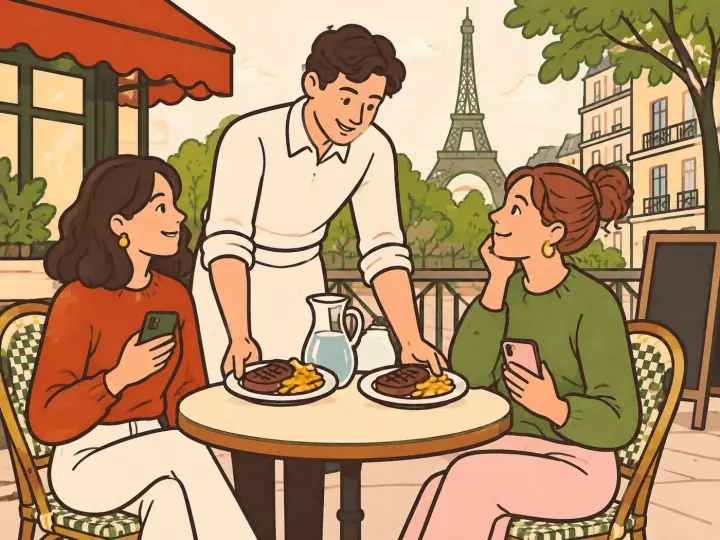
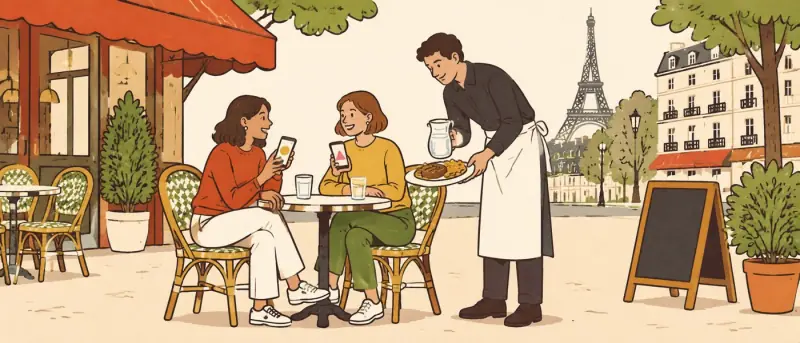
Getting a table 10
Say bonjour first, every time. In France you greet before you ask for anything.
| # | Phrase | Meaning | Example | When to use |
|---|---|---|---|---|
| 1 | Bonjour ! | Hello! / Good day! | Bonjour ! Une table pour deux, s'il vous plaît. Hello! A table for two, please. | Everyday Say it the moment you walk in. Skipping it reads as rude. Switch to bonsoir in the evening. |
| 2 | Une table pour deux, s'il vous plaît. | A table for two, please. | Bonsoir, une table pour quatre, s'il vous plaît. Good evening, a table for four, please. | Everyday The plain way in. Show the number with your fingers too. |
| 3 | J'ai réservé au nom de... | I booked under the name... | Bonsoir, j'ai réservé au nom de Martin. Good evening, I booked under the name Martin. | Everyday Spell the name if they look lost. Au nom de means under the name. |
| 4 | Vous avez une table ? | Do you have a table? | Vous avez une table pour deux ce soir ? Do you have a table for two tonight? | Everyday For walking in without a booking. |
| 5 | Je voudrais réserver une table. | I'd like to book a table. | Je voudrais réserver une table pour samedi soir, vers 20 h. I'd like to book a table for Saturday night, around 8 pm. | Formal French times often use the 24-hour clock. 20 h is 8 pm. |
| 6 | En terrasse, si possible. | Outside, if possible. | On peut manger en terrasse, si possible ? Can we eat outside, if possible? | Everyday The terrasse is the outdoor seating. En salle means inside. |
| 7 | C'est possible près de la fenêtre ? | Is a window seat possible? | C'est possible d'avoir une table près de la fenêtre ? Could we have a table by the window? | Everyday C'est possible de... is an easy, polite way to ask for anything. |
| 8 | On attend combien de temps ? | How long is the wait? | On attend combien de temps à peu près ? Roughly how long is the wait? | Casual On means we in everyday speech. |
| 9 | C'est complet. | We're full. | Désolé, c'est complet ce soir. Sorry, we're full tonight. | Everyday What you hear when there's no room. Ask Et demain ? (and tomorrow?) |
| 10 | Vous êtes ouverts ? | Are you open? | Excusez-moi, vous êtes encore ouverts ? Excuse me, are you still open? | Everyday Kitchens often close between lunch and dinner. Ask before you sit. |
What they'll ask you 16
The lines you'll hear at the table. Learn to recognise them and the meal flows.
| # | Phrase | Meaning | Example | When to use |
|---|---|---|---|---|
| 11 | Vous avez réservé ? | Do you have a booking? | Bonsoir, vous avez réservé ? Good evening, do you have a booking? | Everyday Answer Oui, au nom de... or Non, on n'a pas réservé. |
| 12 | Vous êtes combien ? | How many are you? | Vous êtes combien ? Deux ? How many of you? Two? | Everyday Just say the number: On est trois. |
| 13 | Installez-vous. | Have a seat. | Installez-vous où vous voulez. Sit wherever you like. | Everyday If they don't say it, wait to be seated in a restaurant. In a café you can sit anywhere. |
| 14 | Je vous apporte la carte. | I'll bring you the menu. | Je vous apporte la carte tout de suite. I'll bring you the menu right away. | Everyday La carte is the full menu. Le menu is a set menu. |
| 15 | Vous voulez un apéritif ? | Would you like a drink before the meal? | Vous voulez un apéritif pour commencer ? Would you like a pre-dinner drink to start? | Everyday An apéritif is a drink before food, like a kir or a glass of wine. Non merci is fine. |
| 16 | Vous avez choisi ? | Have you chosen? | Vous avez choisi ou je reviens ? Have you chosen or shall I come back? | Everyday Not yet: Pas encore, encore une minute s'il vous plaît. |
| 17 | Qu'est-ce que je vous sers ? | What can I get you? | Bonjour, qu'est-ce que je vous sers ? Hello, what can I get you? | Everyday Very common in cafés and bars. |
| 18 | Et pour vous ? | And for you? | Et pour vous, madame ? And for you, madam? | Everyday Your turn to order. |
| 19 | Quelle cuisson ? | How would you like it cooked? | Pour l'entrecôte, quelle cuisson ? How would you like the steak cooked? | Everyday Answer with saignant, à point or bien cuit. See the cooking section. |
| 20 | Avec ceci ? | Anything else? | Une entrecôte. Avec ceci ? One steak. Anything else? | Everyday Also Ce sera tout ? (will that be all?). Answer C'est tout, merci. |
| 21 | Je reviens tout de suite. | I'll be right back. | Je vous apporte ça, je reviens tout de suite. I'll get that, I'll be right back. | Everyday Tout de suite means right away, though not always. |
| 22 | Bon appétit ! | Enjoy your meal! | Voilà vos plats, bon appétit ! Here are your dishes, enjoy your meal! | Everyday Reply Merci! People also say it to each other at the table. |
| 23 | Ça a été ? | Was everything OK? | Ça a été ? Vous avez bien mangé ? Was everything OK? Did you enjoy it? | Casual The check when they clear plates. Answer Oui, c'était délicieux. |
| 24 | Vous prendrez un dessert ? | Will you have dessert? | Vous prendrez un dessert ou un café ? Will you have dessert or a coffee? | Everyday Coffee comes after dessert in France, not with it. |
| 25 | Vous réglez comment ? | How are you paying? | Vous réglez comment, carte ou espèces ? How are you paying, card or cash? | Everyday Régler is to pay a bill. Espèces is cash. |
| 26 | Sur place ou à emporter ? | Eat in or take away? | Sur place ou à emporter ? Eat in or take away? | Everyday Asked in bakeries, cafés and fast food places. |
Ordering 17
| # | Phrase | Meaning | Example | When to use |
|---|---|---|---|---|
| 27 | Je vais prendre... | I'll have... | Je vais prendre le plat du jour, s'il vous plaît. I'll have the dish of the day, please. | Everyday The most natural way to order. Je prends works too. |
| 28 | Je voudrais... | I'd like... | Je voudrais une soupe à l'oignon. I'd like an onion soup. | Everyday Polite and safe anywhere. |
| 29 | Pour moi, ... | For me, ... | Pour moi, le magret de canard. For me, the duck breast. | Everyday A short way to order when the server points at you. |
| 30 | La même chose. | The same. | La même chose pour moi, s'il vous plaît. The same for me, please. | Everyday Easy when your friend ordered first. |
| 31 | Qu'est-ce que vous me conseillez ? | What do you recommend? | Qu'est-ce que vous me conseillez ce soir ? What do you recommend tonight? | Everyday Servers like this question and the answer is often good. |
| 32 | Qu'est-ce que c'est ? | What is it? | Le cassoulet, qu'est-ce que c'est exactement ? The cassoulet, what is it exactly? | Everyday Point at the menu line as you ask. |
| 33 | C'est servi avec quoi ? | What does it come with? | Le poulet, c'est servi avec quoi ? What does the chicken come with? | Everyday The answer is the garniture or accompagnement (side). |
| 34 | Je peux avoir des frites à la place ? | Can I have fries instead? | Je peux avoir des frites à la place du riz ? Can I have fries instead of the rice? | Everyday À la place de means instead of. Small swaps are often fine. |
| 35 | Sans oignons, s'il vous plaît. | No onions, please. | Le burger sans oignons, s'il vous plaît. The burger with no onions, please. | Everyday Sans means without. Put it after the dish. |
| 36 | La sauce à part. | The sauce on the side. | La salade avec la sauce à part, s'il vous plaît. The salad with the dressing on the side, please. | Everyday À part means on the side. |
| 37 | On va prendre deux menus. | We'll have two set menus. | On va prendre deux menus, entrée et plat. We'll have two set menus, starter and main. | Everyday Menus are often named by their price on the board. Point or say the number you see. |
| 38 | En entrée, ... | As a starter, ... | En entrée, je vais prendre les escargots. As a starter, I'll have the snails. | Everyday Then en plat for the main and en dessert for dessert. |
| 39 | Juste un plat. | Just a main. | Pour moi, juste un plat, pas d'entrée. Just a main for me, no starter. | Everyday Fine to order one course. No one expects three. |
| 40 | Une carafe d'eau, s'il vous plaît. | A jug of tap water, please. | Et une carafe d'eau, s'il vous plaît. And a jug of tap water, please. | Everyday Tap water comes free with a meal. Ask for it by this name or you may get bottled water. |
| 41 | Je n'ai pas encore choisi. | I haven't chosen yet. | Désolé, je n'ai pas encore choisi. Sorry, I haven't chosen yet. | Everyday In speech, the ne often drops: J'ai pas encore choisi. |
| 42 | On partage. | We're sharing. | On partage le plateau de fromages. We're sharing the cheese board. | Casual Ask for deux assiettes (two plates) too. |
| 43 | C'est pour un enfant. | It's for a child. | Vous avez un menu enfant ? Do you have a children's menu? | Everyday Many places have a menu enfant, often steak haché (burger patty) or nuggets with fries. |
How it's cooked 10
French kitchens cook red meat less than you may expect. À point is on the rare side of medium.
| # | Phrase | Meaning | Example | When to use |
|---|---|---|---|---|
| 60 | bleu | very rare | L'entrecôte bleue, s'il vous plaît. The rib steak very rare, please. | Everyday Seared outside, almost raw inside. |
| 61 | saignant | rare | Je le voudrais saignant. I'd like it rare. | Everyday Red inside. A common choice in France. |
| 62 | à point | medium-rare to medium | À point, s'il vous plaît. Medium, please. | Everyday Pink in the middle. Cooks lean rare, so say bien à point for a little more. |
| 63 | bien cuit | well done | Bien cuit pour moi, s'il vous plaît. Well done for me, please. | Everyday Fine to ask. Servers may check twice. |
| 64 | rosé | pink (for duck or lamb) | L'agneau est servi rosé. The lamb is served pink. | Everyday The word for duck and lamb rather than beef. |
| 65 | cru | raw | Le tartare de bœuf, c'est de la viande crue. Beef tartare is raw meat. | Everyday Steak tartare is raw minced beef. Know before you order. |
| 66 | grillé / poêlé | grilled / pan-fried | Le saumon est grillé ou poêlé ? Is the salmon grilled or pan-fried? | Everyday Poêle is a frying pan. |
| 67 | au four | baked / roasted | Des pommes de terre au four. Roast potatoes. | Everyday Four is oven. |
| 68 | gratiné | browned with cheese on top | La soupe à l'oignon gratinée. Onion soup with cheese browned on top. | Everyday Gratin dishes end up crisp and golden. |
| 69 | pané | breaded | Une escalope panée. A breaded cutlet. | Everyday Like a schnitzel. |
Allergies and diets 10
Say it early, when you order. Kitchens take allergies seriously when told clearly.
| # | Phrase | Meaning | Example | When to use |
|---|---|---|---|---|
| 70 | Je suis allergique à... | I'm allergic to... | Je suis allergique aux arachides. I'm allergic to peanuts. | Everyday À le becomes au and à les becomes aux: allergique au lait, aux noix. |
| 71 | les fruits à coque | tree nuts | Il y a des fruits à coque dans ce dessert ? Are there tree nuts in this dessert? | Everyday Covers almonds, walnuts, hazelnuts. Arachides or cacahuètes are peanuts. |
| 72 | Il y a du gluten ? | Is there gluten in it? | Il y a du gluten dans la sauce ? Is there gluten in the sauce? | Everyday Sans gluten means gluten-free. Many sauces use flour. |
| 73 | Je suis végétarien / végétarienne. | I'm vegetarian. | Je suis végétarienne, qu'est-ce que vous me conseillez ? I'm vegetarian, what do you recommend? | Everyday Ask if the soup is made with bouillon de viande (meat stock). |
| 74 | Je suis végan / végane. | I'm vegan. | Je suis végan, il y a des plats sans produits animaux ? I'm vegan, are there dishes with no animal products? | Everyday Less common on traditional menus. Ask clearly. |
| 75 | Je ne mange pas de porc. | I don't eat pork. | Je ne mange pas de porc. Il y a des lardons dans la salade ? I don't eat pork. Is there bacon in the salad? | Everyday Lardons (bacon bits) turn up in salads and quiches. |
| 76 | sans lactose | lactose-free | Vous avez du lait sans lactose ? Do you have lactose-free milk? | Everyday Butter and cream are in a lot of French cooking. Ask about sauces. |
| 77 | les fruits de mer | seafood / shellfish | Je suis allergique aux fruits de mer. I'm allergic to shellfish. | Everyday Fruits de mer means shellfish and seafood, not fruit. |
| 78 | Est-ce que c'est épicé ? | Is it spicy? | Est-ce que le curry est épicé ? Is the curry spicy? | Everyday French food is rarely hot. Piquant means chilli hot. |
| 79 | Vous pouvez demander en cuisine ? | Can you check with the kitchen? | Vous pouvez demander en cuisine, s'il vous plaît ? Could you check with the kitchen, please? | Everyday When the server isn't sure. Better than guessing. |
Drinks 10
| # | Phrase | Meaning | Example | When to use |
|---|---|---|---|---|
| 80 | une carafe d'eau | tap water | Une carafe d'eau pour la table. A jug of tap water for the table. | Everyday Free with a meal. Une eau minérale is bottled. |
| 81 | de l'eau plate / de l'eau gazeuse | still water / sparkling water | Une bouteille d'eau gazeuse, s'il vous plaît. A bottle of sparkling water, please. | Everyday Also eau pétillante for sparkling. |
| 82 | un verre de vin rouge | a glass of red wine | Un verre de vin rouge, qu'est-ce que vous avez ? A glass of red, what do you have? | Everyday Blanc is white, rosé is rosé. |
| 83 | un pichet | a jug of house wine | Un pichet de rouge pour deux. A jug of red for two. | Everyday House wine by the jug, often a good deal in bistros. |
| 84 | le vin de la maison | house wine | Le vin de la maison, c'est quoi ? What's the house wine? | Everyday Usually decent and the cheapest choice. |
| 85 | un demi | a small draught beer | Un demi, s'il vous plaît. A small beer, please. | Everyday A glass of draught beer, smaller than a pint. |
| 86 | une pression | a draught beer | Une pression blonde. A draught lager. | Everyday Blonde is lager, blanche is wheat beer, ambrée is amber. |
| 87 | un kir | white wine with blackcurrant liqueur | Deux kirs pour l'apéritif. Two kirs as a pre-dinner drink. | Everyday A classic apéritif. Kir royal uses champagne. |
| 88 | un jus de fruits | fruit juice | Un jus d'orange pressé. A fresh orange juice. | Everyday Pressé means freshly squeezed. |
| 89 | un digestif | after-dinner drink | Vous prendrez un digestif ? Would you like an after-dinner drink? | Everyday A strong drink after the meal, like a cognac or calvados. |
During the meal 8
| # | Phrase | Meaning | Example | When to use |
|---|---|---|---|---|
| 90 | Excusez-moi ! | Excuse me! | Excusez-moi, on pourrait avoir du pain ? Excuse me, could we have some bread? | Everyday The polite way to call a server. Never call garçon; say Monsieur or Madame. |
| 91 | Encore un peu de pain, s'il vous plaît. | A bit more bread, please. | Encore un peu de pain, s'il vous plaît. A bit more bread, please. | Everyday Bread is free and refilled in most restaurants. |
| 92 | C'est délicieux. | It's delicious. | C'est délicieux, vraiment. It's really delicious. | Everyday Also C'est très bon. The kitchen likes to hear it. |
| 93 | Ce n'est pas ce que j'ai commandé. | This isn't what I ordered. | Excusez-moi, ce n'est pas ce que j'ai commandé. Excuse me, this isn't what I ordered. | Everyday Calm and clear. Say what you ordered next. |
| 94 | C'est froid. | It's cold. | Excusez-moi, le plat est froid. Excuse me, the dish is cold. | Everyday They'll usually take it back to warm it. |
| 95 | Il manque... | ...is missing. | Il manque une fourchette. We're missing a fork. | Everyday Il manque un verre, il manque le sel. |
| 96 | les toilettes | the toilets | Les toilettes, s'il vous plaît ? Where are the toilets, please? | Everyday Always plural. Often downstairs (au sous-sol) in Paris. |
| 97 | Vous pouvez emballer le reste ? | Can you wrap up the rest? | Vous pouvez emballer le reste pour emporter ? Can you box up the rest to take away? | Everyday Less common in France than in the US, but more places now say yes. |
The bill and paying 11
The bill won't come until you ask. Lingering is normal; the server is being polite.
| # | Phrase | Meaning | Example | When to use |
|---|---|---|---|---|
| 98 | L'addition, s'il vous plaît. | The bill, please. | Excusez-moi, l'addition, s'il vous plaît. Excuse me, the bill, please. | Everyday The line to know. You can also mime writing in the air. |
| 99 | On peut payer ? | Can we pay? | On peut payer au comptoir ? Can we pay at the counter? | Casual In cafés you often pay at the bar on the way out. |
| 100 | Je peux payer par carte ? | Can I pay by card? | Je peux payer par carte ? Can I pay by card? | Everyday The server brings the card machine to the table. |
| 101 | sans contact | contactless | Je paie sans contact. I'll pay contactless. | Everyday Widely used. There's a cap per payment, after which you type your code. |
| 102 | en espèces | in cash | Je vais payer en espèces. I'll pay in cash. | Everyday Espèces is cash. Liquide also works in speech. |
| 103 | On peut payer séparément ? | Can we pay separately? | On peut payer séparément, chacun sa part ? Can we pay separately, each our own share? | Everyday Busy places may say no. Splitting evenly is easier: on partage en deux. |
| 104 | Le service est compris ? | Is service included? | Le service est compris ? Is service included? | Everyday Yes, by law. Prices on the menu include service. |
| 105 | Gardez la monnaie. | Keep the change. | C'est bon, gardez la monnaie. That's fine, keep the change. | Everyday Tipping is optional. Rounding up or leaving some coins is a kind gesture. |
| 106 | Je peux avoir un reçu ? | Can I have a receipt? | Je peux avoir un reçu, s'il vous plaît ? Can I have a receipt, please? | Everyday Also une note for a business receipt. |
| 107 | Il y a une erreur. | There's a mistake. | Excusez-moi, je crois qu'il y a une erreur. Excuse me, I think there's a mistake. | Everyday Je crois softens it. Point to the line. |
| 108 | Merci, au revoir ! | Thanks, goodbye! | Merci beaucoup, bonne soirée ! Thanks a lot, have a good evening! | Everyday Bonne journée by day, bonne soirée in the evening. |
At the café 10
Un café in France is an espresso. Prices are often lower at the counter than at a table.
| # | Phrase | Meaning | Example | When to use |
|---|---|---|---|---|
| 109 | un café | an espresso | Un café, s'il vous plaît. An espresso, please. | Everyday Ask for un café and you get a small black espresso. |
| 110 | un café allongé | a long black coffee | Un café allongé, s'il vous plaît. A long black coffee, please. | Everyday Espresso with extra hot water. The closest to an American coffee. |
| 111 | un café crème | coffee with steamed milk | Un grand crème et un croissant. A large milky coffee and a croissant. | Everyday The French morning milky coffee. Un crème for short. |
| 112 | une noisette | espresso with a dash of milk | Une noisette, s'il vous plaît. An espresso with a dash of milk, please. | Everyday Named for its hazelnut colour, no nuts in it. |
| 113 | un déca | a decaf | Un déca, s'il vous plaît. A decaf, please. | Casual Short for décaféiné. |
| 114 | un chocolat chaud | hot chocolate | Un chocolat chaud pour la petite. A hot chocolate for the little one. | Everyday Also un chocolat. |
| 115 | un thé / une infusion | tea / herbal tea | Une infusion verveine, s'il vous plaît. A verbena herbal tea, please. | Everyday Tea comes as a bag and a pot of hot water. Tisane also means herbal tea. |
| 116 | au comptoir | at the counter | Je le prends au comptoir. I'll have it at the counter. | Everyday Standing at the bar is usually the cheapest way. A table, and the terrace above all, costs more. |
| 117 | un croissant / un pain au chocolat | a croissant / a chocolate pastry | Un café et un pain au chocolat. An espresso and a chocolate croissant. | Everyday Cafés often have a basket of them on the bar. |
| 118 | une tartine | bread with butter and jam | Une tartine beurrée et un café crème. Buttered bread and a milky coffee. | Everyday A classic café breakfast. Beurre-confiture means butter and jam. |
At the boulangerie 12
Bakeries move fast. Bonjour, your order, merci, au revoir.
| # | Phrase | Meaning | Example | When to use |
|---|---|---|---|---|
| 119 | une baguette | a baguette | Bonjour, une baguette, s'il vous plaît. Hello, a baguette, please. | Everyday The default loaf. |
| 120 | une tradition | a traditional baguette | Une tradition, pas trop cuite. A traditional baguette, not too dark. | Everyday Une baguette de tradition is made the old way, with a chewier crumb. Many locals ask for it. |
| 121 | pas trop cuite / bien cuite | not too dark / well baked | Une baguette bien cuite, s'il vous plaît. A well-baked baguette, please. | Everyday Locals choose how dark they like the crust. |
| 122 | une demi-baguette | half a baguette | Une demi-baguette, s'il vous plaît. Half a baguette, please. | Everyday Many bakeries will sell half. |
| 123 | Vous pouvez la couper ? | Can you slice it? | Le pain de campagne, vous pouvez le couper ? The country loaf, can you slice it? | Everyday Bakeries slice round loaves in a machine. |
| 124 | un pain au chocolat / une chocolatine | a chocolate pastry | Deux pains au chocolat, s'il vous plaît. Two chocolate pastries, please. | Regional Chocolatine is the word in the southwest of France. Pain au chocolat everywhere else. |
| 125 | une viennoiserie | a pastry (croissant type) | Qu'est-ce que vous avez comme viennoiseries ? What pastries do you have? | Everyday Croissants, pains aux raisins, chaussons aux pommes. |
| 126 | un sandwich jambon-beurre | ham and butter sandwich | Un jambon-beurre et une bouteille d'eau. A ham and butter sandwich and a bottle of water. | Everyday The classic French lunch sandwich on baguette. |
| 127 | C'est tout. | That's all. | Et une tarte aux pommes. C'est tout, merci. And an apple tart. That's all, thanks. | Everyday The answer to Avec ceci ? or Et avec ça ? |
| 128 | Et avec ça ? | Anything else? | Une baguette. Et avec ça ? One baguette. Anything else? | Everyday What the baker says after each item. |
| 129 | Je vous dois combien ? | How much do I owe you? | Je vous dois combien ? How much do I owe you? | Everyday Or just Ça fait combien ? (how much is it?) |
| 130 | Bonne journée ! | Have a good day! | Merci, bonne journée ! Thanks, have a good day! | Everyday What you say as you leave. They'll say Vous aussi ! (you too!) |
Your French for restaurants and cafés guide is ready
Save it to your phone so it's there when you need it.
Good to know
Bonjour before anything
In France you greet the staff before you ask for a table, a coffee or a baguette. Skipping it is the fastest way to get a cold reply.
Entrée means starter
On a French menu the entrée is the first course and the plat is the main. Ask for la carte to see the full menu; le menu means a set menu.
Ask for the bill
The server won't bring the bill until you ask. It's polite to leave you alone. Say L'addition, s'il vous plaît.
Service is included
Menu prices include service by law. A tip is extra and optional, often just rounding up or leaving a few coins.
Free tap water
Ask for une carafe d'eau and you get tap water at no charge with your meal. Asking for de l'eau may get you a bottle on the bill.
Questions people ask
How do you order food in French?
Say Je vais prendre... or Je voudrais... and the dish, then s'il vous plaît. For example: Je vais prendre le plat du jour, s'il vous plaît.
How do you ask for the check in French?
Say L'addition, s'il vous plaît. In a café you can also pay at the counter on your way out.
What is the difference between la carte and le menu?
La carte is the full list of dishes. Le menu is a set meal of two or three courses at a fixed price.
Do you tip in France?
Service is included in the price by law, so a tip is optional. People often round up or leave a few coins for good service.
How do I order a steak cooked the way I like?
Say bleu for very rare, saignant for rare, à point for medium and bien cuit for well done. French kitchens cook on the rare side.
Should I say garçon to call the waiter?
No. Catch their eye and say Excusez-moi or S'il vous plaît, or call them Monsieur or Madame.
Keep going
- How to order food in Spanish
- How to order coffee in Italy
- French phrases for the doctor
- French emergency phrases
- French false friends and the words you really want
- What does STP mean in French
More travel phrase kits
- Pharmacy Spanish for Mexico
- Renting Spanish for Mexico City
- Lisbon rental Portuguese
- Restaurant Spanish
- Italian coffee bar phrases
- Italian for travel
- Portuguese for travel
- Russian for travel
- Spanish at the doctor
- French at the doctor
- Spanish for emergencies
- French for emergencies
- Portuguese bank account phrases
- French for the préfecture
- Spanish for the NIE and TIE
- Taxi and Uber Spanish
- Hotel and Airbnb Spanish
- Airport Spanish
- Border and immigration Spanish
Sources
- Wikipedia: French cuisine
- Wikipedia: Brasserie
- Wikipedia: Bistro
- Wikipedia: Doneness
- Larousse French dictionary
Want these to stick? Verbamor turns any phrase on this page into a flashcard with a native voice, so it comes back right before you'd forget it.
More free tools
All 18-
Word patterns in 6 languages Understand and say whole groups of words from a few dozen simple rules. Spanish, French, Italian, Portuguese, Russian and German, each with a free PDF.
-
Slang for 20 Latin American countries 300 local phrases for each country, from Mexico to Brazil, with real examples, English translations and when to use each one.
-
How many Spanish words do you know? Tick the words you know from a frequency-banded sample. Fake words catch the guessing.
-
How much of a text do you already know? Paste any text and see what share of it sits inside the first 1,000 to 5,000 words.
-
The forgetting curve, drawn properly Put in the days since your last review and see how much of a word is left, on the real FSRS-6 curve.
-
What do 20 new cards a day cost you? Project your daily reviews for two years from a new-card rate and a retention target.
-
Cognate checker Type an English word, see its likely relatives in five languages, and get warned about false friends.
-
Der, die or das? Type a German noun and get its likely article, with the ending or compound rule behind it.
-
What a tutored word really costs Your lesson price divided by the words you still have next week, with the arithmetic in full.
-
Count the hours a term abroad buys The hours a semester abroad really adds, next to what the same money buys in tutoring.
-
Texting codes in 5 languages What mdr, tqm, kkkk, cmq and спс mean, with real chats, how to reply and a free decoder PDF for each language.
-
Terms of endearment in 5 languages What to call your partner, your kids and your friends in Spanish, French, Italian, Russian and Portuguese, with how each one sounds.
-
Same language, different country Spain vs Mexico, Brazil vs Portugal, Quebec vs France: the words that change and the ones that get you in trouble.
-
False friends in 5 languages Words that look like English and mean something else, from embarazada to préservatif, with the word you really want.
-
How people really talk The short forms, dropped sounds and accents that make fast speech hard to follow, written out so you can hear them.
-
Phrases for your partner's family What to say to your in-laws and your grandparents: first visits, meals, holidays and the questions they will ask.
-
Spanish slang translator Look up 6,000+ slang words and phrases from 20 countries, Spanish to English or English to Spanish.
- All 18 free tools Every tool on one page, plus the free debrief sheet.