 Verbamor
Brazilian vs European Portuguese
- 133 words
- 32 real examples
- 10 topics
- 1 free PDF
Brazil and Portugal share one written language, but Brazilians say você and estou fazendo, while the Portuguese say tu and estou a fazer, swallow many of their vowels and use their own words: a bus is ônibus in Brazil and autocarro in Portugal. Brazilians usually find Portugal harder to understand than the other way round.
Your Brazil vs Portugal Portuguese guide is ready
Save it to your phone so it's there when you need it.
Grammar that changes 12
A handful of grammar habits make up most of the gap.
| # | Phrase | Meaning | Example | When to use |
|---|---|---|---|---|
| 1 | você quer | you want (Brazil) | Você quer um café? Do you want a coffee? | Everyday Brazil's everyday you, with friends and strangers. In Portugal você said to someone's face can sound distant or even rude. |
| 2 | tu queres | you want (Portugal, informal) | Queres um café? Do you want a coffee? | Regional Portugal uses tu with friends and family, often dropping the pronoun. For strangers, the Portuguese use o senhor or a senhora, or just the verb. |
| 3 | tu vai | you go (tu with a você verb, parts of Brazil) | Tu vai na festa hoje? Are you going to the party today? | Regional Rio Grande do Sul, much of the Northeast and casual Rio. Mixing tu with the third-person verb is normal speech there and wrong in Portugal. |
| 4 | estou fazendo | I'm doing (Brazil) | Estou fazendo o jantar. I'm making dinner. | Everyday Brazil uses the gerund. Spoken as tô fazendo. |
| 5 | estou a fazer | I'm doing (Portugal) | Estou a fazer o jantar. I'm making dinner. | Regional Central and northern Portugal. The Alentejo, the Algarve and the Azores also use the gerund. |
| 6 | me diz | tell me (pronoun first, Brazil) | Me diz o que aconteceu. Tell me what happened. | Everyday Brazilians put me, te and se before the verb, even to start a sentence. |
| 7 | diz-me | tell me (pronoun after, Portugal) | Diz-me o que aconteceu. Tell me what happened. | Regional Portugal puts the pronoun after the verb with a hyphen. Me diz sounds Brazilian there. |
| 8 | a gente | we (casual) | A gente vai à praia amanhã. We're going to the beach tomorrow. | Casual Both countries say it, but Brazil says it far more than nós in speech. |
| 9 | tem | there is (Brazil) | Tem pão na cozinha? Is there bread in the kitchen? | Everyday Brazil uses ter for there is. Portugal prefers haver. |
| 10 | há | there is (Portugal) | Há pão na cozinha? Is there bread in the kitchen? | Regional Standard in Portugal. Brazilians write it but rarely say it. |
| 11 | o meu carro | my car (with article, Portugal) | O meu carro está na garagem. My car is in the garage. | Regional Portugal almost always uses o or a before a possessive. Brazil often says meu carro. |
| 12 | o João | João, with an article before the name | O João ligou para ti. João called you. | Everyday Normal in Portugal and São Paulo. Much of the Brazilian Northeast drops it: João ligou. |
Sounds that change 7
Portugal swallows its vowels. Brazil opens them.
| # | Phrase | Meaning | Example | When to use |
|---|---|---|---|---|
| 13 | telefone | unstressed vowels vanish (Portugal) | Atende o telefone, por favor. Answer the phone, please. | Regional Portugal says something like tlfon. Brazil says te-le-fo-ni with every vowel. |
| 14 | dois | a final s sounds like sh (Portugal, Rio) | Dois cafés, por favor. Two coffees, please. | Regional Portugal and Rio de Janeiro say doish. São Paulo and most of Brazil say dois with an s. |
| 15 | bom dia | d and t before i become dj and tch (Brazil) | Bom dia, tudo bem? Good morning, how are you? | Everyday Most of Brazil says bom djia and tchia for tia. Portugal and parts of the Northeast keep a plain d and t. |
| 16 | leite | a final e sounds like i (Brazil) | Um café com leite, por favor. A white coffee, please. | Everyday Brazil says leitchi. Portugal almost drops it: leit. |
| 17 | Rio | an r at the start sounds like h (Brazil) | Moro no Rio há dois anos. I've lived in Rio for two years. | Everyday Brazil says Hio. Portugal uses a throaty r from the back, and older or rural speakers roll it. |
| 18 | Brasil | a final l sounds like w (Brazil) | Eu adoro o Brasil. I love Brazil. | Everyday Brazil says Brasiw. Portugal keeps a dark l. |
| 19 | obrigado (brigad) | fast speech squeezes words (Portugal) | Obrigado, até amanhã. Thanks, see you tomorrow. | Casual In Lisbon you'll often hear brigad. In Brazil it's brigado. |
Words that get you in trouble 13
A few everyday words in one country are insults or jokes in the other.
| # | Phrase | Meaning | Example | When to use |
|---|---|---|---|---|
| 20 | rapariga | girl (Portugal); prostitute (vulgar, Brazil) | Aquela rapariga é a minha prima. That girl is my cousin. | Vulgar Normal in Portugal. In Brazil, especially the Northeast, it's an insult. Say moça or menina there. |
| 21 | puto | kid (Portugal, casual); furious, or a slur (Brazil) | Os putos estão a brincar no parque. The kids are playing in the park. | Vulgar In Brazil tô puto means I'm furious, and puto is also an anti-gay slur. |
| 22 | bicha | queue (Portugal, older); anti-gay slur (Brazil) | Havia uma bicha enorme no banco. There was a huge queue at the bank. | Vulgar Many Portuguese now say fila to be safe. Never use it in Brazil. |
| 23 | paneleiro | anti-gay slur (Portugal) | Não se diz paneleiro, é ofensivo. You don't say paneleiro, it's offensive. | Vulgar Portugal. Brazilians may not even know the word. |
| 24 | teso | broke (Portugal); aroused (vulgar, Brazil) | Estou teso até ao fim do mês. I'm broke until the end of the month. | Vulgar In Brazil, say estou duro or estou sem grana. |
| 25 | gozar | to tease, to enjoy (Portugal); to orgasm (vulgar, Brazil) | Estás a gozar comigo? Are you kidding me? | Vulgar Very common in Portugal. In Brazil, say tá brincando? or tá zoando? |
| 26 | camisola | sweater (Portugal); nightgown (Brazil) | Leva uma camisola, que está frio. Take a sweater, it's cold. | Regional A Brazilian picturing a nightgown on the street will smile. |
| 27 | fato | suit (Portugal); fact (Brazil) | Ele foi de fato ao casamento. He wore a suit to the wedding. | Regional In Brazil the same sentence reads as he really went to the wedding. Fact is facto in Portugal. |
| 28 | propina | university fee (Portugal); bribe (Brazil) | Já paguei as propinas da faculdade. I've already paid my university fees. | Regional A Brazilian will hear that you paid the university a bribe. |
| 29 | apelido | surname (Portugal); nickname (Brazil) | Qual é o seu apelido? What's your surname? | Regional Brazil says sobrenome for surname. |
| 30 | constipado | has a cold (Portugal); constipated (Brazil) | Estou constipado, não vou sair. I've got a cold, I'm not going out. | Regional In Brazil, say estou resfriado or gripado. |
| 31 | peão | pedestrian (Portugal); farmhand, worker (Brazil) | Cuidado com os peões na passadeira. Watch out for pedestrians on the crossing. | Regional Brazil says pedestre. |
| 32 | banheiro | bathroom (Brazil); beach lifeguard (Portugal) | Onde fica o banheiro? Where's the bathroom? | Regional Ask for a casa de banho in Portugal, or people may point to the beach. |
Everyday things 16
| English | Brazil | Portugal | Note |
|---|---|---|---|
| mobile phone | celular | telemóvel | |
| computer mouse | mouse | rato | Portugal translates more tech words. |
| computer file | arquivo | ficheiro | |
| screen | tela | ecrã | Ecrã comes from the French écran. |
| registration, sign-up | cadastro | registo | Registro in Brazil. |
| ticket (travel) | passagem, bilhete | bilhete | Brazil says passagem for a bus or plane ticket. |
| queue, line | fila | fila, bicha | See bicha in the trouble list. |
| cool! | legal! | fixe! | Fixe is very Portuguese. |
| OK, fine | tá bom, beleza | está bem, ok | Beleza also means hi, all good. |
| a lot (slang) | muito, pra caramba | bué | Bué comes from Angola and is very common in Lisbon. |
| team | time | equipa | Equipe also in Brazil. |
| goalkeeper | goleiro | guarda-redes | |
| sports fan | torcedor | adepto | |
| toilet paper | papel higiênico | papel higiénico | Brazil writes ê, Portugal é. |
| cell phone top-up | recarga | carregamento | |
| photo ID | RG, identidade | Cartão de Cidadão | Each country's ID card. |
Food and drink 18
| English | Brazil | Portugal | Note |
|---|---|---|---|
| breakfast | café da manhã | pequeno-almoço | Brazilians in Portugal often get a smile for café da manhã. |
| juice | suco | sumo | |
| ice cream | sorvete | gelado | |
| pineapple | abacaxi | ananás | |
| cooked ham | presunto | fiambre | In Portugal presunto is cured ham. |
| cured ham | presunto cru | presunto | |
| sandwich | sanduíche | sandes, sande | Tosta is a toasted sandwich in Portugal, misto quente in Brazil. |
| espresso | cafezinho | bica, café | Bica in Lisbon, cimbalino in Porto. |
| milky coffee in a glass | café com leite | galão | Meia de leite is in a cup. |
| draught beer | chope | imperial, fino | Imperial in Lisbon, fino in Porto. |
| waiter | garçom | empregado de mesa | Call them with Por favor! in both. |
| cream | creme de leite | natas | Pastel de nata is named after it. |
| minced beef | carne moída | carne picada | |
| cookie | biscoito, bolacha | bolacha | Brazilians argue about biscoito vs bolacha by city. |
| snack bar | lanchonete | snack-bar, pastelaria | |
| bread roll | pão francês | papo-seco, carcaça | Papo-seco in Lisbon, carcaça in much of Portugal. |
| drinking straw | canudo | palhinha | |
| snack (meal) | lanche | lanche | Same word. Both mean an afternoon snack. |
Transport 15
| English | Brazil | Portugal | Note |
|---|---|---|---|
| bus | ônibus | autocarro | |
| train | trem | comboio | Trem is understood in Portugal but sounds Brazilian. |
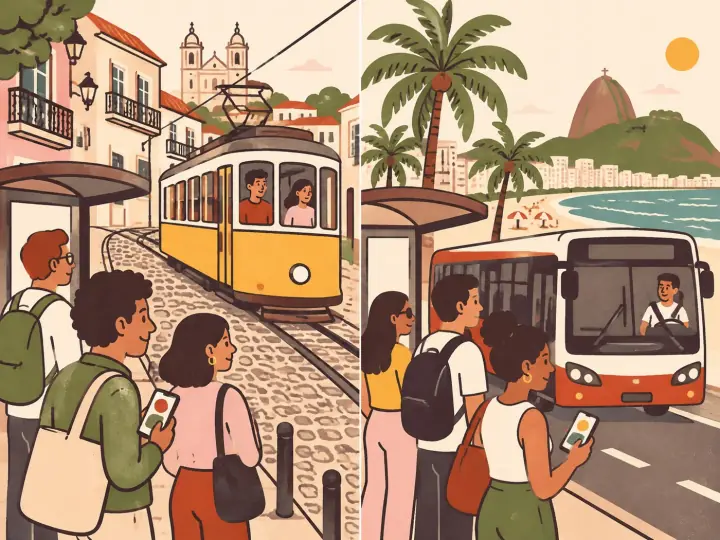
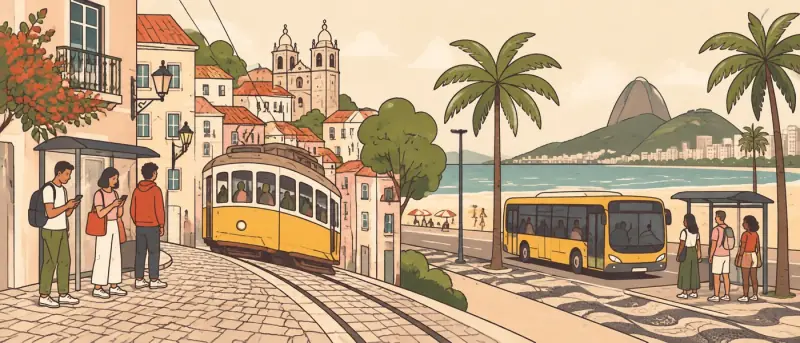
| tram | bonde | elétrico | Lisbon's yellow trams are elétricos. |
| subway | metrô | metro | Note the stress: me-TRÔ in Brazil. |
| truck | caminhão | camião | |
| driver's licence | carteira de motorista, CNH | carta de condução | |
| to drive | dirigir | conduzir | |
| car park | estacionamento | parque de estacionamento | |
| traffic light | semáforo, sinal | semáforo | |
| roundabout | rotatória | rotunda | |
| pedestrian | pedestre | peão | See peão in the trouble list. |
| crosswalk | faixa de pedestres | passadeira | |
| motorway | rodovia | autoestrada | |
| petrol station | posto de gasolina | bomba de gasolina | |
| car trunk | porta-malas | mala, bagageira |
Home 13
| English | Brazil | Portugal | Note |
|---|---|---|---|
| bathroom | banheiro | casa de banho | |
| toilet (bowl) | vaso, privada | sanita | |
| fridge | geladeira | frigorífico | |
| freezer | freezer | congelador | |
| shower | chuveiro | duche, chuveiro | Tomar banho means to shower in both. |
| trash can | lixeira | caixote do lixo | |
| ground floor | térreo | rés-do-chão | R/C on Portuguese doorbells. |
| to rent (as tenant) | alugar | arrendar, alugar | |
| water heater | aquecedor | esquentador | Esquentador is the gas boiler in Portuguese flats. |
| duvet | edredom | edredão | |
| kitchen sink | pia | lava-loiça | |
| dishes | louça | loiça | Both spellings exist in Portugal. |
| studio flat | quitinete, studio | estúdio, T0 | T1, T2 in Portugal count the bedrooms. |
Clothes 13
| English | Brazil | Portugal | Note |
|---|---|---|---|
| sweater | suéter, blusa de frio | camisola | Camisola in Brazil is a nightgown. |
| T-shirt | camiseta | t-shirt | |
| suit | terno | fato | |
| women's swimsuit | maiô, biquíni | fato de banho, biquíni | |
| swim trunks | sunga, calção de banho | calções de banho | |
| men's underwear | cueca | cuecas | |
| women's underwear | calcinha | cuecas | Portugal uses cuecas for both. |
| bra | sutiã | soutien | |
| socks | meias | peúgas, meias | |
| sneakers | tênis | sapatilhas, ténis | |
| jacket | jaqueta | casaco, blusão | |
| shorts | bermuda, short | calções | |
| nightgown | camisola | camisa de noite |
People and slang 14
| English | Brazil | Portugal | Note |
|---|---|---|---|
| guy | cara | gajo | Gajo is casual. Cara in Portugal is a face. |
| girl | garota, menina | miúda, rapariga | |
| kid | moleque, criança | miúdo, puto | |
| awesome | demais, massa | brutal, espetacular | Massa in the Northeast, demais everywhere. |
| mate, dude | mano, cara | pá | Ó pá is a classic Portuguese filler. |
| what's up? | e aí? | então?, tudo bem? | |
| thanks (casual) | valeu | obrigado, obrigadinho | |
| really? | sério? | a sério? | |
| nonsense | besteira, bobagem | disparate, parvoíce | |
| silly, stupid | bobo | parvo | |
| broke (no money) | duro, liso | teso | See teso in the trouble list. |
| boss | chefe | chefe, patrão | |
| money (slang) | grana | guito, massa | |
| nice, pretty | bonito, lindo | giro | Giro is everywhere in Portugal. |
Verbs 12
| English | Brazil | Portugal | Note |
|---|---|---|---|
| to understand | entender | perceber | Percebeste? means did you get it? |
| to take (a bus) | pegar | apanhar | Pegar in Portugal is to grab or to stick. |
| to save (a file) | salvar | gravar | |
| to register | cadastrar | registar | |
| to brake | frear | travar | |
| to have breakfast | tomar café da manhã | tomar o pequeno-almoço | |
| to chat | bater papo, conversar | conversar | |
| to cheer for (a team) | torcer | apoiar, torcer | |
| to tease | zoar | gozar | See gozar in the trouble list. |
| to fire (from a job) | demitir | despedir | |
| to enjoy | curtir | curtir, gostar | Curtir is casual in both. |
| to rent out | alugar | arrendar |
Your Brazil vs Portugal Portuguese guide is ready
Save it to your phone so it's there when you need it.
Good to know
Which one should you learn?
About 215 million people speak Brazilian Portuguese and about 10 million live in Portugal. Learn Brazilian unless you're moving to Portugal. Most courses, songs and series are Brazilian.
Reading is the easy part
Spelling has been close since the 1990 spelling agreement. A Brazilian newspaper and a Portuguese one read almost the same. Speech is where the gap lives.
Train your ear for Portugal
European Portuguese drops unstressed vowels, so words blur. Listen to Portuguese podcasts and TV news at slow speed first, then normal speed.
Learn você and tu
Brazilians use você. The Portuguese use tu with friends and avoid você with strangers. Learn both, and in Portugal just drop the pronoun when unsure.
Check the false friends
Rapariga, puto, bicha and teso are the big four. Learn them before you go, whichever country it is.
Questions people ask
Can Brazilians and Portuguese understand each other?
Yes, but not equally. The Portuguese grew up with Brazilian TV, so they understand Brazil well. Many Brazilians struggle with fast European Portuguese at first.
Is Brazilian or European Portuguese easier?
Brazilian is easier for most learners. The vowels are clear, the speech is slower and there's far more material to learn from.
Is the grammar different?
Only in a few habits: tu vs você, the gerund, where pronouns go and ter vs haver. The tenses and verb endings are the same.
Do Portuguese people say você?
Yes, but carefully. Said directly to someone, it can sound cold or rude. Most people use tu with friends and o senhor or the verb alone with strangers.
Is rapariga a bad word?
In Portugal it just means girl. In Brazil, especially the Northeast, it means a prostitute or a woman who cheats. Say moça or menina in Brazil.
Did the spelling agreement make them the same?
The 1990 agreement brought spelling closer, for example ação in both. Words, accents and grammar habits stayed different.
Keep going
- Why European Portuguese is so hard to understand
- Brazilian slang: 300 phrases to sound like a local
- Portuguese false friends and the words you really want
- Brazilian Portuguese contractions you'll hear every day
- Portuguese phrases for travel
- Portuguese for renting an apartment in Lisbon
- Latin American Spanish vs Spain Spanish
More regional differences
- Spain vs Latin America Spanish
- Spain vs Mexico Spanish
- Argentina vs Mexico Spanish
- Quebec vs France French
- Spanish words that change by country
Sources
- Wikipedia: Brazilian Portuguese
- Wikipedia: European Portuguese
- Priberam: rapariga
- Wiktionary: rapariga
Want these to stick? Verbamor turns any word on this page into a flashcard with a native voice, so it comes back right before you'd forget it.
More free tools
All 18-
Word patterns in 6 languages Understand and say whole groups of words from a few dozen simple rules. Spanish, French, Italian, Portuguese, Russian and German, each with a free PDF.
-
Slang for 20 Latin American countries 300 local phrases for each country, from Mexico to Brazil, with real examples, English translations and when to use each one.
-
How many Spanish words do you know? Tick the words you know from a frequency-banded sample. Fake words catch the guessing.
-
How much of a text do you already know? Paste any text and see what share of it sits inside the first 1,000 to 5,000 words.
-
The forgetting curve, drawn properly Put in the days since your last review and see how much of a word is left, on the real FSRS-6 curve.
-
What do 20 new cards a day cost you? Project your daily reviews for two years from a new-card rate and a retention target.
-
Cognate checker Type an English word, see its likely relatives in five languages, and get warned about false friends.
-
Der, die or das? Type a German noun and get its likely article, with the ending or compound rule behind it.
-
What a tutored word really costs Your lesson price divided by the words you still have next week, with the arithmetic in full.
-
Count the hours a term abroad buys The hours a semester abroad really adds, next to what the same money buys in tutoring.
-
Texting codes in 5 languages What mdr, tqm, kkkk, cmq and спс mean, with real chats, how to reply and a free decoder PDF for each language.
-
Terms of endearment in 5 languages What to call your partner, your kids and your friends in Spanish, French, Italian, Russian and Portuguese, with how each one sounds.
-
Phrase kits for real situations The pharmacy in Mexico, a flat in Lisbon, the prefecture in France: what to say, and what they will ask you back.
-
False friends in 5 languages Words that look like English and mean something else, from embarazada to préservatif, with the word you really want.
-
How people really talk The short forms, dropped sounds and accents that make fast speech hard to follow, written out so you can hear them.
-
Phrases for your partner's family What to say to your in-laws and your grandparents: first visits, meals, holidays and the questions they will ask.
-
Spanish slang translator Look up 6,000+ slang words and phrases from 20 countries, Spanish to English or English to Spanish.
- All 18 free tools Every tool on one page, plus the free debrief sheet.