 Verbamor
5,000+ German words from 26 simple rules
Verbamor's free German word patterns list turns English you already know into German you can understand and say. Learn one of the 26 rules and a whole group of words comes with it, so together they cover 5,000+ words. The page and the PDF give you 203 examples to start with. The first 4 are open below. Leave your email to open the other 22 and get the printable PDF.
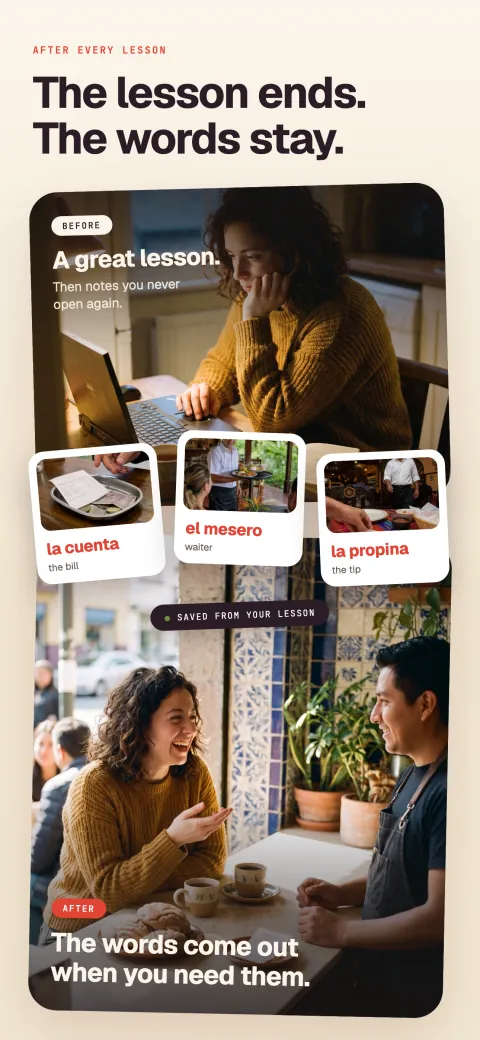
Verbamor records your lesson and turns what your tutor taught into cards that come back on schedule.

- 26 patterns
- 203 example words
- 7 groups
- Free PDF
Words you already know 8
English shares thousands of words with German. Learn one ending and you get the whole group.
-tion stays -tionFeminine, die Nation, station, information -tion stays -tion
English words that end in -tion often end in -tion in German. These words are feminine. Say die Nation. Say the ending tsee-OHN.
- die Nationnation
- die Informationinformation
- die Situationsituation
- die Stationstation
- die Traditiontradition
- die Positionposition
- die Funktionfunction
- die Revolutionrevolution
-ity becomes -itätFeminine, die University, quality, reality -ity becomes -ität
English words that end in -ity end in -ität in German. These words are feminine. Say die Universität. The stress falls on the ending.
- die Universitätuniversity
- die Qualitätquality
- die Realitätreality
- die Aktivitätactivity
- die Nationalitätnationality
- die Elektrizitätelectricity
- die Kreativitätcreativity
- die Identitätidentity
-y becomes -ieFeminine, die Energy, theory, biology -y becomes -ie
Many English words that end in -y end in -ie in German. These words are feminine. Say die Energie. Say the ending EE.
- die Energieenergy
- die Theorietheory
- die Biologiebiology
- die Demokratiedemocracy
- die Philosophiephilosophy
- die Fantasiefantasy
- die Therapietherapy
- die Strategiestrategy
-ment stays -mentNeuter, das Document, experiment, instrument -ment stays -ment
English words that end in -ment often end in -ment in German. Most of them are neuter. Say das Dokument. Der Moment is masculine.
- das Dokumentdocument
- das Experimentexperiment
- das Instrumentinstrument
- das Argumentargument
- das Elementelement
- das Parlamentparliament
- das Medikamentmedicine
- das Fundamentfoundation
All 26 patterns are open. The PDF is in your inbox.
-ism becomes -ismusMasculine, der Tourism, optimism, realism -ism becomes -ismus
English words that end in -ism end in -ismus in German. These words are masculine. Say der Tourismus.
- der Tourismustourism
- der Optimismusoptimism
- der Pessimismuspessimism
- der Realismusrealism
- der Journalismusjournalism
- der Egoismusselfishness
- der Kapitalismuscapitalism
- der Idealismusidealism
-ist stays -istMasculine, der Tourist, journalist, pianist -ist stays -ist
English words that end in -ist end in -ist in German. These words are masculine. Add -in for a woman. Say die Touristin.
- der Touristtourist
- der Journalistjournalist
- der Pianistpianist
- der Spezialistspecialist
- der Optimistoptimist
- der Pessimistpessimist
- der Realistrealist
- der Polizistpolice officer
-ic / -ical becomes -isch Typical, practical, logical -ic / -ical becomes -isch
English adjectives that end in -ic or -ical often end in -isch. Typical is typisch. Logical is logisch. Write them with a small letter.
- typischtypical
- praktischpractical
- elektrischelectric
- logischlogical
- politischpolitical
- fantastischfantastic
- romantischromantic
- historischhistoric
-ize / -ate becomes -ieren Organize, communicate, motivate -ize / -ate becomes -ieren
Many English verbs that end in -ize or -ate end in -ieren in German. Organize is organisieren. These verbs are regular. Their past form takes no ge-. Say ich habe organisiert.
- organisierento organize
- kritisierento criticize
- minimierento minimize
- stabilisierento stabilize
- kommunizierento communicate
- motivierento motivate
- koordinierento coordinate
- demonstrierento demonstrate
Gender and articles 5
The ending or the meaning of a word often gives its gender. Learn the group, not each word.
-ungFeminine, die Newspaper, apartment, opinion Words in -ung are feminine
Words that end in -ung are feminine. Say die Zeitung. Many of them come from a verb. Wohnen becomes die Wohnung.
- die Zeitungnewspaper
- die Wohnungapartment
- die Meinungopinion
- die Rechnungbill, check
- die Übungexercise
- die Erfahrungexperience
- die Bedeutungmeaning
- die Einladunginvitation
-heit / -keitFeminine, die Freedom, health, truth Words in -heit and -keit are feminine
Words that end in -heit or -keit are feminine. Say die Freiheit. They often turn an adjective into a noun. Frei becomes die Freiheit.
- die Freiheitfreedom
- die Gesundheithealth
- die Wahrheittruth
- die Krankheitillness
- die Sicherheitsafety, security
- die Möglichkeitpossibility
- die Schwierigkeitdifficulty
- die Freundlichkeitfriendliness
-chen / -leinNeuter, das Girl, bread roll, kitten Small things in -chen are neuter
Words that end in -chen or -lein are neuter. They name a small one. The vowel often takes an umlaut. Das Haus becomes das Häuschen. Das Mädchen is neuter too.
- das Mädchengirl
- das Brötchenbread roll
- das Kätzchenkitten
- das Häuschenlittle house
- das Hähnchenchicken (to eat)
- das Märchenfairy tale
- das Würstchensmall sausage
- das Büchleinlittle book
derMasculine, der Monday, May, summer Days, months and seasons are masculine
Days, months and seasons are masculine. Say der Montag and der Sommer. Use am for days. Say am Montag. Use im for months and seasons. Say im Mai.
- der MontagMonday
- der FreitagFriday
- der SonntagSunday
- der JanuarJanuary
- der MaiMay
- der DezemberDecember
- der Sommersummer
- der Winterwinter
dasNeuter, das Food, life, meeting A verb used as a noun is neuter
Any verb can work as a noun. Write it with a capital letter. It is always neuter. Essen means to eat. Das Essen means the food.
- das Essenfood, meal
- das Lebenlife
- das Treffenmeeting
- das Schwimmenswimming
- das Lesenreading
- das Wissenknowledge
- das Vertrauentrust
- das Rauchensmoking
Exceptions 2
These common words break the rules. Learn each set together.
≠ Cheese, name, eye -e words that are not feminine
Most nouns that end in -e are feminine. Say die Lampe. These common words break the rule. Learn each one with its article.
- der Käsecheese
- der Namename
- der Jungeboy
- der Haserabbit
- das Endeend
- das Augeeye
- das Interesseinterest
- das Gebäudebuilding
≈ Poison, cell phone, child Words that look like English but are not
Most look-alike words mean the same in English. These do not. Gift means poison, not present. Learn the real meaning of each one.
- bekommento get, to receivenot become
- das Giftpoisonnot gift
- das Handycell phonenot handy
- der Ratadvicenot rat
- der Chefbossnot chef
- aktuellcurrent, up to datenot actual
- die Artkind, typenot art
- das Kindchildnot kind (nice)
Plurals and other rules 2
One small rule changes many words.
Aa Dog, table, city Every noun starts with a capital
Every German noun starts with a capital letter. Write der Hund, not der hund. The capitals help you find the nouns in a sentence.
- der Hunddog
- der Tischtable
- der Apfelapple
- die Stadtcity
- die Türdoor
- das Buchbook
- das Fensterwindow
- das Autocar
+n / +enFeminine, die Lamp, woman, bag Feminine nouns add -n or -en
Most feminine nouns add -n or -en in the plural. Die Lampe becomes die Lampen. The plural article is always die.
- die Lampe becomes die Lampenlamp
- die Frau becomes die Frauenwoman
- die Tasche becomes die Taschenbag
- die Blume becomes die Blumenflower
- die Straße becomes die Straßenstreet
- die Uhr becomes die Uhrenclock, watch
- die Antwort becomes die Antwortenanswer
- die Schule becomes die Schulenschool
Word building 3
Add a small part to a word you know. You get a new word.
+ Glove, fridge, weekend The last word gives the gender
German joins nouns into one long word. The last part gives the gender. Die Hand and der Schuh make der Handschuh, a glove.
- Hand + Schuh becomes der Handschuhglove
- kühl + Schrank becomes der Kühlschrankfridge
- Bahn + Hof becomes der Bahnhoftrain station
- Geburt + Tag becomes der Geburtstagbirthday
- Haus + Aufgabe becomes die Hausaufgabehomework
- fahren + Rad becomes das Fahrradbicycle
- Woche + Ende becomes das Wochenendeweekend
- krank + Haus becomes das Krankenhaushospital
un- Unhappy, impossible, unknown Un- makes the opposite
Add un- to an adjective to make the opposite. Möglich becomes unmöglich. It works like un- in English.
- glücklich becomes unglücklichunhappy
- möglich becomes unmöglichimpossible
- freundlich becomes unfreundlichunfriendly
- bekannt becomes unbekanntunknown
- klar becomes unklarunclear
- gesund becomes ungesundunhealthy
- wichtig becomes unwichtigunimportant
- ruhig becomes unruhigrestless
-inFeminine, die Teacher, friend, doctor -in names the woman
Add -in for a woman. Der Lehrer becomes die Lehrerin. These words are feminine. Some take an umlaut. Der Arzt becomes die Ärztin.
- der Lehrer becomes die Lehrerinfemale teacher
- der Freund becomes die Freundinfemale friend, girlfriend
- der Arzt becomes die Ärztinfemale doctor
- der Koch becomes die Köchinfemale cook
- der Student becomes die Studentinfemale student
- der Verkäufer becomes die Verkäuferinsaleswoman
- der Nachbar becomes die Nachbarinfemale neighbor
- der Kollege becomes die Kolleginfemale colleague
Verbs 4
Each set of verbs behaves in one way. Learn the set together.
an · auf Call, get up, shop The first part moves to the end
Some verbs start with a part that splits off. That part goes to the end. Anrufen becomes ich rufe dich an. Stress the first part.
- anrufen becomes ich rufe anto call (on the phone)
- aufstehen becomes ich stehe aufto get up
- einkaufen becomes ich kaufe einto go shopping
- mitkommen becomes ich komme mitto come along
- abfahren becomes ich fahre abto leave, to depart
- fernsehen becomes ich sehe fernto watch TV
- aufmachen becomes ich mache aufto open
- zumachen becomes ich mache zuto close
sein Go, come, stay Verbs that take sein in the past
Most verbs use haben for the past. Say ich habe gegessen. Verbs of movement and change use sein. Say ich bin gefahren.
- gehen becomes ich bin gegangento go, to walk
- kommen becomes ich bin gekommento come
- fahren becomes ich bin gefahrento drive, to ride
- fliegen becomes ich bin geflogento fly
- laufen becomes ich bin gelaufento run
- bleiben becomes ich bin gebliebento stay
- werden becomes ich bin gewordento become
- passieren becomes es ist passiertto happen
kann Can, must, want The second verb goes to the end
Modal verbs say can, must or want. The second verb goes to the end. Say ich kann gut schwimmen.
- können becomes ich kanncan, to be able to
- müssen becomes ich mussmust, to have to
- wollen becomes ich willto want
- dürfen becomes ich darfmay, to be allowed to
- sollen becomes ich sollshould, to be supposed to
- mögen becomes ich magto like
sich Be glad, sit down, hurry Verbs that need sich
Some verbs need sich. Change sich to match the person. Say ich freue mich and du freust dich.
- sich freuen becomes ich freue michto be glad
- sich setzen becomes ich setze michto sit down
- sich beeilen becomes ich beeile michto hurry
- sich erinnern becomes ich erinnere michto remember
- sich fühlen becomes ich fühle michto feel
- sich waschen becomes ich wasche michto wash (yourself)
Pronunciation 2
Some letters do not sound the way an English reader expects.
ei · ie My, wine, beer Ei says eye, ie says ee
Read the second letter of the pair. Ei sounds like eye, as in mein. Ie sounds like ee, as in Bier.
- meinmysounds like mine
- der Weinwinesounds like vine
- dreithreesounds like dry
- das Bierbeersounds like beer
- die LiebeloveLEE-buh
- vierfoursounds like fear
- siebensevenZEE-ben
w v z Water, father, train W says v, v says f, z says ts
W sounds like English v. Say VAS-er for Wasser. V usually sounds like f. Z sounds like ts, as in cats.
- das WasserwaterVAS-er
- das WetterweatherVET-er
- der VaterfatherFAH-ter
- viela lot, muchsounds like feel
- der VogelbirdFOH-gel
- der Zugtraintsook
- zehntentsayn
- das ZimmerroomTSIM-er
How to use these patterns
Read one pattern a day. Say the example words out loud. Then look for that pattern in what you read and hear that week. A pattern you notice three times in real German stays with you. Soon you hear those words in speech and use them in your own sentences.
Start with the first group, words you already know. Those 8 patterns turn English words you use every day into German ones. The gender group comes next. It tells you der, die or das before you look the word up.
The same kind of list exists for Spanish, French, Italian, Portuguese and Russian, each with its own free PDF.
A pattern is a guide, and every guide has exceptions. The exceptions group lists the common ones, like der Käse. When a word you made from a pattern sounds wrong, check it.
Patterns cover the words you can work out. For the words you can't, the cognate checker marks the false friends that look like English and mean something else.
Questions people ask
What is a German word pattern?
A rule that changes many words at once. English words that end in -ity end in -ität in German. These words are feminine. When you know that rule, you know die Universität, die Qualität and die Realität before anyone teaches them to you.
Do the patterns always work?
Most of the time, and each pattern says where it stops. The exceptions group lists common words that break the rules, like der Käse. The false friends pattern lists words that look like English and mean something else, like bekommen, which means to get, to receive.
Is this the same as the Word patterns screen in Verbamor?
Yes. These are the same 26 German patterns. In the app you can pick any example word and save it as a flashcard with a picture, an example sentence and audio.
What do I get by email?
A printable PDF with all 26 patterns and 203 example words, and my post-lesson debrief handbook. Then a few short emails. You can unsubscribe at any time.
Turn a pattern into words you can say.
Open Word patterns in Verbamor, pick the words you want, and save them. Each card gets a picture, an example sentence and audio, and comes back just before you forget it, so the word is there when you need it in a conversation.
Start 7 days freeThe 7-day free trial is on the yearly plan.
More free tools
All 9-
How many Spanish words do you know? Tick the words you know from a frequency-banded sample. Fake words catch the guessing.
-
How much of a text do you already know? Paste any text and see what share of it sits inside the first 1,000 to 5,000 words.
-
The forgetting curve, drawn properly Put in the days since your last review and see how much of a word is left, on the real FSRS-6 curve.
-
What do 20 new cards a day cost you? Project your daily reviews for two years from a new-card rate and a retention target.
-
Cognate checker Type an English word, see its likely relatives in five languages, and get warned about false friends.
-
Der, die or das? Type a German noun and get its likely article, with the ending or compound rule behind it.
-
What a tutored word really costs Your lesson price divided by the words you still have next week, with the arithmetic in full.
-
Count the hours a term abroad buys The hours a semester abroad really adds, next to what the same money buys in tutoring.
- All 9 free tools Every tool on one page, plus the free debrief sheet.