 Verbamor
5,000+ French words from 40 simple rules
Verbamor's free French word patterns list turns English you already know into French you can understand and say. Learn one of the 40 rules and a whole group of words comes with it, so together they cover 5,000+ words. The page and the PDF give you 317 examples to start with. The first 4 are open below. Leave your email to open the other 36 and get the printable PDF.
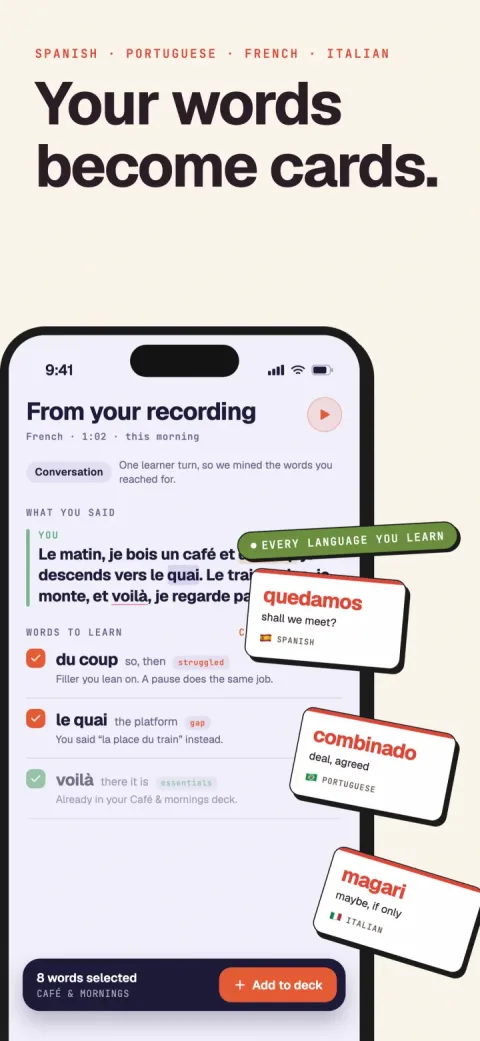
Verbamor turns the words from your own lessons and recordings into flashcards, and brings each one back before you’d forget it.

- 40 patterns
- 317 example words
- 7 groups
- Free PDF
Words you already know 23
English shares thousands of words with French. Learn one ending and you get the whole group.
-tion stays -tionFeminine, la Nation, station, information -tion stays -tion
English words that end in -tion end in -tion in French. The spelling is the same or almost the same. These words are feminine. Say la nation.
- la nationnation
- l'informationinformation
- l'éducationeducation
- la stationstation
- la conversationconversation
- l'attentionattention
- la célébrationcelebration
- la situationsituation
-sion stays -sionFeminine, la Television, decision, version -sion stays -sion
English words that end in -sion end in -sion. The spelling is the same. These words are feminine. Say la décision.
- la télévisiontelevision
- la décisiondecision
- la versionversion
- l'occasionoccasion
- la passionpassion
- la tensiontension
- la confusionconfusion
- l'explosionexplosion
-ty becomes -téFeminine, la University, liberty, quality -ty becomes -té
English words that end in -ty end in -té. These words are feminine. Say la liberté.
- l'universitéuniversity
- la libertéliberty
- la sociétésociety
- la réalitéreality
- la qualitéquality
- l'activitéactivity
- la possibilitépossibility
- la beautébeauty
-ly becomes -ment Finally, normally, probably -ly becomes -ment
English adverbs that end in -ly end in -ment. Take the feminine adjective. Add -ment. Rapide becomes rapidement.
- finalementfinally
- normalementnormally
- probablementprobably
- généralementgenerally
- exactementexactly
- rapidementrapidly
- complètementcompletely
- spécialementespecially
All 40 patterns are open. The PDF is in your inbox.
-ous becomes -eux Delicious, curious, serious -ous becomes -eux
English adjectives that end in -ous end in -eux. Use -euse with a feminine noun. Un homme curieux. Une femme curieuse.
- délicieuxdelicious
- curieuxcurious
- nerveuxnervous
- généreuxgenerous
- dangereuxdangerous
- précieuxprecious
- mystérieuxmysterious
- sérieuxserious
-ic becomes -ique Fantastic, romantic, electric -ic becomes -ique
English adjectives that end in -ic or -ical end in -ique. The word is the same for masculine and feminine.
- fantastiquefantastic
- romantiqueromantic
- électriqueelectric
- typiquetypical
- politiquepolitical
- classiqueclassic
- économiqueeconomic
- magiquemagic
-ist becomes -iste Artist, tourist, journalist -ist becomes -iste
English words for people that end in -ist end in -iste. The word is the same for men and women. Only the article changes. Un artiste. Une artiste.
- artisteartist
- touristetourist
- dentistedentist
- pianistepianist
- optimisteoptimist
- spécialistespecialist
- journalistejournalist
- réalisterealist
-ism becomes -ismeMasculine, le Tourism, optimism, realism -ism becomes -isme
English words that end in -ism end in -isme. These words are masculine. Say le tourisme. The final e is silent.
- le tourismetourism
- l'optimismeoptimism
- le capitalismecapitalism
- le réalismerealism
- l'organismeorganism
- le mécanismemechanism
- le socialismesocialism
- le journalismejournalism
-ble stays -ble Possible, terrible, flexible -ble stays -ble
English adjectives that end in -ble end in -ble. The spelling is usually the same. The word is the same for masculine and feminine.
- possiblepossible
- terribleterrible
- responsableresponsible
- horriblehorrible
- probableprobable
- flexibleflexible
- visiblevisible
- impossibleimpossible
-ent / -ant stays -ent / -ant Important, different, restaurant -ent / -ant stays -ent / -ant
English words that end in -ent or -ant often keep the same ending. The spelling is close. The last t is silent.
- importantimportant
- différentdifferent
- présidentpresident
- étudiantstudent
- éléphantelephant
- restaurantrestaurant
- intelligentintelligent
- excellentexcellent
-ance / -ence stays -ance / -enceFeminine, la Distance, experience, science -ance / -ence stays -ance / -ence
English words that end in -ance or -ence keep the same ending in French. These words are feminine. Say la science.
- la distancedistance
- l'importanceimportance
- l'expérienceexperience
- la différencedifference
- la patiencepatience
- la sciencescience
- la présencepresence
- l'éléganceelegance
s becomes ê ô î â Forest, hospital, island The hat hides an s
A hat on a vowel often replaces an old s. Put the s back. You get an English word. Forêt is forest. Hôpital is hospital.
- forêtforest
- hôpitalhospital
- îleisland
- fêtefeast
- châteaucastle
- bêtebeast
- côtecoast
- intérêtinterest
-age stays -ageMasculine, le Message, garage, village -age stays -age
English words that end in -age often end in -age in French. These words are masculine. Say le voyage. A few short words are feminine. Say la page, la plage and l'image.
- le messagemessage
- le garagegarage
- le villagevillage
- le couragecourage
- le passagepassage
- le massagemassage
- le bagagepiece of luggage
- le voyagetrip
-ment stays -mentMasculine, le Moment, document, apartment -ment stays -ment
English nouns that end in -ment end in -ment in French. These words are masculine. Say le moment. The last t is silent.
- le momentmoment
- le documentdocument
- le gouvernementgovernment
- l'appartementapartment
- le monumentmonument
- le mouvementmovement
- l'instrumentinstrument
- le sentimentfeeling
-or becomes -eurFeminine, la Color, error, terror -or becomes -eur
English idea words that end in -or often end in -eur. These words are feminine. Say la couleur. Words for people and machines are masculine. Say le docteur and le moteur. Honneur and bonheur are masculine too.
- la couleurcolor
- l'erreurerror
- la terreurterror
- l'horreurhorror
- la faveurfavor
- l'odeurodor
- la valeurvalue
- la saveurflavor
-ate becomes -er Celebrate, create, participate -ate becomes -er
English verbs that end in -ate often end in -er in French. Remove -ate. Add -er. But verbs that end in -cate end in -quer. Communicate is communiquer. These verbs are regular. Say je participe.
- célébrerto celebrate
- créerto create
- participerto participate
- communiquerto communicate
- décorerto decorate
- séparerto separate
- éduquerto educate
- calculerto calculate
-ize / -ify becomes -iser / -ifier Organize, authorize, identify -ize / -ify becomes -iser / -ifier
English verbs that end in -ize end in -iser. English verbs that end in -ify end in -ifier. Organize is organiser. Identify is identifier.
- organiserto organize
- utiliserto utilize
- autoriserto authorize
- moderniserto modernize
- identifierto identify
- modifierto modify
- simplifierto simplify
- vérifierto verify
-sis becomes -seFeminine, la Crisis, analysis, thesis -sis becomes -se
English words that end in -sis end in -se in French. These words are feminine. Say la crise. The plural adds s. Say les crises.
- la crisecrisis
- l'analyseanalysis
- la thèsethesis
- l'hypothèsehypothesis
- la synthèsesynthesis
- la basebasis
- la genèsegenesis
s- becomes é- State, strange, study S- becomes é-
Old French words that started with s + consonant now start with é. Change é to s. You get an English word. État is state. Étrange is strange.
- étatstate
- étrangestrange
- étudestudy
- épicespice
- épongesponge
- étrangerstranger, foreigner
- écranscreen
- épousespouse
-ology becomes -ologieFeminine, la Biology, technology, psychology -ology becomes -ologie
English words that end in -ology end in -ologie in French. These words are feminine. Say la biologie.
- la biologiebiology
- la psychologiepsychology
- la technologietechnology
- l'écologieecology
- la sociologiesociology
- l'archéologiearchaeology
- la mythologiemythology
- l'idéologieideology
-ary becomes -aire Necessary, vocabulary, salary -ary becomes -aire
English words that end in -ary often end in -aire. Necessary is nécessaire. The adjectives are the same for masculine and feminine. Anniversaire is also the word for birthday.
- nécessairenecessary
- vocabulairevocabulary
- salairesalary
- anniversairebirthday, anniversary
- dictionnairedictionary
- contrairecontrary
- itinéraireitinerary
- commentairecommentary
-ive becomes -if Active, positive, creative -ive becomes -if
English adjectives that end in -ive end in -if. Use -ive with a feminine noun. Un homme actif. Une femme active.
- actifactive
- positifpositive
- négatifnegative
- créatifcreative
- attentifattentive
- exclusifexclusive
- agressifaggressive
- natifnative
-ure stays -ureFeminine, la Culture, temperature, adventure -ure stays -ure
English words that end in -ure often end in -ure in French. These words are feminine. Say la culture.
- la cultureculture
- la températuretemperature
- la structurestructure
- la naturenature
- la littératureliterature
- l'architecturearchitecture
- l'aventureadventure
- l'agricultureagriculture
Gender and articles 8
The ending or the meaning of a word often gives its gender. Learn the group, not each word.
le / la France, Canada, Japan A country that ends in -e is feminine
A country that ends in -e is feminine. Say la France. Other countries are masculine. Say le Canada. Le Mexique is one exception. Use en for feminine, au for masculine and aux for plural. Say en France, au Canada and aux États-Unis.
- la FranceFrance
- l'ItalieItaly
- l'EspagneSpain
- l'AllemagneGermany
- le CanadaCanada
- le JaponJapan
- le BrésilBrazil
- les États-UnisUnited States
à London, Rome, Brussels Cities take à and no article
Cities take no article. Use à to say in or to. Say j'habite à Londres. A few city names include an article. Say Le Havre, La Rochelle and Le Caire.
- LondresLondon
- RomeRome
- BruxellesBrussels
- GenèveGeneva
- LisbonneLisbon
- MoscouMoscow
- VeniseVenice
- PékinBeijing
-eauMasculine, le Boat, cake, hat Words in -eau are masculine
Words that end in -eau are masculine. Say le bateau. The plural adds x. Say les bateaux. Two words are feminine. Say l'eau and la peau.
- le bateauboat
- le gâteaucake
- le chapeauhat
- le bureaudesk
- le cadeaugift
- le manteaucoat
- le couteauknife
- l'oiseaubird
-meMasculine, le Problem, system, program Greek words in -me are masculine
Most words that end in -e are feminine. Words from Greek that end in -me are masculine. Say le problème. Many are almost the same in English.
- le problèmeproblem
- le systèmesystem
- le programmeprogram
- le thèmetheme
- le poèmepoem
- le diplômediploma
- le dramedrama
+ier Apple, pear, cherry Add -ier for the tree
The fruit is often feminine. Add -ier for the tree. The tree is masculine. La pomme grows on le pommier.
- la pomme · le pommierapple
- la poire · le poirierpear
- la cerise · le cerisiercherry
- la banane · le bananierbanana
- l'olive · l'olivierolive
- la mandarine · le mandariniermandarin
- la prune · le prunierplum
- la figue · le figuierfig
la Head, arm, leg Body parts take the article, not my
French uses the article with parts of the body. It does not use my or your. Say j'ai mal à la tête. Say je me lave les mains.
- la têtehead
- le brasarm
- la jambeleg
- le piedfoot
- la mainhand
- la bouchemouth
- le dosback
- le ventrebelly
leMasculine, le Monday, Friday, Sunday Le lundi means each Monday
Days are masculine. Lundi with no article means this Monday. Le lundi means each Monday. There is no word for on. Write days with a small letter.
- le lundiMonday
- le mardiTuesday
- le mercrediWednesday
- le jeudiThursday
- le vendrediFriday
- le samediSaturday
- le dimancheSunday
l' Friend, school, hotel Le and la become l' before a vowel
Le and la become l' before a vowel. Say l'ami and l'école. Most words that start with h do the same. Say l'hôtel. A few h words keep le. Say le héros.
- l'ami (m)friend
- l'école (f)school
- l'hôtel (m)hotel
- l'homme (m)man
- l'heure (f)hour
- l'arbre (m)tree
- l'enfant (m)child
- l'histoire (f)story
Exceptions 2
These common words break the rules. Learn each set together.
≠ Museum, silence, beach Words that break the ending rules
Words in -ée and -ence are usually feminine. Le musée, le lycée and le silence break the rule. Words in -age are usually masculine. La page, la plage and l'image break the rule.
- le muséemuseum
- le lycéehigh school
- le silencesilence
- le squeletteskeleton
- la pagepage
- la plagebeach
- l'image (f)image
- la peauskin
≈ Bookshop, wait, grape Words that look like English but are not
Most look-alike words mean the same in English. These do not. Librairie means bookshop, not library. Learn the real meaning of each one.
- librairiebookshopnot library
- actuellementcurrentlynot actually
- attendreto waitnot attend
- blesserto hurtnot bless
- monnaiesmall changenot money
- coincornernot coin
- locationrentalnot location
- raisingrapenot raisin
Plurals and other rules 1
One small rule changes many words.
al → aux Animal, newspaper, horse The plural of -al is -aux
Words that end in -al end in -aux in the plural. Un animal becomes des animaux. A few words add s. Say des festivals and des carnavals.
- animal becomes animauxanimal
- journal becomes journauxnewspaper
- cheval becomes chevauxhorse
- canal becomes canauxcanal
- signal becomes signauxsignal
- métal becomes métauxmetal
- terminal becomes terminauxterminal
- tribunal becomes tribunauxcourt
Word building 3
Add a small part to a word you know. You get a new word.
-erieFeminine, la Bakery, cheese shop, fish shop Add -erie for the shop
Add -erie for the shop. Use the product or the person who makes it. Fromage becomes fromagerie. Boulanger becomes boulangerie. These words are feminine.
- le boulanger becomes la boulangeriebakery
- le pâtissier becomes la pâtisseriepastry shop
- le boucher becomes la boucheriebutcher shop
- le fromage becomes la fromageriecheese shop
- le poisson becomes la poissonneriefish shop
- la crêpe becomes la crêperiecrêpe restaurant
- le bijou becomes la bijouteriejewelry shop
- le parfum becomes la parfumerieperfume shop
-eurMasculine, le Singer, dancer, seller -eur names the person who does it
Add -eur to a verb stem for the person who does it. Chanter becomes chanteur. Use -euse for a woman. Say la chanteuse.
- vendre becomes le vendeurseller
- chanter becomes le chanteursinger
- danser becomes le danseurdancer
- jouer becomes le joueurplayer
- servir becomes le serveurwaiter
- coiffer becomes le coiffeurhairdresser
- voyager becomes le voyageurtraveler
- nager becomes le nageurswimmer
dé- Undo, unplug, undress Dé- makes the opposite
Add dé- to make the opposite. Faire becomes défaire. Before a vowel, use dés-. Agréable becomes désagréable.
- faire becomes défaireto undo
- agréable becomes désagréableunpleasant
- ordre becomes désordredisorder
- avantage becomes désavantagedisadvantage
- accord becomes désaccorddisagreement
- brancher becomes débrancherto unplug
- bloquer becomes débloquerto unblock
- habiller becomes déshabillerto undress
Verbs 1
Each set of verbs behaves in one way. Learn the set together.
être Go, come, stay Verbs that take être in the past
Most verbs use avoir for the past. Say j'ai mangé. A small set of movement verbs uses être. Say je suis allé. A woman writes je suis allée.
- aller becomes je suis alléto go
- venir becomes je suis venuto come
- arriver becomes je suis arrivéto arrive
- partir becomes je suis partito leave
- entrer becomes je suis entréto enter
- sortir becomes je suis sortito go out
- rester becomes je suis restéto stay
- tomber becomes je suis tombéto fall
Pronunciation 2
Some letters do not sound the way an English reader expects.
c r f l With, hello, nine Only c, r, f and l sound at the end
A last consonant is usually silent. Say puh-TEE for petit. The letters c, r, f and l are usually sounded. Think of the word careful. The r of an -er verb is silent. Say par-LAY for parler.
- avecwithsay the c
- sacbagsay the c
- bonjourhellosay the r
- hiverwintersay the r
- neufninesay the f
- chefchef, bosssay the f
- selsaltsay the l
- cielskysay the l
h Live, happy, yesterday The letter h is silent
The letter h is always silent in French. Say a-bee-TAY for habiter. The pair ch sounds like sh in shop.
- habiterto livea-bee-TAY
- heureuxhappyuh-RUH
- herbegrasserb
- huileoilweel
- hieryesterdayee-YAIR
- horlogeclockor-LOZH
- habitudehabita-bee-TEWD
- humainhumanew-MAN
How to use these patterns
Read one pattern a day. Say the example words out loud. Then look for that pattern in what you read and hear that week. A pattern you notice three times in real French stays with you. Soon you hear those words in speech and use them in your own sentences.
Start with the first group, words you already know. Those 23 patterns turn English words you use every day into French ones. The gender group comes next. It tells you le or la before you look the word up.
The same kind of list exists for Spanish, Italian, Portuguese and Russian, each with its own free PDF.
A pattern is a guide, and every guide has exceptions. The exceptions group lists the common ones, like le musée. When a word you made from a pattern sounds wrong, check it.
Patterns cover the words you can work out. For the words you can't, the cognate checker marks the false friends that look like English and mean something else.
Questions people ask
What is a French word pattern?
A rule that changes many words at once. English words that end in -tion end in -tion in French. The spelling is the same or almost the same. When you know that rule, you know la nation, l'information and l'éducation before anyone teaches them to you.
Do the patterns always work?
Most of the time, and each pattern says where it stops. The exceptions group lists common words that break the rules, like le musée. The false friends pattern lists words that look like English and mean something else, like librairie, which means bookshop.
Is this the same as the Word patterns screen in Verbamor?
Yes. These are the same 40 French patterns. In the app you can pick any example word and save it as a flashcard with a picture, an example sentence and audio.
What do I get by email?
A printable PDF with all 40 patterns and 317 example words, and my post-lesson debrief handbook. Then a few short emails. You can unsubscribe at any time.
Turn a pattern into words you can say.
Open Word patterns in Verbamor, pick the words you want, and save them. Each card gets a picture, an example sentence and audio, and comes back just before you forget it, so the word is there when you need it in a conversation.
Start 7 days freeThe 7-day free trial is on the yearly plan.
More free tools
All 8-
How many Spanish words do you know? Tick the words you know from a frequency-banded sample. Fake words catch the guessing.
-
How much of a text do you already know? Paste any text and see what share of it sits inside the first 1,000 to 5,000 words.
-
The forgetting curve, drawn properly Put in the days since your last review and see how much of a word is left, on the real FSRS-6 curve.
-
What do 20 new cards a day cost you? Project your daily reviews for two years from a new-card rate and a retention target.
-
Cognate checker Type an English word, see its likely relatives in four languages, and get warned about false friends.
-
What a tutored word really costs Your lesson price divided by the words you still have next week, with the arithmetic in full.
-
Count the hours a term abroad buys The hours a semester abroad really adds, next to what the same money buys in tutoring.
- All 8 free tools Every tool on one page, plus the free debrief sheet.