 Verbamor
5,000+ Portuguese words from 40 simple rules
Verbamor's free Portuguese word patterns list turns English you already know into Portuguese you can understand and say. Learn one of the 40 rules and a whole group of words comes with it, so together they cover 5,000+ words. The page and the PDF give you 317 examples to start with. The first 4 are open below. Leave your email to open the other 36 and get the printable PDF.
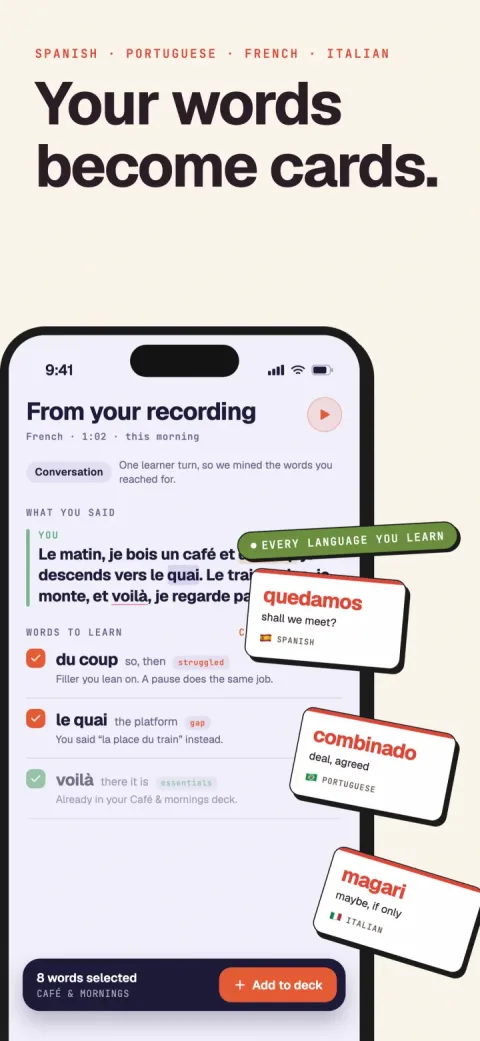
Verbamor turns the words from your own lessons and recordings into flashcards, and brings each one back before you’d forget it.

- 40 patterns
- 317 example words
- 6 groups
- Free PDF
Words you already know 23
English shares thousands of words with Portuguese. Learn one ending and you get the whole group.
-tion becomes -çãoFeminine, a Nation, station, information -tion becomes -ção
English words that end in -tion end in -ção in Portuguese. These words are feminine. Say a nação. The ç sounds like s.
- a naçãonation
- a informaçãoinformation
- a educaçãoeducation
- a estaçãostation
- a atençãoattention
- a celebraçãocelebration
- a situaçãosituation
- a populaçãopopulation
-sion becomes -sãoFeminine, a Television, decision, version -sion becomes -são
English words that end in -sion end in -são. These words are feminine. Say a decisão.
- a televisãotelevision
- a decisãodecision
- a versãoversion
- a expressãoexpression
- a tensãotension
- a confusãoconfusion
- a explosãoexplosion
- a conclusãoconclusion
-ty becomes -dadeFeminine, a University, city, liberty -ty becomes -dade
English words that end in -ty end in -dade. These words are feminine. Say a cidade.
- a universidadeuniversity
- a cidadecity
- a liberdadeliberty
- a sociedadesociety
- a realidadereality
- a qualidadequality
- a atividadeactivity
- a possibilidadepossibility
-ly becomes -mente Finally, normally, probably -ly becomes -mente
English adverbs that end in -ly end in -mente. Take the feminine adjective. Add -mente. Rápida becomes rapidamente.
- finalmentefinally
- normalmentenormally
- provavelmenteprobably
- geralmentegenerally
- exatamenteexactly
- rapidamenterapidly
- completamentecompletely
- especialmenteespecially
All 40 patterns are open. The PDF is in your inbox.
-ous becomes -oso Famous, delicious, curious -ous becomes -oso
English adjectives that end in -ous end in -oso. Use -osa with a feminine noun. Um homem famoso. Uma mulher famosa.
- famosofamous
- deliciosodelicious
- curiosocurious
- nervosonervous
- generosogenerous
- perigosodangerous
- preciosoprecious
- misteriosomysterious
-ic becomes -ico Fantastic, romantic, electric -ic becomes -ico
English adjectives that end in -ic or -ical end in -ico. Use -ica with a feminine noun. The stress mark goes on the vowel before -ico.
- fantásticofantastic
- românticoromantic
- elétricoelectric
- públicopublic
- típicotypical
- políticopolitical
- clássicoclassic
- econômicoeconomic
-al stays -al Animal, hospital, natural -al stays -al
Many English words that end in -al are the same in Portuguese. The spelling does not change. The final l sounds like a soft u.
- animalanimal
- hospitalhospital
- naturalnatural
- finalfinal
- normalnormal
- totaltotal
- capitalcapital
- socialsocial
-ist becomes -ista Artist, tourist, journalist -ist becomes -ista
English words for people that end in -ist end in -ista. The word is the same for men and women. Only the article changes. O artista. A artista.
- artistaartist
- turistatourist
- dentistadentist
- pianistapianist
- otimistaoptimist
- especialistaspecialist
- jornalistajournalist
- realistarealist
-ism becomes -ismoMasculine, o Tourism, optimism, realism -ism becomes -ismo
English words that end in -ism end in -ismo. These words are masculine. Say o turismo.
- o turismotourism
- o otimismooptimism
- o capitalismocapitalism
- o realismorealism
- o organismoorganism
- o mecanismomechanism
- o socialismosocialism
- o jornalismojournalism
-ble becomes -vel Possible, terrible, flexible -ble becomes -vel
English adjectives that end in -ble end in -vel. Possible is possível. The plural is -veis. Say possíveis.
- possívelpossible
- terrívelterrible
- responsávelresponsible
- horrívelhorrible
- provávelprobable
- flexívelflexible
- visívelvisible
- incrívelincredible
-ent / -ant becomes -ente / -ante Important, different, student -ent / -ant becomes -ente / -ante
English words that end in -ent or -ant add an e. Important is importante. Different is diferente. The word is the same for masculine and feminine.
- importanteimportant
- diferentedifferent
- presidentepresident
- estudantestudent
- elefanteelephant
- restauranterestaurant
- inteligenteintelligent
- excelenteexcellent
-ance / -ence becomes -ância / -ênciaFeminine, a Distance, experience, science -ance / -ence becomes -ância / -ência
English words that end in -ance or -ence end in -ância or -ência. These words are feminine. Say a experiência.
- a distânciadistance
- a importânciaimportance
- a experiênciaexperience
- a paciênciapatience
- a ciênciascience
- a elegânciaelegance
- a inteligênciaintelligence
- a independênciaindependence
-age becomes -agemFeminine, a Message, garage, courage -age becomes -agem
English words that end in -age often end in -agem in Portuguese. These words are feminine. Say a viagem. The plural is -agens.
- a mensagemmessage
- a garagemgarage
- a coragemcourage
- a imagemimage
- a linguagemlanguage (speech, wording)
- a massagemmassage
- a bagagemluggage
- a viagemtrip
-or stays -orMasculine, o Motor, favor, humor -or stays -or
Many English words that end in -or end in -or in Portuguese. These words are masculine. Say o motor. Three common words are feminine. Say a cor, a dor and a flor.
- o motormotor
- o favorfavor
- o humorhumor
- o terrorterror
- o horrorhorror
- o atoractor
- o diretordirector
- o professorteacher
-ate becomes -ar Celebrate, create, participate -ate becomes -ar
English verbs that end in -ate often end in -ar in Portuguese. Remove -ate. Add -ar. These verbs are regular. Say eu celebro.
- celebrarto celebrate
- criarto create
- participarto participate
- comunicarto communicate
- decorarto decorate
- separarto separate
- educarto educate
- calcularto calculate
-ize / -ify becomes -izar / -ificar Organize, authorize, identify -ize / -ify becomes -izar / -ificar
English verbs that end in -ize end in -izar. English verbs that end in -ify end in -ificar. Organize is organizar. Identify is identificar.
- organizarto organize
- utilizarto utilize
- autorizarto authorize
- modernizarto modernize
- identificarto identify
- modificarto modify
- simplificarto simplify
- verificarto verify
-sis becomes -seFeminine, a Crisis, analysis, thesis -sis becomes -se
English words that end in -sis end in -se in Portuguese. These words are feminine. Say a crise. The plural adds s. Say as crises.
- a crisecrisis
- a análiseanalysis
- a tesethesis
- a hipótesehypothesis
- a síntesesynthesis
- a ênfaseemphasis
- a basebasis
s- becomes es- School, special, space S- becomes es-
Portuguese words do not start with s + consonant. They add an e first. School is escola. Special is especial. Remove the e to find the English word.
- escolaschool
- especialspecial
- espaçospace
- estilostyle
- estadostate
- estressestress
- esquiski
- esportesport
-ology becomes -ologiaFeminine, a Biology, technology, psychology -ology becomes -ologia
English words that end in -ology end in -ologia in Portuguese. These words are feminine. Say a biologia. The stress is on the i.
- a biologiabiology
- a psicologiapsychology
- a tecnologiatechnology
- a ecologiaecology
- a sociologiasociology
- a arqueologiaarchaeology
- a mitologiamythology
- a ideologiaideology
-ary becomes -ário Necessary, vocabulary, salary -ary becomes -ário
English words that end in -ary often end in -ário. Most are masculine nouns. Say o dicionário. A few are adjectives. Necessary is necessário. Use -ária with a feminine noun. Aniversário is also the word for birthday.
- necessárionecessary
- vocabuláriovocabulary
- saláriosalary
- aniversáriobirthday, anniversary
- dicionáriodictionary
- contráriocontrary
- itinerárioitinerary
- comentáriocommentary
-ive becomes -ivo Active, positive, creative -ive becomes -ivo
English adjectives that end in -ive end in -ivo. Use -iva with a feminine noun. Um homem ativo. Uma mulher ativa.
- ativoactive
- positivopositive
- negativonegative
- criativocreative
- intensivointensive
- exclusivoexclusive
- agressivoaggressive
- nativonative
-ure becomes -uraFeminine, a Culture, temperature, adventure -ure becomes -ura
English words that end in -ure often end in -ura. These words are feminine. Say a cultura.
- a culturaculture
- a temperaturatemperature
- a estruturastructure
- a figurafigure
- a literaturaliterature
- a arquiteturaarchitecture
- a aventuraadventure
- a agriculturaagriculture
ph becomes f Telephone, pharmacy, philosophy Ph becomes f
Portuguese has no ph. It writes f. Telephone is telefone. Portuguese also has no th. It writes t. Theater is teatro.
- filosofiaphilosophy
- telefonetelephone
- farmáciapharmacy
- fotografiaphotography
- frasephrase
- físicaphysics
- alfabetoalphabet
- geografiageography
Gender and articles 6
The ending or the meaning of a word often gives its gender. Learn the group, not each word.
o / a Brazil, France, Japan Countries take the article
Most countries take the article. Say o Brasil and a França. The article joins with em and de. Say no Brasil and da França. Portugal, Angola, Cuba and Israel take no article.
- o BrasilBrazil
- a FrançaFrance
- a AlemanhaGermany
- o JapãoJapan
- o MéxicoMexico
- a ItáliaItaly
- o CanadáCanada
- os Estados UnidosUnited States
em Lisbon, London, New York Cities take no article
Most cities take no article. Say moro em Lisboa. Say sou de São Paulo. A few cities keep the article. Say o Rio de Janeiro, o Porto and o Recife.
- LisboaLisbon
- São PauloSão Paulo
- LondresLondon
- Nova YorkNew York
- RomaRome
- BerlimBerlin
- TóquioTokyo
- MoscouMoscow
-maMasculine, o Problem, system, climate Greek words in -ma are masculine
Most words that end in -a are feminine. Words from Greek that end in -ma are masculine. Say o problema. Many are almost the same in English.
- o problemaproblem
- o sistemasystem
- o tematopic
- o climaclimate
- o idiomalanguage (Portuguese, Japanese)
- o programaprogram
- o poemapoem
- o dramadrama
+eira Orange, apple, banana Add -eira for the tree
Add -eira to the fruit for the tree. A laranja grows on a laranjeira. The tree is usually feminine. Many family names are trees. Pereira is a pear tree. Oliveira is an olive tree.
- a laranja · a laranjeiraorange
- a maçã · a macieiraapple
- a banana · a bananeirabanana
- a pera · a pereirapear
- a cereja · a cerejeiracherry
- o figo · a figueirafig
- a amêndoa · a amendoeiraalmond
- a goiaba · a goiabeiraguava
a Head, arm, leg Body parts take the article, not my
Portuguese uses the article with parts of the body. It often does not use my or your. Say lavo as mãos. Say quebrei o braço.
- a cabeçahead
- o braçoarm
- a pernaleg
- o péfoot
- o olhoeye
- a bocamouth
- o nariznose
- o estômagostomach
na / no Monday, Friday, Sunday Na segunda means on Monday
The five work days end in -feira and are feminine. Sábado and domingo are masculine. Use em with the article to say on. Say na segunda and no sábado. Write days with a small letter.
- a segunda-feiraMonday
- a terça-feiraTuesday
- a quarta-feiraWednesday
- a quinta-feiraThursday
- a sexta-feiraFriday
- o sábadoSaturday
- o domingoSunday
Exceptions 2
These common words break the rules. Learn each set together.
≠ Day, map, hand Words that break the -o and -a rule
Words that end in -o are usually masculine. Words that end in -a are usually feminine. Words that end in -ão go both ways. These common words break the rule. Foto and moto are short for fotografia and motocicleta.
- o diaday
- o mapamap
- o planetaplanet
- o sambasamba
- a mãohand
- a fotophoto
- a motomotorcycle
- a tribotribe
≈ Pull, weird, relatives Words that look like English but are not
Most look-alike words mean the same in English. These do not. Puxar means to pull, not to push. Learn the real meaning of each one.
- puxarto pullnot push
- esquisitoweirdnot exquisite
- parentesrelativesnot parents
- pastafoldernot pasta
- costumehabitnot costume
- novelasoap operanot novel
- educadopolitenot educated
- atualmentecurrentlynot actually
Plurals and other rules 3
One small rule changes many words.
ão → ões Plane, heart, lemon The plural of -ão is usually -ões
Most words that end in -ão end in -ões in the plural. Avião becomes aviões. All -ção words follow this rule. A few words differ. Say as mãos and os pães.
- avião becomes aviõesairplane
- coração becomes coraçõesheart
- limão becomes limõeslemon
- botão becomes botõesbutton
- leão becomes leõeslion
- balão becomes balõesballoon
- milhão becomes milhõesmillion
- opinião becomes opiniõesopinion
l → is Newspaper, paper, hotel The plural of -l is -is
Words that end in -l change the l to -is in the plural. Jornal becomes jornais. Words in -el and -ol get a stress mark. Hotel becomes hotéis.
- jornal becomes jornaisnewspaper
- papel becomes papéispaper
- hotel becomes hotéishotel
- anel becomes anéisring
- sol becomes sóissun
- lençol becomes lençóisbed sheet
- azul becomes azuisblue
- canal becomes canaischannel
m → ns Man, cloud, garden The plural of -m is -ns
Words that end in -m change the m to -ns in the plural. Homem becomes homens. The sound stays in the nose.
- homem becomes homensman
- jovem becomes jovensyoung person
- nuvem becomes nuvenscloud
- jardim becomes jardinsgarden
- fim becomes finsend
- som becomes sonssound
- bom becomes bonsgood
- trem becomes trenstrain
Word building 4
Add a small part to a word you know. You get a new word.
-inho / -inha Small coffee, kitten, a little bit -inho makes a word small or friendly
Add -inho or -inha to make a word small or friendly. Gato becomes gatinho. The gender does not change. Words that end in a stressed vowel take -zinho. Café becomes cafezinho.
- cafezinhosmall coffee
- beijinholittle kiss
- pouquinhoa little bit
- casinhalittle house
- gatinhokitten
- pãozinhobread roll
- rapidinhovery quick
- bonitinhocute
-ariaFeminine, a Bakery, bookshop, pizzeria Add -aria for the shop
Add -aria to a thing to name the shop that sells it. Livro becomes livraria. These words are feminine. A livraria is a bookshop, not a library. A few shops take -eria. Say a sorveteria.
- o pão becomes a padariabakery
- o livro becomes a livrariabookshop
- a pizza becomes a pizzariapizzeria
- o churrasco becomes a churrascariasteakhouse
- o peixe becomes a peixariafish shop
- o papel becomes a papelariastationery shop
- a cerveja becomes a cervejariabrewery
-dorMasculine, o Worker, player, seller -dor names the person who does it
Take an -ar or -er verb. Remove the r. Add -dor for the person who does it. Trabalhar becomes trabalhador. Vender becomes vendedor. Add -a for a woman. Say a trabalhadora.
- trabalhar becomes o trabalhadorworker
- jogar becomes o jogadorplayer
- vender becomes o vendedorseller
- treinar becomes o treinadorcoach
- nadar becomes o nadadorswimmer
- pescar becomes o pescadorfisherman
- ganhar becomes o ganhadorwinner
- comprar becomes o compradorbuyer
des- Undo, turn off, unknown Des- makes the opposite
Add des- to make the opposite. Fazer becomes desfazer. Ligar is to turn on. Desligar is to turn off.
- fazer becomes desfazerto undo
- aparecer becomes desaparecerto disappear
- conhecido becomes desconhecidounknown
- agradável becomes desagradávelunpleasant
- emprego becomes desempregounemployment
- conectar becomes desconectarto disconnect
- ligar becomes desligarto turn off
- ordem becomes desordemdisorder
Pronunciation 2
Some letters do not sound the way an English reader expects.
te de Night, milk, afternoon Te and de sound like chee and jee
In Brazil, an unstressed te at the end sounds like chee. De sounds like jee. Say NOY-chee for noite. Say TAR-jee for tarde. Ti and di do the same. Say JEE-a for dia.
- noitenightNOY-chee
- leitemilkLAY-chee
- tardeafternoonTAR-jee
- gentepeopleZHEN-chee
- verdadetruthver-DA-jee
- ondewhereON-jee
- grandebigGRAN-jee
- dentetoothDEN-chee
r Street, car, dog R at the start sounds like h
An r at the start of a word sounds like an English h. Say HOO-a for rua. The double rr sounds the same. Say KA-hoo for carro. One r between vowels is a soft tap.
- ruastreetHOO-a
- carrocarKA-hoo
- ratomouseHA-too
- roupaclothesHO-pa
- rosaroseHAW-za
- rápidofastHA-pee-doo
- cachorrodogka-SHO-hoo
- terralandTEH-ha
How to use these patterns
Read one pattern a day. Say the example words out loud. Then look for that pattern in what you read and hear that week. A pattern you notice three times in real Portuguese stays with you. Soon you hear those words in speech and use them in your own sentences.
Start with the first group, words you already know. Those 23 patterns turn English words you use every day into Portuguese ones. The gender group comes next. It tells you o or a before you look the word up.
The same kind of list exists for Spanish, French, Italian and Russian, each with its own free PDF.
A pattern is a guide, and every guide has exceptions. The exceptions group lists the common ones, like o dia. When a word you made from a pattern sounds wrong, check it.
Patterns cover the words you can work out. For the words you can't, the cognate checker marks the false friends that look like English and mean something else.
Questions people ask
What is a Portuguese word pattern?
A rule that changes many words at once. English words that end in -tion end in -ção in Portuguese. These words are feminine. When you know that rule, you know a nação, a informação and a educação before anyone teaches them to you.
Do the patterns always work?
Most of the time, and each pattern says where it stops. The exceptions group lists common words that break the rules, like o dia. The false friends pattern lists words that look like English and mean something else, like puxar, which means to pull.
Is this the same as the Word patterns screen in Verbamor?
Yes. These are the same 40 Portuguese patterns. In the app you can pick any example word and save it as a flashcard with a picture, an example sentence and audio.
What do I get by email?
A printable PDF with all 40 patterns and 317 example words, and my post-lesson debrief handbook. Then a few short emails. You can unsubscribe at any time.
Turn a pattern into words you can say.
Open Word patterns in Verbamor, pick the words you want, and save them. Each card gets a picture, an example sentence and audio, and comes back just before you forget it, so the word is there when you need it in a conversation.
Start 7 days freeThe 7-day free trial is on the yearly plan.
More free tools
All 8-
How many Spanish words do you know? Tick the words you know from a frequency-banded sample. Fake words catch the guessing.
-
How much of a text do you already know? Paste any text and see what share of it sits inside the first 1,000 to 5,000 words.
-
The forgetting curve, drawn properly Put in the days since your last review and see how much of a word is left, on the real FSRS-6 curve.
-
What do 20 new cards a day cost you? Project your daily reviews for two years from a new-card rate and a retention target.
-
Cognate checker Type an English word, see its likely relatives in four languages, and get warned about false friends.
-
What a tutored word really costs Your lesson price divided by the words you still have next week, with the arithmetic in full.
-
Count the hours a term abroad buys The hours a semester abroad really adds, next to what the same money buys in tutoring.
- All 8 free tools Every tool on one page, plus the free debrief sheet.