 Verbamor
5,000+ Italian words from 44 simple rules
Verbamor's free Italian word patterns list turns English you already know into Italian you can understand and say. Learn one of the 44 rules and a whole group of words comes with it, so together they cover 5,000+ words. The page and the PDF give you 350 examples to start with. The first 4 are open below. Leave your email to open the other 40 and get the printable PDF.
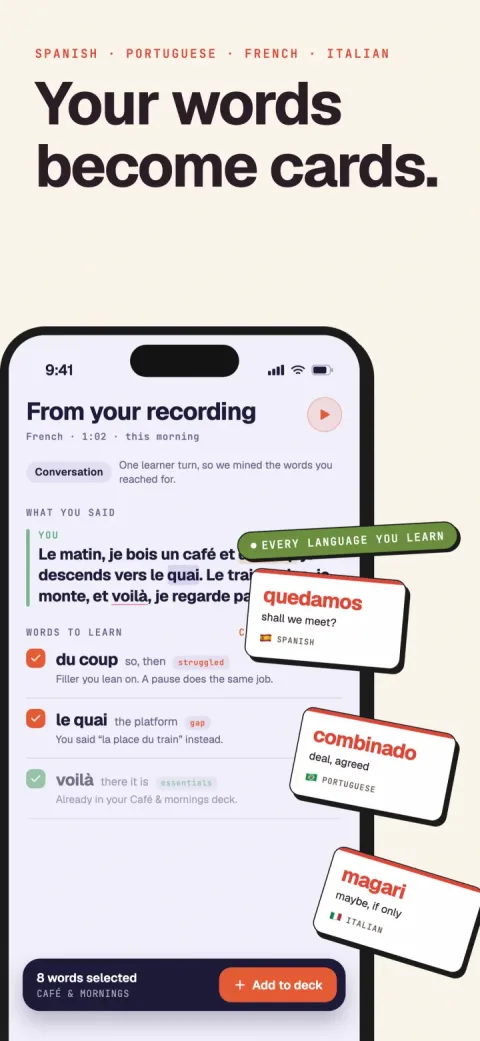
Verbamor turns the words from your own lessons and recordings into flashcards, and brings each one back before you’d forget it.

- 44 patterns
- 350 example words
- 7 groups
- Free PDF
Words you already know 24
English shares thousands of words with Italian. Learn one ending and you get the whole group.
-tion becomes -zioneFeminine, la Nation, station, information -tion becomes -zione
English words that end in -tion end in -zione in Italian. These words are feminine. Say la nazione. The plural is -zioni.
- la nazionenation
- l'informazioneinformation
- l'educazioneeducation
- la stazionestation
- la conversazioneconversation
- l'attenzioneattention
- la celebrazionecelebration
- la situazionesituation
-sion becomes -sioneFeminine, la Television, decision, version -sion becomes -sione
English words that end in -sion end in -sione. These words are feminine. Say la decisione.
- la televisionetelevision
- la decisionedecision
- la versioneversion
- l'occasioneoccasion
- la passionepassion
- la tensionetension
- la confusioneconfusion
- l'esplosioneexplosion
-ty becomes -tàFeminine, la University, city, liberty -ty becomes -tà
English words that end in -ty end in -tà. These words are feminine. The word does not change in the plural. La città. Le città.
- l'universitàuniversity
- la cittàcity
- la libertàliberty
- la societàsociety
- la realtàreality
- la qualitàquality
- l'attivitàactivity
- la possibilitàpossibility
-ly becomes -mente Finally, normally, probably -ly becomes -mente
English adverbs that end in -ly end in -mente. Take the feminine adjective. Add -mente. Rapida becomes rapidamente.
- finalmentefinally
- normalmentenormally
- probabilmenteprobably
- generalmentegenerally
- esattamenteexactly
- rapidamenterapidly
- completamentecompletely
- specialmenteespecially
All 44 patterns are open. The PDF is in your inbox.
-ous becomes -oso Famous, delicious, curious -ous becomes -oso
English adjectives that end in -ous end in -oso. Use -osa with a feminine noun. Un uomo famoso. Una donna famosa.
- famosofamous
- deliziosodelicious
- curiosocurious
- nervosonervous
- generosogenerous
- pericolosodangerous
- preziosoprecious
- misteriosomysterious
-ic becomes -ico Fantastic, romantic, electric -ic becomes -ico
English adjectives that end in -ic or -ical end in -ico. Use -ica with a feminine noun. The stress stays on the vowel before -ico. There is no written accent.
- fantasticofantastic
- romanticoromantic
- elettricoelectric
- pubblicopublic
- tipicotypical
- politicopolitical
- classicoclassic
- economicoeconomic
-al becomes -ale Animal, normal, final -al becomes -ale
English words that end in -al add an e. Normal is normale. The plural is -ali. Say normali.
- animaleanimal
- ospedalehospital
- naturalenatural
- finalefinal
- normalenormal
- totaletotal
- personalepersonal
- capitalecapital
-ist becomes -ista Artist, tourist, journalist -ist becomes -ista
English words for people that end in -ist end in -ista. The word is the same for men and women. The plural changes. Turisti for men. Turiste for women.
- artistaartist
- turistatourist
- dentistadentist
- pianistapianist
- ottimistaoptimist
- specialistaspecialist
- giornalistajournalist
- realistarealist
-ism becomes -ismoMasculine, il Tourism, optimism, realism -ism becomes -ismo
English words that end in -ism end in -ismo. These words are masculine. Say il turismo.
- il turismotourism
- l'ottimismooptimism
- il capitalismocapitalism
- il realismorealism
- l'organismoorganism
- il meccanismomechanism
- il socialismosocialism
- il giornalismojournalism
-ble becomes -bile Possible, terrible, flexible -ble becomes -bile
English adjectives that end in -ble end in -bile. Possible is possibile. The plural is -bili. Say possibili.
- possibilepossible
- terribileterrible
- responsabileresponsible
- orribilehorrible
- probabileprobable
- flessibileflexible
- visibilevisible
- incredibileincredible
-ent / -ant becomes -ente / -ante Important, student, restaurant -ent / -ant becomes -ente / -ante
English words that end in -ent or -ant add an e. Important is importante. Student is studente. The word is the same for masculine and feminine.
- importanteimportant
- presidentepresident
- studentestudent
- elefanteelephant
- ristoranterestaurant
- intelligenteintelligent
- eccellenteexcellent
- differentedifferent
-ance / -ence becomes -anza / -enzaFeminine, la Distance, experience, science -ance / -ence becomes -anza / -enza
English words that end in -ance or -ence end in -anza or -enza. These words are feminine. Say l'esperienza.
- la distanzadistance
- l'importanzaimportance
- l'esperienzaexperience
- la differenzadifference
- la pazienzapatience
- la scienzascience
- la presenzapresence
- l'eleganzaelegance
-age becomes -aggioMasculine, il Message, courage, advantage -age becomes -aggio
English words that end in -age often end in -aggio in Italian. These words are masculine. Say il viaggio. The plural is -aggi. Say i viaggi.
- il messaggiomessage
- il coraggiocourage
- il villaggiovillage
- il passaggiopassage
- il massaggiomassage
- il linguaggiolanguage
- il vantaggioadvantage
- il viaggiotrip
-or becomes -oreMasculine, il Color, error, motor -or becomes -ore
English words that end in -or add an e. Color is colore. These words are masculine. Say il colore. The plural is -ori. Say i colori.
- il colorecolor
- l'erroreerror
- il motoremotor
- il favorefavor
- l'onorehonor
- il terroreterror
- il dottoredoctor
- l'attoreactor
-ate becomes -are Celebrate, create, participate -ate becomes -are
English verbs that end in -ate often end in -are in Italian. Remove -ate. Add -are. These verbs are regular. Say io celebro.
- celebrareto celebrate
- creareto create
- partecipareto participate
- comunicareto communicate
- decorareto decorate
- separareto separate
- educareto educate
- calcolareto calculate
-ize / -ify becomes -izzare / -ificare Organize, authorize, identify -ize / -ify becomes -izzare / -ificare
English verbs that end in -ize end in -izzare. English verbs that end in -ify end in -ificare. Organize is organizzare. Identify is identificare.
- organizzareto organize
- utilizzareto utilize
- autorizzareto authorize
- modernizzareto modernize
- identificareto identify
- modificareto modify
- semplificareto simplify
- verificareto verify
-sis becomes -siFeminine, la Crisis, analysis, thesis -sis becomes -si
English words that end in -sis end in -si in Italian. These words are feminine. Say la crisi. The plural does not change. Say le crisi.
- la crisicrisis
- l'analisianalysis
- la tesithesis
- l'ipotesihypothesis
- la sintesisynthesis
- l'enfasiemphasis
- la diagnosidiagnosis
- l'oasioasis
ct / pt becomes tt Perfect, direct, October Ct / pt becomes tt
Italian does not write ct or pt. It writes tt. Perfect is perfetto. October is ottobre. September is settembre.
- perfettoperfect
- direttodirect
- contattocontact
- prodottoproduct
- insettoinsect
- attoact
- ottobreOctober
- settembreSeptember
x becomes ss Maximum, complex, toxic X becomes ss
Italian does not use x in its own words. It often writes ss. Maximum is massimo. Complex is complesso. Toxic is tossico.
- massimomaximum
- complessocomplex
- tossicotoxic
- lussoluxury
- fissofixed
- riflessoreflex
- tassatax
- sassofonosaxophone
-ology becomes -ologiaFeminine, la Biology, technology, psychology -ology becomes -ologia
English words that end in -ology end in -ologia in Italian. These words are feminine. Say la biologia. The stress is on the i.
- la biologiabiology
- la psicologiapsychology
- la tecnologiatechnology
- l'ecologiaecology
- la sociologiasociology
- l'archeologiaarchaeology
- la mitologiamythology
- l'ideologiaideology
-ary becomes -ario Necessary, vocabulary, salary -ary becomes -ario
English words that end in -ary often end in -ario. Most are masculine nouns. Say il dizionario. A few are adjectives. Necessary is necessario. Use -aria with a feminine noun. Say una cosa necessaria.
- necessarionecessary
- vocabolariovocabulary
- salariosalary
- anniversarioanniversary
- dizionariodictionary
- contrariocontrary
- itinerarioitinerary
- straordinarioextraordinary
-ive becomes -ivo Active, positive, creative -ive becomes -ivo
English adjectives that end in -ive end in -ivo. Use -iva with a feminine noun. Un uomo attivo. Una donna attiva.
- attivoactive
- positivopositive
- negativonegative
- creativocreative
- intuitivointuitive
- esclusivoexclusive
- aggressivoaggressive
- nativonative
-ure becomes -uraFeminine, la Culture, temperature, adventure -ure becomes -ura
English words that end in -ure often end in -ura. These words are feminine. Say la cultura.
- la culturaculture
- la temperaturatemperature
- la strutturastructure
- la figurafigure
- la letteraturaliterature
- l'architetturaarchitecture
- l'avventuraadventure
- l'agricolturaagriculture
ph becomes f Telephone, pharmacy, philosophy Ph becomes f
Italian has no ph. It writes f. Telephone is telefono. Italian also has no th. It writes t. Theater is teatro.
- filosofiaphilosophy
- telefonotelephone
- farmaciapharmacy
- fotografiaphotography
- frasephrase
- fisicaphysics
- alfabetoalphabet
- geografiageography
Gender and articles 8
The ending or the meaning of a word often gives its gender. Learn the group, not each word.
loMasculine, il Backpack, sugar, mirror Lo goes before s + consonant, z, gn, ps and y
Masculine words take lo before s + consonant, z, gn, ps and y. Say lo zaino and lo stadio. The plural is gli. Say gli zaini. Other masculine words take il.
- lo zainobackpack
- lo ziouncle
- lo zuccherosugar
- lo specchiomirror
- lo stadiostadium
- lo sbagliomistake
- lo yogurtyogurt
- lo psicologopsychologist
mia Mother, brother, husband One family member takes no article
Italian uses the article with my and your. Say la mia casa. One family member takes no article. Say mia madre and mio fratello. The plural takes the article again. Say i miei fratelli.
- mia madremother
- mio padrefather
- mio fratellobrother
- mia sorellasister
- mio nonnograndfather
- mia nonnagrandmother
- mio maritohusband
- mia mogliewife
il / la Italy, Brazil, Japan Countries take the article
Countries take the article. Say l'Italia and il Brasile. After in, the article drops. Say vivo in Italia. A plural name keeps it. Say negli Stati Uniti.
- l'ItaliaItaly
- la FranciaFrance
- la GermaniaGermany
- la SpagnaSpain
- il BrasileBrazil
- il GiapponeJapan
- il MessicoMexico
- gli Stati UnitiUnited States
a Florence, Venice, Naples Cities take a and no article
Cities take no article. Use a to say in or to. Say vivo a Roma. Countries take in. Say vivo in Italia. A few city names include an article. Say L'Aquila and La Spezia.
- RomaRome
- FirenzeFlorence
- VeneziaVenice
- NapoliNaples
- TorinoTurin
- LondraLondon
- ParigiParis
- BerlinoBerlin
-maMasculine, il Problem, system, climate Greek words in -ma are masculine
Most words that end in -a are feminine. Words from Greek that end in -ma are masculine. Say il problema. The plural ends in -i. Say i problemi.
- il problemaproblem
- il sistemasystem
- il tematopic
- il climaclimate
- il programmaprogram
- il poemapoem
- il drammadrama
- il diplomadiploma
a → o Apple, pear, cherry The fruit is feminine, the tree is masculine
The fruit often ends in -a and is feminine. Change -a to -o for the tree. The tree is masculine. La mela grows on il melo. Il limone and il fico name the fruit and the tree.
- la mela · il meloapple
- la pera · il peropear
- l'arancia · l'arancioorange
- la ciliegia · il ciliegiocherry
- l'oliva · l'olivoolive
- la banana · il bananobanana
- la pesca · il pescopeach
- la castagna · il castagnochestnut
la Head, leg, foot Body parts take the article, not my
Italian uses the article with parts of the body. It does not use my or your. Say mi fa male la testa. Say mi lavo le mani.
- la testahead
- la gambaleg
- il piedefoot
- l'occhioeye
- la boccamouth
- la schienaback
- lo stomacostomach
- il nasonose
il Monday, Friday, Sunday Il lunedì means each Monday
Days are masculine. Only la domenica is feminine. Lunedì with no article means this Monday. Il lunedì means each Monday. Write days with a small letter.
- il lunedìMonday
- il martedìTuesday
- il mercoledìWednesday
- il giovedìThursday
- il venerdìFriday
- il sabatoSaturday
- la domenicaSunday
Exceptions 3
These common words break the rules. Learn each set together.
≠ Hand, radio, cinema Words that break the -o and -a rule
Words that end in -o are usually masculine. Words that end in -a are usually feminine. These common words break the rule. Foto, moto and auto are short forms. Their plural does not change. The plural of la mano is le mani.
- la manohand
- la radioradio
- la fotophoto
- la motomotorcycle
- l'auto (f)car
- il cinemacinema
- il papapope
- il pianetaplanet
o → a Arm, finger, egg A masculine word with a feminine plural
Some masculine words have a feminine plural that ends in -a. Il braccio becomes le braccia. Many are parts of the body. L'uovo becomes le uova.
- il braccio becomes le bracciaarm
- il dito becomes le ditafinger
- l'uovo becomes le uovaegg
- il ginocchio becomes le ginocchiaknee
- il labbro becomes le labbralip
- l'osso becomes le ossabone
- il paio becomes le paiapair
- il lenzuolo becomes le lenzuolabed sheet
≈ Soft, room, hot Words that look like English but are not
Most look-alike words mean the same in English. These do not. Camera means room, not camera. Learn the real meaning of each one.
- morbidosoftnot morbid
- cameraroomnot camera
- parentirelativesnot parents
- caldohotnot cold
- fattoriafarmnot factory
- noiosoboringnot noisy
- educatopolitenot educated
- argomentotopicnot argument
Plurals and other rules 1
One small rule changes many words.
= Coffee, bar, film Words that do not change in the plural
Words that end in a stressed vowel do not change in the plural. Say il caffè and i caffè. Foreign words that end in a consonant do not change. Say il bar and i bar. Only the article changes.
- il caffè becomes i caffècoffee
- il tè becomes i tètea
- il bar becomes i barbar
- il film becomes i filmfilm
- lo sport becomes gli sportsport
- il computer becomes i computercomputer
- il tram becomes i tramtram
- l'hotel becomes gli hotelhotel
Word building 3
Add a small part to a word you know. You get a new word.
-eriaFeminine, la Pizzeria, ice cream shop, bookshop Add -eria for the shop
Add -eria to a thing to name the shop that sells it. Gelato becomes gelateria. These words are feminine. A libreria is a bookshop, not a library.
- la pizza becomes la pizzeriapizzeria
- il gelato becomes la gelateriaice cream shop
- il libro becomes la libreriabookshop
- la birra becomes la birreriabeer hall
- il pesce becomes la pescheriafish shop
- il profumo becomes la profumeriaperfume shop
- il gioiello becomes la gioielleriajewelry shop
- il pane becomes la panetteriabakery
-toreMasculine, il Writer, player, winner -tore names the person who does it
The ending -tore names the person who does it. Giocare becomes giocatore. These words are masculine. Use -trice for a woman. Say la scrittrice.
- lo scrittorewriter
- il pittorepainter
- il direttoredirector
- l'autoreauthor
- il lettorereader
- il giocatoreplayer
- il lavoratoreworker
- il vincitorewinner
s- Unlucky, unknown, uncomfortable S- makes the opposite
Add s- to the start of a word to make the opposite. Fortunato becomes sfortunato. Comodo becomes scomodo. Coprire is to cover. Scoprire is to discover.
- fortunato becomes sfortunatounlucky
- comodo becomes scomodouncomfortable
- conosciuto becomes sconosciutounknown
- piacevole becomes spiacevoleunpleasant
- corretto becomes scorrettoincorrect
- contento becomes scontentounhappy
- coprire becomes scoprireto discover
- caricare becomes scaricareto download
Verbs 4
Each set of verbs behaves in one way. Learn the set together.
mi Like, miss, need The thing you like is the subject
Piacere means to be pleasing. The thing you like is the subject. Say mi piace il caffè. Use piacciono for many things. Say mi piacciono i libri. These verbs work the same way.
- piacere becomes mi piaceto like
- mancare becomes mi mancato miss
- servire becomes mi serveto need
- sembrare becomes mi sembrato seem
- interessare becomes mi interessato interest
- bastare becomes mi bastato be enough
- dispiacere becomes mi dispiaceto be sorry
- importare becomes mi importato matter
io -go Come, stay, choose The io form ends in -go
Some common verbs end in -go in the io form. Venire becomes vengo. The loro form does the same. Say vengono. The noi and voi forms are regular.
- venire becomes vengoto come
- tenere becomes tengoto hold
- rimanere becomes rimangoto stay
- salire becomes salgoto go up
- scegliere becomes scelgoto choose
- togliere becomes tolgoto remove
- spegnere becomes spengoto turn off
essere Go, arrive, leave Verbs that take essere in the past
Most verbs use avere for the past. Say ho mangiato. Verbs of movement and change use essere. Say sono andato. A woman says sono andata.
- andare becomes sono andatoto go
- arrivare becomes sono arrivatoto arrive
- partire becomes sono partitoto leave
- entrare becomes sono entratoto enter
- uscire becomes sono uscitoto go out
- restare becomes sono restatoto stay
- cadere becomes sono cadutoto fall
- tornare becomes sono tornatoto return
ho… Done, said, written Past forms that break the rule
Most past forms end in -ato, -uto or -ito. Parlare becomes parlato. These common verbs break the rule. Fare becomes fatto. Say ho fatto for I have done.
- fare becomes fattodone
- dire becomes dettosaid
- scrivere becomes scrittowritten
- vedere becomes vistoseen
- prendere becomes presotaken
- mettere becomes messoput
- aprire becomes apertoopened
- chiudere becomes chiusoclosed
Pronunciation 1
Some letters do not sound the way an English reader expects.
c ch Bruschetta, gnocchi, focaccia Ch is hard, c before e and i is soft
C before e or i sounds like ch in cheese. Say CHEH-na for cena. Ch always sounds like k. Say broo-SKET-ta for bruschetta. Gn sounds like ny in canyon.
- bruschettabruschettabroo-SKET-ta
- gnocchignocchiNYOK-kee
- ciabattaciabattacha-BAT-ta
- pistacchiopistachiopee-STAK-kyo
- focacciafocacciafo-KAT-cha
- radicchioradicchiora-DEEK-kyo
- chiavekeyKYA-veh
- cenadinnerCHEH-na
How to use these patterns
Read one pattern a day. Say the example words out loud. Then look for that pattern in what you read and hear that week. A pattern you notice three times in real Italian stays with you. Soon you hear those words in speech and use them in your own sentences.
Start with the first group, words you already know. Those 24 patterns turn English words you use every day into Italian ones. The gender group comes next. It tells you il or la before you look the word up.
The same kind of list exists for Spanish, French, Portuguese and Russian, each with its own free PDF.
A pattern is a guide, and every guide has exceptions. The exceptions group lists the common ones, like la mano. When a word you made from a pattern sounds wrong, check it.
Patterns cover the words you can work out. For the words you can't, the cognate checker marks the false friends that look like English and mean something else.
Questions people ask
What is a Italian word pattern?
A rule that changes many words at once. English words that end in -tion end in -zione in Italian. These words are feminine. When you know that rule, you know la nazione, l'informazione and l'educazione before anyone teaches them to you.
Do the patterns always work?
Most of the time, and each pattern says where it stops. The exceptions group lists common words that break the rules, like la mano. The false friends pattern lists words that look like English and mean something else, like morbido, which means soft.
Is this the same as the Word patterns screen in Verbamor?
Yes. These are the same 44 Italian patterns. In the app you can pick any example word and save it as a flashcard with a picture, an example sentence and audio.
What do I get by email?
A printable PDF with all 44 patterns and 350 example words, and my post-lesson debrief handbook. Then a few short emails. You can unsubscribe at any time.
Turn a pattern into words you can say.
Open Word patterns in Verbamor, pick the words you want, and save them. Each card gets a picture, an example sentence and audio, and comes back just before you forget it, so the word is there when you need it in a conversation.
Start 7 days freeThe 7-day free trial is on the yearly plan.
More free tools
All 8-
How many Spanish words do you know? Tick the words you know from a frequency-banded sample. Fake words catch the guessing.
-
How much of a text do you already know? Paste any text and see what share of it sits inside the first 1,000 to 5,000 words.
-
The forgetting curve, drawn properly Put in the days since your last review and see how much of a word is left, on the real FSRS-6 curve.
-
What do 20 new cards a day cost you? Project your daily reviews for two years from a new-card rate and a retention target.
-
Cognate checker Type an English word, see its likely relatives in four languages, and get warned about false friends.
-
What a tutored word really costs Your lesson price divided by the words you still have next week, with the arithmetic in full.
-
Count the hours a term abroad buys The hours a semester abroad really adds, next to what the same money buys in tutoring.
- All 8 free tools Every tool on one page, plus the free debrief sheet.