 Verbamor
Spanish for talking to your grandparents
- 138 phrases
- 138 real examples
- 12 topics
- 1 free PDF
Start with « ¡hola, abuelita! » and « ¿cómo estás? », then ask « ¿cómo era cuando eras joven? » and listen. Below are 138 Spanish phrases for talking to grandparents, from the phone call before you visit to the goodbye hug.
Your Spanish for your grandparents guide is ready
Save it to your phone so it's there when you need it.
Before you go 11
Calling ahead, by phone or video.
| # | Phrase | Meaning | Example | When to use |
|---|---|---|---|---|
| 1 | ¿Bueno? | Hello? (answering the phone in Mexico) | ¿Bueno? Abuelita, soy yo, Daniel. Hello? Grandma, it's me, Daniel. | Regional Mexico's phone hello. Elsewhere you'll hear aló, ¿diga? or ¿sí? |
| 2 | Abuelita, soy yo. | Grandma, it's me. | Abuelita, soy yo, tu nieta Sofía. Grandma, it's me, your granddaughter Sofía. | Everyday |
| 3 | ¿Cómo amaneciste? | How did you wake up today? (how are you this morning) | Buenos días, abuelo, ¿cómo amaneciste? Good morning, Grandpa, how are you this morning? | Everyday Warm and caring, common in Mexico, Colombia and Central America. |
| 4 | Te llamo el domingo. | I'll call you on Sunday. | Te llamo el domingo después de misa. I'll call you on Sunday after Mass. | Everyday |
| 5 | ¿Puedo pasar a verte? | Can I come by and see you? | ¿Puedo pasar a verte el sábado? Can I come see you on Saturday? | Everyday |
| 6 | ¿Necesitas algo? | Do you need anything? | Voy para allá, ¿necesitas algo de la tienda? I'm on my way, do you need anything from the store? | Everyday |
| 7 | Ya voy para allá. | I'm on my way. | Ya voy para allá, llego en media hora. I'm on my way, I'll be there in half an hour. | Everyday |
| 8 | ¿Me oyes bien? | Can you hear me OK? | Abuela, ¿me oyes bien? Te subo el volumen. Grandma, can you hear me OK? I'll turn up the volume. | Everyday Speak slowly and a bit louder on the phone. |
| 9 | ¿Te hablo por videollamada? | Shall I video call you? | ¿Te hablo por videollamada para que veas a los niños? Shall I video call so you can see the kids? | Everyday |
| 10 | ¿Le hablo de usted o de tú? | Should I use usted or tú with them? | Mamá, ¿a la abuela le hablo de usted? Mom, do I use usted with Grandma? | Everyday In some families, and in rural Mexico, Colombia and Central America, kids use usted with grandparents. Ask your parents. |
| 11 | Te extraño mucho. | I miss you a lot. | Te extraño mucho, abuelita. Ya quiero verte. I miss you so much, Grandma. I can't wait to see you. | Everyday In Spain you'll hear « te echo de menos ». |
Greetings 11
The first hug at the door.
| # | Phrase | Meaning | Example | When to use |
|---|---|---|---|---|
| 12 | ¡Hola, abuelita! | Hi, Grandma! | ¡Hola, abuelita! ¿Cómo estás? Hi, Grandma! How are you? | Everyday Abuelita and abuelito sound loving at any age. |
| 13 | Bendición, abuela. | Bless me, Grandma. | Bendición, abuela. Dios te bendiga, mi amor. Bless me, Grandma. God bless you, my love. | Regional A greeting in Puerto Rico, the Dominican Republic and Venezuela. Say it when you arrive and leave. |
| 14 | Dios te bendiga. | God bless you. | Dios te bendiga, mijo. God bless you, son. | Everyday What your grandparents will say. Answer « amén » or « igualmente ». |
| 15 | ¡Qué gusto verte! | So good to see you! | ¡Qué gusto verte, abuelo! So good to see you, Grandpa! | Everyday |
| 16 | Dame un abrazo. | Give me a hug. | Ven acá, dame un abrazo. Come here, give me a hug. | Everyday |
| 17 | Te extrañé mucho. | I missed you so much. | Te extrañé mucho este año. I missed you so much this year. | Everyday |
| 18 | ¡Qué grande estás! | Look how big you are! | ¡Mijo, qué grande estás! Ya estás más alto que yo. Son, look how big you are! You're taller than me now. | Everyday What they'll say. Smile and hug them. |
| 19 | ¿Cómo has estado? | How have you been? | ¿Cómo has estado, abuela? ¿Te sientes bien? How have you been, Grandma? Are you feeling OK? | Everyday |
| 20 | Te traje algo. | I brought you something. | Te traje pan dulce de la panadería que te gusta. I brought you sweet bread from the bakery you like. | Everyday |
| 21 | Estás muy guapa, abuela. | You look lovely, Grandma. | Estás muy guapa, ¿te pintaste el pelo? You look lovely, did you color your hair? | Everyday |
| 22 | ¿Y el abuelo? | And where's Grandpa? | ¿Y el abuelo? ¿Está en el patio? And where's Grandpa? Is he in the yard? | Everyday |
At the table 12
Cooking together, and eating more than you planned.
| # | Phrase | Meaning | Example | When to use |
|---|---|---|---|---|
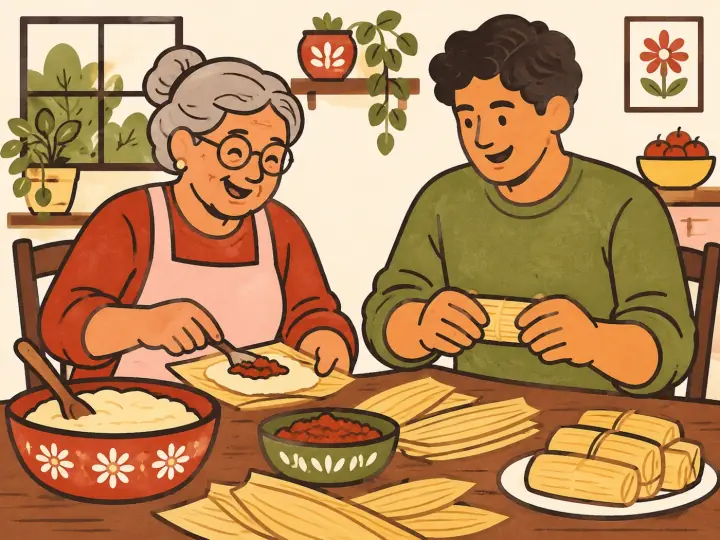
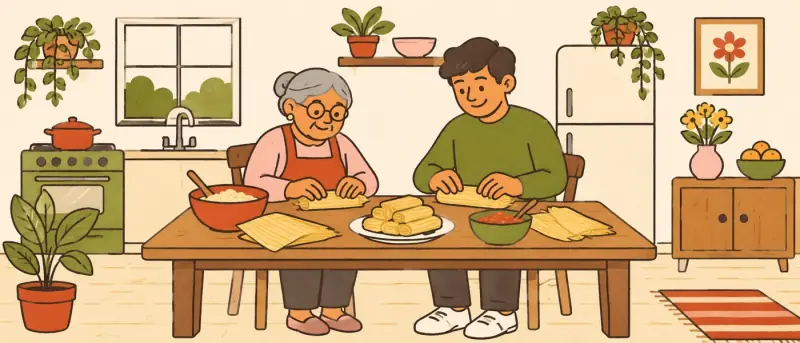
| 23 | ¿Me enseñas a hacer tamales? | Will you teach me to make tamales? | Abuela, ¿me enseñas a hacer tus tamales? Grandma, will you teach me to make your tamales? | Everyday Swap in any dish: arepas, pupusas, flan, arroz con gandules. This question opens hearts. |
| 24 | ¿Cuál es el secreto? | What's the secret? | ¿Cuál es el secreto de tu salsa? What's the secret to your salsa? | Everyday |
| 25 | ¿Cuánto le pones de sal? | How much salt do you put in? | ¿Cuánto le pones de sal? ¿Una cucharada? How much salt do you put in? A spoonful? | Everyday Expect « lo que agarres con los dedos ». Watch her hands and take notes. |
| 26 | ¿Así está bien? | Is this right? | ¿Así está bien la masa o le falta agua? Is the dough right like this, or does it need water? | Everyday |
| 27 | Huele igualito que cuando era niño. | It smells just like when I was a kid. | Huele igualito que cuando era niña, abuela. It smells just like when I was little, Grandma. | Everyday Niña if you're a woman. |
| 28 | Nadie cocina como tú. | No one cooks like you. | Nadie cocina como tú, abuelita. No one cooks like you, Grandma. | Everyday |
| 29 | ¿Me lo escribes? | Will you write it down for me? | ¿Me escribes la receta en un papelito? Will you write the recipe on a scrap of paper for me? | Everyday A recipe in her handwriting becomes a family treasure. |
| 30 | ¿Te grabo mientras cocinas? | Can I film you while you cook? | ¿Te grabo mientras haces el mole? Para no olvidarlo. Can I film you making the mole? So I don't forget it. | Everyday |
| 31 | ¡Qué rico, abuela! | So tasty, Grandma! | ¡Qué rico, abuela! Igualito al de siempre. So tasty, Grandma! Just like always. | Everyday |
| 32 | Un poquito más, por favor. | A little more, please. | Un poquito más de arroz, por favor. A little more rice, please. | Everyday |
| 33 | Ya no puedo más. | I can't eat any more. | Ya no puedo más, abuela, de verdad. I really can't eat any more, Grandma. | Everyday She'll serve you more anyway. That's love. |
| 34 | Come, come, que estás muy flaco. | Eat, eat, you're too thin. | Come, mija, que estás muy flaca. Eat, sweetheart, you're too thin. | Everyday What they'll say. You'll hear it at every meal. |
Compliments 11
Say what you feel. They'll treasure it.
| # | Phrase | Meaning | Example | When to use |
|---|---|---|---|---|
| 35 | Te ves muy bien. | You look really well. | Te ves muy bien, abuelo, muy fuerte. You look really well, Grandpa, very strong. | Everyday |
| 36 | Eres la mejor abuela del mundo. | You're the best grandma in the world. | Eres la mejor abuela del mundo, ¿lo sabías? You're the best grandma in the world, did you know that? | Everyday |
| 37 | Te quiero mucho. | I love you very much. | Te quiero mucho, abuelita. I love you so much, Grandma. | Everyday The everyday family « I love you ». Te amo works too, it's just stronger. |
| 38 | Tienes unas manos de oro. | You have golden hands. | Tienes unas manos de oro para la costura. You're so gifted at sewing. | Everyday |
| 39 | Qué bonita casa tienes. | What a lovely home you have. | Qué bonita tienes la casa, con tantas plantas. Your house looks so lovely, with all these plants. | Everyday |
| 40 | Qué bonitas tus plantas. | Your plants are beautiful. | Qué bonitas tus plantas, ¿cómo las cuidas? Your plants are beautiful, how do you look after them? | Everyday |
| 41 | Me encanta escucharte. | I love listening to you. | Me encanta escucharte contar historias. I love hearing you tell stories. | Everyday |
| 42 | Eres muy sabia. | You're very wise. | Eres muy sabia, abuela, gracias por el consejo. You're very wise, Grandma, thanks for the advice. | Everyday Sabio for a grandfather. |
| 43 | Te pareces a mi mamá. | You look like my mom. | En esta foto te pareces mucho a mi mamá. In this photo you look a lot like my mom. | Everyday |
| 44 | Gracias por todo lo que hiciste por nosotros. | Thank you for everything you did for us. | Gracias por todo lo que hiciste por la familia. Thank you for everything you did for the family. | Everyday Say it while you can. They'll remember it. |
| 45 | Estoy orgulloso de ti. | I'm proud of you. | Estoy orgullosa de ti, abuelo. I'm proud of you, Grandpa. | Everyday Orgullosa if you're a woman. |
Asking about the old days 12
Ask, then listen. These stories won't wait.
| # | Phrase | Meaning | Example | When to use |
|---|---|---|---|---|
| 46 | ¿Cómo era cuando eras joven? | What was it like when you were young? | Abuela, ¿cómo era el pueblo cuando eras joven? Grandma, what was the town like when you were young? | Everyday The best question on this page. Then just listen. |
| 47 | ¿Dónde naciste? | Where were you born? | ¿Dónde naciste, abuelo? ¿En el rancho? Where were you born, Grandpa? On the ranch? | Everyday |
| 48 | ¿Cómo conociste al abuelo? | How did you meet Grandpa? | ¿Cómo conociste al abuelo? ¿Fue en un baile? How did you meet Grandpa? Was it at a dance? | Everyday |
| 49 | ¿Cómo era tu mamá? | What was your mother like? | ¿Cómo era tu mamá? ¿Era estricta? What was your mother like? Was she strict? | Everyday |
| 50 | ¿Qué hacían para divertirse? | What did you do for fun? | ¿Qué hacían para divertirse sin tele? What did you do for fun without TV? | Everyday |
| 51 | ¿Por qué se vinieron para acá? | Why did you come here? | ¿Por qué se vinieron para Estados Unidos? Why did you all come to the United States? | Everyday A big question for many families. Ask gently and let them choose how much to tell. |
| 52 | ¿Qué extrañas de tu tierra? | What do you miss about back home? | ¿Qué es lo que más extrañas de tu tierra? What do you miss most about back home? | Everyday Tierra here means homeland. It's a word full of feeling. |
| 53 | ¿Tienes fotos de cuando eras niña? | Do you have photos from when you were a girl? | ¿Tienes fotos de cuando eras niña? Me encantaría verlas. Do you have photos from when you were little? I'd love to see them. | Everyday |
| 54 | ¿A qué jugabas de niño? | What did you play as a kid? | ¿A qué jugabas de niño, abuelo? What did you play as a kid, Grandpa? | Everyday |
| 55 | ¿Cómo era mi papá de niño? | What was my dad like as a kid? | ¿Cómo era mi papá de niño? ¿Era travieso? What was my dad like as a kid? Was he naughty? | Everyday Grandparents love this one. Expect stories your dad never told you. |
| 56 | Cuéntame más. | Tell me more. | ¿De verdad? Cuéntame más. Really? Tell me more. | Everyday |
| 57 | En mis tiempos... | In my day... | En mis tiempos no había celulares. In my day there were no cell phones. | Everyday What they'll say. Settle in for a story. |
Their health 11
Caring questions, gently asked.
| # | Phrase | Meaning | Example | When to use |
|---|---|---|---|---|
| 58 | ¿Cómo te sientes? | How are you feeling? | ¿Cómo te sientes hoy, abuela? How are you feeling today, Grandma? | Everyday |
| 59 | ¿Te duele algo? | Does anything hurt? | ¿Te duele algo? ¿La rodilla otra vez? Does anything hurt? Your knee again? | Everyday |
| 60 | ¿Ya te tomaste la pastilla? | Have you taken your pill? | ¿Ya te tomaste la pastilla de la presión? Have you taken your blood pressure pill? | Everyday La presión is blood pressure. La azúcar or el azúcar is often how families say diabetes. |
| 61 | ¿Cómo te fue con el doctor? | How did it go at the doctor's? | ¿Cómo te fue con el doctor ayer? How did it go at the doctor's yesterday? | Everyday |
| 62 | ¿Estás durmiendo bien? | Are you sleeping well? | ¿Estás durmiendo bien, abuelo? Are you sleeping well, Grandpa? | Everyday |
| 63 | Cuídate mucho. | Take good care of yourself. | Cuídate mucho y abrígate. Take good care of yourself and wrap up warm. | Everyday |
| 64 | ¿Quieres que te acompañe al médico? | Do you want me to go to the doctor with you? | ¿Quieres que te acompañe al médico el martes? Do you want me to come to the doctor with you on Tuesday? | Everyday You can translate for them. That help means a lot. |
| 65 | Siéntate, descansa. | Sit down, rest. | Siéntate, descansa, yo lo hago. Sit down, rest, I'll do it. | Everyday |
| 66 | ¿Tomaste suficiente agua? | Have you had enough water? | Hace calor, ¿tomaste suficiente agua? It's hot, have you drunk enough water? | Everyday |
| 67 | Que te mejores pronto. | Get well soon. | Que te mejores pronto, abuelita. Get well soon, Grandma. | Everyday |
| 68 | Ya estoy viejo. | I'm old now. | Ay, mija, ya estoy viejo. Oh, sweetheart, I'm old now. | Everyday What they'll say. « Estás joven todavía » is the loving reply. |
Saying you're learning 12
Tell them why. It changes the whole visit.
| # | Phrase | Meaning | Example | When to use |
|---|---|---|---|---|
| 69 | Estoy aprendiendo español. | I'm learning Spanish. | Estoy aprendiendo español para hablar contigo. I'm learning Spanish so I can talk with you. | Everyday Say why. It will move them. |
| 70 | Perdón, mi español no es muy bueno. | Sorry, my Spanish isn't very good. | Perdón, abuela, mi español no es muy bueno todavía. Sorry, Grandma, my Spanish isn't very good yet. | Everyday |
| 71 | Lo entiendo mejor de lo que lo hablo. | I understand it better than I speak it. | Lo entiendo casi todo, pero me cuesta hablarlo. I understand almost everything, but speaking is hard for me. | Everyday True for most heritage learners. Saying it explains the silences. |
| 72 | ¿Me lo repites más despacio? | Can you say it again more slowly? | ¿Me lo repites más despacio, por favor? Can you say that again more slowly, please? | Everyday |
| 73 | ¿Cómo se dice...? | How do you say...? | ¿Cómo se dice « grateful » en español? How do you say "grateful" in Spanish? | Everyday |
| 74 | ¿Qué quiere decir...? | What does... mean? | ¿Qué quiere decir « ahorita »? What does "ahorita" mean? | Everyday |
| 75 | Corrígeme, por favor. | Please correct me. | Si me equivoco, corrígeme, por favor. If I make a mistake, please correct me. | Everyday |
| 76 | ¿Así se dice? | Is that how you say it? | ¿Se dice « la agua » o « el agua »? Is it "la agua" or "el agua"? | Everyday |
| 77 | Quiero hablar como tú. | I want to speak like you. | Quiero hablar español como tú, abuelo. I want to speak Spanish like you, Grandpa. | Everyday |
| 78 | Mi mamá no me lo enseñó de chiquito. | My mom didn't teach me it as a kid. | Mi mamá no me enseñó mucho español de niño. My mom didn't teach me much Spanish when I was little. | Everyday Many families made that choice for good reasons. Say it without blame. |
| 79 | Ten paciencia conmigo. | Be patient with me. | Ten paciencia conmigo, estoy practicando. Be patient with me, I'm practicing. | Everyday |
| 80 | Háblame en español. | Speak to me in Spanish. | No me hables en inglés, háblame en español. Don't speak English to me, speak Spanish. | Everyday Grandparents often switch to English to help. Ask them not to. |
Questions they'll ask you 11
The example is a sample answer you can copy.
| # | Phrase | Meaning | Example | When to use |
|---|---|---|---|---|
| 81 | ¿Ya comiste? | Have you eaten yet? | Todavía no, abuela. ¿Qué hiciste? Not yet, Grandma. What did you make? | Everyday The example is your answer. This question is how grandparents say I love you. |
| 82 | ¿Cómo te va en la escuela? | How's school going? | Bien, abuela, saqué buenas notas. Good, Grandma, I got good grades. | Everyday |
| 83 | ¿Y el trabajo? | And how's work? | Todo bien, ahora trabajo en un hospital. All good, I work at a hospital now. | Everyday |
| 84 | ¿Tienes novio? | Do you have a boyfriend? | Todavía no, abuela, estoy tranquila. Not yet, Grandma, I'm taking it easy. | Everyday Novia for a girlfriend. Expect follow-up questions. |
| 85 | ¿Y cuándo te casas? | So when are you getting married? | ¡Ay, abuela, con calma! Oh, Grandma, no rush! | Everyday Asked lovingly, and often. A laugh works. |
| 86 | ¿Por qué no hablas español? | Why don't you speak Spanish? | Lo estoy aprendiendo, para hablar contigo. I'm learning it, so I can talk with you. | Everyday |
| 87 | ¿Te acuerdas de...? | Do you remember...? | ¿Te acuerdas de tu tía Lupe? Sí, la de los tamales. Do you remember your aunt Lupe? Yes, the one with the tamales. | Everyday |
| 88 | ¿Vas a misa? | Do you go to Mass? | A veces, abuela. En Navidad seguro. Sometimes, Grandma. At Christmas for sure. | Everyday |
| 89 | ¿Estás comiendo bien? | Are you eating properly? | Sí, abuela, pero nada como tu comida. Yes, Grandma, but nothing beats your cooking. | Everyday |
| 90 | ¿Cuándo vienes otra vez? | When are you coming again? | Pronto, abuelita, te lo prometo. Soon, Grandma, I promise. | Everyday |
| 91 | ¿Y tu mamá, cómo está? | And how's your mom? | Está bien, te manda muchos besos. She's fine, she sends you lots of kisses. | Everyday |
Helping out 11
Small jobs that mean a lot.
| # | Phrase | Meaning | Example | When to use |
|---|---|---|---|---|
| 92 | ¿Te ayudo? | Can I help you? | ¿Te ayudo con eso, abuelo? Can I help you with that, Grandpa? | Everyday |
| 93 | Déjame, yo lo hago. | Let me, I'll do it. | Déjame, yo lavo los trastes. Let me, I'll wash the dishes. | Everyday Trastes is the dishes in Mexico and Central America. In Spain, los platos. |
| 94 | ¿Te bajo eso? | Shall I get that down for you? | ¿Te bajo la olla grande? Shall I get the big pot down for you? | Everyday |
| 95 | ¿Te arreglo el celular? | Shall I fix your phone? | ¿Te arreglo el celular para que se vean más grandes las letras? Shall I set up your phone so the letters look bigger? | Everyday The help every grandparent needs. |
| 96 | Te enseño a mandar fotos. | I'll show you how to send photos. | Mira, te enseño a mandar fotos por WhatsApp. Look, I'll show you how to send photos on WhatsApp. | Everyday |
| 97 | ¿Necesitas que te lleve a algún lado? | Do you need a ride anywhere? | ¿Necesitas que te lleve al súper? Do you need a ride to the supermarket? | Everyday |
| 98 | Yo cargo las bolsas. | I'll carry the bags. | Tú no cargues nada, yo cargo las bolsas. Don't carry anything, I'll take the bags. | Everyday |
| 99 | ¿Dónde guardas esto? | Where do you keep this? | ¿Dónde guardas las tazas? Where do you keep the cups? | Everyday |
| 100 | ¿Riego las plantas? | Shall I water the plants? | ¿Riego las plantas del patio? Shall I water the plants in the yard? | Everyday |
| 101 | No te preocupes. | Don't worry. | No te preocupes, abuela, ya está todo. Don't worry, Grandma, it's all done. | Everyday |
| 102 | Para eso estoy. | That's what I'm here for. | Gracias, mijo. Para eso estoy, abuela. Thanks, son. That's what I'm here for, Grandma. | Everyday |
Holidays and family events 12
Birthdays, Christmas and remembering those who are gone.
| # | Phrase | Meaning | Example | When to use |
|---|---|---|---|---|
| 103 | ¡Feliz cumpleaños, abuela! | Happy birthday, Grandma! | ¡Feliz cumpleaños, abuela! Que cumplas muchos más. Happy birthday, Grandma! Many more to come. | Everyday |
| 104 | Las mañanitas | the Mexican birthday song | Le cantamos las mañanitas al abuelo a las siete. We sang Las mañanitas to Grandpa at seven in the morning. | Regional Learn the first verse. Singing it will make their year. |
| 105 | ¡Feliz Navidad! | Merry Christmas! | ¡Feliz Navidad, abuelitos! Merry Christmas, Grandma and Grandpa! | Everyday |
| 106 | la Nochebuena | Christmas Eve, and its big dinner | En Nochebuena cenamos todos en tu casa. On Christmas Eve we all have dinner at your house. | Everyday |
| 107 | ¿Hacemos tamales para Navidad? | Shall we make tamales for Christmas? | ¿Hacemos tamales para Navidad, como antes? Shall we make tamales for Christmas, like we used to? | Everyday The tamalada is a family event. Ask to be part of it. |
| 108 | ¡Feliz Día de las Madres! | Happy Mother's Day! | ¡Feliz Día de las Madres, abuelita! Happy Mother's Day, Grandma! | Everyday Wish it to your grandmother too. In Mexico it's May 10. |
| 109 | el Día de Muertos | the Day of the Dead (November 1 and 2) | ¿Me ayudas a poner la ofrenda para el bisabuelo? Will you help me set up the altar for great-grandpa? | Regional A time to ask about relatives who have died. Grandparents love to tell their stories. |
| 110 | la ofrenda | a home altar for family who have died | En la ofrenda ponemos su comida favorita. We put their favorite food on the altar. | Everyday |
| 111 | ¡Feliz aniversario! | Happy anniversary! | ¡Feliz aniversario! ¡Cincuenta años juntos! Happy anniversary! Fifty years together! | Everyday |
| 112 | ¡Felicidades! | Congratulations! Happy birthday! | ¡Felicidades, abuelo, en tu santo! Congratulations, Grandpa, on your saint's day! | Everyday |
| 113 | Que Dios te dé muchos años más. | May God give you many more years. | Que Dios te dé muchos años más, abuelita. May God give you many more years, Grandma. | Everyday |
| 114 | Lo siento mucho. | I'm so sorry. | Lo siento mucho, abuela. Era un gran hombre. I'm so sorry, Grandma. He was a great man. | Everyday |
Saying goodbye 11
Leaving with a blessing.
| # | Phrase | Meaning | Example | When to use |
|---|---|---|---|---|
| 115 | Ya me tengo que ir. | I have to go now. | Ya me tengo que ir, abuela, pero vuelvo pronto. I have to go now, Grandma, but I'll be back soon. | Everyday |
| 116 | Gracias por todo, abuelita. | Thanks for everything, Grandma. | Gracias por todo, abuelita, estuvo riquísimo. Thanks for everything, Grandma, it was delicious. | Everyday |
| 117 | Me dio mucho gusto verte. | It was so good to see you. | Me dio mucho gusto verte, abuelito. It was so good to see you, Grandpa. | Everyday |
| 118 | La bendición. | Your blessing, please. | Ya me voy, abuela. La bendición. I'm off, Grandma. Bless me. | Regional In the Caribbean and Venezuela, ask for it as you leave. |
| 119 | Que Dios te acompañe. | May God go with you. | Ve con cuidado, mija, que Dios te acompañe. Drive safe, sweetheart, God be with you. | Everyday What they'll say. « Amén, abuela » is a fine reply. |
| 120 | Te llamo cuando llegue. | I'll call you when I get home. | Te llamo cuando llegue a la casa. I'll call you when I get home. | Everyday |
| 121 | Vuelvo pronto. | I'll be back soon. | Vuelvo pronto, te lo prometo. I'll be back soon, I promise. | Everyday |
| 122 | Llévate esto. | Take this with you. | Llévate esto para la cena, mija. Take this for dinner, sweetheart. | Everyday What they'll say. Leftovers are love. Take them. |
| 123 | Un besito. | A little kiss. | Dame un besito antes de irte. Give me a little kiss before you go. | Everyday |
| 124 | Saluda a tu mamá de mi parte. | Say hi to your mom for me. | Saluda a tu mamá de mi parte, ¿eh? Say hi to your mom for me, OK? | Everyday |
| 125 | Nos vemos el domingo. | See you on Sunday. | Nos vemos el domingo, abuelito. See you on Sunday, Grandpa. | Everyday |
Family words 13
The words for everyone on the family tree.
| # | Phrase | Meaning | Example | When to use |
|---|---|---|---|---|
| 126 | el abuelo / la abuela | grandfather / grandmother | Mi abuela es de Oaxaca. My grandmother is from Oaxaca. | Everyday |
| 127 | el abuelito / la abuelita | grandpa / grandma (loving) | La abuelita hace las mejores tortillas. Grandma makes the best tortillas. | Everyday |
| 128 | los abuelos | grandparents | Los domingos comemos con los abuelos. On Sundays we eat with the grandparents. | Everyday |
| 129 | el bisabuelo / la bisabuela | great-grandfather / great-grandmother | Mi bisabuelo llegó de España en 1920. My great-grandfather came from Spain in 1920. | Everyday |
| 130 | el nieto / la nieta | grandson / granddaughter | Soy su nieta mayor. I'm her oldest granddaughter. | Everyday |
| 131 | mijo / mija | son / daughter, sweetheart (from mi hijo, mi hija) | Ven acá, mija. Come here, sweetheart. | Everyday What grandparents call you, even when you're 40. |
| 132 | el tío abuelo / la tía abuela | great-uncle / great-aunt | Mi tía abuela vive en el rancho. My great-aunt lives on the ranch. | Everyday |
| 133 | los primos segundos | second cousins | En la boda conocí a mis primos segundos. I met my second cousins at the wedding. | Everyday |
| 134 | el padrino / la madrina | godfather / godmother | Mi abuelo es mi padrino de bautizo. My grandfather is my godfather. | Everyday |
| 135 | Mamá Lupe / Papá Chema | grandma / grandpa with a first name | Vamos a ver a Mamá Lupe. Let's go see Grandma Lupe. | Everyday Many families say mamá or papá plus a name for grandparents. Use what your family uses. |
| 136 | la familia | the family | Toda la familia viene a la fiesta del abuelo. The whole family is coming to Grandpa's party. | Everyday |
| 137 | los antepasados | ancestors | Quiero saber más de nuestros antepasados. I want to know more about our ancestors. | Everyday |
| 138 | el pueblo | the hometown, the village | Mi abuelo siempre habla de su pueblo. My grandfather always talks about his hometown. | Everyday For many grandparents, el pueblo is home, wherever they live now. |
Your Spanish for your grandparents guide is ready
Save it to your phone so it's there when you need it.
Good to know
Ask about the old days
« ¿Cómo era cuando eras joven? » turns a quiet visit into an afternoon of stories. Record them if they say yes.
Tú or usted
Most grandchildren use tú. In some families, and in parts of Mexico, Colombia and Central America, kids say usted to abuelos. Ask your parents what your family does.
Tell them you're learning
Say « estoy aprendiendo español para hablar contigo ». Then ask them to keep speaking Spanish, even when you're slow.
Cook with them
Ask for a recipe and stand next to them while they make it. You'll learn the dish and fifty new words.
Use your family's words
If your family says Mamá Lupe, trastes or la presión, use those. They're more yours than any textbook word.
Questions people ask
How do you say grandma in Spanish?
Abuela, or abuelita to sound loving. Grandpa is abuelo or abuelito.
Should I use tú or usted with my grandparents?
Most families use tú. Some, often rural or older ones, expect usted. Ask your parents, or listen to how your cousins talk to them.
What does mijo mean?
It's short for mi hijo, my son. Grandparents use mijo and mija as a loving word for any child or grandchild.
How do I tell my grandparents I'm learning Spanish?
Say « estoy aprendiendo español para hablar contigo » (I'm learning Spanish so I can talk with you). Add « ten paciencia conmigo ».
What should I ask my grandparents in Spanish?
Ask about the old days: « ¿dónde naciste? », « ¿cómo conociste al abuelo? », « ¿cómo era mi papá de niño? ».
What is la bendición?
A request for a blessing, said to grandparents and parents when you arrive and leave, mostly in Puerto Rico, the Dominican Republic and Venezuela.
Keep going
- Spanish phrases for meeting your in-laws
- Portuguese phrases for meeting your Brazilian in-laws
- Spanish terms of endearment
- Spanish contractions: the 2 you write and the ones you hear
- Mexican slang: 300 phrases to sound like a local
- Puerto Rican slang: 300 phrases to sound like a local
More family and partner phrases
Sources
- Real Academia Española: abuelo
- Wikipedia: Heritage language
- Wikipedia: Day of the Dead
- Wiktionary: mijo
Want these to stick? Verbamor turns any phrase on this page into a flashcard with a native voice, so it comes back right before you'd forget it.
More free tools
All 18-
Word patterns in 6 languages Understand and say whole groups of words from a few dozen simple rules. Spanish, French, Italian, Portuguese, Russian and German, each with a free PDF.
-
Slang for 20 Latin American countries 300 local phrases for each country, from Mexico to Brazil, with real examples, English translations and when to use each one.
-
How many Spanish words do you know? Tick the words you know from a frequency-banded sample. Fake words catch the guessing.
-
How much of a text do you already know? Paste any text and see what share of it sits inside the first 1,000 to 5,000 words.
-
The forgetting curve, drawn properly Put in the days since your last review and see how much of a word is left, on the real FSRS-6 curve.
-
What do 20 new cards a day cost you? Project your daily reviews for two years from a new-card rate and a retention target.
-
Cognate checker Type an English word, see its likely relatives in five languages, and get warned about false friends.
-
Der, die or das? Type a German noun and get its likely article, with the ending or compound rule behind it.
-
What a tutored word really costs Your lesson price divided by the words you still have next week, with the arithmetic in full.
-
Count the hours a term abroad buys The hours a semester abroad really adds, next to what the same money buys in tutoring.
-
Texting codes in 5 languages What mdr, tqm, kkkk, cmq and спс mean, with real chats, how to reply and a free decoder PDF for each language.
-
Terms of endearment in 5 languages What to call your partner, your kids and your friends in Spanish, French, Italian, Russian and Portuguese, with how each one sounds.
-
Phrase kits for real situations The pharmacy in Mexico, a flat in Lisbon, the prefecture in France: what to say, and what they will ask you back.
-
Same language, different country Spain vs Mexico, Brazil vs Portugal, Quebec vs France: the words that change and the ones that get you in trouble.
-
False friends in 5 languages Words that look like English and mean something else, from embarazada to préservatif, with the word you really want.
-
How people really talk The short forms, dropped sounds and accents that make fast speech hard to follow, written out so you can hear them.
-
Spanish slang translator Look up 6,000+ slang words and phrases from 20 countries, Spanish to English or English to Spanish.
- All 18 free tools Every tool on one page, plus the free debrief sheet.