 Verbamor
Portuguese phrases for meeting your Brazilian in-laws
- 134 phrases
- 134 real examples
- 10 topics
- 1 free PDF
Greet them with « muito prazer » and use o senhor and a senhora until they say « pode me chamar de você », then praise the food with « tá uma delícia! ». Below are 134 Brazilian Portuguese phrases for in-laws, in the order a visit happens.
Your Portuguese for your in-laws guide is ready
Save it to your phone so it's there when you need it.
Before you go 13
Questions for your partner, and what to bring.
| # | Phrase | Meaning | Example | When to use |
|---|---|---|---|---|
| 1 | Chamo seus pais de senhor e senhora? | Should I call your parents senhor and senhora? | Amor, chamo seus pais de senhor e senhora ou de você? Babe, should I use senhor and senhora with your parents, or você? | Everyday Ask your partner first. Many Brazilian families expect o senhor and a senhora at the start. |
| 2 | o senhor / a senhora | you (polite, to an older man / woman) | A senhora quer ajuda, dona Lúcia? Would you like some help, dona Lúcia? | Everyday Used like a pronoun: « o senhor quer café? » means do you want coffee? |
| 3 | seu / dona | Mr. / Mrs. before a first name | Bom dia, seu Antônio! Bom dia, dona Rosa! Morning, seu Antônio! Morning, dona Rosa! | Everyday Seu here is short for senhor, not « your ». Warm and respectful. |
| 4 | O que eu levo? | What should I bring? | O que eu levo pro almoço de domingo? What should I bring to Sunday lunch? | Everyday |
| 5 | Trouxe uma lembrancinha. | I brought a little something. | Trouxe uma lembrancinha pra vocês. I brought you a little something. | Everyday Flowers, wine, a cake from a good padaria or a box of bombons all work. |
| 6 | É pra vocês. | It's for you (all). | É pra vocês, de nós dois. It's for you, from both of us. | Everyday |
| 7 | Estou um pouco nervoso. | I'm a little nervous. | Estou um pouco nervosa, é a primeira vez que vou conhecer eles. I'm a little nervous, it's my first time meeting them. | Everyday Nervosa if you're a woman. |
| 8 | Que horas é o almoço? | What time is lunch? | Que horas é o almoço na casa da sua mãe? What time is lunch at your mom's? | Everyday Sunday lunch often starts around 1 p.m. and lasts all afternoon. |
| 9 | Precisa levar alguma coisa pro churrasco? | Do we need to bring anything to the barbecue? | Precisa levar carne ou cerveja pro churrasco? Should we bring meat or beer to the barbecue? | Everyday Bringing a pack of cold beer or soda is normal and welcome. |
| 10 | Seu pai torce pra qual time? | Which football team does your dad support? | Seu pai torce pra qual time? Não quero dar fora. Which team does your dad support? I don't want to put my foot in it. | Everyday Learn this before the visit. It's a real question in Brazil. |
| 11 | Que assunto eu evito? | What topic should I avoid? | Que assunto eu evito com seu avô? Política? What should I avoid talking about with your grandpa? Politics? | Everyday |
| 12 | Quero causar uma boa impressão. | I want to make a good impression. | Quero causar uma boa impressão na sua família. I want to make a good impression on your family. | Everyday |
| 13 | Eles falam inglês? | Do they speak English? | Seus pais falam inglês ou só português? Do your parents speak English or only Portuguese? | Everyday |
Greetings 15
Kisses, hugs and the first two minutes.
| # | Phrase | Meaning | Example | When to use |
|---|---|---|---|---|
| 14 | Boa tarde! | Good afternoon! | Boa tarde, tudo bem? Good afternoon, how are you? | Everyday Boa noite once it's dark. |
| 15 | Muito prazer. | Very nice to meet you. | Muito prazer, eu sou o Alex. Very nice to meet you, I'm Alex. | Everyday Prazer alone is fine too. |
| 16 | É um prazer conhecer vocês. | It's a pleasure to meet you all. | Finalmente! É um prazer conhecer vocês. Finally! It's a pleasure to meet you all. | Everyday |
| 17 | O prazer é meu. | The pleasure is mine. | Muito prazer. O prazer é meu! Nice to meet you. The pleasure is mine! | Everyday |
| 18 | Tudo bem? | How are you? All good? | Oi, dona Rosa, tudo bem? Hi, dona Rosa, how are you? | Everyday The answer is « tudo, e com a senhora? » or « tudo bem, e você? ». |
| 19 | Tudo ótimo, e com o senhor? | All great, and you, sir? | Tudo ótimo, e com o senhor? All great, and how about you, sir? | Everyday |
| 20 | Finalmente a gente se conhece. | We finally meet. | Finalmente a gente se conhece! A Júlia fala muito de vocês. We finally meet! Júlia talks about you all the time. | Everyday |
| 21 | A Júlia fala muito de vocês. | Júlia talks about you a lot. | A Júlia fala muito de vocês, só coisa boa. Júlia talks about you a lot, only good things. | Everyday |
| 22 | Obrigado por me receber. | Thanks for having me. | Obrigada por me receber na sua casa. Thank you for having me in your home. | Everyday Obrigado if you're a man, obrigada if you're a woman. |
| 23 | Com licença. | Excuse me (coming in or passing). | Com licença, posso entrar? Excuse me, may I come in? | Everyday |
| 24 | Entra, entra! | Come in, come in! | Entra, entra, fica à vontade! Come in, come in, make yourself at home! | Everyday What they'll say at the door. |
| 25 | Fica à vontade. | Make yourself at home. | Senta aí, fica à vontade. Sit down, make yourself at home. | Everyday You'll hear this ten times. Answer « obrigado, muito gentil ». |
| 26 | A casa é sua. | Our house is your house. | Não precisa pedir, a casa é sua. You don't need to ask, this is your house. | Everyday |
| 27 | um beijo no rosto | a kiss on the cheek | Em São Paulo é um beijo; no Rio, muitas vezes dois. In São Paulo it's one kiss; in Rio, often two. | Everyday Women kiss everyone, men often hug or shake hands with men. Follow their lead. |
| 28 | Que bom te ver! | So good to see you! | Que bom te ver de novo, querida! So good to see you again, dear! | Everyday |
At the table 15
Sunday lunch is the main event.
| # | Phrase | Meaning | Example | When to use |
|---|---|---|---|---|
| 29 | Bom apetite! | Enjoy your meal! | Bom apetite, gente! Enjoy your meal, everyone! | Everyday |
| 30 | Que cheiro bom! | That smells so good! | Que cheiro bom vindo da cozinha! Something smells amazing in the kitchen! | Everyday |
| 31 | o almoço de domingo | Sunday lunch with the family | O almoço de domingo na casa da sogra é sagrado. Sunday lunch at my mother-in-law's is sacred. | Everyday The big family meal of the week, often with feijoada, lasanha or a roast. |
| 32 | Pode me passar o arroz, por favor? | Could you pass the rice, please? | Pode me passar o feijão, por favor? Could you pass the beans, please? | Everyday |
| 33 | Só um pouquinho, por favor. | Just a little, please. | Só um pouquinho de farofa, por favor. Just a little farofa, please. | Everyday |
| 34 | Vou repetir! | I'm having seconds! | Está tão bom que vou repetir. It's so good I'm having seconds. | Everyday Taking seconds is the best compliment. |
| 35 | Já estou satisfeito, obrigado. | I'm full, thank you. | Estava uma delícia, mas já estou satisfeita, obrigada. It was delicious, but I'm full, thank you. | Everyday Expect « come mais um pouquinho! » anyway. |
| 36 | Tô cheio! | I'm stuffed! | Nossa, tô cheia, não cabe mais nada. Wow, I'm stuffed, I can't fit another thing. | Everyday Casual. Fine once everyone's relaxed. |
| 37 | O que é isso? | What's this? | O que é isso? É doce ou salgado? What's this? Is it sweet or savory? | Everyday |
| 38 | Nunca tinha provado. | I'd never tried it before. | Nunca tinha provado feijoada. Amei! I'd never tried feijoada before. I loved it! | Everyday |
| 39 | Tem pimenta? | Is it spicy? / Is there hot sauce? | Tem pimenta nisso? Pode passar a pimenta? Is there chili in this? Can you pass the hot sauce? | Everyday |
| 40 | Sou vegetariano. | I'm vegetarian. | Sou vegetariana, mas adoro a salada e o arroz. I'm vegetarian, but I love the salad and rice. | Everyday Tell your partner first, especially before a churrasco. |
| 41 | Saúde! | Cheers! | Saúde! À família! Cheers! To the family! | Everyday |
| 42 | um cafezinho | a small strong coffee after the meal | Aceita um cafezinho? Would you like a little coffee? | Everyday Always say yes. It's offered at every visit. |
| 43 | a sobremesa | dessert | De sobremesa tem pudim de leite. For dessert there's flan. | Everyday Pudim de leite and brigadeiro are classic family desserts. |
At the churrasco 10
If they invite you to a barbecue, you're in.
| # | Phrase | Meaning | Example | When to use |
|---|---|---|---|---|
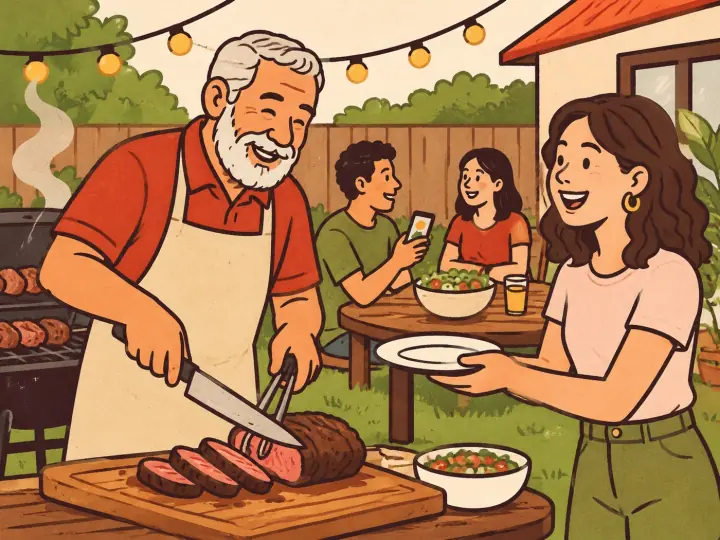
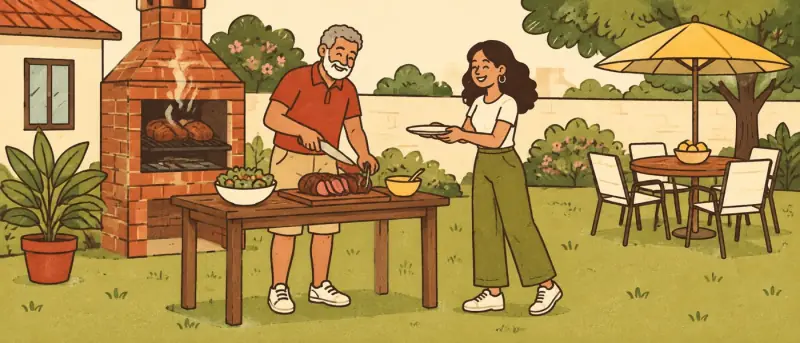
| 44 | o churrasco | a Brazilian barbecue | Domingo tem churrasco na casa do seu Antônio. There's a barbecue at seu Antônio's on Sunday. | Everyday Meat comes off the grill in rounds, sliced onto a board. |
| 45 | o churrasqueiro | the person running the grill | O churrasqueiro hoje é o meu sogro. My father-in-law is on the grill today. | Everyday Never touch the grill unless invited. Praise it instead. |
| 46 | Qual o ponto da carne? | How do you like your meat cooked? | Qual o ponto? Mal passada, ao ponto ou bem passada? How do you like it? Rare, medium or well done? | Everyday |
| 47 | mal passada / ao ponto / bem passada | rare / medium / well done | Pra mim, ao ponto, por favor. Medium for me, please. | Everyday |
| 48 | a picanha | top sirloin cap, the star cut | Essa picanha tá perfeita! This picanha is perfect! | Everyday |
| 49 | a linguiça | sausage | Me vê um pedaço de linguiça? Can I get a piece of sausage? | Everyday |
| 50 | o pão de alho | garlic bread off the grill | O pão de alho acabou de sair! The garlic bread just came off! | Everyday |
| 51 | Quer uma cerveja gelada? | Want a cold beer? | Quer uma cerveja gelada ou um refri? Want a cold beer or a soda? | Everyday « Bem gelada » (ice cold) is how Brazilians like it. |
| 52 | Posso ajudar na churrasqueira? | Can I help at the grill? | Seu Antônio, posso ajudar na churrasqueira? Seu Antônio, can I help at the grill? | Everyday Offer once. If he says no, cut the vinaigrette instead. |
| 53 | Mandou bem! | Nailed it! | Mandou bem na carne, seu Antônio! You nailed the meat, seu Antônio! | Everyday Casual praise. Perfect for the grill master. |
Compliments 12
Praise the food first, then the house, then their kid.
| # | Phrase | Meaning | Example | When to use |
|---|---|---|---|---|
| 54 | Tá uma delícia! | It's delicious! | Dona Rosa, tá uma delícia! Dona Rosa, it's delicious! | Everyday |
| 55 | A senhora cozinha muito bem. | You cook really well, ma'am. | Agora entendo por que o Pedro diz que a senhora cozinha muito bem. Now I see why Pedro says you're such a good cook. | Everyday |
| 56 | Me passa a receita? | Will you give me the recipe? | Me passa a receita desse bolo? Will you give me the recipe for this cake? | Everyday The highest praise for a cook. |
| 57 | Que casa linda! | What a lovely house! | Que casa linda, e que vista! What a lovely house, and what a view! | Everyday |
| 58 | Adorei o jardim. | I love the garden. | Adorei o jardim, foi a senhora que plantou? I love the garden, did you plant it? | Everyday |
| 59 | Me sinto em casa. | I feel at home. | Obrigado, de verdade me sinto em casa. Thank you, I really feel at home. | Everyday |
| 60 | Sua filha é maravilhosa. | Your daughter is wonderful. | Sua filha é maravilhosa, vocês fizeram um ótimo trabalho. Your daughter is wonderful, you did a great job. | Everyday Seu filho é maravilhoso for a son. |
| 61 | Agora sei de quem ela puxou. | Now I know who she takes after. | Agora sei de quem ela puxou a simpatia. Now I know where she gets her charm. | Everyday |
| 62 | Que família linda! | What a lovely family! | Que família linda vocês têm! What a lovely family you have! | Everyday |
| 63 | Que bolo divino! | What a heavenly cake! | Que bolo divino, dona Rosa! What a heavenly cake, dona Rosa! | Everyday |
| 64 | A senhora está muito bonita. | You look lovely, ma'am. | A senhora está muito bonita hoje. You look lovely today, ma'am. | Everyday |
| 65 | Que bairro gostoso. | What a nice neighborhood. | Que bairro gostoso, tão tranquilo. What a nice neighborhood, so quiet. | Everyday Gostoso for a place means pleasant. Avoid it for people: it sounds sexual. |
Questions they'll ask you 15
The example is a sample answer you can copy.
| # | Phrase | Meaning | Example | When to use |
|---|---|---|---|---|
| 66 | Você é de onde? | Where are you from? | Sou de Toronto, no Canadá. I'm from Toronto, in Canada. | Everyday The example is your answer. They may ask « o senhor é de onde? » to be formal. |
| 67 | Você trabalha com o quê? | What do you do for work? | Trabalho com tecnologia, sou programador. I work in tech, I'm a programmer. | Everyday |
| 68 | Como vocês se conheceram? | How did you two meet? | A gente se conheceu numa viagem a Salvador. We met on a trip to Salvador. | Everyday Have a short, sweet version ready. |
| 69 | Há quanto tempo vocês estão juntos? | How long have you been together? | Faz dois anos que a gente está junto. We've been together two years. | Everyday |
| 70 | Você fala português? | Do you speak Portuguese? | Tô aprendendo, aos poucos! I'm learning, little by little! | Everyday |
| 71 | Onde você aprendeu português? | Where did you learn Portuguese? | Com um app e com a Júlia, que tem muita paciência. With an app and with Júlia, who's very patient. | Everyday |
| 72 | Você tem irmãos? | Do you have brothers and sisters? | Tenho uma irmã mais velha. I have an older sister. | Everyday |
| 73 | Gostou do Brasil? | Do you like Brazil? | Adorei! O povo é muito acolhedor. I love it! People are so welcoming. | Everyday |
| 74 | Já provou feijoada? | Have you tried feijoada? | Já, e hoje provei a melhor de todas. Yes, and today I had the best one yet. | Everyday |
| 75 | Você torce pra qual time? | Which football team do you support? | Ainda não tenho time. Qual o senhor me recomenda? I don't have a team yet. Which one do you recommend? | Everyday A safe and charming answer if you don't follow football. |
| 76 | E o casamento, sai quando? | So when's the wedding? | Ainda não tem data! A gente avisa. No date yet! We'll let you know. | Everyday Usually half a joke. Laugh and deflect. |
| 77 | E os netos, quando vêm? | And when are the grandkids coming? | Calma, uma coisa de cada vez! Easy, one thing at a time! | Everyday Very common, rarely meant to pry. |
| 78 | Já comeu? | Have you eaten? | Já, obrigado, mas aceito um cafezinho. Yes, thanks, but I'll take a little coffee. | Everyday Usually an offer of food in disguise. |
| 79 | Vai dormir aqui? | Are you staying the night? | Se não for incômodo, eu adoraria. If it's no trouble, I'd love to. | Everyday |
| 80 | Quando vocês voltam? | When are you coming back? | No Natal, se Deus quiser. At Christmas, God willing. | Everyday « Se Deus quiser » is a gentle way to say hopefully. |
Helping out 12
They'll say imagina. Offer again.
| # | Phrase | Meaning | Example | When to use |
|---|---|---|---|---|
| 81 | Posso ajudar? | Can I help? | Dona Rosa, posso ajudar em alguma coisa? Dona Rosa, can I help with anything? | Everyday |
| 82 | Quer ajuda? | Do you want some help? | Quer ajuda com as panelas? Want some help with the pans? | Everyday |
| 83 | Deixa que eu lavo a louça. | Let me do the dishes. | Vocês cozinharam, deixa que eu lavo a louça. You cooked, let me do the dishes. | Everyday |
| 84 | Eu ponho a mesa? | Shall I set the table? | Eu ponho a mesa? Onde ficam os pratos? Shall I set the table? Where are the plates? | Everyday |
| 85 | Imagina! | Don't be silly! / Not at all! | Posso ajudar? Imagina, senta aí! Can I help? Don't be silly, sit down! | Everyday What they'll say when you offer. Offer again anyway. |
| 86 | Faço questão. | I insist. | Faço questão de ajudar. I really want to help. | Everyday |
| 87 | Onde eu coloco isso? | Where should I put this? | Onde eu coloco o que sobrou? Where should I put the leftovers? | Everyday |
| 88 | Onde fica o banheiro? | Where's the bathroom? | Com licença, onde fica o banheiro? Excuse me, where's the bathroom? | Everyday |
| 89 | Precisa de alguma coisa do mercado? | Do you need anything from the store? | Vou no mercado, precisa de alguma coisa? I'm going to the store, do you need anything? | Everyday |
| 90 | Deixa comigo. | Leave it to me. | Essa sacola é pesada, deixa comigo. That bag is heavy, let me take it. | Everyday |
| 91 | Pronto! | All done! | Pronto, louça lavada! All done, dishes washed! | Everyday |
| 92 | Não precisa se incomodar. | Please don't go to any trouble. | Não precisa se incomodar, eu me sirvo. Don't go to any trouble, I'll help myself. | Everyday |
Holidays and family events 14
Christmas, New Year's and birthdays, Brazilian style.
| # | Phrase | Meaning | Example | When to use |
|---|---|---|---|---|
| 93 | Feliz Natal! | Merry Christmas! | Feliz Natal, gente! Merry Christmas, everyone! | Everyday |
| 94 | a ceia de Natal | Christmas Eve dinner | A ceia de Natal é na casa da vó, às dez da noite. Christmas Eve dinner is at grandma's, at 10 p.m. | Everyday The big meal is the night of the 24th, often near midnight. |
| 95 | o amigo secreto | Secret Santa | Esse ano eu tirei a minha sogra no amigo secreto! This year I got my mother-in-law in Secret Santa! | Everyday Every Brazilian family does it. You'll be added to the draw. |
| 96 | Feliz Ano Novo! | Happy New Year! | Feliz Ano Novo! Muita saúde pra todos. Happy New Year! Good health to everyone. | Everyday |
| 97 | o réveillon | New Year's Eve | Vamos passar o réveillon na praia. We're spending New Year's Eve at the beach. | Everyday Many people wear white for peace. |
| 98 | pular sete ondas | to jump seven waves at midnight | À meia-noite todo mundo vai pular sete ondas. At midnight everyone jumps seven waves. | Everyday A beach tradition for luck. Make a wish on each wave. |
| 99 | Feliz aniversário! | Happy birthday! | Feliz aniversário, sogrinha! Happy birthday, mother-in-law! | Everyday |
| 100 | Parabéns! | Congratulations! Happy birthday! | Parabéns, muitas felicidades! Happy birthday, all the best! | Everyday Also the start of the birthday song, « Parabéns pra você ». |
| 101 | Muitos anos de vida! | Many more years! | Parabéns, seu Antônio! Muitos anos de vida! Happy birthday, seu Antônio! Many more years! | Everyday |
| 102 | o Dia das Mães | Mother's Day (second Sunday in May) | No Dia das Mães o almoço é na casa da minha sogra. On Mother's Day lunch is at my mother-in-law's. | Everyday |
| 103 | a Páscoa | Easter | Na Páscoa a gente dá ovo de chocolate pras crianças. At Easter we give the kids chocolate eggs. | Everyday |
| 104 | a festa junina | the June festival | Tem festa junina na escola da sobrinha. There's a June festival at my niece's school. | Everyday Expect quentão, pamonha, square dancing and plaid shirts. |
| 105 | o batizado | a christening | O batizado do afilhado é em março. Our godson's christening is in March. | Everyday |
| 106 | Meus sentimentos. | My condolences. | Meus sentimentos, dona Rosa. I'm so sorry for your loss, dona Rosa. | Everyday « Meus pêsames » is the more formal version. |
Saying goodbye 13
A Brazilian goodbye takes half an hour.
| # | Phrase | Meaning | Example | When to use |
|---|---|---|---|---|
| 107 | Obrigado por tudo. | Thanks for everything. | Obrigado por tudo, foi um dia incrível. Thanks for everything, it was an amazing day. | Everyday Obrigada if you're a woman. |
| 108 | Estava tudo uma delícia. | Everything was delicious. | Estava tudo uma delícia, dona Rosa. Everything was delicious, dona Rosa. | Everyday |
| 109 | Adorei conhecer vocês. | I loved meeting you. | Adorei conhecer vocês, de verdade. I really loved meeting you. | Everyday |
| 110 | Já vou indo. | I'm going to get going. | Bom, gente, já vou indo. Well, everyone, I'm going to get going. | Everyday A Brazilian goodbye takes a while. Say this half an hour before you need to leave. |
| 111 | Vamos nessa? | Shall we head off? | Amor, vamos nessa? Babe, shall we head off? | Everyday Casual. Say it to your partner, not your in-laws. |
| 112 | Foi um prazer. | It was a pleasure. | Foi um prazer, seu Antônio. It was a pleasure, seu Antônio. | Everyday |
| 113 | Até a próxima! | Until next time! | Até a próxima, e obrigado de novo! Until next time, and thanks again! | Everyday |
| 114 | Da próxima vez é lá em casa. | Next time it's at our place. | Da próxima vez o almoço é lá em casa. Next time lunch is at our place. | Everyday |
| 115 | Vai com Deus. | Go with God, travel safe. | Vai com Deus, meu filho. Travel safe, my son. | Everyday What they'll say. Answer « amém, fica com Deus ». |
| 116 | Me avisa quando chegar. | Let me know when you get home. | Me avisa quando chegar, tá? Let me know when you get home, OK? | Everyday Your mother-in-law means it. Send a WhatsApp. |
| 117 | Leva um pouco pra casa. | Take some home. | Leva um pouco de bolo pra casa! Take some cake home! | Everyday Say yes. A marmita of leftovers is love. |
| 118 | Manda um beijo pra... | Send my love to... | Manda um beijo pra sua mãe. Send my love to your mom. | Everyday |
| 119 | Fica com Deus. | Stay with God, take care. | Tchau, dona Rosa, fica com Deus. Bye, dona Rosa, take care. | Everyday |
Family words 15
Who's who in a Brazilian family.
| # | Phrase | Meaning | Example | When to use |
|---|---|---|---|---|
| 120 | a sogra | mother-in-law | Minha sogra faz o melhor pão de queijo do mundo. My mother-in-law makes the best pão de queijo in the world. | Everyday |
| 121 | o sogro | father-in-law | Meu sogro é o rei do churrasco. My father-in-law is the king of the barbecue. | Everyday |
| 122 | os sogros | parents-in-law | Vamos passar o Natal com os sogros. We're spending Christmas with the in-laws. | Everyday |
| 123 | o cunhado / a cunhada | brother-in-law / sister-in-law | Meu cunhado mora em Belo Horizonte. My brother-in-law lives in Belo Horizonte. | Everyday |
| 124 | o concunhado / a concunhada | your sibling-in-law's spouse | Minha concunhada é a esposa do irmão do meu marido. My concunhada is my husband's brother's wife. | Everyday |
| 125 | o genro | son-in-law | Minha sogra diz que sou o genro favorito. My mother-in-law says I'm her favorite son-in-law. | Everyday |
| 126 | a nora | daughter-in-law | A nora da dona Rosa é americana. Dona Rosa's daughter-in-law is American. | Everyday |
| 127 | o namorado / a namorada | boyfriend / girlfriend | Essa é a minha namorada, a Sarah. This is my girlfriend, Sarah. | Everyday |
| 128 | o noivo / a noiva | fiancé / fiancée; also groom / bride | Meu noivo é irlandês. My fiancé is Irish. | Everyday |
| 129 | o marido / a esposa | husband / wife | Meu marido e eu moramos em Austin. My husband and I live in Austin. | Everyday Mulher for wife is common in speech too. |
| 130 | o padrinho / a madrinha | godfather / godmother; also best man, maid of honor | Meu cunhado vai ser padrinho do casamento. My brother-in-law is going to be a sponsor at the wedding. | Everyday Brazilian weddings have several couples of padrinhos. |
| 131 | o afilhado / a afilhada | godson / goddaughter | Meu afilhado faz cinco anos amanhã. My godson turns five tomorrow. | Everyday |
| 132 | o sobrinho / a sobrinha | nephew / niece | Os sobrinhos me ensinaram a jogar truco. The nephews and nieces taught me to play truco. | Everyday |
| 133 | a vó / o vô | grandma / grandpa | A vó faz questão de cozinhar para todo mundo. Grandma insists on cooking for everyone. | Everyday Short for avó and avô. Everyone uses them, in-laws included. |
| 134 | a família do meu marido | my husband's family | A família do meu marido é enorme e muito carinhosa. My husband's family is huge and very affectionate. | Everyday There's no single word for in-laws as a group. Say a família dele or a família dela. |
Your Portuguese for your in-laws guide is ready
Save it to your phone so it's there when you need it.
Good to know
Start with o senhor and a senhora
Many Brazilian parents expect it at first, especially outside big cities. If they say « pode me chamar de você », switch.
Seu and dona are warm
Seu Antônio and dona Rosa sound respectful and friendly at once. They work for in-laws, neighbors and the lady who runs the bakery.
Say yes to the cafezinho
You'll be offered coffee at every visit. Saying yes is part of the welcome.
Pick a football team
Ask your partner which team the family supports. Showing up in the rival's shirt is a story they'll tell for years.
Leave slowly
Brazilians say goodbye at the table, again in the living room, and once more at the gate. Plan for it.
Questions people ask
Should I use você or o senhor with my Brazilian in-laws?
Start with o senhor and a senhora. Many families switch to você fast, but let them invite you to.
How do you say mother-in-law in Portuguese?
A sogra. Father-in-law is o sogro, and both together are os sogros.
What does seu mean before a name?
It's short for senhor. Seu Antônio means Mr. Antônio, used with the first name. For women, say dona.
How do I compliment my mother-in-law's food in Portuguese?
Say « tá uma delícia! », « a senhora cozinha muito bem » and « me passa a receita? ». Taking seconds says it too.
How many kisses do Brazilians give?
One in São Paulo, often two in Rio, and it varies by family. Lean in and follow their lead.
What should I bring to a Brazilian family lunch?
Flowers, a dessert, wine, or cold beer for a churrasco. Say « trouxe uma lembrancinha ».
Keep going
- Spanish phrases for meeting your in-laws
- Spanish for talking to your grandparents
- Portuguese terms of endearment
- Brazilian Portuguese contractions you'll hear every day
- Portuguese false friends and the words you really want
- Brazilian slang: 300 phrases to sound like a local
More family and partner phrases
Sources
Want these to stick? Verbamor turns any phrase on this page into a flashcard with a native voice, so it comes back right before you'd forget it.
More free tools
All 18-
Word patterns in 6 languages Understand and say whole groups of words from a few dozen simple rules. Spanish, French, Italian, Portuguese, Russian and German, each with a free PDF.
-
Slang for 20 Latin American countries 300 local phrases for each country, from Mexico to Brazil, with real examples, English translations and when to use each one.
-
How many Spanish words do you know? Tick the words you know from a frequency-banded sample. Fake words catch the guessing.
-
How much of a text do you already know? Paste any text and see what share of it sits inside the first 1,000 to 5,000 words.
-
The forgetting curve, drawn properly Put in the days since your last review and see how much of a word is left, on the real FSRS-6 curve.
-
What do 20 new cards a day cost you? Project your daily reviews for two years from a new-card rate and a retention target.
-
Cognate checker Type an English word, see its likely relatives in five languages, and get warned about false friends.
-
Der, die or das? Type a German noun and get its likely article, with the ending or compound rule behind it.
-
What a tutored word really costs Your lesson price divided by the words you still have next week, with the arithmetic in full.
-
Count the hours a term abroad buys The hours a semester abroad really adds, next to what the same money buys in tutoring.
-
Texting codes in 5 languages What mdr, tqm, kkkk, cmq and спс mean, with real chats, how to reply and a free decoder PDF for each language.
-
Terms of endearment in 5 languages What to call your partner, your kids and your friends in Spanish, French, Italian, Russian and Portuguese, with how each one sounds.
-
Phrase kits for real situations The pharmacy in Mexico, a flat in Lisbon, the prefecture in France: what to say, and what they will ask you back.
-
Same language, different country Spain vs Mexico, Brazil vs Portugal, Quebec vs France: the words that change and the ones that get you in trouble.
-
False friends in 5 languages Words that look like English and mean something else, from embarazada to préservatif, with the word you really want.
-
How people really talk The short forms, dropped sounds and accents that make fast speech hard to follow, written out so you can hear them.
-
Spanish slang translator Look up 6,000+ slang words and phrases from 20 countries, Spanish to English or English to Spanish.
- All 18 free tools Every tool on one page, plus the free debrief sheet.