 Verbamor
You understand it because you heard it. You’ve never been asked to produce it.
Recognition and retrieval are different jobs, and one of them you have done thousands of times. Here is what actually moves a word across.
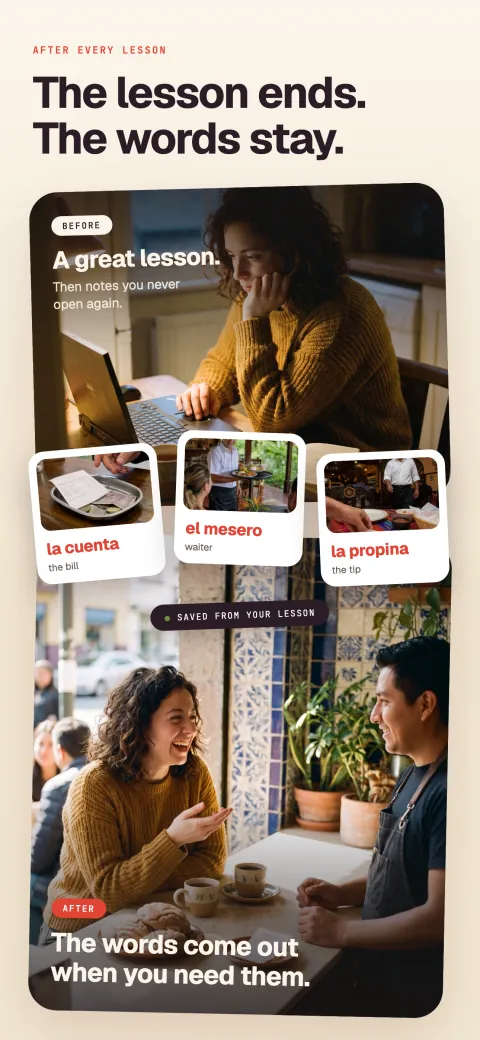
Verbamor records your lesson and turns what your tutor taught into cards that come back on schedule.

Last month I tried to tell my tutor the flat had been repainted before I moved in. I got as far as pintado and stopped.
Four seconds of nothing. Then she filled it in for me: lo habían pintado antes de mudarme.
I recognised every word the instant she said it. I'd read the pluperfect, the had done tense, twice that month. And I couldn't assemble those six words in the time a conversation allows.
I did know it. Which is the strange part, and also the whole explanation.
Two jobs, and you've only practised one
Recognising habían pintado is a matching problem. The form arrives, your memory checks whether it has seen this shape before, and something lights up. The cue does most of the work.
Producing it is a search problem. No cue, no options on the table. You start from a concept and hunt for a form, under a social clock.
Every hour you've spent reading, listening, watching a show with subtitles or flipping a card Spanish-side-first has trained the first job. Thousands of reps.
The second one you've attempted maybe a few hundred times, mostly in lessons, mostly badly.
So the gap is a training log.
You've barely ever practised speaking, and your practice has been quietly grading you on the easier task.
It's the same illusion that makes rereading a chapter feel like studying: familiarity is fast and reads internally as knowledge. That's why the testing effect keeps surprising people who have lived it.
Understanding speech takes 6,000 to 7,000 word families
The page ranking first for this question is Clozemaster’s guide to active versus passive vocabulary, and it’s confident. Your passive vocabulary is “three to five times larger” than your active one.
Words need “5–7 successful retrievals”. At least “40–50% of your study time” should be retrieval.
Then it hands you a ladder: 1,000 active words for “basic survival conversation”, 2,500 for “comfortable daily communication”, 5,000 for “fluent discussion of common topics”, 10,000 and up for “advanced fluency”.
Not one of those numbers carries a citation. And at the foot of the page sits a line most readers never scroll to: the post “was created by the team at Clozemaster with the help of AI”. The most-read answer to this question is a language model’s guess about your vocabulary, printed in bold.
Paul Nation counted instead. From Nation (2006), verbatim: if 98% coverage is needed for unassisted comprehension, you need 8,000 to 9,000 word families for written text and 6,000 to 7,000 for spoken text.
A word family is a base word plus its related forms. 98% coverage means 1 unknown word in 50: the bar for following a conversation without a patient friend.
Clozemaster says 2,500 words buys “comfortable daily communication”. Nation, having counted, says merely understanding spoken text takes 6,000 to 7,000 word families. The two measure different things, which is the problem: one of them says so.
Adolphs and Schmitt (2003) ran the same question over a corpus (a large collection) of recorded British conversation and landed nearby. Around 5,000 individual words gets you to about 96% coverage of spoken discourse.
Their abstract is what I can read, so I won't push it further than that. But 96% is a long way below the bar, and 5,000 words is a long way above what any active ladder promises.
Drop to 95% and Nation gives the most vivid figure in the paper. You meet 1 unknown word in every two lines of text, or 7 unknown words in every minute of speech at 150 words per minute.
Seven. Every minute. That's why intermediate listening is exhausting.
And no, I can't hand you the sourced production ladder instead. Nobody has measured one. The pages that print one are inventing it, and I'd rather leave the column empty than fill it the same way.
Your passive vocabulary is large, it took years, and it sits in a form that only answers when spoken to. There's a fuller version of the coverage story in when you are actually ready for your first novel.
The list you need already exists, and somebody else is holding it
Here's the practical question everyone skips. You have thousands of passive words. Which ones do you activate first?
The usual advice is to drill the words you repeatedly fail to reach for. Correct, and useless on its own, because no app can see you failing.
A frequency-ordered sentence bank knows which words are common across a language. It can't know which one you stalled on at 11:04 on Tuesday.
But something already knows. My tutor watched it happen: she heard the four seconds, supplied the pluperfect, and moved on. That moment is a measurement, and the only one in my week that is about me specifically.
The entry from that lesson is the gap I fell into on the way to a finished sentence. Pintar is a common word, and it exists on my list only because somebody watched me fall short of using it.
Global frequency lists are aimed at the average learner of your language, and frequency still does real work at the beginner end. This one is aimed at a single person. A corpus of one, generated free, every single lesson, and thrown away by almost everybody within the hour.
Retrieving into a blank, out loud, moves a word across
Two mechanisms, both with real evidence behind them.
- Retrieve before you look, into a gap. Karpicke and Roediger’s 2008 Swahili study is the sharp version: after the first correct recall, continued restudying added almost nothing, while continued retrieval roughly doubled one-week retention. A blank in a sentence is how you get that onto a card, since it makes you generate the form and fit it grammatically. A card you flip before answering does neither. Reading, with extra steps.
- Say it out loud. MacLeod and colleagues found spoken items are remembered better than silently read ones, with a catch worth knowing. When they ran one group reading every word aloud against another reading every word silently, the advantage vanished, and they concluded it is “restricted to within-subject, mixed-list designs”. Speak some of the deck, not all of it, so the spoken words have something to stand out against. Longer version, with the per-experiment numbers, in the production effect.
None of this is exotic. The whole difference lies between a review that asks do you know this? and one that asks say it, now, with nothing to look at. The second one is worse to do, which is roughly how memory works in general.
The honest ceiling: retrieval practice makes words available. It doesn't make you fluent. That still costs speaking hours with a human, and cards and input do different jobs before any app claims to replace either.
I built Verbamor for the narrow part of this I kept failing at myself. You record or type what came up in the lesson, and it turns those words into fill-in-the-blank cards with native audio and an image. FSRS, an open-source algorithm that predicts when you're about to forget each card, schedules them.
It refuses to let the lesson evaporate. That's the whole of it.
iOS only, $19.99 a month or $129.99 a year, and there's no free tier, which I'd rather say plainly than bury.
Who should close this tab
If you don't have a tutor, most of the above is harder to use. A corpus of one needs somebody watching you fail, and a partner or an exchange can do that too. Without one, paying for an app to review a short list is poor value.
In that case go and use Clozemaster, and I mean that. The method is right where it counts: fill-in-the-blank sentences on a spaced-repetition schedule, ordered, as its about page puts it, by “how common the missing word is”.
Below a working intermediate level, that ordering is a genuine feature, because at that stage the frequent words and your personal gaps are mostly the same words. There's a free tier, with a paid Pro upgrade whose price I haven't verified.
One setting matters more than the rest. The default answer format is multiple choice, and the homepage puts it in that order: “Choose from multiple choice, or type the answer yourself for an extra challenge.”
Picking appelé out of four options is recognition again, the job you've already over-trained. Switch typing on. The good version of the product is one tap away.
Which is the honest limit of my complaint. The tool is better than the numbers it publishes.
Same answer if you're on Android, since we aren't, or if you already have an Anki deck you like. Anki is free, runs the same algorithm family once you switch FSRS on, and we have no import.
So moving would mean building the deck fresh. For a deck you're happy with, that's a bad trade.
What's left is a specific person: an intermediate learner, on iOS, paying somebody to talk to them weekly. They keep having the four-second silence and losing the evidence of it by Thursday.
That silence is the only diagnostic you get all week, and it has a shelf life of about a day. If you want to see what happens to it, here are the first ten minutes in the app.
Sources
How big the recognition vocabulary has to be
- Nation, I. S. P. (2006). How large a vocabulary is needed for reading and listening? The Canadian Modern Language Review, 63(1), 59–82.
- Adolphs, S., & Schmitt, N. (2003). Lexical coverage of spoken discourse. Applied Linguistics, 24(4), 425–438.
Retrieval beats restudying
- Roediger, H. L., & Karpicke, J. D. (2006). Test-enhanced learning: taking memory tests improves long-term retention. Psychological Science, 17(3), 249–255.
- Karpicke, J. D., & Roediger, H. L. (2008). The critical importance of retrieval for learning. Science, 319(5865), 966–968.
Saying it out loud
- MacLeod, C. M., Gopie, N., Hourihan, K. L., Neary, K. R., & Ozubko, J. D. (2010). The production effect: delineation of a phenomenon. Journal of Experimental Psychology: Learning, Memory, and Cognition, 36(3), 671–685.
What Clozemaster says about itself
- Clozemaster. Homepage and about page, read 22 August 2026. Free tier and frequency ordering quoted from those pages.
Anki and FSRS
- Anki Manual, deck options, read 22 August 2026. Verbatim: “The Free Spaced Repetition Scheduler (FSRS) is an alternative to Anki’s legacy SuperMemo 2 (SM-2) algorithm.” FSRS is opt-in; SM-2 is still the default. See the Anki manual.
The word you stalled on is worth more than the next 100 on a frequency list.
Verbamor turns what came up in your lesson into cards that make you produce it, before you get another chance to say the place with food.
Start 7 days freeThe 7-day free trial is on the yearly plan.