 Verbamor
How long does it take to learn Portuguese? 24 FSI weeks, and an ear to train
The US Foreign Service Institute gives Portuguese 24 weeks, as short as Italian: 552 hours in class and about 960 with homework. One university program reaches B1 in 240 class hours. At an hour a day, plan on about a year to B1 and 2.6 years to FSI’s finish line. The slow part is your ear, because Portuguese is spelled further from its sound than Spanish or Italian.
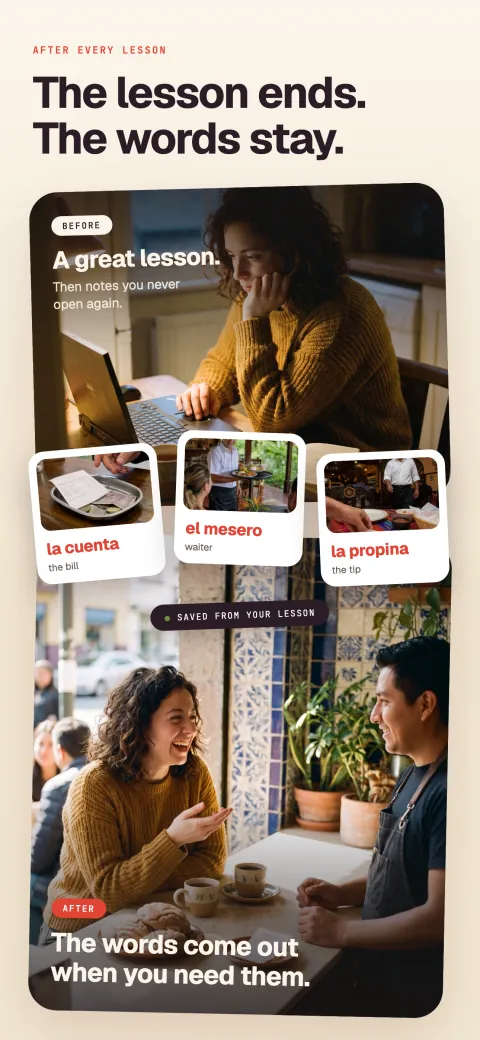
Verbamor records your lesson and turns what your tutor taught into cards that come back on schedule.

At an hour a day, an English speaker can expect to reach B1 Portuguese, a comfortable conversation, in about a year. The level US diplomats are trained to takes about 2.6 years at that pace. Speakers of Spanish start well ahead, and everyone's slowest part is learning to hear it.
Those estimates come from the US Foreign Service Institute and from schools that publish their course hours. They disagree more than you'd hope, so I'll show you each one.
If you're starting a word list, the Portuguese flashcards guide covers the Brazilian or European question in detail, and the best way to learn Portuguese puts a price on each route. This page is about time.
FSI gives Portuguese 24 weeks: 552 class hours, about 960 in all
FSI, the US State Department's language school, lists Portuguese at 24 weeks on its training page. That's its shortest timeline for any language, shared with Italian, Danish, Dutch, Norwegian, Romanian and Swedish. Spanish and French get 30.
The page says a typical week is “23 hours per week in class and 17 hours of self-study.” So 24 weeks is 552 hours in class plus 408 of homework, about 960 hours in all.
FSI's finish line is “an integrated score of 3 (Speaking + Listening)” on the Interagency Language Roundtable scale, which is working professional Portuguese. Its students study full time in small classes, and the page itself says real time varies with “natural ability, prior language-learning experience, and time spent in the classroom.”
So treat 24 weeks as a full-timer's figure. The FSI number everyone quotes is also an older version of the page, which still circulates.
Schools put B1 anywhere from 240 to about 700 class hours
Most learners want B1 on the CEFR, the six-level scale from A1 to C2 used for European language exams. B1 is a comfortable conversation about familiar things.
I found few Portuguese schools that publish hours per level. One that does is the Language Center at Hamad Bin Khalifa University in Qatar. Each CEFR level is two 40-hour courses, so B1 is complete at 240 class hours and B2 at 320.
That's low next to schools teaching other Romance languages. The Alliance Française puts French B1 at 360 to 424 hours of tuition. Perugia's university for foreigners will teach Italian B1 as 9 months of full-time class from January 2027, about 650 to 700 hours. I set out both in how long it takes to learn French and the Italian version.
So the published range for B1 in a Romance language runs from 240 to about 700 class hours. The schools teach different students at different intensities, and none of them counts homework.
My planning number is the middle, about 400 hours. Then check yourself after 6 weeks and move it.
At an hour a day, about a year to B1
This table divides 400 hours for B1, and FSI's 960, by your week. The B1 column is my middle estimate, so treat it as a starting plan you'll adjust.
| Your pace | Hours a week | To B1 (400 h) | To FSI's 960 |
|---|---|---|---|
| 2 hours a day | 14 | about 7 months | about 1.3 years |
| 1 hour a day | 7 | about 13 months | about 2.6 years |
| A 3-hour Saturday class | 3 | about 2.6 years | about 6.2 years |
| 2.5 hours a week | 2.5 | about 3.1 years | about 7.4 years |
At HBKU's 240 hours, the hour-a-day learner reaches B1 in about 8 months. At Perugia-style hours it's nearer 2 years. The 6-week check below tells you which end you're on.
If you need Portuguese for one trip, you need far less, and how many words you actually need before the trip does that sum.
Pick your variety of Portuguese before you start
Decide which Portuguese you want before you count hours. Brazilian and European Portuguese share a written standard closely enough to read each other, and they sound noticeably different.
The biggest difference for a learner is the vowels. European Portuguese reduces unstressed vowels until they nearly vanish, so a word you can read fine on the page can arrive in your ear with its middle missing. Brazilian Portuguese keeps more of them.
Pick the one you'll use: the country you'll visit, the family you'll talk to, the shows you'll watch. Then keep your listening in that variety, because switching costs you the ear training you've done.
Portuguese spelling drifts from its sound, so your ear is the bottleneck
Portuguese is one of the harder Romance languages to sound out from the page. Seymour, Aro and Erskine (2003) studied children learning to read across Europe. Most became accurate readers within their first school year, with exceptions “notably in French, Portuguese, Danish, and, particularly, in English.”
That study is about children reading their own language, but the spelling system is the one you'll read too. For you, it means learning each word twice: how it looks and how it sounds.
FSI still gives Portuguese 24 weeks, 6 fewer than Spanish. My guess is that regular grammar and a large shared Latin vocabulary make up for the sound. Either way, the practical advice is the same: listen from week 1, and never learn a word without its audio.
Spanish speakers get the biggest head start, and the sharpest traps. Polvo is dust in Spanish and octopus in Portuguese. Spanish exquisito is delicious, and Portuguese esquisito is strange. There's more on these in cognates and false friends.
The other lever is how you review. In Karpicke and Roediger's 2008 study, students who kept testing themselves on word pairs recalled about 80% a week later. Students who kept rereading them recalled about 36%.
Run your own check. Write down 20 Portuguese words or phrases you meet this week, with the date. In 6 weeks, cover the Portuguese and say all 20 from the English. Your score tells you whether your hours are sticking.
Verbamor is built for that part. You record or type what came up in a lesson or a conversation, and it makes fill-in-the-blank Portuguese cards with native-accent audio, scheduled to come back before you forget them. It won't teach Portuguese from zero beyond a starter deck of about 650 common words, so start with a class or a tutor. It's on iPhone and iPad, at $19.99 a month or $129.99 a year.
Questions people actually ask
Is Portuguese harder than Spanish?
On FSI's list it's quicker: 24 weeks against 30 for Spanish. It's harder to hear at first, because Portuguese spelling sits further from its sound, especially in European Portuguese, where unstressed vowels shrink or disappear.
How many hours does it take to reach B1 in Portuguese?
Hamad Bin Khalifa University's Language Center reaches B1 in 240 class hours, at 80 hours a level. Schools teaching other Romance languages publish more, up to about 700. Plan on around 400 hours and adjust after 6 weeks.
How long does it take to learn Portuguese if I speak Spanish?
Less, especially for reading. FSI names prior language-learning experience as one of the things that shortens its timelines. Budget extra time for listening and for false friends like polvo, which is octopus in Portuguese.
Should I learn Brazilian or European Portuguese?
Learn the one you'll use most: the country, the family or the media you have in mind. The two read alike and sound different, so keep your listening in one variety.
Sources
The published hours
- U.S. Department of State, Foreign Service Institute. Foreign language training. Category I: 24–30 weeks (552–690 class hours); Portuguese 24 weeks; “23 hours per week in class and 17 hours of self-study.” Read 13 October 2026.
- Hamad Bin Khalifa University Language Center. Portuguese course descriptions for adults. Two 40-hour courses per CEFR level, A1 to C1. Read 13 October 2026.
Spelling, and getting more from each hour
- Seymour, P. H. K., Aro, M., & Erskine, J. M. (2003). Foundation literacy acquisition in European orthographies. British Journal of Psychology, 94(2), 143–174.
- Karpicke, J. D., & Roediger, H. L. (2008). The critical importance of retrieval for learning. Science, 319(5865), 966–968.
Every Portuguese word you keep, with its sound.
Verbamor turns the Portuguese from your own lessons into fill-in-the-blank cards with native-accent audio, so you learn each word the way it’s actually said.
Start 7 days freeThe 7-day free trial is on the yearly plan.