 Verbamor
How long does it take to learn French? About a year to B1 at an hour a day
The US Foreign Service Institute gives French 30 full-time weeks: 690 hours in class and about 1,200 once you add the homework it sets. Most learners want B1, a comfortable conversation, and two Alliance Française branches put that at 360 to 424 hours of tuition. At an hour a day that’s about a year. At one class a week it’s closer to three.
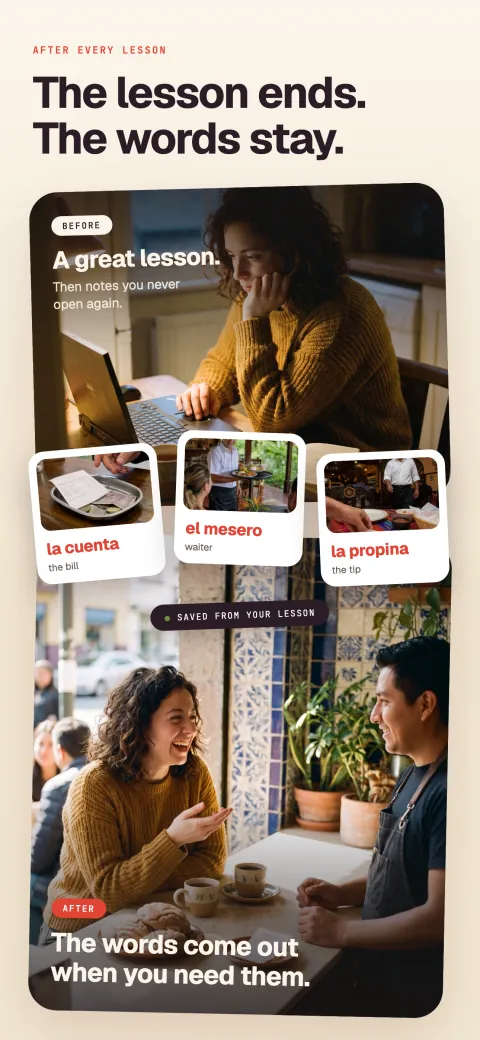
Verbamor records your lesson and turns what your tutor taught into cards that come back on schedule.

At an hour a day, most adults can reach B1 French, the level where a real conversation holds together, in about a year. The US Foreign Service Institute's full course is 30 weeks: 690 hours in class and about 1,200 once you add the homework. Most people never need that much, and most people also study less than an hour a day.
Those two facts set the range. A keen learner with daily practice is chatting within a year. Someone with one evening class a week is looking at about three.
If you're already building a word list for French, the French flashcards guide compares the options and what each one costs, and the best way to learn French prices every route across these hours. The rest of this page is the arithmetic.
FSI's French course is 30 weeks, which is 1,200 hours with homework
FSI, the US State Department's language school, publishes how long its students take. Its page lists French at 30 weeks, inside Category I, the group closest to English.
The same page says “a typical week is 23 hours per week in class and 17 hours of self-study.” So 30 weeks is 690 class hours and 510 hours of homework. That's 1,200 hours in all.
Read the target before you borrow the number. FSI times its course to “an integrated score of 3 (Speaking + Listening)” on the Interagency Language Roundtable scale. That's a working diplomat's French: meetings, negotiations, the news.
FSI's students are also unusual. They study full time in small classes, and many have learned a language before. The page itself warns that “the actual time can vary” with “natural ability, prior language-learning experience, and time spent in the classroom.” I wrote up why that page's numbers changed in the FSI number everyone quotes is the old one.
Alliance Française puts B1 at 360 to 424 hours of tuition
Most people asking this question want B1 or B2 on the CEFR scale, the six-level ladder from A1 to C2 used for European language exams. B1 is a comfortable conversation about familiar things. B2 is following most of what's said around you.
The Alliance Française, the network of French-teaching schools, publishes hours for those levels. Two branches publish different ladders, so I'll give you both.
Alliance Française de Leeds gives cumulative hours of instruction: A1 60 to 100, A2 160 to 200, B1 360 to 400, B2 560 to 650, C1 810 to 950, C2 1,060 to 1,200.
Alliance Française de Vancouver gives hours per level: A1 84, A2 140, B1 200, B2 230. Add them up and B1 is 424 hours from zero, and B2 is 654.
| Level | Leeds, cumulative | Vancouver, added up |
|---|---|---|
| A1 | 60–100 | 84 |
| A2 | 160–200 | 224 |
| B1 | 360–400 | 424 |
| B2 | 560–650 | 654 |
The two branches land close together. At B1 they differ by 24 to 64 hours, and at B2 by 4 at most. That's closer than most published hour figures manage, and it makes 360 to 424 hours a fair planning number for B1.
One caution travels with it. Those are hours of tuition. Neither branch says how much homework sits on top, and FSI's own week puts 17 hours of self-study beside every 23 in class.
At an hour a day, B1 takes about a year
Divide the hours by your week and the answer gets personal fast. This table uses 360 to 424 hours for B1 and FSI's 1,200 for the diplomat's finish line.
| Your pace | Hours a week | To B1 | To FSI's 1,200 |
|---|---|---|---|
| 2 hours a day | 14 | 6 to 7 months | about 1.6 years |
| 1 hour a day | 7 | 12 to 14 months | about 3.3 years |
| A 3-hour Saturday class | 3 | 2.3 to 2.7 years | about 7.7 years |
| 2.5 hours a week | 2.5 | 2.8 to 3.3 years | about 9 years |
| 30 minutes, 3 days a week | 1.5 | 4.6 to 5.4 years | about 15 years |
The 2.5-hour row is a typical evening course, and Leeds does that sum itself. It says A1 “translates as one year on the basis of 2h30 hours of week of tuition.” Vancouver's own timeline lands in the same place: about 2 years to finish B1 and 3 to finish B2, taking its courses in sequence.
So the honest answer for a weekly class is years, and it isn't a sign you're slow. It's what 2.5 hours a week buys.
If your goal is a trip rather than a conversation, the number is much smaller. I worked that one out in how many words you actually need before the trip.
French spelling is far from its sound, and that costs time at the start
FSI gives French 30 weeks and Italian 24. Those 6 weeks are 138 class hours, at 23 a week. FSI doesn't say where they go. Spelling can't be the whole answer, since Spanish also gets 30 weeks and is spelled the way it sounds. But for an English speaker, it's the part of French that costs the most at the start: French isn't said the way it's spelled.
A large study of children learning to read across Europe, Seymour, Aro and Erskine (2003), found most became accurate readers within their first school year. It named exceptions, “notably in French, Portuguese, Danish, and, particularly, in English.” The study is about children reading their first language, but the property it measured belongs to the spelling system.
For you, that means two facts per word: how it looks and how it sounds. Vingt is said like vin. Vert, verre and vers all sound the same, and the -ent on ils parlent is silent. A word learned only from the page arrives in your ear unrecognized.
So spend your first months listening as much as reading, and never learn a French word without its sound. The longer version of this, with the other Romance languages beside French, is in Spanish, French, Italian or Portuguese: picking one.
The upside comes later. English took a large share of its vocabulary from French, so a reader meets a lot of familiar-looking words, with false friends to watch for, as the cognates post covers.
Spaced recall and listening from week 1 get more from each hour
The hours above are averages, and how you spend them moves your number more than anything else you control. Two habits matter most.
Pull the word out before you look. In a 2008 study by Karpicke and Roediger, students who kept testing themselves on word pairs recalled about 80% a week later. Students who kept rereading them recalled about 36%. The spacing side of this, with the arithmetic, is in how long it takes to learn Spanish, and it applies to French unchanged.
Say it out loud. In French more than most languages, the sound is half the word. Say each card before you flip it.
Then measure yourself rather than trusting a table. Write down 20 French words or phrases you meet this week, with the date. In 6 weeks, cover the French and try to say all 20 from the English. Your score is your real retention rate.
Verbamor is built for the “words you meet” part. You record or type what came up in a lesson or a conversation. It makes fill-in-the-blank French cards with native-accent audio and an image, scheduled to come back before you forget them. It won't teach you French from zero, apart from a starter deck of about 650 common words. A class or a tutor does that job better. It's on iPhone and iPad, at $19.99 a month or $129.99 a year.
Questions people actually ask
Can you learn French in a year?
You can reach B1, a comfortable conversation, in about a year at an hour a day. Alliance Française branches put B1 at 360 to 424 hours of tuition. FSI's full diplomat course is 30 weeks of full-time study, about 1,200 hours with homework, so professional French in a year means studying close to full time.
How many hours does it take to reach B2 in French?
Alliance Française de Leeds says 560 to 650 cumulative hours of instruction, and Alliance Française de Vancouver's levels add up to 654. Those count tuition only, so plan on homework on top.
Is French harder than Spanish for English speakers?
FSI gives both 30 weeks, so on its numbers they cost the same. French is harder to read aloud and to hear at first, because its spelling is further from its sound. Spanish is easier to pronounce from day one.
How long does FSI say French takes?
FSI's page lists French at 30 weeks in Category I. At its stated 23 class hours and 17 self-study hours a week, that's 690 hours in class and about 1,200 in all, aimed at professional working proficiency.
Sources
The published hours
- U.S. Department of State, Foreign Service Institute. Foreign language training. Category I: 24–30 weeks (552–690 class hours); French 30 weeks; “23 hours per week in class and 17 hours of self-study.” Read 13 October 2026.
- Alliance Française de Leeds. FAQ. Cumulative hours of instruction per CEFR level. Read 13 October 2026.
- Alliance Française de Vancouver. How long does it take to learn French? A1 84 hours, A2 140, B1 200, B2 230. Read 13 October 2026.
Why French costs more at the start
- Seymour, P. H. K., Aro, M., & Erskine, J. M. (2003). Foundation literacy acquisition in European orthographies. British Journal of Psychology, 94(2), 143–174.
Getting more from each hour
- Karpicke, J. D., & Roediger, H. L. (2008). The critical importance of retrieval for learning. Science, 319(5865), 966–968.
Hear the French before you trust the spelling.
Verbamor turns the French from your own lessons into fill-in-the-blank cards with native-accent audio, so every word you keep comes with the sound it actually makes.
Start 7 days freeThe 7-day free trial is on the yearly plan.