 Verbamor
How long does it take to learn Italian? 24 weeks for a diplomat, longer for you
The US Foreign Service Institute gives Italian 24 weeks, its shortest timeline for any language: 552 hours in class and about 960 with homework. From January 2027, the Università per Stranieri di Perugia teaches B1 as 9 months of full-time class. At an hour a day that’s roughly 2 years to B1 and 2.6 to FSI’s finish line, and less if you already speak Spanish or French.
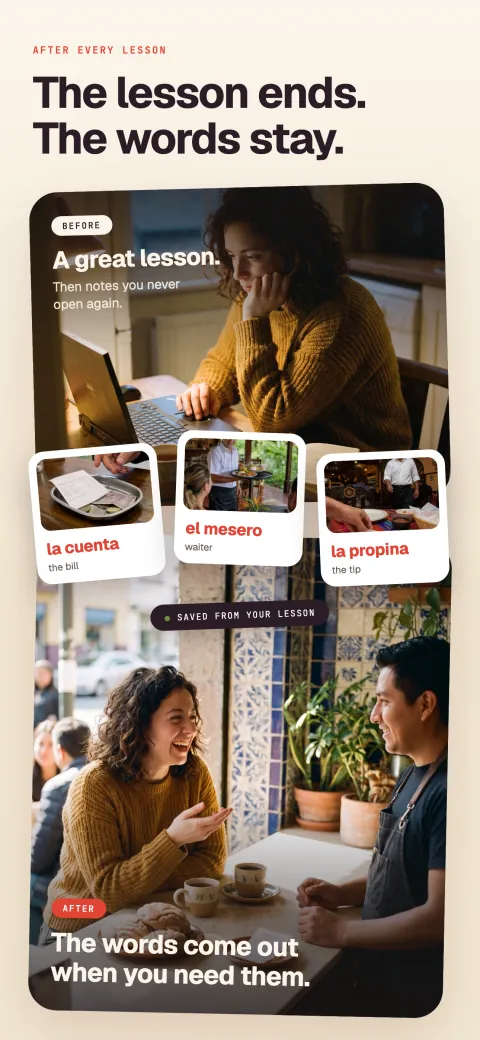
Verbamor records your lesson and turns what your tutor taught into cards that come back on schedule.

At an hour a day, plan on roughly 2 years to B1 Italian, a comfortable conversation. The level US diplomats are trained to takes about 2.6 years. Those numbers come from two institutions that teach Italian full time. If you already speak Spanish or French, take months off the front.
That's slower than the “24 weeks” you'll see quoted, because the 24 weeks are full-time weeks. Here's how the published figures turn into your calendar.
If you're starting a word list, the Italian flashcards guide works out how long 1,000 words take at different daily paces. This page covers the whole language.
FSI gives Italian 24 weeks: 552 class hours, about 960 in all
FSI, the US State Department's language school, lists Italian at 24 weeks on its training page. That's the shortest timeline it gives any language. Danish, Dutch, Norwegian, Portuguese, Romanian and Swedish share it, while Spanish and French get 30.
The same page says a typical week is “23 hours per week in class and 17 hours of self-study.” Multiply it out and Italian is 552 hours in class plus 408 of homework. That's about 960 hours in all.
FSI's finish line is high. It trains to “an integrated score of 3 (Speaking + Listening)” on the Interagency Language Roundtable scale, which is professional working Italian. Its students study full time in small classes, and the page warns that real time varies with “natural ability, prior language-learning experience, and time spent in the classroom.” Why the page's numbers changed a few years ago is in the FSI number everyone quotes is the old one.
From 2027, Perugia runs each level as 3 months of full-time class
For a level-by-level view, the best Italian source I found is the Università per Stranieri di Perugia, a public university that teaches Italian to foreigners. Its courses follow the CEFR, the six-level scale from A1 to C2 used for European language exams.
Each level runs as one-month modules. A2 to C2 already have three; A1 has two today and gains a third, A1.3, in January 2027. Levels A1 to B2 meet for 18 hours a week.
So from January 2027, finishing B1 from zero takes 9 months of full-time class (it's 8 until then). In hours, that's about 650 to 700, depending on how many teaching weeks a month holds. That figure is my arithmetic, since Perugia publishes the weekly hours and the months, and not the product.
Notice the tension with FSI. Perugia's route to B1 uses more class hours than FSI's entire course to a professional level. The two schools teach different students: FSI's are selected English speakers, and Perugia's classes mix every native language, including ones far from Italian. Perugia says as much, recommending its standard 3-month A1 for “speakers of typologically distant languages such as Arabic, Chinese, Russian, Japanese.”
So I treat FSI as the fast case and Perugia as the safe plan. An English speaker studying alone sits between the two, and probably closer to Perugia.
At an hour a day: roughly 2 years to B1, 2.6 to FSI's finish line
This table divides Perugia's 650 to 700 class hours for B1, and FSI's 960 hours, by your week.
| Your pace | Hours a week | To B1 (Perugia) | To FSI's 960 |
|---|---|---|---|
| 2 hours a day | 14 | about 11 months | about 1.3 years |
| 1 hour a day | 7 | 1.8 to 1.9 years | about 2.6 years |
| A 3-hour Saturday class | 3 | 4.2 to 4.5 years | about 6.2 years |
| 2.5 hours a week | 2.5 | 5 to 5.4 years | about 7.4 years |
The Perugia column counts class hours only, at a school where every other hour of the day is Italian too. Treat it as a fair estimate for focused study, and expect a weekly evening class to run long.
If your goal is a trip to Italy rather than a conversation, the number is far smaller. I worked it out in how many words you actually need before the trip. And if you're weighing the cost of each route across these hours, the best way to learn Italian prices them.
A Romance language you already speak cuts A1 from 3 months to 1
If you already speak Spanish, French, Portuguese or Romanian, Perugia lets you skip most of A1. From January 2027 it runs a one-month A1 course “intended exclusively for students who speak Romance languages (French, Spanish, Romanian, Portuguese) or students with substantial experience in learning foreign languages.”
That's 2 months saved before B1 even starts, on Perugia's own timetable. FSI makes the same point more quietly, listing “prior language-learning experience” among the things that move its numbers.
A head start brings its own trap, though. Spanish and Italian share many words that differ by a vowel or a meaning. Burro is a donkey in Spanish and butter in Italian, and caldo is broth in Spanish and hot in Italian. Watch the false friends (there's a whole post on cognates and false friends).
Italian is spelled the way it sounds, so you can read it aloud in week 1
Italian's spelling is close to one letter, one sound. Seymour, Aro and Erskine (2003) studied children learning to read across Europe. Most became accurate readers within their first school year, and the exceptions they named were French, Portuguese, Danish and English. Italian wasn't one of them.
The study is about children reading their first language, but the spelling system is the same one you'll read. For you, it means a new Italian word can be said correctly the first time you see it. That's the early win French learners don't get.
The long part of Italian is everything after that. Verb forms multiply, and native speech at full speed outruns your vocabulary for a long while. Both are paid for in hours of listening and in words you can actually retrieve.
Retrieving is the trainable part. In Karpicke and Roediger's 2008 study, students who kept testing themselves on word pairs recalled about 80% a week later, and students who kept rereading them recalled about 36%. The spacing arithmetic is in how long it takes to learn Spanish, and it carries over to Italian unchanged.
Verbamor is the tool I built for that part. You record or type what came up in a lesson or a conversation, and it makes fill-in-the-blank Italian cards with native-accent audio. They're scheduled to return just before you'd forget them. It won't teach Italian from zero beyond a starter deck of about 650 common words, so a class or a tutor comes first. It's on iPhone and iPad, at $19.99 a month or $129.99 a year.
Questions people actually ask
Is Italian the easiest language for English speakers?
On FSI's list it's tied for the shortest timeline: 24 weeks, shared with Danish, Dutch, Norwegian, Portuguese, Romanian and Swedish. Spanish and French get 30. Italian is also among the easiest to read aloud, because its spelling is close to its sound.
How many hours does it take to reach B1 in Italian?
From January 2027, the Università per Stranieri di Perugia teaches B1 as 9 months of full-time class at 18 hours a week, which works out to about 650 to 700 class hours (8 months until then, when A1 is two modules). A learner who already speaks a Romance language can take Perugia's one-month A1 and save about 2 months.
How long does it take to learn Italian if I speak Spanish?
Less, especially at the start. From January 2027, Perugia runs a one-month A1 course for speakers of Spanish, French, Portuguese and Romanian, against 3 months for everyone else. Watch the false friends, like burro, which is butter in Italian.
Can you learn Italian in a year?
At 2 hours a day, B1 in about a year fits Perugia's numbers. At an hour a day, plan on closer to 2 years for B1. FSI's full professional course is 24 full-time weeks, about 960 hours with homework.
Sources
The published timelines
- U.S. Department of State, Foreign Service Institute. Foreign language training. Category I: 24–30 weeks (552–690 class hours); Italian 24 weeks; “23 hours per week in class and 17 hours of self-study.” Read 13 October 2026.
- Università per Stranieri di Perugia. Structure of Italian language and culture courses. One-month modules, 18 hours a week for A1 to B2, the A1.3 module and the one-month A1 for Romance-language speakers, both from January 2027. Read 13 October 2026; module table re-read 18 October 2026.
Spelling, and getting more from each hour
- Seymour, P. H. K., Aro, M., & Erskine, J. M. (2003). Foundation literacy acquisition in European orthographies. British Journal of Psychology, 94(2), 143–174.
- Karpicke, J. D., & Roediger, H. L. (2008). The critical importance of retrieval for learning. Science, 319(5865), 966–968.
Keep the Italian you already met.
Verbamor turns the words from your Italian lessons into fill-in-the-blank cards with native-accent audio, scheduled to come back right before you’d forget them.
Start 7 days freeThe 7-day free trial is on the yearly plan.