 Verbamor
The best way to learn Portuguese, priced honestly
The best way to learn Portuguese is to choose European or Brazilian first, then pair a tutor with one cheap app built for that variety. Portuguese takes 552 FSI class hours, about 18 months at an hour a day, and over 2 years the apps here cost $25 to about $400 while tutoring runs into four figures. For what the first 1,000 words take on cards, see Portuguese flashcards.
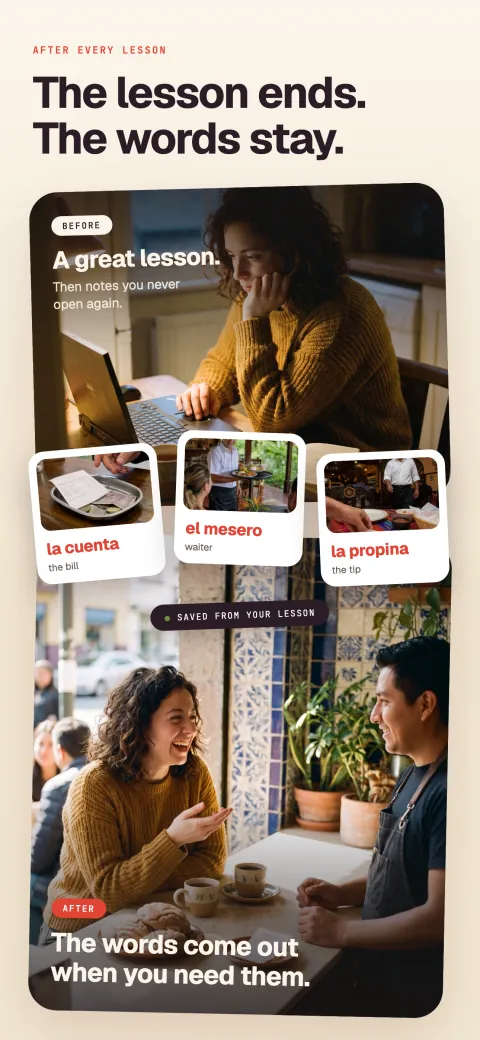
Verbamor records your lesson and turns what your tutor taught into cards that come back on schedule.

European or Brazilian comes first
Every other choice on this page depends on one decision: which Portuguese.
Brazil and Portugal write nearly the same language and say it quite differently. European Portuguese swallows many unstressed vowels, so a learner raised on Brazilian audio can find Lisbon hard to follow at first. The grammar and spelling differences are smaller, and you can fix them later. The ear takes longer.
Products pick a side. Pimsleur’s Portuguese page opens with “Brazilian Portuguese is the most common variety”. Practice Portuguese says “Strictly European Portuguese, since 2012”. Several others never say, and you find out when you press play.
So decide by where you’ll use it. Moving to Portugal, partner from Porto: European. Brazilian family, work in São Paulo, or no particular place in mind: Brazilian, because far more people speak it, so there’s far more Brazilian audio to learn from. The best-app guide goes product by product on this.
What I sell
I make Verbamor, an iPhone and iPad app that turns words from your own lessons and conversations into flashcards. It’s $19.99 a month or $129.99 a year, US prices taken from the app’s own plan definitions on 21 September 2026, and your App Store may show a different amount. It sits in the table like every other row.
I haven’t used Practice Portuguese, Rocket, PortuguesePod101, Pimsleur or Babbel myself. Every price below is from the company’s own page or App Store listing, read on the date given in the sources.
What Portuguese costs, route by route
| Route | Cost per year | What you’re buying |
|---|---|---|
| Duolingo | Free tier. Super Duolingo runs $9.99 to $119.99 on the US App Store | A full Portuguese course, which Duolingo says now teaches through CEFR B2. No billing term sits next to any Super price on the App Store |
| Anki | US$24.99 once on iPhone and iPad. Free on desktop, Android and sync | An empty scheduler. You add the cards, or start from a free shared deck in your variety |
| Practice Portuguese | €15 a month, shown as US$16.49 by its own converter | European Portuguese only: video, audio and lessons set in Portugal |
| Babbel | $107.40 for 12 months, or $299.99 lifetime | Structured lessons. The 12 months are priced against a $215.40 reference, 12 monthly payments of $17.95 |
| Rocket Portuguese | $149.95, paid once | One level, 138 hours of lesson time, a 60-day guarantee. Its pricing page doesn’t name a variety |
| PortuguesePod101 | Basic $2.20/mo, Premium $5.50/mo, Premium PLUS $12.58/mo in a 45% sale ending 23 October. List $4, $10, $23 | Audio and video lessons by level. The rate assumes a 24-month subscription, per the asterisk |
| Pimsleur | Premium $19.95 a month or $149.95 a year in its own plan data | Brazilian Portuguese, 5 levels and 150 lessons, mostly listening and answering out loud |
| italki tutoring | Portuguese lessons $5 to $30 an hour, by italki’s Portuguese page | A person who corrects you, in whichever variety you ask for |
| Verbamor (mine) | $129.99 a year or $19.99 a month. 7-day trial on the yearly plan only | Cards from your own lessons, plus about 650 starter words. No course, no free tier, iPhone and iPad only |
Not priced: Memrise, Busuu, Clozemaster and Duolingo Max. I couldn’t read a price for any of them on their own websites, and I won’t copy one from a roundup. Memrise and Busuu do print prices on their US App Store listings, with no language named: on 18 October 2026, Memrise's "Monthly Language Learning Plan" at $24.99 and "Annual Language Learning Plan" at $61.99, and Busuu's purchases from $6.99 to $139.99.
How many hours Portuguese takes, and what that costs
Portuguese takes about 552 class hours. The Foreign Service Institute’s current page lists it at 24 weeks, the bottom of Category I’s 552 to 690 hours, level with Italian and 6 weeks shorter than French or Spanish.
Read that number with its context. FSI’s students do 23 hours a week in class and 17 more on their own, so the 24 weeks also contain 408 hours of self-study. The goal is professional working proficiency, ILR level 3, which is a lot more than ordering lunch. The State Department doesn’t split the figure by variety.
Over 2 years, the apps barely differ. Babbel’s annual plan twice is $214.80. Rocket is $149.95 once. Pimsleur Premium on the annual plan is $299.90. Anki is $24.99 once. Verbamor is $259.98. Practice Portuguese, monthly for 24 months, is €360, roughly $396 at its own converter’s rate.
Tutoring is where the money goes. At italki’s published $5 to $30 an hour, two lessons a week for 2 years is 208 hours: $1,040 at the bottom, $6,240 at the top.
Pick the variety, then the tutor, then the cheapest app that teaches the same accent. That order saves the most money.
What all the money buys is the same 4 things, in order. Audio you can mostly follow, in your variety. Recall, which in Karpicke and Roediger’s 2008 study left about 80% of words remembered a week later against 36% for restudying. Spacing across days. And speaking to someone who corrects you, which in Saito and Akiyama’s 2017 video-call study improved comprehensibility in the group that got feedback, and not in the comparison group.
Which route fits which learner
Brazilian, from zero, no money yet. Duolingo’s free tier to find out if you’ll stick with it, then free Anki for the words you keep losing. Give it 3 months before you pay for anything.
Brazilian, from zero, mostly in the car. Pimsleur, at $149.95 a year on the annual plan. It’s Brazilian by its own description, and answering out loud is the right habit for a language you’ll mostly speak.
European, any level. Practice Portuguese at €15 a month. It teaches only that variety, which is exactly why it’s the pick: it’s one of the few products where you know which accent you’re paying for.
Want a syllabus and hate subscriptions. Rocket Portuguese, $149.95 once, with 60 days to ask for a refund. Check the sample audio is the variety you want first, since the pricing page doesn’t say.
Want to speak. A tutor on italki, and say up front whether you want Brazilian or European. Two hours a month at $15 is $360 a year.
You like building things. Anki, free on a computer, with FSRS switched on in the deck options (the default is still the older SM-2). Make cards from what you hear in your variety. That beats my app on price by $129.99 a year, and if you’ll keep it up it’s the better answer.
What the courses leave behind
Every course here teaches you Portuguese somebody chose for you, in an order that suits most people. That’s fine for the first thousand words.
What it can’t keep is the Portuguese that happened to you. Your tutor uses saudade in a sentence, explains it, you nod, and a week later you’ve kept the feeling and lost the sentence.
That’s the gap Verbamor fills. Record a lesson or paste a transcript, and it picks out the words and phrases, then turns each into a card with the word blanked from the sentence you heard, plus native-accent audio and an image. FSRS decides when each one comes back.
The limit: Verbamor has no course and no grammar lessons. Past a starter deck of about 650 common words it holds what you’ve met, so from zero you’ll get more from Duolingo’s free tier, or Practice Portuguese if you’re European-track, for your first months. I’d rather say that than sell you the wrong thing.
Questions people actually ask
How long does it take to learn Portuguese?
About 552 class hours, by the Foreign Service Institute’s current page, which lists Portuguese at 24 weeks in Category I. FSI students also do 17 hours of self-study a week, and the target is professional working proficiency. At an hour a day, 552 hours is about 18 months; at 30 minutes a day it’s about 3 years.
Should I learn European or Brazilian Portuguese?
Learn the variety of the place and the people you’ll actually talk to. If that’s Portugal, learn European, and use a product built for it such as Practice Portuguese. If it’s Brazil, or nowhere in particular, learn Brazilian, because far more people speak it, so there’s more Brazilian audio to learn from. Switching later is possible, and the ear is the slow part.
What does it cost to learn Portuguese?
Over 2 years the apps here run from $24.99 (Anki on iPhone, once) to about €360 (Practice Portuguese monthly), with Babbel at $214.80, Pimsleur annual at $299.90 and Verbamor at $259.98. Tutoring dominates: at italki’s published $5 to $30 an hour, two lessons a week for 2 years is $1,040 to $6,240.
Is Duolingo enough to learn Portuguese?
Duolingo is enough to start Portuguese, and its Portuguese course claims content through CEFR B2 since April 2026. That describes the course content, and says nothing about the level learners actually reach. The gaps that show up later are listening at native speed and speaking, and both need real audio and a person who corrects you.
What is the best free way to learn Portuguese?
The best free way to learn Portuguese is Duolingo’s free tier, free Anki on a computer with a shared deck in your variety, and audio you enjoy from Brazil or Portugal. For European learners, the 2026 Portuguese Phrase Book deck on AnkiWeb has human audio and costs nothing.
Sources
Hours
- U.S. Department of State, Foreign Service Institute. Foreign Language Training. Read 13 October 2026: “24-30 weeks (552-690 class hours)”, “Portuguese (24 weeks)”, and “A typical week is 23 hours per week in class and 17 hours of self-study.”
What builds memory and speech
- Karpicke, J. D., & Roediger, H. L. (2008). The critical importance of retrieval for learning. Science, 319(5865), 966–968.
- Cepeda, N. J., Pashler, H., Vul, E., Wixted, J. T., & Rohrer, D. (2006). Distributed practice in verbal recall tasks. Psychological Bulletin, 132(3), 354–380.
- Saito, K., & Akiyama, Y. (2017). Video-based interaction, negotiation for comprehensibility, and second language speech learning. Language Learning, 67(1), 43–74.
Prices and varieties, each read on its own page
- Practice Portuguese. Home page, read 13 October 2026: “Strictly European Portuguese, since 2012”, “€15 per month”, and $16.49 in its currency converter.
- Pimsleur. Learn Portuguese, read 13 October 2026: “Brazilian Portuguese is the most common variety”, 5 levels and 150 lessons, with $19.95 and $149.95 in the page’s plan data.
- Rocket Languages. Rocket Portuguese pricing. Read 13 October 2026: one level at $149.95, one-time, 138 hours of lesson time, 60-day guarantee.
- PortuguesePod101. Pricing. Read 13 October 2026: $2.20, $5.50 and $12.58 a month in a 45% sale ending October 23, list $4, $10 and $23, based on a 24-month subscription.
- Babbel. Prices, read in a browser 13 October 2026: 12 months $107.40 against a $215.40 reference, lifetime $299.99.
- italki. Portuguese teachers, read 13 October 2026: “prices for Portuguese lessons range from $5 to $30 per hour”.
- Apple App Store, US. AnkiMobile $24.99, and Duolingo Super entries from $9.99 to $119.99 with no term attached, read 13 October 2026.
- Duolingo. Duolingo course content can take you to B2, 22 April 2026, naming Portuguese among the B2 courses.
The Portuguese from your own lessons, kept.
Verbamor turns what you heard in a lesson or a conversation into fill-in-the-blank cards, scheduled so it’s still there next month.
Start 7 days freeThe 7-day free trial is on the yearly plan.