 Verbamor
What Duolingo is actually for
Almost every "Duolingo isn't enough" post is arguing with a version of the app that stopped existing in April. Below: the limit that survives the upgrade, and 11 named tools to put next to it, priced only where I could verify the price on 22 August 2026.
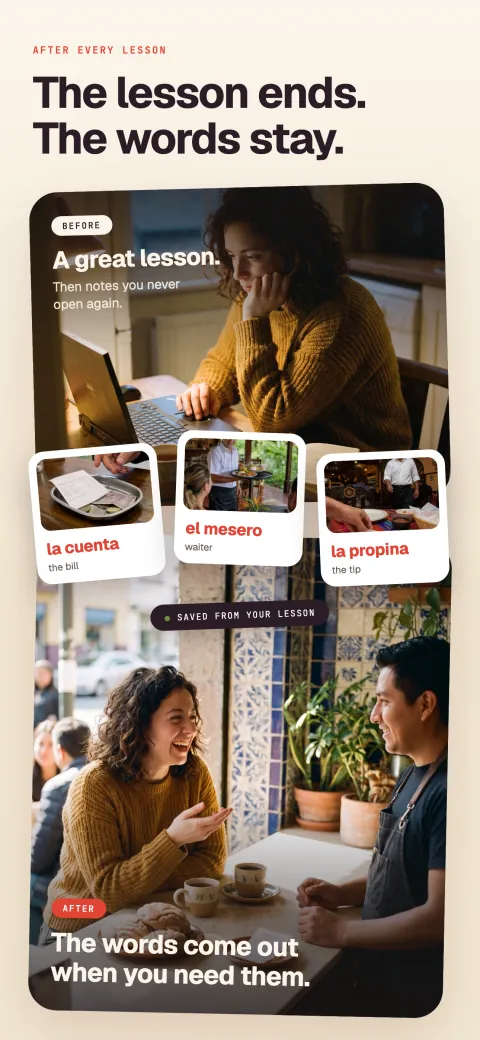
Verbamor records your lesson and turns what your tutor taught into cards that come back on schedule.

There's a notebook in my desk drawer with a year of Spanish lessons in it. Every page got written in the last few minutes of a call, in handwriting that deteriorated as the hour went.
A few words have stars beside them, because I wanted to be certain I'd come back to those ones.
I've reopened it maybe twice.
My Duolingo streak over that same year never missed. It scheduled hablar at precisely the right moment, every time, off a model fit on millions of students.
Two systems running as designed, and the one holding the words I'd actually reached for in conversation was the one made of paper.
That gap is the whole argument, and it survives every good thing you can say about Duolingo. Which is more than the internet admits.
The standard anti-Duolingo article describes an app with no real method and gamification standing in for teaching. Both halves of that are out of date.
Duolingo published a real spaced repetition model
The paper is Settles & Meeder (2016), "A Trainable Spaced Repetition Model for Language Learning." The model estimates the half-life of a word in your memory (how long until your odds of recalling it fall to half), and schedules against it.
They fit it on two weeks of logs, 12.9 million student-word traces, training on 90% and testing on the rest. It cut mean absolute error (the average gap between predicted and actual recall) "nearly in half" against Leitner, Pimsleur and a logistic regression.
The paper is careful about where it loses, too. Leitner "did yield the highest AUC values among the algorithms we tried," and the authors say so themselves. (AUC scores how well a model ranks words by recall odds.)
Then they shipped it after a six-week trial on just under 1 million students, in which daily activity moved 0.3% and practice sessions fell 7.3%. The 12% figure quoted from the abstract comes from a second experiment, comparing two configurations of HLR (their half-life regression model) against each other.
Hold whatever opinion you like about streaks and gems. A company that fit a memory model on 12.9 million traces, validated it on a million students and open-sourced the code has a spaced repetition method. "Gamified SRS" (spaced repetition system) as a dismissal is inaccurate.
Duolingo's scheduler is genuinely good at scheduling the words Duolingo chose. That sentence contains both halves of this post.
Duolingo says its courses now teach to B2
The other stale claim is the level. Plenty of older write-ups still treat it as an A2 app.
On 22 April 2026, Duolingo published its own post saying its courses now teach to "B2 on the CEFR scale, or a Duolingo Score of 129," across nine languages.
Stories and DuoRadio carry the advanced material. B2 is the independent user on that scale, the European framework for language levels: complex texts, a view on a wide range of topics.
Take that at face value. Duolingo publishes no vocabulary count for any level, and I'm not inventing one.
For the real scale of the job, Nation's figure: 6,000 to 7,000 word families for 98% coverage of spoken text. (A word family is a word plus its forms.) No app, mine included, hands you that.
Duolingo can only schedule the words it chose
Half-life regression schedules items from Duolingo's curriculum. That's what it was built for, and the paper says so plainly. The whole system runs on a fixed inventory of words chosen in advance by people who've never met you.
Which is fine, until you start speaking to a human being.
Your tutor corrects your word for a work deadline. You grope for a word in a conversation about your sister's wedding, and she hands it to you. Maybe 15 items an hour, all specific to your life, and not one will ever reach a Duolingo review queue.
Push Duolingo to C1 and this stays true by construction: a course-shaped app schedules course-shaped content.
And those words surfaced for a reason, which makes them disproportionately the ones you'll need again. Your job, your family, the thing you always end up talking about.
Duolingo's own paper is what makes this convincing rather than snide. They proved, on a million students, that scheduling the right item at the right moment works. The open question is what schedules the words from your mouth.
A word from your lesson fades within days unless you retrieve it
The gap is a week wide and everyone walks straight through it. You understand the word in the lesson. Comprehension runs on far less machinery than production, and by Thursday it has faded.
The fix is boring and well documented. Retrieve the word before it's gone, by producing it rather than recognizing it: the testing effect, with the production effect on top when you say it aloud. Duolingo does this beautifully for hablar, and can't do it for the phrase your tutor gave you on Tuesday.
Which brings us back to the drawer. A notebook is a genuinely decent answer right up until you measure how often it gets reopened. A starred word you never look at again is just ink.
The capture worked. Nothing scheduled it.
Put a tutor, some input and your own cards next to it
One rule first, because it changes what the list looks like. I publish a price only where I read it on the company's own page on 22 August 2026. Otherwise the cell says so.
| Tool | What it fixes | Price, verified 22 Aug 2026 | The limit |
|---|---|---|---|
| italki | Talking to a person | $4–$20 per lesson community, $10–$40 professional First-party pricing page. Per lesson, not per hour. | A comfortable tutor can hide that you learned nothing new |
| Preply | Talking to a person, on a schedule | $16/hr speaking practice, $21 SIELE prep, stated $15–$50 Its own labeled table, updated 2 March 2026. | Charged every 28 days, minimum 4 lessons, unscheduled ones expire |
| Anki | Holding your own words forever | Free desktop and Android, $24.99 once on iOS App Store listing. | You type every card. FSRS ships off by default |
| Graded readers | Reading volume | Library card, or a few dollars used | Nothing for production |
| A show with subtitles | Listening volume | Whatever you already pay for streaming | 40 pleasant hours can leave you unable to say any of it |
| Duolingo Max | More Duolingo | Not published on a first-party page Its App Store listing has no entry named Max, so I have no price to print. | Same fixed inventory of words |
| Babbel | Structured lessons | Not published on a first-party page Pricing page 404'd, help centre 403'd. | Another fixed curriculum |
| Quizlet Plus | Shared decks | Not published on a first-party page Page returned 403. | Other people's decks, not your lessons |
| Clozemaster | Cloze drilling at volume | Not published on a first-party page Price is rendered in the browser; the served HTML has no figure. | Sentences from a corpus, not from you |
| Memrise | Native video clips | Not published on a first-party page Nothing I could find. | Same |
| Verbamor | The words from your own lessons | $19.99 a month, or $129.99 a year 7-day trial on the annual plan. | iOS only, no free tier, no Anki import, no course past 650 starter words |
Those italki bands are per lesson, not per hour, a distinction affiliate roundups smear constantly.
And a range hides the shape. So on 22 August I wrote down the trial price of 21 Spanish tutors: $5, $5, $6, $7, $7, $9, $10, $10, $10, $11, $12, $12, $12, $12, $15, $15, $17, $18, $18, $20, $25.
The median, the middle price, was $12.
Same job at Preply, different meter. Its help centre is plain: you're charged every 28 days for a fixed number of lessons, and "any lessons not scheduled before the renewal date expire."
That cycle punishes a chaotic month. (The "$17.08 average" everyone quotes isn't a Preply number.)
Then there's Anki, which will outlive every company on this page including mine, if you'll genuinely build the cards.
One correction, since the SEO blogs have this wrong: FSRS (a newer scheduling algorithm) is opt-in. The manual calls it "an alternative to Anki's legacy SuperMemo 2 (SM-2) algorithm," enabled at the bottom of deck options. Leave it alone and you're on a 1987 algorithm.
The cost is typing every card. Migaku, which sells a tool for that exact problem, puts its own floor at 30 seconds a card, or 12.5 hours for 1,500.
For sheer volume, graded readers and a show you'll actually finish. (Graded readers are books written for learners at a set level.)
The argument for readers is that you read at a level where you're not stopping, which is the level few people pick unaided. And picking the show is most of the work.
Now look at the 5 unpriced rows. A 404, two 403s, a price assembled by JavaScript after the page loads, one company publishing nothing at all.
None of it sinister. But it means a monthly figure for any of the five would be a guess from me, so there isn't one.
Verbamor is mine, so here it is worst features first. Past a starter deck of about 650 common words it teaches you nothing, has no curriculum, no free tier, is iOS only, and can't import your Anki deck.
What it does is turn the vocabulary from your own lessons and conversations into fill-in-the-blank cards with native audio, scheduled by FSRS. You record or type what came up; it makes the cards.
A container for the words a curriculum can't know about, useless as your only tool.
The pairing I'd suggest: Duolingo for the habit, a tutor for the pressure, something you enjoy for volume, and a card system holding whatever came out of your own mouth. That's 4 things, more than most people will run. Drop the third before the fourth, since cards and input do different jobs.
Beginners who need a habit should just use Duolingo
Three disqualifications, because this post is worthless if it recommends me to everyone.
- If you're starting from zero and your real problem is consistency, use Duolingo and nothing else here. It's free, it teaches to B2, its scheduler is peer-reviewed, and at building a daily habit it beats me and everything else I know of.
- If you have no tutor, no exchange partner and no lessons, Verbamor has much less to hold. The Translate tab saves any word or phrase you look up, but a curriculum will do more for you right now. Come back when you have conversations to mine.
- If your bottleneck is nerve rather than vocabulary, more cards won't touch it. That's a different problem with a different fix, mostly hours in front of a person.
Duolingo publishes its research and gets people back tomorrow, which is the hardest thing on this entire page to do.
It just can't schedule a word it never heard you say.
Sources
Duolingo's spaced repetition model is real and published
- Settles, B., & Meeder, B. (2016). A trainable spaced repetition model for language learning. Proceedings of the 54th Annual Meeting of the Association for Computational Linguistics, 1848–1858.
- Duolingo. halflife-regression (source code and data release).
Duolingo now teaches to B2, in nine languages
- Duolingo (22 April 2026). Our courses now teach advanced content. Duolingo Blog.
How much vocabulary coverage actually takes
- Nation, I. S. P. (2006). How large a vocabulary is needed for reading and listening? The Canadian Modern Language Review, 63(1), 59–82.
Retrieval and production beat recognition
- Roediger, H. L., & Karpicke, J. D. (2006). Test-enhanced learning: Taking memory tests improves long-term retention. Psychological Science, 17(3), 249–255.
- MacLeod, C. M., Gopie, N., Hourihan, K. L., Neary, K. R., & Ozubko, J. D. (2010). The production effect: Delineation of a phenomenon. Journal of Experimental Psychology: Learning, Memory, and Cognition, 36(3), 671–685.
Anki's scheduler is opt-in, and cards take time to build
- Anki. Deck options: FSRS. Anki Manual.
- Anki. AnkiMobile Flashcards (App Store listing, $24.99 one-time, checked 22 August 2026).
- Migaku. How to make Anki cards (30 seconds per card, 12.5 hours for 1,500).
Tutor pricing, from first-party pages only
- italki. How much does italki cost? (per-lesson bands). Spanish trial-lesson prices observed directly, 22 August 2026.
- Preply. How does my Preply subscription work? (28-day cycle, minimum 4 lessons, unscheduled lessons expire).
- Preply. Spanish tutoring rates (labeled "Average Price on Preply," updated 2 March 2026).
Keep the words your tutor gave you.
Verbamor turns the vocabulary from your own lessons into fill-in-the-blank cards with native audio, scheduled by FSRS.
Start 7 days freeThe 7-day free trial is on the yearly plan.