Verbamor
Graded readers work, for the opposite reason they are sold
Graded readers teach almost no new words: 25 planted in one reader left about 1 after 3 months. Where they earn their place is reading speed and words you already half-know, and reading volume moves reading proficiency by d = 0.57. So take the words you guess at to your tutor for the 8 sightings a word needs.
You finished the Level 3 reader in a week. Somewhere around 15 words you had to guess at from context. Reading a whole book in Spanish is a real thing to have done.
Now it's a month later. Name 5 words you learned from it.
01 / 05 · the measurementHow many words from one graded reader survive 3 months?
About 1 new word in 25. That's the documented rate, and almost everyone who reads that book comes out holding the same one.
Rob Waring and Misako Takaki ran the cleanest test of graded-reader vocabulary anyone has run. Their 2003 study gave 15 Japanese learners a Level 1 Oxford Bookworm, A Little Princess.
They had respelled 25 words inside it (house became windle) so nobody could have known them already. Readers took 56 minutes.
Then the researchers came back at 3 months. Out of 25 words planted in a book people actually read, roughly 1 survived.
A whole book buys you 1 word.
Keep reading graded readers anyway. Judge a graded reader by how much it thickens vocabulary you already half-know.
A reader takes a word you've met twice and pushes it past you 8 more times inside a story you care about. Back covers sell headword counts (how many base words a level uses) instead.
The 8-sighting floor comes from the same Waring and Takaki paper. Every word met fewer than 8 times was gone at 3 months, all of them, for all 15 readers.
So catch the words while you still have them. Keep a scrap of paper in the book as your bookmark, and write down every word you guess at instead of looking up. Then bring it to your tutor: "I met these while reading. I only half-know them. Use them on me until I've hit each one 8 times."
Then tell your tutor what counts, because an encounter is a moment where the word makes you do work.
A question you can't answer without understanding the word counts. A sentence they make you build around it counts. A story where they use it and wait for you to react counts.
And tell your tutor to open each session by recycling last week's words before touching the new ones. Otherwise you'll get 8 encounters spread across 15 words instead of 8 encounters each.
Even a cleared list is thin cover. Words seen 15 or more times scored 42% immediately and 6% at 3 months. So when half your list goes anyway, stop trusting reading to do the remembering.
02 / 05 · the arithmetic8 sightings is the floor, and one chapter gives 2 or 3
The numbers underneath Waring and Takaki's result. 400 headwords, 5,872 running words, 96.2% coverage (the share of the text's words the readers already knew).
Right away the readers could translate 4.6 of the 25 words, 18.4%. At 3 months, under 1. About 3.6%.
The easier tests decay more slowly. Word-form recognition went 15.3 down to 8.4. Prompted meaning recognition went 10.6 down to 6.1.
What's left is a shape the reader recognises, stripped of the meaning they were reading for. More on why that decay curve is so steep.
Something did survive in Waring and Takaki's readers. Those women moved at 104.8 words a minute, and 3 months later 8.4 of the fake words were still sitting there as shapes. Reading speed is what turns a language you've studied into one you can use on a page.
Read 1 chapter a sitting. At a Level 1 or 2 reader that's 15 to 20 pages, roughly 30 minutes, and a book pitched at your level should throw up 10 to 15 unknown words. If a chapter gives you 40, drop a level.
Then bring your list of unknown words to your next lesson. 8 exposures is the floor, and your book gave most of those words 2 or 3. Your tutor can supply the rest in 50 minutes.
Say this: "I read this chapter last week, here are 12 words from it, can we use these today instead of new vocabulary."
Now do the arithmetic on what the lesson pays out. 50 minutes of talking lands 5 or 6 of your 12 words at maybe 4 or 5 exposures each, and the other 6 get said once and float off. So at the end of the hour, circle the ones your tutor drilled and cross out the ones that never came up twice.
The crossed-out words go back in the book. Re-read the same chapter before you start the next one, which takes 10 minutes the second time and hands every word on the page another sighting. That gets you to 8: the book gave 3, the lesson gave 4, the re-read gives the last one.
03 / 05 · the trapThe feeling of knowing outlasts the word underneath it
Waring and Takaki's study tracked a second number, and it's the one that changed how I read. They asked the readers to flag words they recognised.
Right after reading, 8.5% of those claims were wrong. Three months later, 28.5% were. The readers kept the feeling of knowing and lost the word underneath it.
Repeat sightings are why reading a graded reader feels so good. You meet a word on page 8, again on page 20, again on page 41.
By the third meeting it's warm, and your brain files that warmth as learning. That warmth is fluency of processing, a measure of how smoothly the word went down, and the reading gives you no way to tell it apart from knowing.
Reading only ever tests you on recognition, the easy one, with the word right there on the page. Pulling it out of an empty room is what builds the memory.
Here's the practical ruling: never grade a word while you're reading it. And write the English only.
Put windle next to "house" and you've built a page you can read straight down and feel good about, the exact trap the 28.5% figure describes. Leave the right side blank. The right side is the test.
Then hand the English side to your tutor in random order, because you can't run a cold prompt on yourself. "Prompt me on these one at a time with no sentence around the word. Mark every word I hesitated on." Hesitation is a word you'll produce today and lose by March.
04 / 05 · what survivesReading volume does move reading proficiency: d = 0.57
The effect size of reading volume on reading proficiency, a measure of how big the difference is, is d = 0.57. Jeon and Day found it in their 2016 meta-analysis, pooling 71 samples and 5,919 participants. The confidence interval, the range the true value likely sits in, is 0.46 to 0.68.
The average reader ended up at the 72nd percentile of the control group. Adults beat kids: d = 0.67.
Nakanishi's 2015 meta-analysis is d = 0.46 across 34 studies and 3,942 participants, pointing the same direction.
What improves is speed. Meet a word 40 times in print and it stops needing a lookup. Vocabulary tests are blind to that.
The rest is the stuff around the word. Which preposition it takes. Which adjectives it sits next to.
Spanish speakers say me da vergüenza, which puts the shame in the position of something handed to you. Volume of text teaches that part, cheaply.
None of the reading gains work at the wrong level. So run the page test.
Open any reader to a page in the middle and count the words you'd look up. More than 2 or 3 and you're a level too high.
Dropping down will feel insulting. Do it anyway. At 98% understood, the repeat sightings land. At 90% you're decoding, and decoding eats the attention the repeats need.
If you're starting Spanish, the right level is Penguin Readers Level 1 or the Lecturas Graduadas A1 series. Start lower than your ego wants.
On volume: 30 to 40 sightings is the threshold, and a Level 1 reader holds about 6,000 words. Aim for 1 reader a week, 40 to 50 pages. At Waring's 104.8 words per minute, that's 20 minutes a night.
05 / 05 · the ceilingThe hardest reader stops about 6,000 words short of a novel
Count the headwords. Cambridge English Readers stop at 3,800. Penguin stops at 3,000.
Oxford Bookworms tops out at 2,500. A real novel wants 8,000 to 9,000.
So there's a gap of roughly 6,000 words between the hardest graded reader and the easiest paperback. You can read every level 6 reader ever printed and never meet them once.
Pellicer-Sánchez and Schmitt (2010) went looking above the ceiling. 20 advanced Spanish learners read Things Fall Apart unmodified, about 67,000 words, over a month, for pleasure. 34 Ibo words nobody could have known.
Across all frequencies, the novel readers showed measurable learning in 28% of cases, 9.39 words out of 34. Meaning recall came in at 14%.
And the novel study had no delayed post-test, meaning no second test weeks later. The authors say so themselves. Those are day-one numbers, before any forgetting, and Waring and Takaki (2003) is what happens 3 months later.
So above the ceiling, read normally and underline. At the end of the session, pick 6 words and leave the rest underlined. Pull 30 and you've built a list you'll meet twice each, which is a list you're going to lose.
Hand those 6 words to your tutor before the small talk, or the hour will eat them. Ask for the specific moves, because a tutor who asks what each word means has given you 1 meeting per word and called it practice.
- Ask me a question the word is the answer to. Ask me what time I got in on Saturday, and make me reach for madrugada myself.
- Say my answer back to me with the word in it. I'll fumble the sentence. You repair it out loud, and I'll hear it built correctly right after I built it wrong.
- Make me use it about something real. My commute, my sister, the thing I'm annoyed about this week.
- Come back to it cold 20 minutes later. No warning and no run-up.
Running all four moves takes about 4 minutes a word. 6 words fills half the hour and gets each one to 5 or 6 meetings. The last 2 come from the week: a card each, 2 minutes a morning.
Then Thursday 2, where most people's system quietly dies. The same 6 come back first, cold.
Whatever you produce clean, retire: it's had 8-plus meetings and a week of sleep on top, the bar Waring and Takaki set. Whatever you fumble rides into week 3 with a fresh harvest.
Run the loop 4 weeks and the arithmetic is about 18 to 20 retired words, not 24, because a few fail out. That's still 20 times what a month of unassisted reading gave those Spanish learners at 3 months.
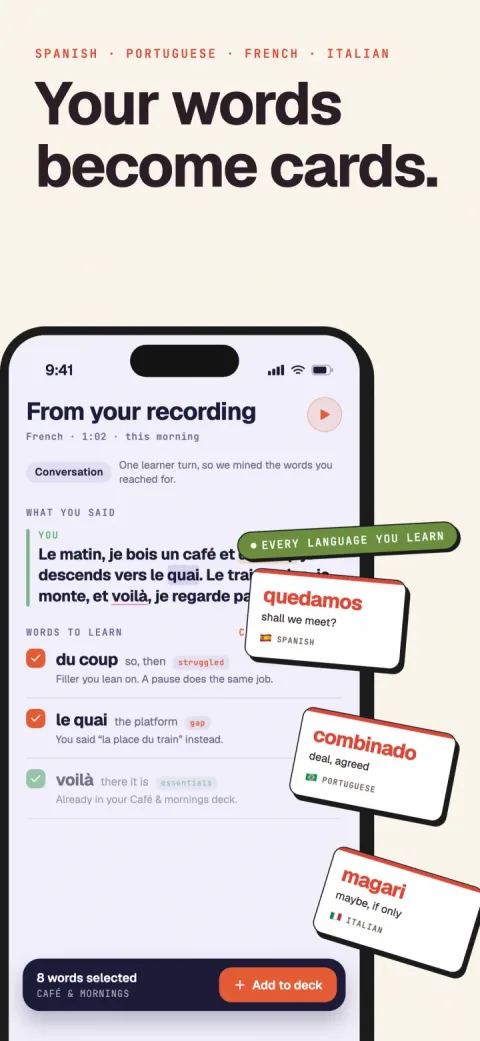
Verbamor is that loop, built because I kept losing the words between one Thursday and the next. It records the lesson, pulls out what you heard, and brings those words back while they're warm.
You can run the same loop with a notebook and an honest tutor. The reader and the cards do different jobs, and the words in the gap only ever come from the second one.
Sources
A whole graded reader leaves you about 1 new word in 25 after 3 months
- Waring, R., & Takaki, M. (2003). At what rate do learners learn and retain new vocabulary from reading a graded reader? Reading in a Foreign Language, 15(2), 130-163.
Words met fewer than 8 times don't survive, and familiarity outlives meaning
- Waring, R., & Takaki, M. (2003). At what rate do learners learn and retain new vocabulary from reading a graded reader? Reading in a Foreign Language, 15(2), 130-163.
Reading a real novel doesn't close the gap either
- Pellicer-Sánchez, A., & Schmitt, N. (2010). Incidental vocabulary acquisition from an authentic novel: Do Things Fall Apart? Reading in a Foreign Language, 22(1), 31-55.
Extensive reading does move reading proficiency, and adults gain most
- Jeon, E.-Y., & Day, R. R. (2016). The effectiveness of ER on reading proficiency: A meta-analysis. Reading in a Foreign Language, 28(2), 246-265.
- Nakanishi, T. (2015). A meta-analysis of extensive reading research. TESOL Quarterly, 49(1), 6-37.
Reading thickens. Cards add.
Verbamor takes the words from your lessons and schedules them so the new ones actually stay.
Start 7 days free