Verbamor
How to pick a first show that is actually at your level
Pick a soap opera for your first show: Ha (2022) found soaps need about 2,000 word families for 95% coverage, against 3,000 for general TV. Then test the show: play 60 seconds with subtitles off and tally the words you miss. Roughly 3 or fewer means you're at or above 95%.
You did what the internet told you. You put on the prestige crime drama, the one on every list. Four minutes in, you were reading the English subtitles and had quietly stopped listening to the Spanish.
Recommendation lists rank shows by how good they are.
The easiest genre is the soap opera
Ranking by quality is why Narcos and La Casa de Papel land on every beginner list, next to shows needing thousands fewer words.
A show's word difficulty is measurable. Webb and Rodgers (2009) ran 88 television programs through a corpus (a collection of transcripts) of 264,384 running words.
To cover 95% of what you hear, some genres needed 2,000 word families, others 4,000. For 98%, the spread ran 5,000 to 9,000.
Webb and Rodgers counted word families, so run, runs, running count once. The gap between the easiest genre and the hardest is bigger than most learners' entire vocabulary, and those first 2,000 families do far more work than the next 2,000.
Ha (2022) redid the count on an updated wordlist and got friendlier numbers. Soap operas: 2,000 families for 95% coverage, 4,000 for 98%.
General TV programs sit at 3,000 and 5,000, movies at 2,000 and 5,000. Treat every figure here as rough.
Both Webb and Rodgers and Ha counted English-language television, so the sizes will move in Spanish, though I'd be surprised if the ordering did. What makes a soap easy is built into the thing: a small cast, the same rooms every week, and actors who say the important line twice.
The easiest genre is the soap opera. Your teacher was probably too embarrassed to bring it up.
Here are 3 you can start tonight. Pick the accent that matches where you're headed.
- Rebelde (Netflix). Teenagers at a boarding school, in the neutral Mexican Spanish most learning material trains you on.
- Gran Hotel (Netflix). Period drama, 1905, slow enough that you can miss a line and stay oriented. Castilian vosotros and the c/z lisp, so take it if Spain is where you're going.
- Pasión de Gavilanes (Netflix). Colombian Spanish is clear and slow. Ranch melodrama, and the ridiculousness is what keeps you watching past minute 4.
Watch 10 minutes of one of those soaps, subtitles off, and write down the 5 spots where you lost the thread. Then open your next lesson with the exact words: "I watched 10 minutes of Rebelde and lost the thread at these 5 spots. Can we read them together and tell me if it's vocabulary or speed?"
If the answer is vocabulary, pull every word you didn't know out of those 5 lines, usually 15 to 25. Study them for a week, then rewatch the same 10 minutes and count how many of the 5 spots you now understand.
If the answer is speed, the words are already yours and your ear is losing them. Take 1 of the 5 lines, play it 10 times in a row, then say it back at the speed the actor said it. 5 minutes a day, 1 line a day, drilling the listening problem.
Guessing costs a month. Asking costs 10 minutes of homework.
How much do you understand if you know 95% of the words?
Know 19 words out of every 20 in a scene and you'll still miss about 1 line in 7.
Durbahn and colleagues (2024) swapped 5%, 10%, or 20% of the words in documentary clips for invented ones, then tested what viewers understood. At 95% coverage, comprehension landed around 85.7%. At 80% it fell to about 71.4%, the 4-minute wall you already hit.
The coverage curve underneath that 85.7% is steep. Nation (2006) counted the vocabulary in Shrek, proper nouns included.
The first 1,000 word families cover 83.01% of the script. Push to 2,000 and you get 87.91%. Push to 3,000 and you jump to 94.28%.
Then the coverage curve flattens. 4,000 families gets 96.74%, 5,000 gets 97.62%, and 98% needs somewhere near 7,000. The last 1 percentage point costs more than the first 10 did.
You can get a coverage ruling on any show in a minute. Play 60 seconds of real dialogue, no subtitles, and write down every word you didn't catch.
Roughly 3 or fewer puts you at or above 95%. More than 3 and an hour of it washes over you.
If you tallied 7, here's the Spanish ladder, by the tally you'd get at roughly 1,000 word families:
- Extra en Español: about 1 a minute. Sitcom Spanish written for learners, and every line is repeated in some form.
- Destinos: about 2 a minute. A telenovela built as a course, so a narrator recaps the plot in easier Spanish after every scene.
- Gran Hotel: about 4 a minute. Real telenovela speed, but the plot is so signposted you can lose a line and stay oriented.
- Narcos: about 7 a minute, which is where you started.
A tally of 0 or 1 means the show has nothing left to teach you, so climb a rung tonight. Aim for 2 or 3 a minute, where you understand the scene and still meet words worth keeping. Those are my own tallies, so run your own 60 seconds.
Measure your vocabulary first, then close the gap on purpose
Before you press play, find out where you stand. Take Paul Nation's free Vocabulary Size Test, or convert from CEFR, the European scale of levels: A2 is roughly 1,000 word families, B1 roughly 2,000, B2 roughly 3,000.
Say you land at 1,200. You're 800 short of soap comfort.
Watching alone, at 8 words an episode and 2 episodes a week, you'll pick up about 65 a month, so 12 months for 800. Want it in 4? Bolt on a deck or a frequency list and add 130 a month on top of the show.
Then start the soap. Café con Aroma de Mujer, Yo Soy Betty, la Fea and Rubí are all on Netflix, and Avenida Brasil drifts between Globoplay and Netflix by country. Italian and French have no telenovela tradition, so take Un Posto al Sole (RaiPlay) or Plus Belle la Vie (France.tv).
About 650 words carry most of the load, which the frequency curve post works through. Several hundred more come nearly free, because familia, momento and importante are already words you know. That's the cognate discount: words that look and mean the same in both languages.
Then hand your tutor this: "I'm watching Rubí, 2 episodes a week. Can we spend 10 minutes a lesson on the words I pulled from it, and tell me which are frequent enough to keep?"
Ask your tutor that question every week. She can tell you in 5 seconds whether a word is common or soap-opera scenery you'll never hear again.
Sutton and Webb (2026) pooled 56 experiments and found viewing with supplementary activities beat viewing alone, g = 1.09 against .76. (g is an effect size, a standard measure of how big a difference is.) The lesson is that activity.
Documentaries beat TV drama by more than double
Documentaries came out at g = 1.21. TV series came out at .51. That's Sutton and Webb's 2026 meta-analysis in SSLA, a study pooling 75 effect sizes from 56 experiments and 1,954 learners.
Watching video scored g = .89 overall. Video type mattered at p = .00, meaning the gaps were very unlikely to be chance: TED Talks 1.23, documentaries 1.21, movies .53, TV series .51.
My honest read on why documentaries win: narration is slower than dialogue. One person reads a drafted script aloud, and the camera holds on what the narrator just named. Drama keeps the important thing off screen while two characters talk over each other in slang.
Documentaries and TED Talks beat drama by more than double.
Grade the source before you commit. Narration is dense native speech with no repetition and no plot to carry you. So a 55-minute wildlife film at B1 is 55 minutes of feeling stupid.
Open a 6-minute DW Español explainer, turn Spanish subtitles on, and watch 60 seconds. Lost even with the subtitles carrying you? Drop a tier.
A tier below, News in Slow Spanish reads real news at maybe 60% of normal pace, in 5-minute segments, with a full transcript. The slow delivery does the work: you hear where each word ends. It stops feeling slow after about 3 weeks, your signal to move up.
News in Slow French, News in Slow Italian, Coffee Break Italian and Practice Portuguese do the same job.
Above that, DW Español runs 6 to 10 minute explainers with clear studio narration, roughly B1, and RTVE's Documentos TV is the step up at B2. Elsewhere: ARTE and Brut in French, DW Brasil and RTP Play in Portuguese, Rai Cultura and Rai Documentari in Italian.
Watch 15 minutes with subtitles on in the language you're learning. English subtitles turn it into reading practice, and you'll stop hearing the audio inside 2 minutes.
Four minutes of tally marks rules a show in or out
Put on an episode with every subtitle off, keep a pen in your hand, and watch 4 minutes.
A mark is one tally per sentence where you couldn't say what just happened, called live, at full speed, no rewinding. Half-caught counts as a mark. Half-caught is the whole problem.
Tick the margin every time somebody finishes a line. Fast dialogue runs about 40 sentences in 4 minutes, a telenovela about 25.
At 40 sentences, under 3 marks: this show is at your level. Watch it.
Between 3 and 8 you're on the edge. 8 marks out of 40 means a fifth of the scene went past you, the 71.4% rung. You can stay with Spanish subtitles on and a second pass.
The thresholds tighten to 2 and 5 at 25 sentences: 8 marks out of 25 is 68% comprehension, under the rung I just used to justify staying. A slow show can hand you a comfortable 6 marks while you're failing it.
Over your top number: close it. You're under Ha's soap-opera bar, and prestige crime drama sits thousands higher.
Beginners, start with Yo soy Betty, la fea or Rebelde, both 25-sentence shows, so use 2 and 5. Past that, run the same 4 minutes on Narcos or La Casa de Papel. Narcos buries Colombian slang inside overlapping dialogue, and the Money Heist crew talks over each other by design.
Then carry the marks into your next lesson, play those sentences for your tutor, and ask the same question: vocabulary or speed?
Pull the word list straight off your own marked sentences. Your marks give you the words standing between you and the episode you already want to finish. Cards from your own viewing are the cheapest deck you'll ever build.
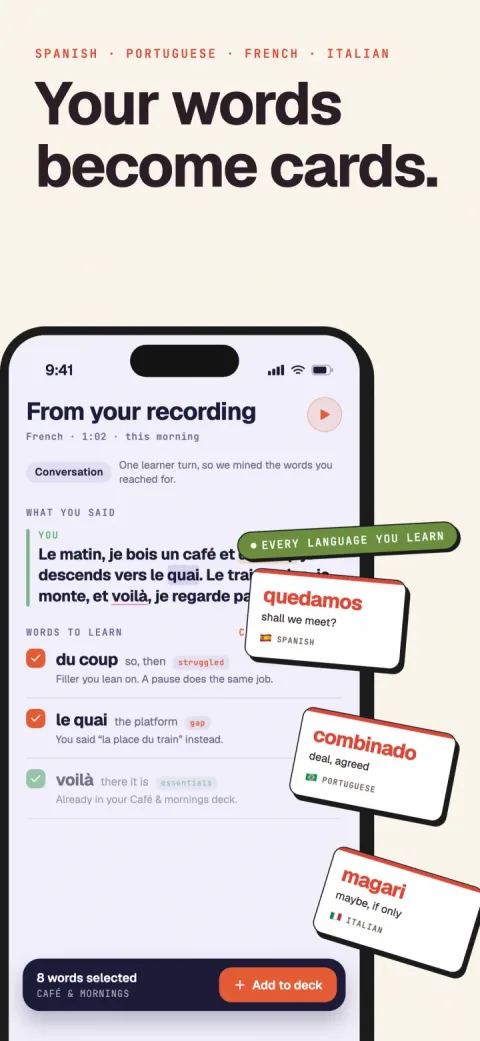
Writing words down mid-episode is also how people quit. Verbamor records your tutor lesson and turns the vocabulary you met into cards that hide each word inside its sentence. Each card gets an image and 2 recordings of that sentence in a native accent.
Your teacher was embarrassed to recommend the telenovela. The word counts say she should have led with it.
Sources
Soap operas need thousands fewer word families than prestige drama
- Ha, H. T. (2022). Vocabulary Demands of Informal Spoken English Revisited: What Does It Take to Understand Movies, TV Programs, and Soap Operas? Frontiers in Psychology, 13, 831684.
- Webb, S., & Rodgers, M. P. H. (2009). Vocabulary Demands of Television Programs. Language Learning, 59(2), 335–366.
95% coverage gives you about 86% comprehension, and 80% drops you to 71%
- Durbahn, M., Rodgers, M., Macis, M., & Peters, E. (2024). Lexical coverage in L1 and L2 viewing comprehension. Studies in Second Language Acquisition, 46(4), 1045–1068.
The first 3,000 word families do most of the work, and the last 1% costs the most
- Nation, I. S. P. (2006). How large a vocabulary is needed for reading and listening? The Canadian Modern Language Review, 63(1), 59–82.
Documentaries beat drama, and doing something afterward beats watching alone
- Sutton, D., & Webb, S. (2026). The effects of audiovisual input on second language learning: A meta-analysis. Studies in Second Language Acquisition, 48(2), 571–595.
The words you paused on become cards.
Verbamor builds a fill-in-the-blank card, with native audio, from language you actually met.
Start 7 days free