 Verbamor
The best way to learn German as an adult
The best way to learn German as an adult is to learn every noun with its article, der, die or das, from the first day, get the four cases from a course or a tutor, and review your words every day. English already gives you thousands of German words, so start with those. For the words themselves on cards, see German flashcards.
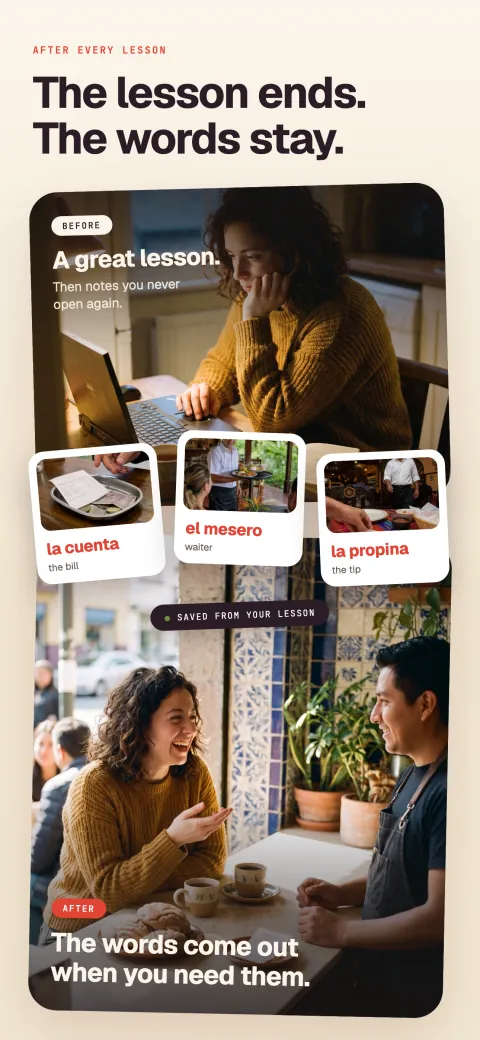
Verbamor records your lesson and turns what your tutor taught into cards that come back on schedule.

The head start English gives you
German and English are close relatives. Haus is house, Wasser is water, Hand is hand, and a whole layer of later borrowings lines up by ending: Nation, Universität, Energie, praktisch. The free German word patterns page lists 26 of those rules with 203 example words, and the cognate checker now guesses the German twin of an English word and labels every guess.
Watch the false friends while you collect them. Gift is poison, bekommen is to get, and Handy is a cell phone. They’re few, and they’re the ones that embarrass you at dinner.
What makes German hard
Three things, and the order matters.
Every noun has a gender. Der Löffel, die Gabel, das Messer: spoon, fork and knife take three different articles, and the thing itself won’t tell you which. Learn the article as part of the word, out loud, from the start. Retrofitting it later is the hardest habit in German to fix. The ending helps more than people expect, which is what the der, die or das checker is for.
Four cases. The article changes with the noun’s job in the sentence: der Hund becomes den Hund when you see the dog and dem Hund when you give it something. This is grammar, and it’s where a course or a person explaining your own mistakes earns its price.
Verbs that move. Anrufen is to call, and in a sentence it splits: ich rufe dich morgen an. In a subordinate clause the verb goes to the end. You understand this in an afternoon and you stop getting it wrong after months of hearing it.
Capital letters are the one easy rule. Every noun starts with one, which makes German text easier to read than it looks.
What I sell
I build Verbamor, an iPhone and iPad app that turns the German from your own lessons, conversations and reading into flashcards. It’s $19.99 a month or $129.99 a year, US prices from the app’s own plan definitions on 21 September 2026, and the App Store may show a different number where you are. It has no course and no grammar lessons, so it won’t take you from zero, and I’ll say below who should spend their money elsewhere.
The routes, and what they cost
| Route | What it gives you | Cost |
|---|---|---|
| Duolingo | A free course, one of nine that now run through CEFR B2. 15.9M learners on Duolingo’s own count | Free, or Super from $9.99 on the App Store |
| Babbel | Lessons with grammar tips, and a placement quiz for German | $107.40 for 12 months (13 Oct 2026) |
| Mango Languages | 721 German lessons, its largest course | Free with a library card, if your library subscribes |
| A tutor on italki | A person who hears your mistakes and explains the cases you keep missing | Community $4–$20, professional $10–$40 a lesson |
| Anki | Flashcards you build yourself, any material, any scheduler setting | Free on a computer, $24.99 on iPhone |
| Verbamor | Cards built for you from what you meet, each noun with its article | $19.99 a month or $129.99 a year |
None of these is the whole job. A course gives you the grammar in an order, a person catches your own mistakes, and a review habit keeps the words. Pay for at most one of each.
Which route fits which learner
Starting from zero, nothing spent yet. Duolingo’s free course for structure and free Anki on a computer for the words. Give it three months before you pay anyone.
Want more grammar along the way. Babbel, whose lessons carry grammar tips as you go, or Mango if your library subscribes. The cases reward a course that stops to tell you why.
Moving to Germany, Austria or Switzerland soon. A tutor, early. Two lessons a month is the best money on this page, because it turns the cases from a table into something you say.
You like making things. Anki, free on a computer, with FSRS turned on in the deck options. Put the article on the front of every noun card. For this learner Anki beats my app on price, and I’d recommend it.
What the courses leave behind
Courses teach the German their authors picked. That’s the right way to get the first thousand words and the grammar.
What they don’t keep is the German you met yourself. Your tutor says das ist mir egal, a colleague says Feierabend, a show uses sich beeilen, and by the weekend you remember the meaning and not the article or the sentence.
Verbamor is built for that. Record a lesson or a conversation, paste a transcript, or translate a phrase, and it turns the words and phrases into cards: the word gapped out of its sentence, with audio and a picture, and every noun with its article. It starts you with a deck of about 650 common German words, and FSRS schedules the reviews.
The honest limits. It won’t teach you the cases, and its cards don’t drill plurals yet. From zero, Duolingo’s free course will do more for your first months than my app will.
Questions people actually ask
How should an adult start learning German?
Start with the words English already shares, like Haus, Wasser and Nation, and learn every noun with its article from the first day. Take a course or a tutor for the four cases, and review vocabulary for a few minutes every day so it stays.
Is German hard for English speakers?
The vocabulary is easier than it looks, because English and German are close relatives and share thousands of words. The grammar is the hard part: three genders, four cases and verbs that split or move to the end of the sentence.
Do I need to learn der, die and das?
Yes, with every noun, as part of the word. The article decides how the rest of the sentence is built, and fixing a wrong article later is harder than learning the right one first. Noun endings predict it more often than people expect, for example -ung is always die.
Is Duolingo enough to learn German?
Duolingo is a good free start, and its German course now runs through CEFR B2 on Duolingo’s own description. Most learners still need a person to explain the cases they keep getting wrong, and a way to keep the words they meet outside the course.
Sources
Courses and prices, each read on its own page
- Duolingo. Courses for English speakers, rendered 13 October 2026: German 15.9M learners, Duolingo’s own count. Our top courses now teach advanced content, 22 April 2026: German is one of the nine courses that go through CEFR B2.
- Babbel. Placement quiz, read 17 October 2026: available for Spanish, French, Italian and German. Prices, read in a browser 13 October 2026: 12 months $107.40.
- Mango Languages. Available-languages page, read 21 September 2026: German 721 lessons, the most of any language it lists a count for. Libraries, read 18 October 2026: free access with a library card where the library subscribes.
- Duolingo. Explain My Answer is now free, 1 January 2026, for courses teaching Spanish, French, German, Japanese, Portuguese, Italian and Korean.
- Babbel. Home page, read 17 October 2026: “Get helpful grammar tips while reading, writing, listening, and exploring culture bites.”
- italki. Teachers and price guide, read 13 October 2026: community tutors “$4-$20 per lesson”, professional teachers “$10-$40 per lesson”.
- Apple App Store, US. AnkiMobile $24.99, and Duolingo Super entries from $9.99 to $119.99, read 13 October 2026.
What builds memory
- Karpicke, J. D., & Roediger, H. L. (2008). The critical importance of retrieval for learning. Science, 319(5865), 966–968.
- Cepeda, N. J., Pashler, H., Vul, E., Wixted, J. T., & Rohrer, D. (2006). Distributed practice in verbal recall tasks. Psychological Bulletin, 132(3), 354–380.
The German you meet, kept with its article.
Verbamor turns the words from your lessons and conversations into cards from the sentence you heard, with der, die or das on every noun.
Start 7 days freeThe 7-day free trial is on the yearly plan.