 Verbamor
German flashcards: learn the article with the word
A good German flashcard puts the article on every noun, der Tisch rather than Tisch, shows the word in a sentence you could say, and plays it aloud. Review it on a spaced schedule and you keep it. Build the cards yourself in Anki, or let an app like Verbamor build them from the German you meet.
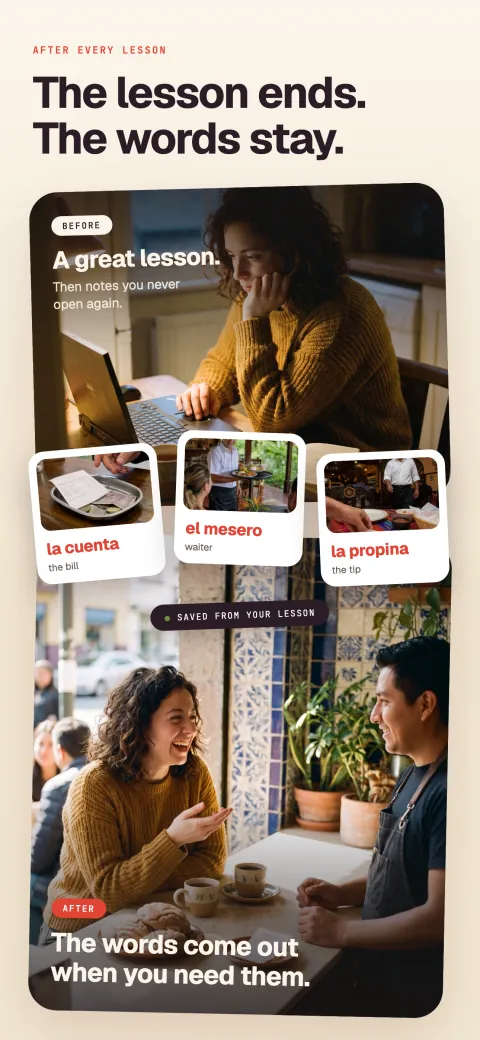
Verbamor records your lesson and turns what your tutor taught into cards that come back on schedule.

Put the article on the card
A German noun without its article is half a word. Tisch on a card teaches you the meaning; der Tisch teaches you the word you’ll actually say. The article decides the endings around it, so a learner who knows a thousand bare nouns still can’t build a sentence with them.
So the rule for every noun card is the article, always, on the side you have to produce. If you only see der on the answer side, you’ll recognise it and never recall it.
Endings take some of the load off. -ung, -heit, -keit and -schaft are always die, -chen is always das, and a compound takes the gender of its last part. The free der, die or das checker shows the rule behind each guess, which is quicker than memorising the exceptions one by one.
What else a German card needs
A sentence. A word met in a sentence brings its grammar with it. Ich rufe dich morgen an teaches you that anrufen splits, which a card saying “anrufen: to call” never will.
Audio. German spelling is regular, but ei, ie, w and z all sound different from English, and a card you only read gets an English accent by default.
Retrieval on a schedule. Make yourself produce the word before you flip the card, and let a scheduler bring it back just before you’d forget it. Retrieval practice beats rereading (Karpicke & Roediger, 2008), and spacing beats cramming (Cepeda and colleagues, 2006).
What I sell
I build Verbamor, an iPhone and iPad app that turns the German from your own lessons, conversations and reading into flashcards. It’s $19.99 a month or $129.99 a year, US prices from the app’s own plan definitions on 21 September 2026, and the App Store may show a different number where you are. It has no course and no grammar lessons, so it won’t take you from zero, and I’ll say below who should spend their money elsewhere.
The options for making them
Anki, built by hand. Free on a computer, $24.99 on iPhone, and every card is yours to design: article on the front, plural on the back, your own sentence. Turn FSRS on in the deck options. If you like building, this is the best deal here.
A premade deck. Fast, and it teaches somebody else’s German. Check that every noun carries its article before you download one, because plenty don’t.
Verbamor, built from your German. You record a lesson or a conversation, paste a transcript, or translate a phrase, and it makes the cards from the words and phrases that came up: the word gapped out of its sentence, with audio, a picture, and the article on every noun. It starts you with a deck of about 650 common German words, and its Word patterns screen has 26 rules that turn English you know into German. FSRS schedules the reviews.
Where Verbamor falls short
It’s iPhone and iPad only, with no Android and no web. It has no course and no grammar lessons, so it won’t teach you the cases or take you from zero. Its cards don’t drill plurals yet. And its audio is synthesised with a native-accent instruction, not recorded by a person.
Questions people actually ask
How do you make good German flashcards?
Put the article on every noun, der Tisch rather than Tisch, show the word in a sentence you could say, add audio, and make yourself recall the word before you flip the card. Review on a spaced schedule so each card comes back before you forget it.
Should German flashcards include der, die and das?
Yes, on every noun, on the side you have to produce. The article decides the endings around the noun, so a card without it teaches only half the word.
What is the best app for German flashcards?
Anki, if you like building your own cards; it is free on a computer. If you would rather have the cards made from the German you meet in lessons and conversations, Verbamor builds them with the article, a sentence and audio.
How many German words do I need?
A few hundred common words carry most everyday conversation, which is why a starter deck of about 650 words is a sensible first target. Past that, the words worth learning are the ones you keep meeting.
Sources
What builds memory
- Karpicke, J. D., & Roediger, H. L. (2008). The critical importance of retrieval for learning. Science, 319(5865), 966–968.
- Cepeda, N. J., Pashler, H., Vul, E., Wixted, J. T., & Rohrer, D. (2006). Distributed practice in verbal recall tasks. Psychological Bulletin, 132(3), 354–380.
Prices
- Apple App Store, US. AnkiMobile $24.99, read 13 October 2026.
- Verbamor. $19.99 a month or $129.99 a year, from the app’s own plan definitions on 21 September 2026; the 7-day trial is on the yearly plan only.
Every German noun, with its article.
Verbamor builds German cards from what you meet, with der, die or das, the sentence you heard and audio on every one.
Start 7 days freeThe 7-day free trial is on the yearly plan.