 Verbamor
The best app to learn German, judged on the hard parts
The best app to learn German depends on the job. Duolingo is the best free course, Babbel explains the grammar better, a tutor app is the only one that fixes your cases, and Anki or Verbamor keeps the words with their articles. Most learners need one course and one way to review, not five apps.
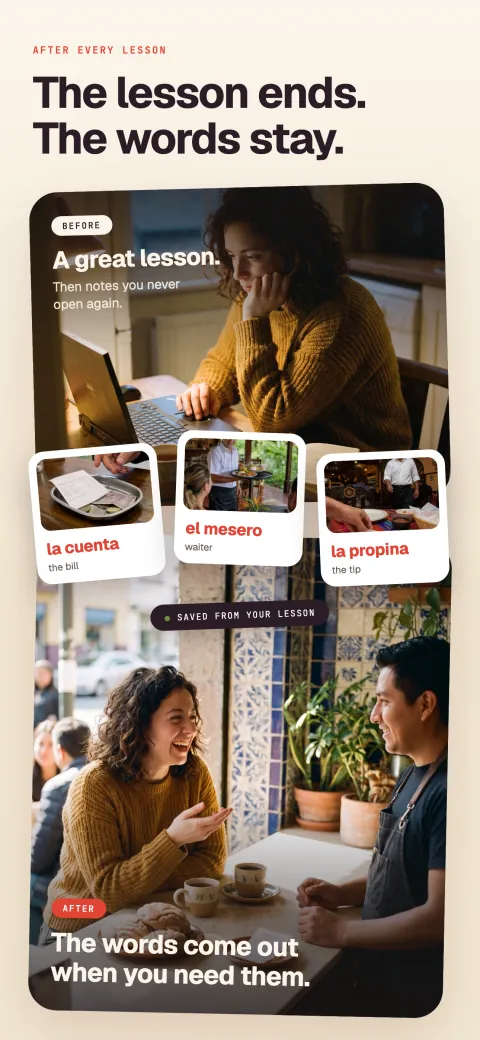
Verbamor records your lesson and turns what your tutor taught into cards that come back on schedule.

German has four jobs, and no app does all of them
Judge a German app on the parts of German that are actually hard, rather than on how many lessons it has.
The course. Something has to put the grammar in an order. The cases. Somebody has to explain why you said dem when it was den. Speaking. You need a person or a convincing stand-in to talk to. Keeping the words. Every noun has to come back with its article until you no longer think about it.
What I sell
I build Verbamor, an iPhone and iPad app that turns the German from your own lessons, conversations and reading into flashcards. It’s $19.99 a month or $129.99 a year, US prices from the app’s own plan definitions on 21 September 2026, and the App Store may show a different number where you are. It has no course and no grammar lessons, so it won’t take you from zero, and I’ll say below who should spend their money elsewhere.
The apps, one by one
Duolingo, for the free course
The best place to start for nothing. German is one of the nine Duolingo courses that now teach through CEFR B2, according to Duolingo’s post of 22 April 2026, and its own course page counts 15.9 million German learners. When you get an answer wrong, Explain My Answer tells you why, and Duolingo made it free for German learners on 1 January 2026. What no course can do is notice the case you get wrong when you speak. Super starts at $9.99 on the US App Store.
Babbel, for grammar along the way
Babbel promises “helpful grammar tips while reading, writing, listening” in its lessons, and German is one of the four languages with a placement quiz that recommends where to start. Twelve months cost $107.40 on its prices page on 13 October 2026. If you want a paid course with a clear starting point, this is the one I’d look at first.
Mango Languages, for free through a library
German is Mango’s largest course, 721 lessons on its own languages page in September 2026. Mango says many public libraries give their patrons access for free with a library card, so check whether yours subscribes before paying for anything on this page.
A tutor app, for the cases and for speaking
No app on this page fixes your own mistakes the way a person does. On italki, community tutors run $4 to $20 a lesson and professional teachers $10 to $40, on its price guide in October 2026. Two lessons a month is enough to turn the case tables into something you say.
Anki, for keeping words if you like building
Free on a computer, $24.99 on iPhone. You make the cards, so you decide that every noun carries its article on the front, and you can add a plural if you want one. Turn FSRS on in the deck options. If building cards is a hobby rather than a chore, Anki beats my app on price, and I’d tell you to use it.
Verbamor, for keeping the words you met
The narrow job. Verbamor takes German from your lessons, conversations and reading, records or pastes or translates it, and turns the words and phrases into cards: the word gapped out of its sentence, with audio, a picture and the article on every noun. It starts with a deck of about 650 common German words, FSRS schedules the reviews, and its Word patterns screen teaches the 26 rules that turn English you know into German.
Skip it if you’re starting from zero and want to be taught. It has no course and no grammar lessons, its cards don’t drill plurals yet, and it runs on iPhone and iPad only.
How to pick two
Pick one course and one way to keep the words. Duolingo or Babbel for the course; a tutor if you can afford one; Anki if you’ll build cards, Verbamor if you won’t. A third app only adds a streak to keep.
Before you start any of them, try the free der, die or das checker and the German word patterns. They’ll show you how much of German you can already predict.
Questions people actually ask
What is the best free app to learn German?
Duolingo, for a structured course at no cost. Its German course is one of nine that now run through CEFR B2, on Duolingo’s own description. Pair it with free Anki on a computer if you want to keep the words.
Which app helps most with German grammar?
Babbel puts grammar tips into its lessons, and Duolingo’s Explain My Answer, free since 1 January 2026, tells you why an answer was wrong. A tutor still explains your own mistakes with the cases better than any app.
Can an app teach me der, die and das?
An app can show you the article every time you meet a noun, which is how it sticks. Endings help too: -ung, -heit and -keit are always die, -chen is always das. The free noun gender checker on this site shows the rule behind each guess.
Do I need more than one app to learn German?
Usually two: one course for the grammar and one way to review words. A third app tends to add another streak rather than more German.
Sources
Courses and prices, each read on its own page
- Duolingo. Courses for English speakers, rendered 13 October 2026: German 15.9M learners, Duolingo’s own count. Our top courses now teach advanced content, 22 April 2026: German is one of the nine courses that go through CEFR B2.
- Babbel. Placement quiz, read 17 October 2026: available for Spanish, French, Italian and German. Prices, read in a browser 13 October 2026: 12 months $107.40.
- Mango Languages. Available-languages page, read 21 September 2026: German 721 lessons, the most of any language it lists a count for. Libraries, read 18 October 2026: free access with a library card where the library subscribes.
- Duolingo. Explain My Answer is now free, 1 January 2026, for courses teaching Spanish, French, German, Japanese, Portuguese, Italian and Korean.
- Babbel. Home page, read 17 October 2026: “Get helpful grammar tips while reading, writing, listening, and exploring culture bites.”
- italki. Teachers and price guide, read 13 October 2026: community tutors “$4-$20 per lesson”, professional teachers “$10-$40 per lesson”.
- Apple App Store, US. AnkiMobile $24.99, and Duolingo Super entries from $9.99 to $119.99, read 13 October 2026.
What builds memory
- Karpicke, J. D., & Roediger, H. L. (2008). The critical importance of retrieval for learning. Science, 319(5865), 966–968.
- Cepeda, N. J., Pashler, H., Vul, E., Wixted, J. T., & Rohrer, D. (2006). Distributed practice in verbal recall tasks. Psychological Bulletin, 132(3), 354–380.
Keep the German you met.
Verbamor turns what came up in your lessons and conversations into cards, with the article on every noun and the sentence you heard.
Start 7 days freeThe 7-day free trial is on the yearly plan.