Verbamor
Is Rosetta Stone worth it? The price every review gets wrong
Two plans, $19.99 a month or $159 a year, read off the checkout page on 21 September 2026. No lifetime tier is on sale. No free trial. Here is who should pay it and who shouldn't.
I opened Rosetta Stone's checkout page on 21 September 2026. Two plans. $19.99 a month, or $159 billed yearly, which the page prints as $13.25 a month under a "SAVE 33%" badge.
Then I read the three reviews ranking above it. One quotes $35.97, $119.88, $167.76 and $199. One is in euros. One cites $200 for a CD set.
None of those numbers is on sale anywhere today, and the product they describe has been replaced by something called Sapphire.
I should say plainly that I haven't used Rosetta Stone. Everything below comes from Rosetta Stone's own pages, quoted with the date I read them, plus arithmetic you can check. I also build a competing app, which I'll come back to at the end.
Worth it for beginners, on the $159 yearly plan
Worth it if you're starting a common language from zero and you'll pay $159 for the year. At $19.99 a month, it stops being worth it around month 8.
That's roughly when most people's motivation has already decided the question for them.
Skip it if you're past the beginner stage, or if what you want is to speak. Both of those are the wall, and the wall arrives sooner than a year.
The rest of this is the evidence, starting with the money, because the money is where every page on this query falls over.
It costs $19.99 a month, or $159 a year
Read off rosettastone.com/buy in a browser on 21 September 2026. The page renders its prices with JavaScript, which is why automated tools (and, I suspect, some reviewers) miss them.
Now the arithmetic the query is really asking for, and which none of the three ranking pages performs.
$159 divided by $19.99 is 7.95. So the yearly plan pays for itself at 8 months. Stay 8 months on the monthly plan and you've spent $159.92, a few cents more than the whole year costs.
That makes the monthly plan a rental with a short honest life. It's the right purchase if you genuinely intend to test the thing for 2 or 3 months and walk. Past month 8, it's just an expensive way to buy the annual plan.
The 14-day window matters more than it looks. Babbel lets you keep the first lesson of every course free forever.
Rosetta Stone's page advertises no free trial at all. So 14 days is your entire evaluation period, and it starts the moment you pay.
The yearly plan overtakes monthly at 8 months. Every page ranking for this query skips the division.
The lifetime plan everyone quotes wasn't on sale
Two of the three top results build their value case on a lifetime purchase, at $199 in one and €199 in the other. I couldn't find a lifetime plan on the checkout page at all.
I'm being careful here, because Rosetta Stone runs promotions and a lifetime tier has clearly existed. What I can say is what I saw: on 21 September 2026, the plans page offered monthly and yearly, and nothing else.
And if a lifetime offer does surface in front of you, read Rosetta Stone's own definition of the word first. From its support site, About Our Lifetime Subscription, verbatim:
"With a 'Lifetime' subscription, you'll be able to access the products and services that you purchased for as long as they're available and supported by us."
Your lifetime, or the product's, whichever ends first. The same page adds that a license "is intended for one person only and cannot be transferred."
That isn't hypothetical. The old app is now listed on the App Store as Rosetta Stone Classic (2024).
Its own description says it's "only available for current Rosetta Stone Classic subscribers, and existing enterprise/education users," and it points new buyers to Sapphire instead. A product did get retired, and people who bought "lifetime" access to it found out what the word meant.
Its real strength is grading your pronunciation
I'd rather concede this properly than have you discount everything else I say.
TruAccent, the speech engine, is the real feature. You talk, it grades your pronunciation, and it has been doing that since long before every app bolted on a microphone.
Rosetta Stone calls it "industry-leading," which is marketing. But the capability is old and specific, and it works on the thing most self-study leaves untouched.
The picture-matching exercises are also better designed than they look. Multilingual Mastery makes the sharpest observation on the whole results page. The multiple-choice items are built so you can't pass by recognising the image. You have to actually read.
And the immersion format has one honest advantage. No English translation means no English crutch, which is why absolute beginners often report it clicking when a translation-first app didn't.
Sapphire adds Chat Missions. Rosetta Stone's membership page describes them as conversation practice where you "ask for water at a restaurant, or negotiate a better price with a market vendor."
It also adds 500+ flashcard sets and a tool for making your own material.
It stops helping past the beginner stage, and that decides the price
Here's the thing the price alone can't tell you. "Lifetime" access is worth very little if the useful life is 6 months. And a year is worth $159 only if you're still learning in month 11.
Two of the three reviews reach the same verdict independently, from different directions. Multilingual Mastery puts it in its title: beginners only, and it tells intermediate learners to skip.
Fluent in 3 Months argues the mechanism. One curriculum cloned across unrelated languages can't teach the parts of Japanese that aren't Spanish-shaped.
When a paid affiliate site and a hostile critic agree on the ceiling, I believe the ceiling.
Rosetta Stone publishes no CEFR level for its courses that I could find, which is itself worth knowing. (CEFR is the European scale of language levels, running from beginner to mastery.) Duolingo does: since April 2026 it claims its Spanish course teaches through CEFR B2. Agree with that claim or not, one company will tell you where its course stops and the other won't.
So price it per useful month instead of per year. If the wall is real and it's somewhere in the beginner range, $159 buys you a good introduction, then a subscription you keep paying for out of guilt.
That's the calculation, and it's why the monthly plan is more defensible than it first appears.
The other half of the ceiling is the one every immersion app shares: recognition isn't production. Picking the right picture is a different act from pulling the word out of your own head with nothing on the screen.
The second one is what you need mid-sentence.
The answer changes across four kinds of buyer
Absolute beginner, Spanish or French or Italian. Yes, at $159 for the year. You'll get a real foundation, and the pronunciation work is a genuine head start. Set a calendar reminder for day 12 so you can still use the refund window.
Beginner in something far from English. Probably not. This is where the cloned-curriculum criticism bites hardest, and a language with a different writing system needs teaching the method doesn't offer.
Intermediate, stuck. No. Both reviews say so, and you'd be paying $159 to redo material you've covered. Your problem is output, not input, and no picture-matching app fixes that.
You mainly want to speak. Buy lessons instead. A tutor on italki runs a median (the middle rate) of $19 an hour. That's my own count of 20 standing rates on one directory page, 23 August 2026.
Eight hours of that costs about what Rosetta Stone's year does, and a person answers back.
If you do buy, buy the year and diarise day 12. The monthly plan only makes sense as a deliberate 2-month trial you've already decided to end.
Now my own conflict of interest, stated plainly. I build Verbamor, an iOS app for Spanish, French, Italian, Portuguese and Russian.
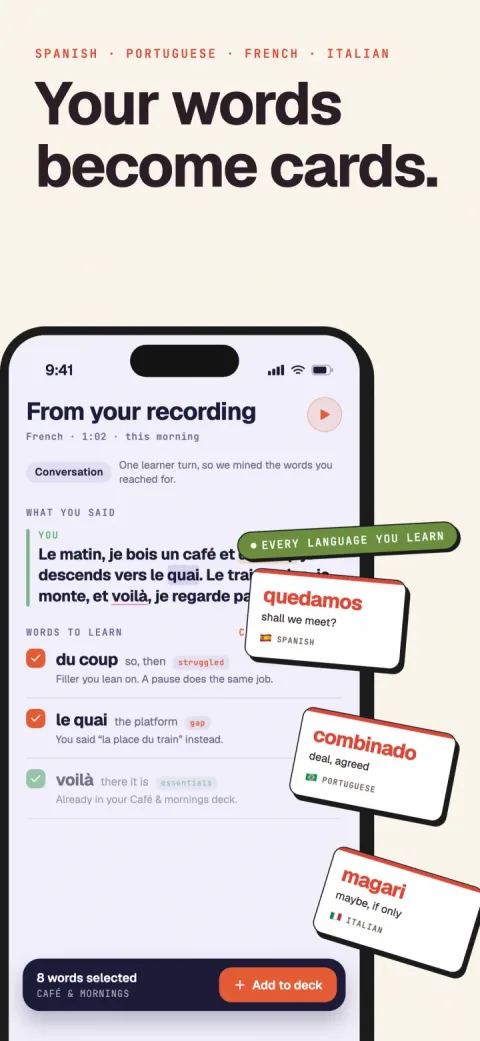
It turns the vocabulary from lessons you've already had into fill-in-the-blank cards with audio and an image. FSRS schedules them. (FSRS is an open-source algorithm that predicts when you're about to forget each card.) Outside a starter deck of about 650 common words, it teaches you nothing new and won't find you a tutor: it holds what you already met.
It's $19.99 a month, or $129.99 a year with a 7-day trial on the annual plan. There's no free tier, which is a fair reason to skip it. Both are US prices, read off the app's own plan definitions on 21 September 2026. The App Store sets a different number in other countries.
It also solves a different problem from Rosetta Stone's, so this isn't really a swap. Rosetta Stone is for people with no words yet. Mine is for people losing the words they have.
And if you'll build your own cards, use Anki. It's free on desktop and Android, $24.99 once on iOS, and it runs a serious scheduler.
It beats everything here, mine included, for the kind of person who will actually sit down and make the deck.
Sources
What Rosetta Stone costs
- Rosetta Stone. Plans and Pricing. Read in a browser on 21 September 2026, twice, on separate page loads. Source for $19.99 monthly billed monthly; $13.25 a month "Billed yearly as $159" under a "SAVE 33%" badge; the verbatim "14-day money-back guarantee"; access to all 25 languages; and the absence of any lifetime option. Prices render client-side, so a server-side fetch of this URL returns no figures at all. Re-check before relying on it: Rosetta Stone runs promotions.
- Rosetta Stone Support. About Our Lifetime Subscription. Read 21 September 2026. Source for the verbatim definition of "Lifetime" access and the non-transferable single-person license.
- Apple App Store listing for Rosetta Stone Classic (2024), Rosetta Stone Ltd., read via Apple's public lookup API on 21 September 2026. Source for the quoted line restricting the Classic app to existing subscribers and directing new buyers to Sapphire. Rosetta Stone Sapphire is listed separately by the same seller.
- Rosetta Stone. Rosetta Stone Sapphire. Read 21 September 2026. Source for the Chat Missions description, the TruAccent wording, and "every subscription includes access to all 25 languages."
- Arithmetic: $159 / $19.99 = 7.95 months to break even; 8 monthly payments = $159.92; 12 monthly payments = $239.88, which is $80.88 above the annual price and matches Rosetta Stone's own 33% badge. Mine, and checkable.
The reviews this page is arguing with
- Fluent in 3 Months. An Honest Rosetta Stone Review. About 6,500 words, built on "Version 4 TOTALe" and quoting $35.97 / $119.88 / $167.76 / $199 with no as-of date. Source of the cloned-curriculum argument, which I credit above. Its recommended alternative is the author's own paid bootcamp.
- Multilingual Mastery. Rosetta Stone review: for beginner language learners only. About 2,400 words, the tightest of the three. Source of the observation that the multiple-choice items can't be passed by recognising the picture. Its only price is $200 for a single-level CD set.
- talkreal. Rosetta Stone Review: Our 2025 Take on Pros & Cons. About 8,500 words, scored 8.7/10 beside recurring affiliate links to discount pages, priced in euros. States its testing method, which the other two don't.
Comparisons used above
- Duolingo (22 April 2026). Our courses now teach advanced content. Source for the CEFR B2 claim about its Spanish course. A claim about course content, not about validated learner outcomes.
- Babbel's free tier: the first lesson of every course is free permanently, per support.babbel.com, "Try Babbel for free," read 5 September 2026. Babbel states no trial length in days.
- italki standing hourly rates: my own extraction of the 20 Offer nodes in the JSON-LD on italki.com/en/teachers/spanish, 23 August 2026, median $19, range $6 to $85. Page-one listings in italki's default order, not a random sample of the marketplace.
- Anki: free on desktop, Android and AnkiWeb sync; AnkiMobile for iOS is US$24.99 one-time, per the Apple listing. FSRS is built in but opt-in, with SM-2 the default, per the Anki manual.
What I could not verify
- Any current lifetime price. I found no lifetime plan on the checkout page on 21 September 2026, so the $399 list and $149 to $199 street figures circulating in affiliate roundups are not stated as fact here. If you see one, check the support page's definition of the word before buying.
- The CEFR level Rosetta Stone's courses reach. No first-party statement found. The beginners-only ceiling above is attributed to two independent reviewers rather than asserted as measured fact.
- Whether TruAccent's pronunciation scoring is accurate. No independent evaluation found; the capability is real, its accuracy is unmeasured here.
- I have not used Rosetta Stone. Nothing above is a report of personal use, and no claim rests on one.
Keep the words you already paid for.
Verbamor turns your lesson vocabulary into fill-in-the-blank cards with audio, scheduled so they're still there next month.
Start 7 days free