 Verbamor
Your 900-day streak is about 75 hours, and none of them were speaking hours
You can't speak after 900 days of Duolingo because, at five minutes a day, that's about 75 hours, a seventh of the State Department's 552-hour low end for Spanish, and almost none of it was spent pulling words from memory out loud. Those hours built recognition. A stranger asking where you're from doesn't hand you options.
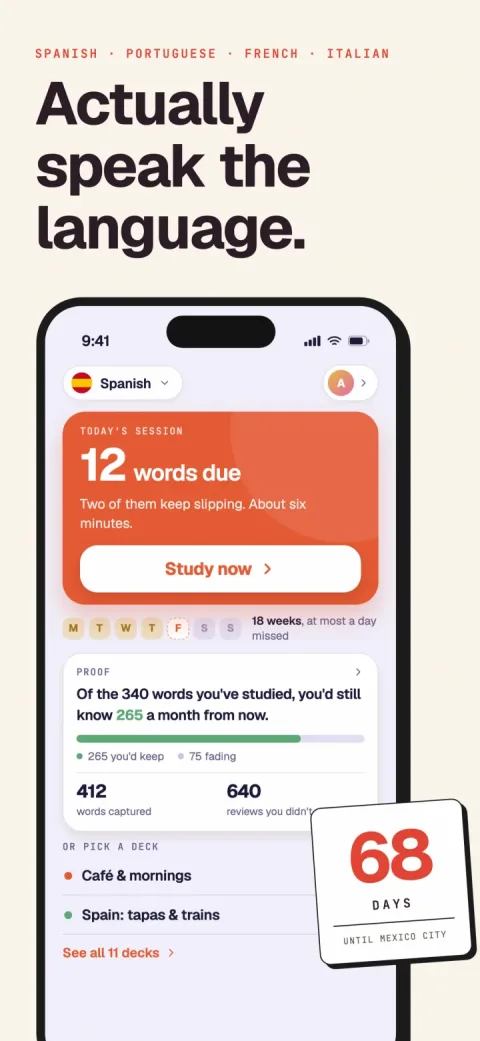
Verbamor opens on one short session a day: the words that are due, and about how long they’ll take.

You have a 900-day streak. A Spanish speaker asks where you're from, and you stall.
You've seen "soy de" a hundred times, but the sentence doesn't come out, and by the time it does the conversation has moved on. Two years of daily practice made you very good at one skill, and this isn't it.
The strongest published result on app learning measured reading and listening
Start with what Duolingo's own researchers measured. Jiang, Peters, Plonsky and Pajak tested 245 learners who finished the Basic content of a Duolingo English course. They published in the CALICO Journal, volume 41, 2024.
The learners scored Intermediate High on average, above the Intermediate Mid the course targets. Three of the four authors work at Duolingo, so this is the friendliest evidence available, and it's good news.
Read what the Duolingo study tested. It measured reading and listening. In its limitations section, the authors write that the skills assessed "are both receptive."
They add that learners "were not assessed in productive skills such as speaking and writing, or overall proficiency." (Receptive skills take language in. Productive ones, like speaking, put it out.) The strongest published result on app learning is a receptive one, stated as such by the people who ran it.
Duolingo does ship speaking exercises, and has since your first lesson. Its own blog lists repeat-the-word items, spoken dialogues, a microphone option on many writing exercises, and speaking-only sessions in the Practice Hub.
They train your mouth. They don't close this gap, though, because they put the target sentence on the screen and ask you to say it. So the retrieval step, finding the word in memory, is still done for you.
That step is the whole difficulty. Speaking to a person gives you a meaning and nothing else: you pull each word from memory cold and say it before the pause gets awkward.
Scheduling belongs to the receptive job too. Duolingo published a real spaced-repetition scheduler: Settles and Meeder, "A Trainable Spaced Repetition Model for Language Learning", peer-reviewed at ACL in 2016 and open-sourced. It predicts how much of an item you still remember and sets the day the word comes back.
The paper decides when an item reappears. It doesn't claim to control which exercise the item lands in, and the exercise is what sets what your mouth does.
The recognition-production gap also widens with study. Laufer, in Applied Linguistics, 1998, volume 19, followed 48 Israeli school students across grades 10 and 11.
In one year, their passive vocabulary (the words they could recognize) grew by about 1,600 word families. A word family is a base word plus the forms built from it. The words they could produce on demand grew by about 850, and the ratio between the two fell from 89% to 73%.
The more English they learned, the larger the share they could only recognize.
You get good at the thinking you practise, and a cafe supplies no options
Morris, Bransford and Franks ran the useful experiment in 1977, in the Journal of Verbal Learning and Verbal Behavior. They named it transfer-appropriate processing: memory works best when the thinking you do while studying matches the thinking the test demands.
One group learned words by thinking about meaning, the other about rhyme. The meaning group won a normal recognition test, the rhyme group won a rhyme test, and the match between study and test decided the result.
Two years of practice at selecting the correct answer makes you good at selecting the correct answer. And the cafe supplies no options.
Karpicke and Roediger, in Science in 2008, tell you which practice moves production. Students learned 40 Swahili-English word pairs.
Those who kept retrieving the words from memory recalled about 80% a week later. Those who kept restudying the list recalled about 36%. The students predicted around 50% in every condition, and their predictions didn't separate the groups.
Pulling an item from an empty head is what makes it available later. Picking from options on screen is closer to restudying.
Five minutes a day for 900 days is 75 hours, against FSI’s 552 at the low end
Do the arithmetic. If those 900 days averaged five minutes, that's 75 hours.
Put it against the only public number for how long a language takes. The US Foreign Service Institute spends 552 to 690 class hours training a diplomat in Spanish or French, Spanish over 30 weeks.
Your 75 hours is a seventh of the low end. And every FSI hour is a production hour spent talking in a room, while almost none of yours were.
How much conversation does it take to improve your speaking?
About four and a half hours of talking, in the one study that puts a number on the dose. Saito and Akiyama, in Language Learning, volume 67, 2017, ran 30 Japanese university students learning English.
Fifteen did weekly video calls with a native speaker in the United States, 30 minutes of English per call. That was 9 calls across one semester, so four and a half hours of talking in total. The other 15 did weekly vocabulary and grammar exercises at home, about 30 minutes a week, so both groups spent similar time.
Independent raters scored the Saito and Akiyama recordings before and after. The talking group improved on how easy they were to understand, with a medium effect (Cohen's d of 0.58, p = .012). Cohen's d measures how big a change is, and a p of .012 means a gap this size would be rare if talking did nothing.
The talking group also improved more on speech rate, on the number of different words per minute, and on verb and article accuracy. Those were large effects (d between 0.82 and 1.17). The exercise group improved on nothing at a significant level.
Two limits. Groups of 15 are small, and the authors say so. And their partners were trained to correct errors out loud, which an untrained conversation partner won't do unless you ask.
The number to take from that study is a floor: about 4 to 5 hours of real conversation, spread over roughly ten weeks, moved a scored measure. One hour a week for ten weeks gets you there. Below about half an hour of conversation a week, nothing published says to expect a measured change.
FSI's published week is 23 hours in class plus 17 hours of self-study. That's about 1.35 hours with a person for every hour alone.
FSI publishes that as a schedule and doesn't attribute its results to the ratio. So treat it as a shape worth copying rather than a proven cause. It's useful for one reason: it says most of your hours should be spent talking.
Don't use the ratio as your target on its own. At five minutes of app time a day, one tutor hour clears 1.35 easily, and clearing it by studying less alone isn't progress.
The hours floor is the real test. The ratio only tells you how to split hours once you're above it.
Write the words down and record yourself, then judge from the playback
- Set a timer for 2 minutes. Write down every word you can produce in your target language on the topic "my morning". No app open. No dictionary. Just what comes out.
- Set it again for 2 minutes. Same rules, topic "my job" or "my studies".
- Count only the words you could say out loud to a person, with the right article or ending. Half-remembered spellings don't count.
No published benchmark says what your produced-word count should be after a year of daily app study, so use it as a baseline. Your app's word count is no comparison: it counts words met.
Now the harder version, out loud. Record 60 seconds answering one question out loud: "What did you do yesterday?" Speak without a script and keep going through every error. Play it back and count two things: seconds silent, and times you switched to English. Save it.
Expect the recording to feel worse than the test in your head. Koriat and Bjork named this illusions of competence, in the Journal of Experimental Psychology: Learning, Memory, and Cognition in 2005. When you judge how well you know something while the answer sits in front of you, you can't subtract the help. The playback removes it.
The four numbers below are my own rules. No study published them, and here they are in one place.
On the written test, 10 more produced words in four weeks is movement worth keeping. Fewer than 5 more means the routine isn't working.
On the recording, more than 20 silent seconds in 60, or more than two switches to English, means the problem is production speed rather than vocabulary. After four weeks of talking, aim to cut the silent seconds by about a third, so 20 becomes 13. And aim to drop to one switch or none.
Book one conversation hour a week, unless you are reading or just started
If you do one thing, talk to a person once a week. It's the only change here that moves the 60-second recording, and one hour a week for ten weeks matches the dose that moved scores in the Saito and Akiyama study.
To find the person: italki lists community tutors, native speakers who do conversation practice rather than formal lessons. Reading 21 Spanish trial-lesson prices off italki's directory on 22 August 2026 gave a median (the middle price) of $12. A full hour ran around $10 to $30.
Rates move, so filter by price and read two profiles before booking. Tandem is a free exchange app where you trade an hour of your language for theirs, and a library conversation group is free.
Then run the conversation hour to a rule. Talk for at least 40 of the 60 minutes, and time it. A pleasant hour listening to a native speaker is the failure mode.
Bring four topics written down, four words each, no script. Use these: what I did at the weekend, my job, the last thing I cooked, a trip I want to take.
Ask your partner to interrupt on errors. An error that goes unnamed is one you repeat next week, and the corrections were part of what worked in the study.
Send a tutor this sentence before the first session, in English, verbatim:
I want a speaking-practice hour, not a lesson. Please let me talk most of the time, correct my mistakes out loud when I make them, and do not send me homework or slides.
One smaller change, in the Duolingo app itself. Turn off the word bank in your settings, so tap-the-tiles items become type-the-answer items, and say each answer out loud before you look.
Two honest exceptions to the weekly conversation hour. If your goal is reading, an app that built a large recognition vocabulary built what reading leans on hardest. The CALICO result is the evidence.
Nation, in the Canadian Modern Language Review in 2006, put the vocabulary needed to read most written text without help at 8,000 to 9,000 word families. That's above the 6,000 to 7,000 he gives for listening.
Don't check your app's number against those. Nation counts word families, where "speak", "speaks" and "speaking" are one item, and an app counts words met once. Enjoy the novels.
The same ceiling shows up in paid immersion courses, which is why the Rosetta Stone price question hinges on how long you stay a beginner.
If you're in your first few months, keep the routine you have. Early on you need a base of words at all, and recognizing a word is a step toward producing it. Fix this gap once you have a year behind you and still stall on "where are you from".
Name today's recording with today's date, so spanish-2026-08-24.m4a. Open your calendar, put the date ten weeks out in it, and book the first conversation hour for this week.
Move from recognizing words to producing them.
Verbamor builds cards from your own lessons and schedules them with FSRS, so review means pulling the word from memory and saying it out loud, not picking it off a list.
Start 7 days freeThe 7-day free trial is on the yearly plan.