Verbamor
Is it too late to learn a language at 40?
40 isn't too late to learn a language: the famous 17.4 cutoff measures how fast you pick up grammar, and a 2022 reanalysis reads that cliff as an artifact of schooling. Your real constraint is the calendar. At 5 hours a week, Spanish takes about 5 years to a diplomat's standard; your accent is the part that won't move.
You already know the cutoff number, or half of it. Somebody told you there's a cutoff for learning a language, somewhere in the teens. You went past it around the year you gave up on high school French.
The number is 17.4, it comes from a real study, and it measures speed.
17.4 is a speed limit on grammar, and the ceiling is earlier
In 2018, Joshua Hartshorne, Joshua Tenenbaum and Steven Pinker ran a grammar quiz as a viral internet game. 669,498 people took it, native and non-native English speakers. That's a census.
The Hartshorne team's best-fitting model (R2 = 0.89, meaning it accounts for most of the variation in scores) found "a rate change beginning at 17.4 years." After 17.4, your grammar-learning rate slides. Rate means how many months of Thursday lessons it takes for a piece of syntax to stick.
Quote 17.4 as your last shot at perfection and you've flipped the paper on its head, because Hartshorne puts the ceiling much earlier. The last age at which native-like attainment is still within reach is "likely well prior to 17." Kids who move abroad hold that ceiling to about 12.
17.4 is a speed limit, and you drove past it in your second year of university.
Hartshorne's test was written comprehension. People read sentences on a screen and judged whether they sounded right, so the finding covers syntax. Your accent sits outside that fence, and so does your vocabulary, which the test skipped.
(If your accent is what keeps you quiet in lessons, read about speaking anxiety. It's costing you more lesson time than your birthday ever has.)
No study measured adult vocabulary, so use last week instead
The Hartshorne study left vocabulary alone. There's no 669,498-person curve for how many words a 40-year-old can absorb, and I'd be inventing one if I handed you a number.
Having no vocabulary curve leaves you without a minute split, and I won't fake one. I had a 45/15 ratio in an earlier draft and pulled it, because nothing I can cite compares vocabulary time against grammar time at 40. So use last week instead.
Here's the rule. If you couldn't say the thing at all, that's a word problem. If you said it and your tutor winced, that's a grammar problem. Spend the hour wherever this week's failures came from, and let the ratio change every week.
Most weeks the split lands on words. Ask your tutor to leave your rr alone and give you 20 words you'd actually say this week, then make her force you to use them. (Mine sighed. She also complied.) Test your recall in 6 weeks.
The cliff may be an artifact, but the accent slide is real
In 2022, Frans van der Slik, Job Schepens, Theo Bongaerts and Roeland van Hout took the same 669,498-person dataset and ran it again in Language Learning. They call the famous cutoff an artifact of the model: Hartshorne's team's conclusion of "one sharply defined critical age at 17.4 for all language learners is based on artificial results."
Hartshorne's team fit a model that assumes a break. Van der Slik's team fit one with no break at all, just a steady slide, and for monolinguals, bilinguals and early immersion learners the smooth version won. The abstract reports which model fit better without publishing the margin, so take the direction.
Two groups did still show a break: non-immersion learners at 18.6 and later immersion learners at 19.0. Both land roughly when school ends, which is a suspicious place for biology to draw a line.
Van der Slik and colleagues put it in the abstract: "These age effects can be interpreted as schooling effects." They conclude the two breaks "are not the outcome of cognition-driven developmental factors leading to one or more critical periods." On their reading, the drop at 18.6 is the year somebody stopped scheduling your lessons for you.
Hartshorne's side has an answer that survives either way. Sand off the cliff and "the last age of first exposure at which native-like attainment is still within reach is likely well prior to 17" stays standing. I lean toward the Dutch version, and a steady slope means an hour buys the same thing at 40 that it bought at 25.
Accent slides smoothly too. Flege, Munro and MacKay rated 240 native Italian speakers who'd started English in Canada between 2 and 23 and had lived there about 32 years. The 10 listeners put the start of accent between 3.1 and 11.6 years old, averaging 7.4.
Accents turned up in people who started "long before what is traditionally considered to be the end of a critical period." Age of learning alone explained 59% of the variation.
The accent ceiling is lower than the grammar one. Niclas Abrahamsson and Kenneth Hyltenstam tested 195 Spanish and Swedish bilinguals in 2009. They pulled the ones who'd passed as native to listeners, ran detailed testing, and "none of the late learners performed within the native-speaker range."
Your accent has been sliding since you were 7, and by 40 the native ceiling closed decades ago no matter what you buy. So tell your tutor to stop correcting your pronunciation. Spend the hour building sentences out loud, in the tenses you keep dodging. Buy the part that still moves.
How long does Spanish take at 5 hours a week?
Spanish at 5 hours a week takes about 5 years, going by the course lengths the US Foreign Service Institute publishes. Spanish and French run 30 weeks, 690 class hours. Italian and Portuguese finish in 24 weeks on 552.
The flat 600 hours quoted all over the internet comes from somewhere else, and FSI's own page has never said it.
FSI's 690 and 552 hours only count class. A typical FSI week is 23 hours in class plus 17 of self-study, 40 hours a week. Stack the solo hours on and Spanish runs about 1,200 hours. Italian and Portuguese, 960.
Now do the division. Buy 1 tutor hour a week plus 3 hours of listening and you're running 4 hours against their 40, so their 30 weeks becomes about 6 years for you. You're working with a tenth of the fuel a diplomat gets.
Six years sounds brutal until you notice the alternative is 1 tutor hour a week and nothing else, which is 13 years. The gap between you and a 17-year-old is a schedule, and every hour you add between Thursdays pulls the finish line in.
You're 40 with a job and a family. Say you find 5 hours a week and hold it. That's 260 hours a year, so you reach FSI's diplomat standard around your 45th birthday.
Split those 5 hours the way FSI splits its week, 23 class to 17 solo, roughly 58/42. On 5 hours that's 2 hours of live speaking and 3 hours alone.
Book a 60-minute tutor slot on a fixed weeknight, then find a second hour with a language exchange partner. Put both on the calendar this week.
Ask your tutor to spend the last 5 minutes of each lesson naming next week's podcast and episode numbers out loud. Pay for the tutor who hands you the week.
Of the 3 solo hours, 20 minutes of flashcards a day covers about 2, and the last goes to a podcast on the commute or a show with subtitles.
FSI aims at a speaking and listening score of 3 on the ILR scale, roughly "can do the job in the language." Your own target is smaller: handle a hotel desk, follow your in-laws at dinner. The hour counts floating around for CEFR B1 trace back to the same misquoting that produced the 600, so I'd ignore all of them. (CEFR B1 is an intermediate level on the European scale.)
Use 300 hours as your first checkpoint instead, a quarter of the Spanish 1,200, which at 5 hours a week takes about 14 months. Then run an actual test on it.
Here's the test. Talk to your tutor about your weekend for 10 minutes with no English, and ask them to say nothing in English either. Record it, then listen back with a pen and count 2 things. Count every time you switched to English for a word, and every time your tutor rescued a sentence you'd stalled on. Under 5 combined and you passed. Over 15 and you didn't.
If you failed, the fix depends on which number was high. Lots of English words means your vocabulary is thin, so push the flashcard minutes up and pull them from the podcast hour.
Lots of rescues means you know words you can't retrieve fast enough under pressure, and only the 2 live hours fix that. Take one back from solo work.
Between 5 and 15, hold steady and rerun the test at 400 hours, then plan for the plateau, because it's coming.
At 40 you can buy the hours a 15-year-old could not
You can pay someone to talk to you for an hour every week. On italki a Spanish tutor runs about $15 an hour, and Preply sits in the same range. At 15 you had no money.
The italki tutor list will show you hundreds of people and every one has 5 stars. Sort by lessons taught instead, because ratings compress and lesson counts don't. Then book 3 trial lessons in the same week and pick the tutor who talked least.
You also picked one of the government's fastest 4 languages, and your head start inside it is real. Nación, importante, posible, universidad. English handed you those, and I counted them in cognates. The shape of what you have to learn first is in the frequency curve.
Botes, Dewaele and Greiff's 2022 meta-analysis (a study that combines earlier studies) pooled 96 effect sizes from 28,166 learners. Enjoyment tracked with willingness to speak at r = .48, the strongest link they found.
That r is a correlation, where 1 would mean the two move in lockstep. Enjoyment and achievement came in lower, at r = .30. The data is correlational, so enjoyment and speaking may simply travel together.
You can push on enjoyment Thursday. Pick the lesson topic yourself and send it the night before, because a tutor with no instructions defaults to the textbook. Ask for 20 minutes of talk about your work or a football result.
Then tell your tutor to bank the corrections in writing and hand them over at the end. That last one changed my lessons more than any app did.
(Keeping a second language going also looks good for your brain later on, which I dug into in bilingual brain aging.)
Your accent probably won't go, and your listeners will still get the joke. Month 4 is where I watch adults stall. You've had 16 good lessons by then and most of it is gone.
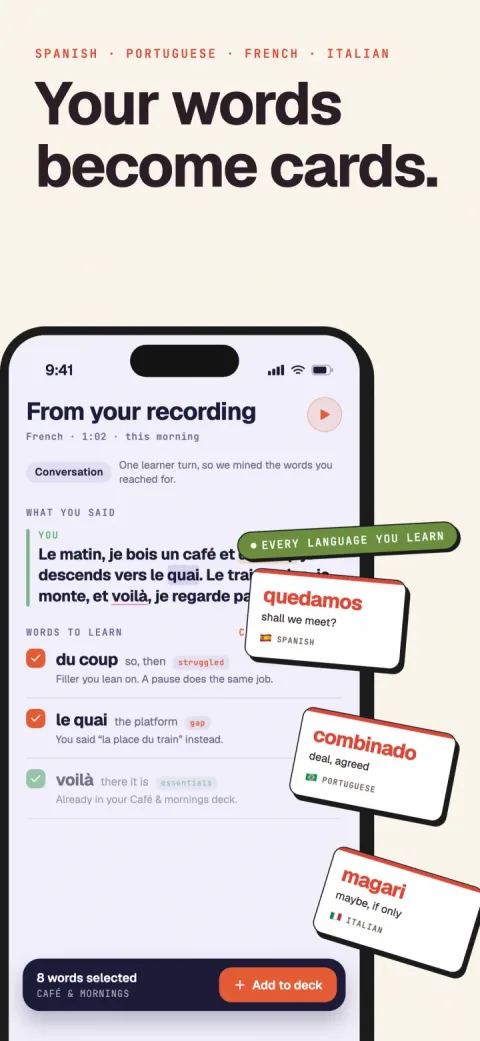
Verbamor records the lesson and turns the words you actually used into cards on a review schedule. I built it because I kept re-learning the same 40 words.
So book the 3 trials, and spend the 552 hours. Your mouth keeps its accent and the rest of it is still open.
Sources
17.4 is a grammar-learning rate, and the native-like ceiling closes years earlier
- Hartshorne, J. K., Tenenbaum, J. B., & Pinker, S. (2018). A critical period for second language acquisition: Evidence from 2/3 million English speakers. Cognition, 177, 263-277.
The cliff may be an artifact, and the leftover breaks look like school ending
- van der Slik, F., Schepens, J., Bongaerts, T., & van Hout, R. (2022). Critical period claim revisited: Reanalysis of Hartshorne, Tenenbaum, and Pinker (2018) suggests steady decline and learner-type differences. Language Learning, 72(1), 87-112.
The hours a working score actually costs, and why the flat 600 is wrong
- Foreign Service Institute, U.S. Department of State. Foreign language training. Category I languages: 24-30 weeks (552-690 class hours), 23 class hours and 17 self-study hours a week.
Enjoying the hours tracks with being willing to speak
- Botes, E., Dewaele, J.-M., & Greiff, S. (2022). Taking stock: A meta-analysis of the effects of foreign language enjoyment. Studies in Second Language Learning and Teaching, 12(2), 205-232.
The adult problem is retention.
Verbamor records your lessons and turns them into scheduled reviews, so the hours you buy do not leak away.
Start 7 days free