Verbamor
Do bilingual brains age slower? What 86,149 people showed
In a study of 86,149 people across 27 European countries, multilingual speakers had 2.17 times lower odds of accelerated brain aging, and the gap widened with each extra language. The finding is correlational: the authors claim no causation, and proficiency is the one factor an adult can still move.
86,149 people. 27 European countries. One question: do people who speak more than one language age differently, or does it only look that way from outside?
Lucia Amoruso and a team published their answer in Nature Aging in November 2025. The team spans the Basque Center on Cognition, Brain and Language, Trinity College Dublin, and institutes across Latin America.
People in the multilingual group were 2.17 times less likely to show signs of accelerated brain aging.
The 2.17 figure travelled fast, and it picked up some baggage on the way. So here's the careful version.
01 / 06The number survived the adjustments you'd reach for first
The headline figure is an odds ratio, drawn from a population-scale comparison across 27 countries. An odds ratio compares how likely something is in one group against another.
It survived adjustment for education, socioeconomic status, and physical health. Those are the three confounds (outside factors that could explain a result) you'd reach for first if you wanted to explain it away.
The odds ratio held in two analyses that fail in different ways: a cross-sectional snapshot of one moment, and a longitudinal follow-up that tracked people over time. When a finding survives both, it's harder to write off as an artifact of one design.
"Brain age" is a machine reading of brain activity
Brain age isn't a metaphor in this paper. A subset of 728 participants went through magnetoencephalography (MEG), which reads the brain's electrical activity and how its regions talk to each other.
Researchers trained a model on the MEG connectivity patterns to estimate an age. Then they compared the estimate to the person's real age.
A 50-year-old whose brain reads as 45 is running ahead of the calendar. One reading 55 is running behind.
Multilingual speakers, on average, ran ahead.
The measurement is the interesting part here. This isn't a memory quiz where the bilingual group might just be better test-takers. It's physiology, read off the machine, and it lines up with the population-level odds.
03 / 06The gap scaled with the number of languages
The protective association wasn't flat. It scaled with how many languages a person spoke, which the authors describe as a cumulative effect.
Dose-response patterns, where more of something brings a bigger effect, matter more than most single findings. Coincidences rarely come with a dial.
Suppose speaking a second language tracked with younger-reading brains, but a third and fourth changed nothing. Then you'd suspect the whole thing was really about who ends up bilingual.
A gap that keeps widening as the dose climbs is the shape you'd expect if the languages themselves were doing something.
Two other factors moved the needle in the same direction: earlier age of acquisition, and higher proficiency. Both point at sustained, real use rather than a line on a CV.
One caution on the numbers you may have read elsewhere. Some press coverage carries a specific per-language breakdown, a set number of years younger for bilingual versus trilingual speakers.
I couldn't confirm those figures against the primary text, so I'm not repeating them. The direction is solid. The precise years aren't, at least not from where I'm reading.
Coincidences rarely come with a dial. A gap that widens as the dose climbs is the shape you'd expect if the languages were doing the work.
Switching and connectivity, and neither is settled
The first candidate explanation is switching. A bilingual brain doesn't keep one language running while the other sits in a drawer.
Both stay active, and holding back the one you don't need right now is a rep, every time you open your mouth.
Holding back the unneeded language is an executive-function workout (executive function is the brain's control of attention and switching). It runs thousands of times a week without anyone calling it practice.
Picture ordering coffee in your second language while a friend asks you something in your first. You produce one language, understand another, and suppress the wrong word for the wrong listener, all inside about two seconds.
Monolingual life has moments that tax attention like that. It doesn't have them every time somebody speaks to you.
The switching account has been argued over for a decade, and it's worth knowing that. Some studies find a bilingual advantage on attention tasks, others find nothing.
The replication record is patchy enough that researchers who study it professionally disagree in print. What makes this paper interesting is that it skipped the attention tasks and went to the imaging.
The second candidate is connectivity. The MEG data pointed at how well-connected the brain stayed, not raw processing speed. That's the same territory as cognitive reserve, the idea that some brains keep more parallel routes open and can lose a few without losing function.
Worth saying plainly: the 2025 study didn't measure dementia outcomes. It measured brain age. The reserve literature is a neighbor, and you can't borrow its conclusions.
The reserve literature is where a lot of the public interest in bilingualism started. Earlier research on delayed dementia onset in bilinguals reported that those patients reached a diagnosis several years later than monolingual ones.
They had similar brain damage on the scans at the point of diagnosis. The reading was that a well-connected brain absorbs more damage before the symptoms surface.
The dementia-onset findings drew heavy criticism, mostly about who ends up in a memory clinic and when. Later attempts to reproduce them in different populations gave mixed answers.
So the 2025 paper lands in a field that has been arguing with itself for 20 years. Keep that in mind before treating any single result as the last word.
05 / 06Does learning a language actually slow brain aging?
The Nature Aging study can't tell you whether learning a language slows brain aging, because it's correlational: it shows two things travel together, without showing that one causes the other.
86,149 people is a lot of people. It's still a comparison between groups who chose their own lives, not a trial that assigned languages at random. The authors don't claim causation, and I won't either.
The obvious alternative explanation is the kind of life that produces multilingual people. Travel, schooling, migration, wide social networks.
The team adjusted for education and socioeconomic status, which handles part of that, and no adjustment handles all of it.
Then there's the question most readers actually have. If you started Spanish at 34, does any of this apply to you?
The study leans toward earlier being better and doesn't rule adult starts out. That's the honest state of it. An adult learner isn't the population this paper measured most confidently.
There's a reason to stay hopeful and no reason to promise anything. Proficiency mattered on its own in this data, alongside age of acquisition, and proficiency is the one an adult can still move.
A late start with 20 years of daily use is a different exposure from a childhood start abandoned at 15. This study doesn't cleanly separate those two people.
There's also a survivorship trap sitting under the whole question. People whose thinking is already sharp at 70 find it easier to keep a second language going, so some of the gap could run backwards from the direction everyone assumes.
The longitudinal arm helps here, since it watched people over time rather than comparing strangers at one moment. It doesn't settle it, though.
One more thing, about my own sourcing. The primary paper sits behind a paywall, so I worked from the DOI record, a press release from a co-author's own institution, and coverage corroborated across several outlets.
Every figure here appeared in at least two of those. It's the reason the per-language years aren't in this post.
06 / 06Proficiency is the one factor an adult can still move
The takeaway isn't "learn Mandarin at 60 to avoid dementia." The study doesn't support a claim that clean, and anyone selling you that is reading a press release instead of a paper.
Here's the version I'd stand behind. Sustained second-language use tracks with brains that age differently, in a large sample, with a dose-response pattern and two independent analyses behind it. If you're already learning a language for ordinary reasons, a partner, a move, a job, this is a decent reason to keep going through the boring middle.
And the boring middle is where the finding gets practical. The factors that mattered were proficiency and years of use.
So the failure mode is the two years of French that quietly lapse into nothing, whichever language you picked.
Lapsing is the same problem the forgetting curve describes, and roughly why plateaus end so many attempts. Sustained use is a scheduling problem before it's a motivation problem.
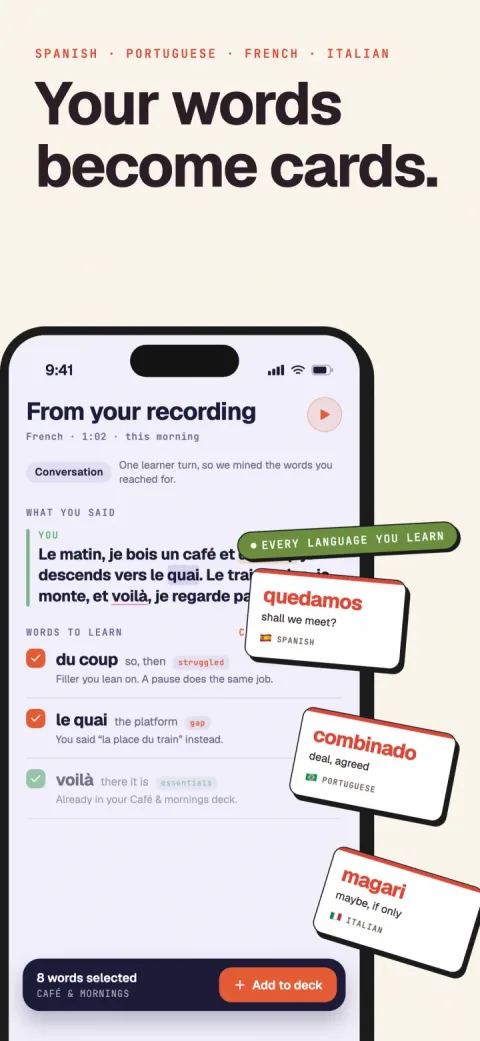
Keeping a language in daily use is the part Verbamor is built for. The app went live on the App Store today, which is either good timing or a small joke at my expense.
I'd rather describe it honestly than tell you an app protects your brain, because this study doesn't say that about any app, mine included.
If you want the practical version of keeping a language alive after a lesson, the free handbook covers the routine.
Sources
The study
- Amoruso, L., Hernandez, H., Santamaria-Garcia, H., Moguilner, S., et al. (2025). Multilingualism protects against accelerated aging in cross-sectional and longitudinal analyses of 27 European countries. Nature Aging, 5, 2340–2354.
A note on sourcing
- The primary paper is paywalled. Publication details above are confirmed against the Crossref record for the DOI. Sample size, study design and confound adjustment come from a Global Brain Health Institute release at a co-author's own institution, with figures cross-checked against multiple independent science-press reports. A per-language year breakdown circulating in some coverage could not be corroborated and is deliberately left out.
Keeping a language is a scheduling problem.
Verbamor turns what your tutor taught you into cards and schedules each one so the words survive the years, rather than the fortnight.
Start 7 days free