Verbamor
What Rosetta Stone costs, as of 21 September 2026
$19.99 a month, or $159 for the year. There's no lifetime plan and no free trial, whatever the pages above this one tell you. And Rosetta Stone's own documents give two different refund windows.
I opened rosettastone.com/buy on 21 September 2026 and wrote down what it said. That's the whole method here, and it's apparently more than the pages ranking above this one did.
Two plans. $19.99 a month billed monthly, or $13.25 a month billed yearly as $159.
A "SAVE 33%" badge on the yearly card. Underneath both, one line: "14-day money-back guarantee."
No lifetime plan on that page. No free trial on that page. 25 languages, and both plans get all of them.
I should say what I am and am not. I haven't used Rosetta Stone. Everything below comes from Rosetta Stone's own live pages, its App Store listing and its purchase terms PDF, each quoted with the date I read it.
I also build a language app, which I'll get to at the end rather than pretend otherwise. I earn nothing if you buy Rosetta Stone, and nothing if you don't.
The checkout says $19.99 a month or $159 a year
Here's the full plan table as the page presents it, with the arithmetic done.
Two things here are genuinely clean, and it's worth saying so plainly because most comparison pages bury it.
First, the tiers are feature-identical. The "What's included" block sits below both cards and applies to both.
It lists all 25 languages, the lessons with their TruAccent speech tool, Chat Missions, "500+ flashcard sets", and Sapphire Studio. There's no crippled cheap tier to worry about, which is more than plenty of subscription products manage.
Second, the price doesn't change by language. Spanish costs what Latin costs. You get all 25 either way, listed by name on the page: Spanish in both Spain and Latin America flavours, German, French, Italian, Dutch, Arabic, Korean, Swedish, Japanese, Hebrew, Chinese, Greek, Persian, Turkish, Russian, Vietnamese, Hindi, Brazilian Portuguese, Filipino, Irish, Latin, Polish, and English in both American and British.
A buyer arriving from that page has budgeted $131.40 for a product that costs $159, and believes a lifetime plan is waiting that isn't for sale.
The $199 lifetime plan doesn't exist
One page ranking for this query sells a $199 lifetime plan hard, with a button pointing at it. I checked. That plan isn't on Rosetta Stone's checkout.
The same page is wrong about four other things. It quotes the annual at $10.95 a month, $131.40 total, against the live $13.25 and $159. It promises a 30-day guarantee where the checkout says 14.
It promises a three-day free trial, and no trial appears anywhere on the buy page. It counts 24 languages where the page counts 25.
Every one of those errors costs the reader in the same direction: budget too low, relax about the refund deadline, then go hunting for a product nobody is selling.
Now, the lifetime plan is a slightly more interesting story than "made up." Rosetta Stone's own Purchase Terms & Conditions, last revised 28 October 2024, still carries a whole clause about them.
A Lifetime plan is "a limited offer" lasting "for as long as the Product and those services are available and supported", with an "annual auto-renewal rate of $0.00".
And the document says outright that "Rosetta Stone may stop issuing new lifetime subscriptions at any time."
That looks like exactly what happened. The clause governs people who already hold one. You couldn't buy one on 21 September, and the pages still advertising it are running affiliate buttons at a shelf that's empty.
The free trial is a cleaner correction. There's no trial. I searched the buy page's source for "free trial", "trial" and "lifetime" and got zero hits on all three.
What Rosetta Stone offers instead is a refund window, and that's a different product with a different failure mode: you pay first.
Plan around 14 days, though an older policy says 30
This is the part I didn't expect to find, and it's the one genuinely worth knowing before you pay.
The checkout says 14 days. The Sapphire subscriptions support page, updated 5 May 2026, agrees: "All Sapphire subscriptions purchased directly from Rosetta Stone come with a 14-day satisfaction guarantee."
That sentence then links you to "our complete Return and Exchange Policy" for the details. The link goes to the Purchase Terms PDF above. It says: "All Rosetta Stone online product purchases may be exchanged or returned for a refund of the purchase price within thirty (30) days from the Purchase Date."
So the support page's 14-day promise cites, as its authority, a document saying 30.
My read is that the PDF predates the Sapphire relaunch and nobody re-pointed the link. The 14-day figure is the one that governs a subscription bought today, because it's on the checkout and on the current support page.
Plan around 14 days. If you're arguing for a refund on day 20, that PDF is a reasonable thing to have open.
One more wrinkle. Buy through the App Store or Google Play and Rosetta Stone's window doesn't apply at all: "Products purchased from an authorized retailer are subject to that retailer's return policy, which may differ from our own." Apple's refund process is Apple's.
Year 2 may cost full price, and renewal is on by default
None of the ranking pages I read answers the renewal question, which is strange, because it's the one that decides what the product actually costs you.
Rosetta Stone's answer is in two places, and they don't quite match either. The Purchase Terms say your subscription renews "at the same price you paid at the time of purchase (plus applicable taxes)", and that discounts applied to your first term "are not applicable to auto-renewal purchases".
A few lines later, the same document says 1-month, 3-month, 6-month and 12-month subscriptions "automatically renew at the full retail price (plus tax) then in effect."
Read together, the safe assumption is that a sale price is a first-year price. If you buy at a discount, budget for the sticker next year.
Auto-renewal is on by default and Rosetta Stone says so: "To ensure uninterrupted access, your Online Subscription purchase is set to automatic renewal by default." So the cancellation path matters.
From the current Sapphire support page: log in through a web browser and click the profile icon top right for Account settings. Then select Manage subscription and click Cancel subscription.
Note "through a web browser". If you bought from Apple or Google, you cancel in that store instead. The App Store listing adds the deadline Rosetta Stone's own site doesn't: subscriptions "renew automatically unless canceled at least 24 hours before the end of the current period."
Older Rosetta Stone accounts work differently again, and the split is worth knowing before you install anything. There are two consumer apps in the App Store: Rosetta Stone Sapphire, and Rosetta Stone Classic (2024), whose own listing says it "is only available for current Rosetta Stone Classic subscribers".
Classic cancellation lives under a "TURN OFF AUTO RENEW" button in My Account. New money buys Sapphire.
$159 suits a true beginner more than an intermediate learner
Pricing a thing and asking what it delivers are separate jobs, and the pages ranking here only do the first. So, the second.
$159 a year is about $13 a month, which is cheap against a tutor and expensive against a library card.
The comparison I can actually make honestly is a narrow one. Most competitors render their prices in JavaScript that a fetch can't read, and I won't publish a number I couldn't verify. Babbel's plan table defeated me that way on 21 September.
What I can tell you is how it sits against Pimsleur. Pimsleur's own blog puts both its tiers at "around $20 per month", and its site's plan data, read the same day, lists $19.95 a month for Premium and $149.95 a year. Rosetta Stone's $19.99 monthly plan costs about the same as Pimsleur's monthly. Its $159 yearly plan costs slightly more than Pimsleur Premium's annual, about $13.25 a month against $12.50, but covers all 25 languages instead of one.
What the money buys is a recognition-heavy immersion course. Rosetta Stone calls the method Dynamic Immersion and describes it on the buy page as tapping "your brain's innate ability to learn, no translations or rote memorization needed". Lessons as short as 5 minutes, speech scoring through TruAccent, scripted conversation practice in Chat Missions.
That shape suits a true beginner who wants a structured path and will show up most days. It suits someone who might switch languages, since all 25 are included and you'd pay twice elsewhere.
It fits badly if you're already intermediate and stuck at the thing everyone gets stuck at: understanding fine, producing nothing. A scripted course keeps putting the target sentence in front of you, and recognition and recall are different systems. The one that shows up mid-conversation is the one you trained by pulling words out of an empty head.
There's also a published-evidence angle most Rosetta Stone reviews skip. Rosetta Stone commissioned efficacy work (a test of whether it works) from the same lab that tested Duolingo, Babbel, Busuu and Pimsleur, and its oldest report there dates from January 2009.
Reading all of those reports together is more informative than any single one, including the dropout rates each vendor prints about itself.
On the discount question, which is the most useful thing on the current results page: Rosetta Stone runs sales. The badge on the yearly plan on 21 September read SAVE 33%. That's a standing comparison against the monthly rate rather than a limited-time cut.
I can't put a date on the next real sale without guessing, so I won't. Paying attention for a week before you buy costs nothing, and the renewal clause above means a discount you catch is a discount on year 1 only.
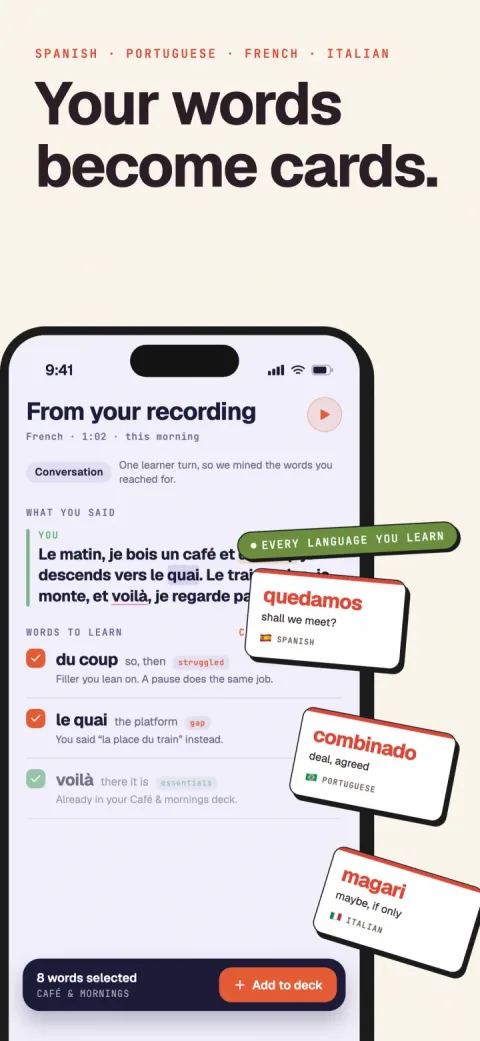
Here's the part where I declare an interest. I built Verbamor, an iOS app for five languages that turns vocabulary from your own lessons and conversations into fill-in-the-blank cards with spoken audio. FSRS, an open-source algorithm that predicts when you're about to forget each card, schedules them.
Past a starter set of about 650 everyday words, it teaches you nothing new, which makes it close to useless for the beginner Rosetta Stone is built for. $19.99 a month or $129.99 a year with a 7-day trial on the annual plan, no free tier.
Both are US prices, read off the app's own plan definitions on 21 September 2026. The App Store sets a different number in other countries.
And the honest close: plenty of people reading this should buy neither. If you'll write the words you met today into a notebook and test yourself on them next week, that beats every app in this post and costs nothing.
Anki is free on desktop and Android, runs a serious scheduler, and ships no language content at all, which suits people who enjoy building their own. The people who should pay anyone are the ones who've tried that twice and stopped.
Sources
The live prices
- Rosetta Stone. Plans and Pricing. Read 21 September 2026. Source for "$19.99 /mo" with "Billed monthly", "$13.25 /mo" with "Billed yearly as $159", the "SAVE 33%" badge, "14-day money-back guarantee", "Access to all 25 of our languages", the named language list, the "500+ flashcard sets" line, the shared "What's included" block covering immersive lessons, TruAccent, Chat Missions, Flashcards and Sapphire Studio, and the Dynamic Immersion description. A search of the page source returned zero occurrences of "free trial", "trial" or "lifetime". The $239.88 twelve-month total and the $80.88 saving are my arithmetic.
- Rosetta Stone Sapphire, US App Store listing (trackId 6757200007), read via the iTunes lookup API on 21 September 2026. Source for "Subscriptions renew automatically unless canceled at least 24 hours before the end of the current period" and the 25-language list as the app states it. Rosetta Stone Classic (2024), trackId 435588892, same read, source for "This app is only available for current Rosetta Stone Classic subscribers".
Refunds, renewal and cancellation
- Rosetta Stone Support (updated 5 May 2026). Subscriptions. Read 21 September 2026. Source for the "14-day satisfaction guarantee" wording, the authorized-retailer carve-out, the four-step web cancellation path, and the link to the Purchase Terms as the "complete Return and Exchange Policy".
- Rosetta Stone. Purchase Terms & Conditions. PDF, last revised 28 October 2024, read 21 September 2026. Source for the thirty-day return sentence, renewal "at the same price you paid at the time of purchase", the separate "full retail price (plus tax) then in effect" clause for termed subscriptions, the exclusion of first-term discounts from renewals, and the Lifetime clause including "may stop issuing new lifetime subscriptions at any time" and the "$0.00" annual auto-renewal rate.
- Rosetta Stone Support (updated 5 January 2026). Managing Your Subscription. Source for "your Online Subscription purchase is set to automatic renewal by default" and the Classic "Turn off Auto Renewal" path.
Why recognition is not recall
- Karpicke, J. D., & Roediger, H. L. (2008). The critical importance of retrieval for learning. Science, 319(5865), 966–968. 40 Swahili–English pairs; 80% recalled a week later when pairs kept being tested, against 36% when they were only restudied.
- Roediger, H. L., & Karpicke, J. D. (2006). Test-enhanced learning. Psychological Science, 17(3), 249–255. Rereading wins after 5 minutes and loses after a week.
What I could not verify
- Babbel prices. babbel.com/prices redirects to a page whose figures never appear in the served HTML, so no Babbel figure is published above. The Pimsleur figures come from its own blog ("around $20 per month") and its site's plan data, read 21 September 2026.
- The timing and depth of Rosetta Stone's sales. The 33% shown on 21 September was a standing yearly-against-monthly comparison. I found no first-party page stating a sale calendar or a maximum discount, so this post gives neither.
- Whether the 14-day or 30-day window governs a purchase made today. Both figures are Rosetta Stone's own and the support page links the one to the other. The reasoning above is mine; ask the Memberships team before relying on day 20.
- Any claim about what using Rosetta Stone is like. I have not used it, and nothing here is a review of the experience.
Keep the words you already paid for.
Verbamor turns your lesson vocabulary into fill-in-the-blank cards with spoken audio, scheduled so they're still there next month.
Start 7 days free