 Verbamor
Mango Languages review: check your library card first
The three reviews ranking above this one quote three different prices, and all three are wrong today. Mango costs $13.99 a month. A lot of readers can have it for nothing, and none of those pages walks you through that.
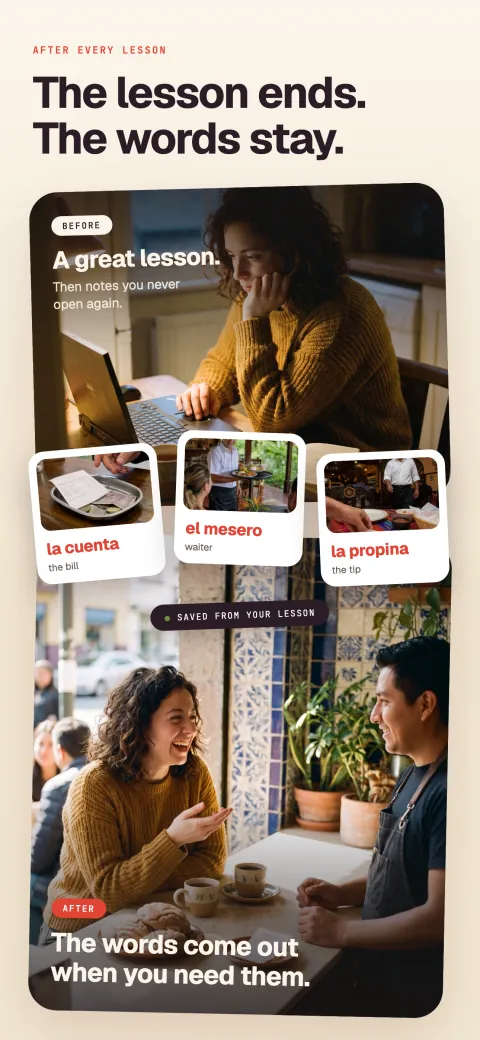
Verbamor records your lesson and turns what your tutor taught into cards that come back on schedule.

I haven't used Mango Languages. Everything below comes from Mango's own pricing page, its help centre and its App Store listing, all read on 21 September 2026. I'll say which page each number is from.
That's worth stating up front. The pages ranking above this one all describe hours of hands-on testing, and all three print a price that Mango doesn't charge.
So here's the answer before the evidence. Search your library first.
If your card covers Mango, the buying decision is over and you saved $167.88 a year. If it doesn't, Mango is $13.99 a month, and whether that's worth it depends almost entirely on which language you picked.
Mango costs $13.99 a month, and the ranking reviews print old prices
Mango's pricing page, read 21 September 2026, lists two personal plans.
Individual is $13.99/mo, with a badge reading "Save 28% when billed annually ($10/mo)". Family is $19.99/mo, up to 5 profiles, badged "Save 37% when billed annually ($12.50/mo)".
Now compare that to the three pages currently ranking for this query:
- Mezzoguild says $7.99 single language, $17.99 all languages. Undated.
- Langoly says $11.99 single, $19.99 all. Published 13 December 2021, no update stamp.
- All Language Resources says $11.99 single, $19.99 all, $119.99 a year. Undated.
Every one of those is describing a product Mango no longer sells. There's no single-language plan on the pricing page at all.
Individual buys all 70+ languages. That quietly makes Mango cheaper than all three reviews claim for the all-language tier, while they were busy arguing about which tier to recommend.
The one figure that survives is All Language Resources' $119.99 a year, and it survives because Mango still charges it. Its help centre article Subscription Types, updated 28 July 2026, says it plainly: "You can subscribe monthly at 13.99 USD per month or 119.99 USD per year." Family is "19.99 USD per month or 199.99 USD per year."
Which sets up a small piece of arithmetic Mango would rather you skipped.
The pricing page rounds $119.99 a year to "$10/mo". It's $9.9992, so that's fair. But Family annual is $199.99, which is $16.67 a month, and the pricing page prints $12.50/mo.
I can't reconcile that. Apple's listing for the Mango Languages app, read the same day, shows a fourth number again: Family Plan (Yearly) at $149.99, which does divide to $12.50.
My best guess is the web page is quoting the App Store price while its own help centre quotes the web price, and Mango never noticed. Check the figure on the screen where you're actually paying.
Three reviews, three prices, zero dates. The cheapest way to beat them is to read the pricing page and write down when you read it.
One thing Mezzoguild flagged that the others didn't: there's no refund policy. I went looking to confirm it and couldn't.
A search of Mango's help centre for "refund" returns two articles, neither about refunding a Mango subscription. So the honest statement is that Mango publishes no refund policy I could find, which isn't the same as confirming it refuses refunds.
The trial is the protection you actually have. Mango's App Store listing offers a 14-day free trial, and the pricing page lists a trial on both personal plans.
Your library card may get you Mango free, in four steps
This is the part that decides the purchase, and Langoly mentions it in passing before selling you a subscription anyway.
Mango's own libraries page says its pitch to librarians out loud: "Give every patron free access to 70+ languages with their library card." Patrons get Mango "with just their library card, no extra logins and no extra cost", and a library profile carries "5 family profiles", which is the Family plan.
The help centre article Availability, updated 19 August 2026, widens it: "Mango is also available for free through many institutions around the world." It names public libraries, colleges and universities, plus a separate route for US military.
Here's the actual procedure, from Link to Library, updated 1 June 2026. It's four steps and takes about two minutes:
- Create a Mango profile, or log into the one you have.
- On the Subscribe page, pick the tab that says Search for Free Mango.
- Search by postal code (US or Canada) or by your library's name.
- Enter your library card number, and a PIN if your library uses one. You should see "Your profile is now linked".
Mango's Find Mango search does the lookup without an account, and its own wording is worth reading closely: "matching on those alone is approximate."
So a miss on a postal-code search isn't proof your library doesn't have it. Ask a librarian before you accept a no.
Two honest caveats, because free isn't identical to paid.
Mango's Learn Tab article says chapter quizzes are "not available through public library access", and the pricing page's own footnote adds that "Public libraries get placement tests, not assessments."
You lose the quizzes. For most people that's worth $167.88.
And if no library near you carries it, there's a real free sample regardless. Mango's Pricing/Free Access article: "Anyone can try the first three lessons of each course for free." Three lessons in your actual language beats any review, mine included.
Mango publishes lesson counts for only 8 of its 70-plus languages
All three reviews land on the same complaint: Mango's depth swings wildly by language. And all three prove it with exactly one example.
Langoly counts Spanish, Korean, Mandarin and Cantonese; Mezzoguild has Icelandic; All Language Resources has Polish. If your language isn't in that handful, you learn nothing.
Mango publishes lesson counts itself, which is more than any of the reviews mention. Its available languages page, read 21 September 2026, has a section headed "Our most in-depth courses, with hundreds of lessons each":
So the useful finding is the shape of that list. Mango publishes depth for 8 languages out of 70-plus, and those 8 are the ones it's confident about.
I opened the individual pages for Russian, Polish, Icelandic, Hindi, Swedish, Turkish, Dutch, Greek, Irish, Hawaiian and Cherokee. Not one carries a lesson count, a chapter count or a unit count. They carry an essay about the country.
Treat that silence as the answer. If your language is on the list of 8, you're buying something substantial. If it isn't, Mango is declining to tell you how much content you get, and the one place you'll find out is those 3 free lessons.
One trap worth flagging, because I nearly fell in it. Mango's Korean page does show "129 lessons", and it'd be easy to read that as the Korean course being a seventh the size of German's.
It isn't the core course. It's a specialty course called Academic Study, "Sixteen chapters of Korean built around life on a college campus". Langoly's count of Korean at 1 unit was measuring something different again.
The pronunciation tool grades you with your own ears
All three reviews note that Mango has no speech recognition. None of them says what that costs you in practice, which is the part a beginner buying an app to start speaking actually needs.
Mango's Voice Comparison article, updated 30 July 2025, describes the whole loop.
Record yourself, then "click, hold, and drag your voice-wave to adjust it so it aligns with the narrator's voice-wave", then listen to both.
And then it tells you what the grading technology is, with a cheerfulness I find genuinely disarming: "this tool uses the most advanced technology to do so; our ears!"
They're not wrong that ears are good at this. But the learner supplying the ears is the same learner who can't yet hear the distinction, which is the whole reason they bought a pronunciation tool.
Babbel's help centre documents speech recognition on your own voice. So this is a real axis where Mango loses, and the reviews that mention it in a bullet don't say so.
Credit where it's due on the review side, though. Mango's Review article describes genuine scheduling, with card eligibility "based on a combination of predetermined time intervals and the outcomes of the learner's previous interactions with a given card".
So the interval responds to how you did on that specific card, which is more than several better-known apps can claim. It also confirms you can't add your own words: cards arrive from lessons you completed, the day after.
With a library card, don’t pay; without one, it depends on your language
Segmented, because the answer genuinely differs:
Anyone with a library card: don't pay. Run the Find Mango search. You lose chapter quizzes and nothing else I can find documented.
Beginner in one of those 8 languages, no library access: $13.99 is defensible. 550 to 720 lessons is a real course, and the review scheduler is real.
Beginner in a language Mango won't count: use the 3 free lessons and decide from the product. Mezzoguild's advice, that Mango is worth it precisely for languages nothing else covers, holds up, and Mango's list does carry Cherokee, Hawaiian, Dzongkha and Chaldean.
Intermediate and above: probably not. the scheduler only reviews words from Mango's own lessons, so it can't hold the vocabulary your tutor or your reading gives you.
That last limitation is the one I care about, because it's the gap I built into.
Verbamor is an iOS app for 5 languages: Spanish, French, Italian, Portuguese and Russian. It turns vocabulary from your own lessons, conversations or reading into fill-in-the-blank cards with audio and an image, scheduled by FSRS (an open-source scheduling algorithm). Apart from a starter deck of about 650 common words, it teaches you nothing new, which is the opposite trade from Mango.
It's $19.99 a month or $129.99 a year, with a 7-day trial on the annual plan and no free tier. It's the wrong tool for an absolute beginner, because it has no course and no grammar lessons, only that starter deck and the words you've already met.
Both are US prices, read off the app's own plan definitions on 21 September 2026; the App Store sets a different number in other countries.
Which means for most people reading a Mango review, Mango is the better buy, and free is better still.
If you want to own your own words instead of Mango's, Anki is free on desktop and Android and runs a serious scheduler. And a notebook you actually test yourself from beats every app in this post.
Sources
What Mango charges
- Mango Languages. Pricing. Read 21 September 2026. Source for Individual at $13.99/mo badged "Save 28% when billed annually ($10/mo)", Family at $19.99/mo badged "Save 37% when billed annually ($12.50/mo)", the absence of any single-language plan, the trial on both personal plans, and the footnote "Public libraries get placement tests, not assessments."
- Mango Languages Help Center (updated 28 July 2026). Subscription Types. Verbatim source for "13.99 USD per month or 119.99 USD per year" and "19.99 USD per month or 199.99 USD per year."
- Apple App Store. Mango Languages: Learning. Read 21 September 2026. In-app purchases listed as Individual Monthly $13.99, Family Monthly $19.99, Individual Yearly $119.99, Family Yearly $149.99. The $149.99 figure is the one that divides to the $12.50/mo the pricing page prints, which is why the mismatch above is reported rather than resolved.
- Refund policy: a help-centre search for "refund" returned 2 articles, one about Little Pim subscriptions and one about GDPR and CCPA compliance. No general refund policy for a Mango subscription was found, which is reported here as an absence rather than as a refusal.
The free library route
- Mango Languages. Mango for Libraries. Read 21 September 2026. Source for "Give every patron free access to 70+ languages with their library card", patron access "with just their library card, no extra logins and no extra cost", and the 5 family profiles a library profile carries.
- Mango Languages Help Center (updated 19 August 2026). Availability. Source for free access through public libraries, colleges and universities worldwide, and the separate US military route.
- Mango Languages Help Center (updated 1 June 2026). Link to Library. Source for the four linking steps, the postal-code or library-name search, the card number and optional PIN, and the "Your profile is now linked" confirmation.
- Mango Languages Help Center (updated 25 March 2025). Pricing/Free Access. Verbatim: "Anyone can try the first three lessons of each course for free."
- Mango Languages. Find Mango. Source for the organization search and its own caveat that matching on a name, city or postal code alone "is approximate."
Depth, pronunciation and review
- Mango Languages. Available languages. Read 21 September 2026. Source for all 8 published lesson counts and for the fact that no other language on the list carries one. The individual pages for Russian, Polish, Icelandic, Hindi, Swedish, Turkish, Dutch, Greek, Irish, Hawaiian and Cherokee were each fetched and checked for a lesson, chapter or unit count; none carried any. Korean's "129 lessons" is attached to the Academic Study specialty course, described on that page as "Sixteen chapters", not to the core Korean course.
- Mango Languages Help Center (updated 30 July 2025). Voice Comparison. Verbatim source for the drag-to-align waveform procedure and for "this tool uses the most advanced technology to do so; our ears!"
- Mango Languages Help Center (updated 26 June 2024). Review. Verbatim source for card eligibility "based on a combination of predetermined time intervals and the outcomes of the learner's previous interactions with a given card", and for words entering Review the day after they are studied.
- Mango Languages Help Center (updated 26 June 2024). Learn Tab. Verbatim source for chapter quizzes being "not available through public library access".
- Babbel Help Center (updated 16 October 2026). Speech recognition. Read 17 October 2026. Source for Babbel offering speech recognition in its app and web version.
The pages this one is arguing with
- Langoly. Mango Languages Review. Published 13 December 2021, no visible update stamp. Quotes $11.99/mo single language and $19.99/mo all languages, and counts units per language for Spanish, Korean, Mandarin and Cantonese.
- Mezzoguild. Mango Languages Review: Could Be Amazing But Far Too Shallow. Undated. Quotes $7.99/mo single and $17.99/mo all languages, generalises from an Icelandic course, and is the only one of the three to raise the missing refund policy.
- All Language Resources. Mango Languages Review. Undated. Quotes $11.99/mo, $19.99/mo and $119.99/year, and audits Mango Reader, Mango Vocab and the translation plugin, which the other two skip.
- Structural descriptions of these three pages come from a recon pass rather than my own full read; the prices, dates and per-language counts attributed to each were the load-bearing claims, and each is quoted above as that page's figure rather than as a fact about Mango.
Keep the words you already paid a tutor for.
Verbamor turns your lesson vocabulary into fill-in-the-blank cards with native audio, scheduled so they're still there next month.
Start 7 days freeThe 7-day free trial is on the yearly plan.