 Verbamor
The best spaced repetition apps, and how their schedulers differ
Anki is the best pick for most serious learners: free everywhere except iOS, where AnkiMobile is $24.99, with FSRS-6 two clicks away in deck options. RemNote's free tier gets you FSRS-6 on any platform. Memrise and Clozemaster run a fixed ladder that ignores you, and Quizlet’s scheduler, new in August 2026, names no algorithm at all.
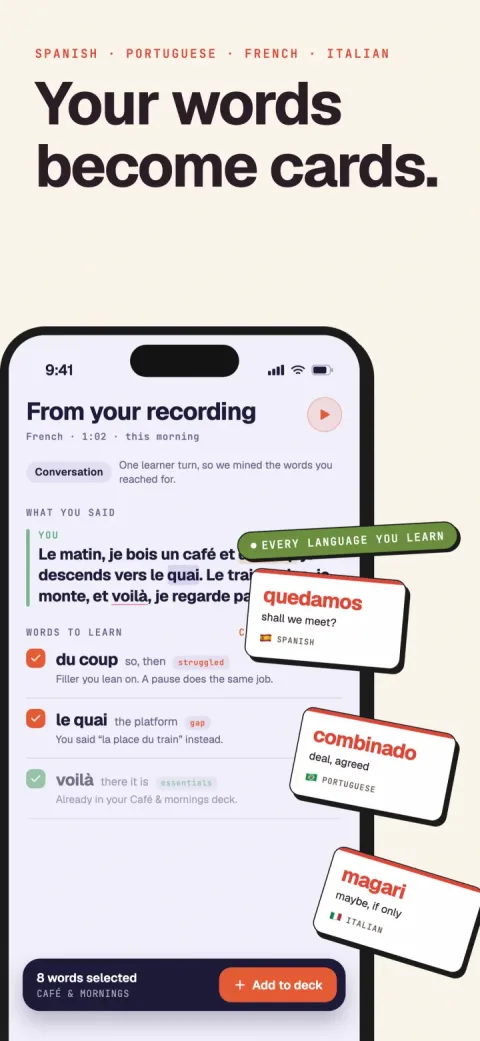
Verbamor turns the words from your own lessons and recordings into flashcards, and brings each one back before you’d forget it.

Some roundups hand every app a retention percentage. One is laxuai.com's 2026 roundup. It studied a 50-card pharmacology deck for 14 days and reports 89% for Anki against 87% for Laxu AI, the app it sells.
No raw data, no named tester, no sample size, no screenshots.
One person reviewing one deck for 2 weeks can't tell 87% from 89%. That gap is smaller than the noise from a single bad night's sleep, and the whole ranking rests on it.
The tell is in laxuai.com's own algorithm column, which calls Anki "SM-2 (customizable)" and RemNote an "SM-2 variant." SM-2 is an older scheduling formula, from 1987.
Both of those apps have shipped FSRS for years. (FSRS is an open-source algorithm that predicts when you're about to forget each card.) Whoever ran the 14 days didn't open the deck options screen.
MethodEvery scheduler claim comes from a manual, a help centre or the code
I didn't run a head-to-head retention test, and I'm not going to pretend I did. Doing it properly needs randomized assignment, matched material, hundreds of learners in each group and a delayed test. That's a research project with an ethics board, far beyond a blog post with a spreadsheet.
What I did do is read the documentation and the source. Then I ran FSRS-6 myself on its published default parameters, so the worked example below has real intervals in it instead of adjectives.
Every scheduler claim comes from the app's own manual, help centre or code, with the source named. I checked all of it on 11 August 2026.
Quizlet is the exception. It added spaced repetition ten days after my check, so I re-read its sources on 18 October 2026 and rewrote its section.
I've named the page I'm rebutting and linked it. Quoting a rival's figures while hiding whose figures they are is the same unfalsifiability I'm objecting to. Go read it and decide whether I've characterised it fairly.
I have a stake in this. Verbamor is mine, it's on this list, and I've put it last on purpose.
A retention percentage from an unnamed tester on a single deck is a number shaped like evidence. Ask for the raw data and there isn't any.
Only two of the four are known to aim a review at a fading memory
Strip away the branding and there are 4 things an app can be doing when it decides your next review:
- A fitted memory model. FSRS, and SuperMemo's later algorithms. Each card carries its own state, and the model's parameters are fitted to your review history. Adaptive per card and per person.
- A fixed formula with one adjustable number. SM-2, from 1987. Every card has an ease factor that drifts up when you pass and down when you fail. Your grades move that one number, and the formula around it stays the same for everybody.
- A fixed ladder. Memrise and Clozemaster. The intervals are hard-coded. Pass and you climb a rung, fail and you drop to the bottom. Nothing about you or the item changes the numbers.
- A scheduler that won't say how it works. Quizlet's spaced repetition, added in August 2026. You rate each card on 4 buttons and Quizlet picks the next date, but it names no algorithm and publishes no parameters, so nobody outside Quizlet can tell which of the other three it is.
All 4 kinds of scheduler are marketed with the same phrase. It matters because the first 2 aim your reviews at the moment a specific memory is fading. A ladder can't, because it doesn't model the memory.
Quizlet's might. It hasn't published enough for anyone to check.
One failure costs the ladder the whole climb again
Here's the ladder-versus-model difference as it happens to an actual word. Take Spanish el sacacorchos, corkscrew. You've never held onto it.
Memrise's rungs are documented: 4 hours, 12 hours, 24 hours, 6 days, 12 days, 48 days, 96 days, 6 months, with a wrong answer resetting to 4 hours. So say you pass the first four reviews, fail a week in, then pass slowly at day 14.
Walk the rungs and the dates fall out. Review 1 at 4 hours, review 2 at 12 hours, review 3 at 24 hours, which is day 1. Review 4 is 6 days after that, so day 7, and that's where sacacorchos goes.
The reset drops you to 4 hours, and you climb 4h, 12h, 24h, 6d again. That puts the next test at roughly day 14.
Then I ran the same sacacorchos answers, on the same dates, through FSRS-6. Both columns below are arithmetic you can redo.
| What happened | Fixed ladder | FSRS-6 on defaults |
|---|---|---|
| Day 0, learned it | Next review in 4h. | Difficulty 4.88, stability 3.26 days. Left to itself, it would ask again on day 3. |
| Reviews at 4h, 12h and 24h, all passed | 4h, 12h, 24h, then the 6-day rung. | Stability creeps 3.26 → 3.83 → 4.94 → 6.55 days. Three reviews inside a day buy almost nothing, and the model prices them that way. |
| Day 7, failed | Back to 4h. Climb the same rungs again. | Difficulty 4.84 → 7.21, stability 6.55 → 1.69 days. Due about 2 days later. It records the failure instead of only reacting to it. |
| Day 14, passed but slowly | Next rung is 12 days, then 48. | Difficulty 7.82, stability 3.35 days, so the next review is about 3 days out. A high-difficulty card grows its interval slowly. |
| The word you never miss, same dates | Identical rungs: 4h, 12h, 24h, 6d, 12d, 48d. | Stability 39.6 days by day 14, so the next review is about 40 days out. Same answers in, 12x the interval out. |
The day-7 failure cost the Memrise ladder the whole climb over again. And after a pass at day 14, it still hands you a 4x jump from 12 days to 48.
FSRS charged the same failure to the card and kept it close, at roughly 3 days. Meanwhile it pushed the word you never miss out past a month.
The table's last row is the one I'd sit with. The ladder gives sacacorchos and gato the same 8 rungs forever. Count the rungs below 12 days and there are 4 of them, so every word you already own still costs you 5 reviews before it clears the 12-day mark.
For the model's behaviour over a longer stretch, with your grades driving the dates instead of a ladder's, the FSRS post follows one card through 6 weeks.
How is FSRS different from SM-2?
SM-2 moves one number per card, while FSRS-6 fits 21 parameters to your own review log. Most roundups I read duck that distinction, so here it is in full.
SM-2 is Piotr Wozniak's algorithm from 1987, written for SuperMemo and inherited by nearly everything since. It applies a fixed formula. Each card holds one adjustable number, the ease factor.
The ease factor rises when you grade well and falls when you don't. The next interval is the previous one multiplied by that ease. Your review history changes the ease factor, and it never changes the formula.
FSRS, the Free Spaced Repetition Scheduler, models each card with 3 quantities, the DSR model. The Open Spaced Repetition wiki defines them precisely:
- Retrievability is "the probability that the person can successfully recall a particular piece of information at a given moment."
- Stability is "the time, in days, required for R to decrease from 100% to 90%."
- Difficulty is "the inherent complexity of the information."
The current version is FSRS-6, and it uses 21 parameters, optimized by machine learning against your own review log. (That count changed in Anki 25.06, so anything quoting an FSRS-5 parameter count is out of date.)
It also gives you a dial SM-2 has no equivalent for: desired retention, settable from roughly 70% to 97%. Desired retention is the recall rate you want at the moment each card comes due.
The three DSR definitions are load-bearing in the table above. A stability of 6.55 days means the model put your odds of producing sacacorchos at 90% about six and a half days out. That's why failing on day 7 was informative, and no surprise.
FSRS was created by Jarrett Ye, a research engineer at MaiMemo, and developed by the Open Spaced Repetition community. It derives from MaiMemo's DHP model.
One honest note on the headline claim. The 20 to 30% fewer reviews for the same retention figure comes from FSRS's own docs. Treat it as directional.
| App | Scheduler | Adapts to you? |
|---|---|---|
| Anki | SM-2 by default, FSRS-6 once enabled | Yes, fully, with FSRS on |
| RemNote | SM-2 by default, FSRS-6 as opt-in beta | Yes, fully, with FSRS on |
| SuperMemo | SM-19 in SuperMemo 19 (2024) | Yes |
| Clozemaster | Fixed mastery ladder, 0% to 100% | No, though Pro lets you edit the intervals |
| Memrise | Fixed ladder, 4h to 6 months | No |
| Duolingo | Published half-life regression (2016) | Unknown in production today |
| Quizlet | Spaced repetition since August 2026, no algorithm named | Unknown: no published parameters |
| Verbamor | FSRS | Yes |
1. Anki is the right answer for most people, though its default is SM-2
Anki is the right answer for most people who are serious about this, and I'd say so if I sold something twice as good.
Anki was released in 2006 by Damien Elmes, so it has close to 2 decades of development behind it. The current stable desktop release is 26.08.1, out on 5 August 2026.
Desktop is free on Windows, macOS and Linux. AnkiDroid is free. AnkiWeb sync is free.
iOS is the only paid platform: AnkiMobile is US$24.99 one time, and that purchase is what funds the whole project. Regional prices differ, so check your own store.
On scheduling: FSRS is opt-in, and SM-2 is the default. The manual calls FSRS "an alternative to Anki's legacy SuperMemo 2 (SM-2) algorithm." It has you switch it on yourself from the FSRS section, which is the final one in deck options.
I've verified that in both the manual and the Rust source. A lot of SEO posts claim FSRS became the default in 23.10, and that's simply false.
What happened in 23.10, October 2023, is that FSRS became built in, replacing the fsrs4anki add-on. Current Anki ships FSRS-6, with a hardcoded default desired retention of 0.9.
So if you installed Anki and never opened deck options, you're on a 1987 algorithm. Two minutes of setup gets you the best scheduler on this page for free.
The real trade is content. Anki ships no language content of its own. It's an empty engine, and you fill it with cards you build or decks the community shared.
Building them yourself is a genuine advantage for retention: material you generate is remembered better than the same material read (Slamecka and Graf, 1978). It's also the reason a lot of people bounce off it in week 2.
There are well over a thousand community add-ons if you want to reshape it.
You want the best scheduler and you'll do the setup
Free everywhere except iOS, FSRS-6 two clicks away, your data in an open format, and it will outlive every app on this list. Turn FSRS on the day you install it. I've written a longer Verbamor and Anki comparison which lands in the same place.
2. RemNote: FSRS-6 on a free tier, if you enable the beta
RemNote is the one to know about if the phrase "free FSRS" is what brought you here.
RemNote's spaced repetition is free. The free tier lists "Unlimited Notes & Flashcards", and what it caps is AI-generated cards (5 of them). The spaced repetition itself has no cap.
Paid plans are Pro at $8 a month or $96 a year, and Pro with AI at $18 a month or $216 a year.
The scheduler story mirrors Anki almost exactly. The default is SM-2.
FSRS is there, it's FSRS-6, and the docs are blunt about its status: "FSRS is a beta feature. It may become the default scheduler in the future, but for now you need to manually enable it." You'll find it under Settings, then Custom Schedulers.
So Anki and RemNote, the 2 apps on this page with the most capable schedulers, both ship them switched off. Any roundup that ranks apps by "uses FSRS" without checking the default is ranking a checkbox nobody ticked.
The apps · 3 of 83. SuperMemo: the most researched scheduler, on the hardest software here
Everything else here is downstream of SuperMemo. Wozniak's SM-2, published in 1987, is the algorithm Anki and RemNote both inherited, and the DSR ideas in FSRS grew out of the same research lineage.
SuperMemo's Windows line kept going. The history page lists SM-17 in 2015, SM-18 in 2019 and SM-19 in 2024, introduced in SuperMemo 19. If you read a comparison that stops at SM-17 or SM-18, it was written before 2024 or copied from something that was.
One practical caution. SuperMemo is split across several products, so "SuperMemo" on a price list may not mean the Windows program with the current algorithm.
I'm not publishing a price because I couldn't verify one. The SuperMemo 19 listing on the official store showed as sold out when I checked, and a sold-out price is no use to you.
The most researched scheduler in existence, attached to the least approachable software here. I wouldn't start with it.
The apps · 4 of 84. Clozemaster is a fixed ladder too, and the sentences are why you’d take it
Clozemaster drills vocabulary inside cloze sentences (sentences with the word blanked out), which is a good format. And if you read the docs, it's honest about being a fixed ladder.
Clozemaster's mastery levels are the schedule: 0% same day, 25% next day, 50% at 10 days, 75% at 30 days, 100% at 180 days. Four consecutive correct answers mark an item mastered. One wrong answer sends it back to 0%.
Clozemaster has no per-card difficulty and no fitted model, so a word you keep fumbling sits on the same rungs as one you've never missed. Pro lets you customize the intervals manually. You pick the numbers, once, for everything.
Clozemaster's content is the draw. The Fluency Fast Track is 10,000 sentences in 10 levels of 1,000, ordered roughly by word frequency. There's a newer Fast Track and a Legacy version, and availability varies by language.
I'm not publishing a price because I couldn't verify one.
The apps · 5 of 85. Memrise gives every learner and every word the same eight rungs
Memrise uses neither SM-2 nor FSRS. It runs a fixed, non-adaptive interval ladder, and the rungs are documented: 4 hours, 12 hours, 24 hours, 6 days, 12 days, 48 days, 96 days, 6 months. A wrong answer resets you to 4 hours.
Memrise uses the same schedule for every user and every item. So the word you can never hold onto and the word you got first try sit on identical rungs forever. That's the ladder worked through above, and the 12-to-48-day rung is where it costs the most.
Memrise has also moved on in its marketing. The homepage now leads with "Real native video. Smart review. Private AI practice," and the phrase "spaced repetition" doesn't appear on it. The ladder is still in the help centre.
I'm not publishing a price because I couldn't verify one. It's region-varying and promo-heavy enough that any figure I quoted would be wrong for most readers.
The apps · 6 of 86. Duolingo published a real scheduler; what runs today is undocumented
Duolingo gets dismissed in most of these roundups, and the dismissal is wrong on the facts.
Duolingo published a real scheduler and open-sourced it: half-life regression, in Settles and Meeder, "A Trainable Spaced Repetition Model for Language Learning," ACL 2016. Half-life regression (HLR) estimates how quickly each word fades from a learner's memory. It's peer-reviewed and trained on production data, which is more than Quizlet or Memrise has published.
What I can't tell you is whether HLR is what's running today. Secondary sources say it was folded into a later system around 2020. I couldn't find that on a Duolingo-owned page, so I'm not going to state it.
The published paper is real. The 2026 production model is undocumented.
Two other Duolingo claims are worth correcting while I'm here. The free tier's gate is now Energy, a learning battery that lessons drain and correct answers refill, which replaced hearts.
And the "Duolingo only gets you to A2" line is stale. Since 22 April 2026, Duolingo says its Spanish course now teaches through CEFR B2, a Duolingo Score of 129. CEFR is the European scale of language levels, from A1 for beginners up to C2.
The expansion covers 9 courses. That's a claim about course content rather than measured learner outcomes, but repeating the A2 line in 2026 is just out of date.
Super Duolingo's App Store prices run from $9.99 to $119.99 depending on term and plan, with a 14-day free trial. The store doesn't label which price goes with which term, so I'm not going to guess.
The apps · 7 of 87. Quizlet schedules reviews now, and won't say how
Quizlet is on this list because it often gets named as a spaced repetition app. When I first wrote this, it wasn't one: a full-text scan of all 164 English articles in its help centre on 11 August 2026 found zero hits for "spaced repetition".
Ten days later, on 21 August, Quizlet published Studying with Spaced Repetition. This section kept saying Quizlet had no scheduler until 18 October 2026, so the correction is mine to make.
Here's the whole feature, in Quizlet's words. You open a set in Flashcards, pick spaced repetition as the study method, flip a card and rate yourself on 4 buttons:
- Repeat: the card "returns within minutes".
- Hard: it "returns soon".
- Okay: it "typically returns in about a day".
- Easy: it "typically returns in four or more days".
There's a "New cards per day" setting, and you review "until no more are due". That's a scheduler, and it moves Quizlet out of the empty box this section used to put it in.
What Quizlet doesn't do is say how it works. I re-scanned all 167 English help articles on 18 October 2026 and got zero hits for "algorithm", "interval", "forgetting curve", FSRS or SM-2. Those 4 glosses are the entire published specification, so I can't tell you whether it's a fitted model, a formula or a ladder.
Learn is described as built on learning-science principles and powered by machine learning with a personalized study path. No named algorithm. No intervals.
Quizlet also disagrees with itself about your phone. The help article says spaced repetition "is currently only available on the Quizlet website", 3 times, and still did after its update on 17 October 2026. But the App Store listing for version 10.56 of the iPhone app, released 13 October, lists "Spaced Repetition" as a feature.
I haven't tested the app, so check it before you count on it.
Progress is still there and still separate, and it's a paid feature, per Quizlet's help centre. It buckets terms by how often you answered correctly (Not Studied, Still Learning, Mastered), with no due dates and no next-review calculation.
One Quizlet concession that's easy to miss. Learn and Test are paid for individuals, but students in a teacher-created class get unlimited ad-free Learn and Test on sets added to that class page. So "Learn is paid" is true for you and false for a lot of students.
Quizlet's audio is machine text-to-speech, free in Flashcards mode. Custom recordings are on the paid tier, and native-speaker recordings aren't a feature at all.
I'm not publishing a price because I couldn't verify one from a first-party page, so I'm describing what's gated instead. Roundups that quote you a flat Quizlet monthly figure are quoting each other.
The apps · 8 of 88. Verbamor is tied on the algorithm, and narrower than everything else
Verbamor runs FSRS. So does Anki with 2 clicks, and so does RemNote's beta, on a free tier. On the algorithm, we're tied, and I'd be embarrassed to argue otherwise.
Verbamor's narrowness is the point, and it's severe. iOS only. Five languages: Spanish, French, Italian, Portuguese and Russian.
Paid, with no free tier at all. Explorer is $19.99 a month, and Native is $129.99 a year (about $10.83 a month). The yearly one opens with a 7-day trial, and the monthly one doesn't.
Anki does more than that for free on 5 platforms.
Verbamor isn't a general spaced repetition app. You can't put pharmacology in it, or Japanese, or your law-school outlines. If your deck isn't Spanish, French, Italian, Portuguese or Russian vocabulary, stop reading this section and go install Anki.
What Verbamor does is the step before the scheduler. This page has spent 2,000 words demanding other people show their working, so here's mine.
It records the lesson and reads the transcript, which arrives with speaker labels. It identifies you as the less fluent speaker: the one who hesitates, asks what a word means, reaches for an English word mid-sentence, or gets corrected.
Then Verbamor tags each candidate item with a ranked reason. Struggled means you reached for it and couldn't produce it cleanly. Corrected means the other speaker fixed it after you got it wrong.
Gap means you needed the word and never produced it at all, so it's inferred from what you talked around. Those 3 outrank merely taught or used.
You review the mined list and pick what to keep. Each survivor becomes a card carrying the sentence from your lesson with the answer blanked.
It also gets 2 recordings of that sentence. One has the word replaced by a tone for the recall test, and one has it spoken for the answer.
Verbamor's mining misfires in ways worth knowing. Talk over your tutor and the speaker split degrades. Pause to think about a word you knew perfectly well and it can read as a struggle.
None of that is a retention claim, because I don't have one. It's a mechanism you can judge on the trial.
What the fixed-ladder apps can't match here has nothing to do with scheduling: they don't know your lesson happened at all.
You already build cards and don't mind doing it
Anki plus FSRS costs nothing on desktop and does the scheduling just as well. The card-making is the only thing you're paying us for. So if that step isn't your bottleneck, this isn't your purchase.
Three questions, and a free app answers the first two
Three questions, in order.
Is your material anything other than these 5 languages? Anki. It's the only one here that takes any subject at any scale, and its scheduler is as good as it gets. Turn FSRS on.
Do you want FSRS without spending money on any platform? RemNote's free tier, with FSRS-6 enabled under Custom Schedulers, or Anki on any computer or Android phone, where it costs nothing. Both give you the same algorithm class.
Is making the cards the reason you've quit twice? That's the one thing the free options don't solve, and it's the whole argument for a paid app in this category. Ours does it for 5 languages on iOS. Judge it on that, and only on that.
Whichever you land on, 2 things matter more than the choice. Grade honestly, since a fitted model is only as good as the data you feed it. And mix your cards rather than blocking them by topic (see interleaving).
If you want the scheduling principles without an app attached, the guide to spaced repetition for language learners covers the manual version. The forgetting curve post explains why any of this works.
Short answersThe six questions this page gets asked
What is the best spaced repetition app?
Anki, for most people who are serious about this. You pay nothing for it outside iOS, it has close to 2 decades of development behind it, it has FSRS-6 built in, and your data stays in an open format. The cost is that it ships no content of its own, so every card is one you build. If you want FSRS free on any platform, RemNote's free tier includes unlimited notes and flashcards, and its FSRS-6 is a beta you enable under Settings then Custom Schedulers.
What is the difference between SM-2 and FSRS?
SM-2 applies a fixed formula with one adjustable number per card, the ease factor, which moves with your grades. FSRS tracks 3 quantities per card and fits its parameters to your own review log: retrievability, "the probability that the person can successfully recall a particular piece of information at a given moment"; stability, "the time, in days, required for R to decrease from 100% to 90%"; and difficulty, "the inherent complexity of the information." FSRS-6 uses 21 parameters, machine-optimized against your individual review history, and it lets you set a desired retention target of roughly 70 to 97%. SM-2 has no such dial.
Does Anki use FSRS by default?
No. Anki ships SM-2, the legacy SuperMemo 2 algorithm, out of the box. The manual describes FSRS as an alternative to Anki's legacy SM-2 algorithm and leaves you to turn it on in its own FSRS section, the last thing in deck options. FSRS has been built in natively since Anki 23.10 and AnkiMobile 23.10 in October 2023, and before that it was the fsrs4anki add-on. "Built in since 23.10" is right. "Default since 23.10," which many blog posts claim, is wrong. When you enable it, default desired retention is 90%.
Does a fixed interval ladder actually hurt me?
A fixed ladder hurts you on the words you keep failing, and it costs you time on the words you already know. Memrise's documented ladder is 4 hours, 12 hours, 24 hours, 6 days, 12 days, 48 days, 96 days, 6 months, and a wrong answer drops you back to 4 hours. Walk it: reviews at 4 hours, 12 hours and 24 hours put you at day 1, and the 6-day rung puts the fourth review at day 7. Fail there and you climb from 4 hours all the way back to the 12-day rung before the word is anywhere again. I ran that same sequence of answers through FSRS-6 on its default parameters at desired retention 0.9. The failure at day 7 raised the card's difficulty from 4.84 to 7.21 and cut its stability from 6.55 days to 1.69 days, so the model asked for the word again about 2 days later rather than restarting a fixed climb, and a slow pass at day 14 bought roughly 3 days instead of the ladder's next 12-day rung. The ladder has one response to failure, which is start over.
Does Quizlet use spaced repetition?
Yes, since August 2026, and this page said no until 18 October 2026. Quizlet's help article "Studying with Spaced Repetition" was created on 21 August 2026 and last updated on 17 October. You pick spaced repetition as the study method in Flashcards and rate each card Repeat, Hard, Okay or Easy; Quizlet's own glosses put those at "within minutes", "soon", "about a day" and "four or more days". No algorithm is named and no parameters are published: a scan of all 167 English help articles on 18 October 2026 returned zero hits for "algorithm", "interval" or "forgetting curve". Quizlet's help centre says the feature is website only, while the App Store listing for version 10.56 of the iPhone app (13 October 2026) lists Spaced Repetition, so check the app before you count on it. Progress, the separate mastery tracker for subscribers (Not Studied, Still Learning, Mastered), still has no due dates.
Is a free spaced repetition app good enough?
Yes, for the scheduling itself. Anki is free everywhere but iOS and gives you FSRS-6 once you enable it, and RemNote's free tier includes unlimited notes and flashcards with FSRS-6 available as a beta. No paid app schedules better than free Anki with FSRS turned on. What money buys in this category is the work around the scheduler: the content, the audio, and getting cards built without you typing them. If the card-making step isn't your bottleneck, the free option is the correct answer.
Sources
Schedulers and algorithms
- Anki manual, deck options and FSRS. Confirms SM-2 is the default and FSRS is enabled per deck.
- The FSRS algorithm, Open Spaced Repetition wiki. Source of the DSR definitions quoted above, and of the default parameters and update formulas used in the worked example.
- Ye, J., Su, J., & Cao, Y. (2022). A stochastic shortest path algorithm for optimizing spaced repetition scheduling. Proceedings of KDD '22.
- Settles, B., & Meeder, B. (2016). A trainable spaced repetition model for language learning. Proceedings of ACL 2016, 1848–1858.
- RemNote's Anki SM-2 documentation for the default scheduler, and its FSRS documentation for the beta status. Checked 9 September 2026.
- Quizlet help centre, Studying with Spaced Repetition, article 48324742264077, created 21 August 2026 and updated 17 October 2026, read 18 October 2026. Source for the four rating buttons and Quizlet's glosses on each, the "New cards per day" setting, and the sentence "Spaced repetition is currently only available on the Quizlet website", printed three times. A scan of all 167 English help articles the same day found no named algorithm and no parameters.
- Quizlet on the App Store, version 10.56 (13 October 2026), read 18 October 2026, for the listed feature "Spaced Repetition: Quizlet intelligently resurfaces exactly what you need to review, right when you need it".
- Quizlet help centre, Using Progress for targeted studying, read 18 October 2026: "Progress is available in Quizlet Plus subscriptions." Subscribing to Quizlet, read the same day, lists keeping "track of their Progress" under Quizlet Plus Unlimited.
Why spacing works at all
- Cepeda, N. J., Pashler, H., Vul, E., Wixted, J. T., & Rohrer, D. (2006). Distributed practice in verbal recall tasks: A review and quantitative synthesis. Psychological Bulletin, 132(3), 354–380. 317 experiments across 184 articles.
- Cepeda, N. J., Vul, E., Rohrer, D., Wixted, J. T., & Pashler, H. (2008). Spacing effects in learning: A temporal ridgeline of optimal retention. Psychological Science, 19(11), 1095–1102. More than 1,350 people.
- Karpicke, J. D., & Roediger, H. L. (2008). The critical importance of retrieval for learning. Science, 319(5865), 966–968.
Why building your own cards helps
- Slamecka, N. J., & Graf, P. (1978). The generation effect: Delineation of a phenomenon. Journal of Experimental Psychology: Human Learning and Memory, 4(6), 592–604.
The scheduler is the easy part.
Anki gives you FSRS for free, and you should take it. Verbamor exists for the other half: getting Spanish, French, Italian, Portuguese or Russian cards built from what your tutor actually corrected, without you typing a single one.
Start 7 days freeThe 7-day free trial is on the yearly plan.