 Verbamor
Flashcards from lessons: a card company says 30 seconds each
Every guide to making flashcards assumes your source is a file you can click inside. Your lesson was a conversation with a person. That difference is the whole problem.
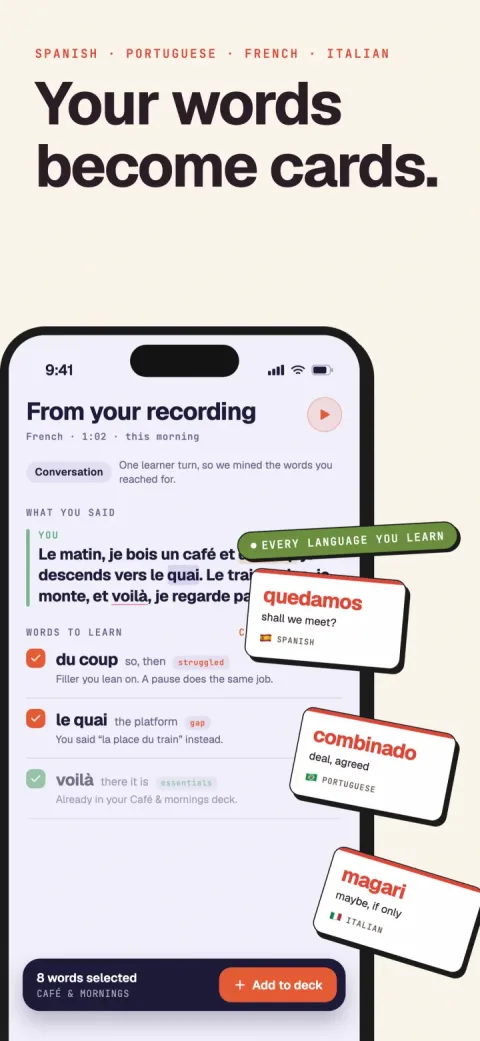
Verbamor turns the words from your own lessons and recordings into flashcards, and brings each one back before you’d forget it.

Your tutor said me da igual at minute 34. You laughed, you understood it from context, you moved on. It's Thursday now and it's gone.
So you go looking for how to make flashcards from your lessons, and every guide you find teaches you to import a file.
Then it quotes you 30 seconds of typing per card for the privilege. That's a figure I'll come back to, because it's the card industry's own.
Every import path wants a file
In August I read the page that topped my search for this question, Migaku's guide to making Anki cards. It's a long beginner tutorial, and it's genuinely good at what it does. It has correct menu paths, exact notetype names, and real advice about cloze deletion (blanking a word out of a sentence) and tags.
Then I searched its raw HTML for the words I came in looking for.
"Lesson" appears zero times. "Tutor" zero. "Teacher" zero. "Conversation" zero. "Speaking" zero. Five words, five zeros, on the top result for a question about lessons.
That's the shape of the whole category. Card tools are built around a source you can address: a subtitle you can click, an article you can select, a word list you can paste.
The Anki manual is admirably blunt about what its own import path expects. "Any plain text file that contains fields separated by commas, semicolons or tabs can be imported into Anki, provided some conditions are met." The conditions follow immediately: "The files must be plain text (myfile.txt)."
Fine rules. They just start one step after your problem ends.
Nothing that happened in your lesson is a file yet, and turning it into one is the labour no one schedules.
Getting a spoken hour into any format at all is the hard part, and no import screen has ever helped with it.
italki, which sells the lessons, says the quiet part on its own blog: "It's up to you to take the language you learned in your italki lesson and add it to a smart platform." Up to you. Unpaid, and dependent on you having written something down while a human being was talking to you.
During the lesson, capture the word, a translation and its sentence
Everything in this section is my own routine, worked out over about two years of weekly Spanish lessons and never tested against anyone else's method. No study backs it. Steal the parts that fit.
Capture is a live problem under time pressure. It has to cost almost nothing or you won't do it.
So mine is deliberately unglamorous: one plain text note, open next to the video call, never closed.
When a word lands, type three things and stop: the word as you heard it, a quick English translation, and the sentence's last four or five words.
Six seconds in my hands, and I've never timed it properly. me da igual / I don't care, all the same to me / dijo que le da igual.
That third field is the one people skip, and here I can point at something firmer than my own habit. A word gets filed together with the situation you met it in, which is why the word you nailed on the sofa deserts you at the restaurant. The fragment is the only piece of that situation you can carry out of the call.
My note for me da igual nearly went in as the bare pair. By Thursday I'd have rebuilt some tidy dictionary sentence around it, instead of my tutor Marta shrugging at a question about weekend plans.
The harder question is what deserves a line at all. My rulings, again from practice rather than evidence:
One hard rule underneath all six: never stop the lesson to write. You're paying for talk time.
A misspelled note is recoverable. A derailed conversation isn't.
If typing pulls you out of the conversation, record the lesson (ask first) and mark timestamps by typing bare numbers. 14. 31. 38. Then you revisit four moments rather than fifty minutes.
And do the write-up within a day, while you can still hear the sentence. A week later you're guessing, and the guess is what gets encoded.
Building a card costs at least twice what studying it does
Now the part that decides whether you'll keep this up. The best number available comes from a card company, in a guide recommending you make cards by hand.
In its own FAQ, Migaku writes: "If you spend 30 seconds per card (Typing front, back, maybe adding an image), that's 750 minutes or about 12.5 hours." That 12.5 hours is their figure for a 1,500-card deck.
Read the conditional carefully, because it's doing a lot of work. That's an assumption ("if you spend"), not a measurement, and it covers manual typing of front, back and image.
No one stopwatched anyone. I'm quoting it because it's the industry's own estimate of its own labour, published against its interest.
I won't multiply it by a guess about how many words a lesson yields, because I haven't counted. Take the per-card figure on its own.
Building a card costs at least twice what studying it costs, on the card company's own numbers. And that's before you've studied it a second time.
The build cost also comes due up front, at the exact moment you're least in the mood, which is why decks die at the front end. Worth weighing against how many cards a day you can genuinely sustain.
Turn minute 34 into a cloze card with the tutor’s own sentence
Let's take me da igual the whole distance. You wrote this during the call: me da igual / I don't care, all the same to me / dijo que le da igual. That's your raw material, and the build is quick from here.
Use cloze, always. In Anki that's the Cloze notetype, picked from the dropdown at the top left of the Add window, with the answer wrapped in {{c1::…}}.
Type Dijo que le {{c1::da igual}} into the Text field, put "he said he didn't care either way" in Extra, and you're done. The card shows the sentence with a hole in it, and you produce the missing piece.
The skill you're short of is producing da igual mid-sentence, and producing it out loud is better still. A pair that asks you to recognise it on sight trains the half you already have.
Four things belong on a card built from a lesson:
- The sentence your tutor actually said. It carries the register (how formal or casual it sounds) and the preposition, and those are the parts you'll get wrong.
- A blank where the target word goes, so every review is a retrieval attempt. That's the testing effect doing the work.
- Audio of the sentence, because you met this word by ear and you'll need it by ear again.
- One picture, for the words that take one. Me da igual doesn't, and forcing it wastes the 30 seconds twice over.
Keep one card per word. Ten cards mined from one sentence all cue each other, and the deck flatters you.
I built Verbamor because I kept not doing the 30 seconds. You record or type what came up in the lesson, and it makes the cloze card, the native audio and the image. Then it schedules the card with FSRS (an open-source scheduling algorithm).
It's an iOS app, there's no free tier, and $129.99 a year (or $19.99 a month) is a real cost to weigh against typing you might enjoy.
Beyond a starter deck of about 650 common words, it doesn't teach you anything. It holds words you've already met.
For common words, download a premade deck instead
If your source is a textbook chapter or a frequency list, don't build anything. Download a premade deck.
I mean that for a specific reader: someone working through the first few thousand words, where the vocabulary is identical for everyone. Migaku's own recommendation is a hybrid: a premade deck for the most common 1,000 to 2,000 words, and self-made cards for what you meet in the wild. I think that's right.
Hand-typing la mesa spends 30 seconds reproducing a card that already exists in a thousand shared decks, and the frequency curve means those words will find you anyway.
Anki wins outright for a second reader: anyone who'll genuinely build their own cards. It's free on desktop, and it runs FSRS if you switch it on. The manual notes it's "an alternative to Anki's legacy SuperMemo 2 (SM-2) algorithm", off by default.
No subscription beats free plus total control. If you've read this far and 30 seconds a card sounds fine to you, it probably is. Go be that person.
Where the file assumption stops holding is the lesson that happened once, to you, containing the four words you couldn't reach for. There's no deck of those. There's only what you wrote down at minute 34.
Sources
Card import paths presuppose a file
- Anki Manual. Importing: Text Files. Verified 22 August 2026: plain text with separated fields can be imported "provided some conditions are met," and non-text formats must be converted first.
- Anki Manual. Deck Options: FSRS. FSRS is presented as an alternative to the legacy SM-2 scheduler, enabled from the deck options page.
The stated cost of manual card entry
- Migaku. How to Make Anki Cards: Complete Guide for Making Anki Flashcards. Read 22 August 2026; the two quoted figures re-confirmed 13 October 2026. The 30-seconds-per-card figure (and the 12.5 hours it implies for 1,500 cards) is a stated assumption in the page's FAQ covering manual typing only, as is the 10-15 second review estimate. Word-frequency counts are my own, run against the page's raw HTML on 22 August 2026 so that client-rendered text is included in the search.
Lesson capture is left to the learner
- italki. 3 Ways to Get More Out of Your italki Lessons. Verified live 22 August 2026.
Skip the 30 seconds a card.
Verbamor takes what came up with your tutor and builds the cloze card, the native audio and the image for you.
Start 7 days freeThe 7-day free trial is on the yearly plan.