 Verbamor
Which language app teaches useful words?
Useful words come from 2 places: the most common words in the language, and the words your own life keeps using. Lingvist and Clozemaster teach from frequency lists, while LingQ, Anki and Verbamor, which I build, turn your own reading, notes or lessons into cards.
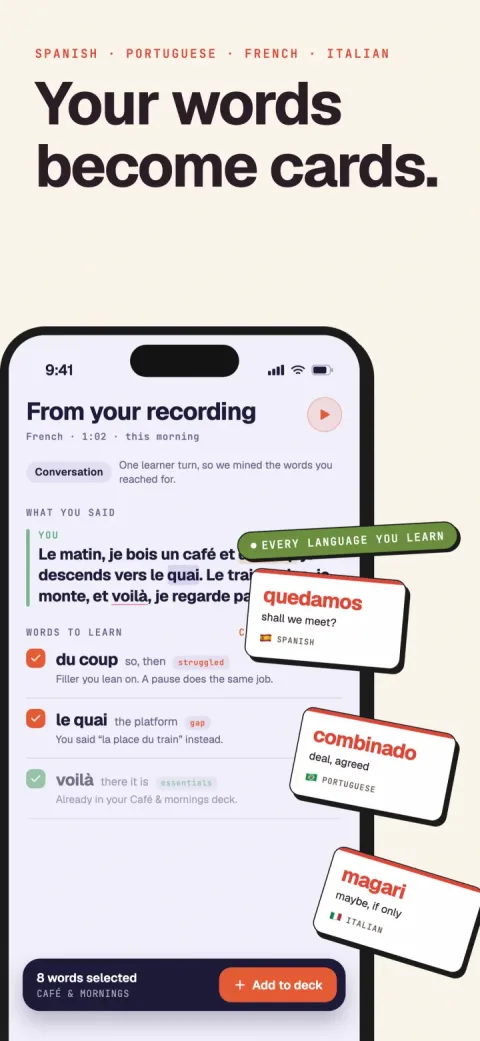
Verbamor turns the words from your own lessons and recordings into flashcards, and brings each one back before you’d forget it.

Course apps like Duolingo and Babbel choose the words for you. Babbel's own help centre says you can't add your own words to its review queue.
So the best app for useful words does 2 jobs. It starts you on the most common words, then it adds the words you meet in your own lessons, conversations and reading.
What makes a word useful?
A word is useful when you'll hear it or need to say it soon. That depends on how common the word is in the language. It also depends on how often you meet it in your own week.
Frequency does most of the work at the start. In Davies's 2005 count of spoken Spanish, the 1,000 most common words covered 87.8% of the words people said. The first 2,000 covered 92.7%.
Nation and Waring (1997) found the same shape in English. About 2,000 word families give around 96% coverage of informal speech.
Then the curve flattens fast. I explained why the word-frequency curve flattens, with the numbers for each step.
That flat part is where frequency stops choosing for you. Nation (2006) puts comfortable listening at 6,000 to 7,000 word families, for 98% coverage of spoken text.
The words between 2,000 and 7,000 are different for a nurse and for someone with Italian in-laws.
So "useful" has 2 parts. The first 2,000 or so words are the same for almost everyone. After that, the most useful words are the ones from your own life.
For the first part, any good list works. I compared every published frequency list for Spanish, French, Italian and Portuguese, with the corpus and date of each.
Why do language apps teach words you'll never use?
A course app writes one path for every learner. It can't know your job or the people you talk to, so it teaches what a typical beginner might need.
Babbel's homepage promises course material "tailored to your proficiency level, interests, and time commitment" (read 17 Oct 2026). Its help centre says its review queue holds only words from lessons you finish (read 5 Sep 2026).
In Babbel's own words: "It is not possible to manually add random words or phrases to your review."
Learners notice the gap. I counted complaints in 13,183 one- and two-star App Store reviews of 30 language apps, fetched 17 Oct 2026.
An AI model checked each match and confirmed 78 complaints about useless or odd words and sentences, across 18 apps. Babbel had 15 of them and Duolingo had 14.
Treat 78 as a lower bound. A keyword search picked the reviews first, so the count missed any complaint worded some other way.
A 2-star App Store review of Duolingo says the "words it teaches you are far from common words you are likely to use". A 1-star App Store review of Babbel complains about "learning words I won’t use in a normal conversation".
Where does each app get its words?
The table shows where 8 apps get the words they teach, and whether you can add your own. Each row comes from the company's own site or help pages, on the date shown.
| App | Where the words come from | Can you add your own words? | Read |
|---|---|---|---|
| Duolingo | Its course. Since 22 April 2026, 9 courses teach through CEFR B2. | I couldn't confirm it on a Duolingo page. | 13 Oct 2026 |
| Babbel | Its course, which Babbel says "200+ language experts" wrote. | No. Its review queue holds words from lessons you finish. | 5 Sep and 17 Oct 2026 |
| Drops | A bank of "over 5,000 words and phrases" on everyday topics. | Its homepage doesn't say. | 17 Oct 2026 |
| Lingvist | The most common words first. Lingvist says they "cover 80% of everyday scenarios". | Yes. Custom Decks turns "any words or text you provide" into a course. | 17 Oct 2026 |
| Clozemaster | Sentences from Tatoeba. The blank is the least common word in the sentence within the 10,000 most common. | The FAQ I read describes no way to add one. | 13 Oct 2026 |
| LingQ | Content you pick from its library or import, such as podcasts or books. | Yes. You mark the words you don't know as you read. | 17 Oct 2026 |
| Anki | Nothing. Anki ships no language content, so you write the cards or download a shared deck. | Yes. Every card is yours to write. | 12 Oct 2026 |
| Verbamor | Essentials, about 650 common words in a fixed order. Then your recordings, pasted text and Translate look-ups. | Yes, as a word or a whole phrase. You can't write a fully custom card. | 17 Oct 2026 |
2 rows need a caveat. The 80% figure is Lingvist's own claim, and its page gives no source for it.
Clozemaster's sentences come from Tatoeba, a set that users curate. Clozemaster's FAQ warns there will "probably be a few errors here and there".
Anki's manual takes a side on decks: "Creating your own deck is the most effective way to learn a complex subject". The cost is your time, because you write every card by hand.
How can you test an app's words in 5 minutes?
Run this test during an app's trial, before you pay.
- List 10 words you needed this week and didn't know.
- Count how many of the 10 words the app teaches.
- Add 1 missing word to the app's review queue.
If the app teaches most of your 10 or lets you add them, its words will follow your life. If it teaches 2 and step 3 fails, the course will keep choosing for you.
Repeat the test after a month with a fresh 10 words. One pass in week 1 proves little, because your needs grow past the beginner topics fast.
Who writes the sentences on Verbamor's cards?
In Verbamor, you supply most of the words. You can record a lesson or conversation of up to 90 minutes. You can also import an audio file, paste text, or search for a word in the Translate tab.
Ask the other people before you record a conversation. You choose which words or phrases to save, and each new word becomes 2 cards in one review queue.
FSRS-6 schedules every card. Before you have any recordings, there's Essentials, a starter deck of about 650 common words per language in a fixed order.
AI writes the rest of each card. Claude and OpenAI models write the card text, the example sentence and the picture. Automated checks run on them, and no human reviews them.
The 2 recordings on each card are generated speech with a native accent. If a word is wrong, you can flag it on the lesson results.
So I can promise you relevant words. I can't promise hand-picked sentences, and AI sentences go wrong in ways learners spot fast.
A 2-star App Store review of Falou says "Stupid AI made sentences that no one would say in real life". That risk applies to Verbamor's sentences too.
You can't edit a card's text. You can add a personal note, swap the picture for your own photo, or remove the card from your review queue.
When should you pick something else?
A total beginner with nothing to record yet should start from a frequency list or a course. My comparison of frequency lists names the published ones. Verbamor's Essentials stops at about 650 words, and after that the app needs your own lessons or text.
If you want a full course, pick Babbel. Its homepage promises "helpful grammar tips" inside the lessons. Verbamor has no course, no curriculum and no grammar lessons.
Verbamor's grammar cards come only from your own mistakes, taken from your recordings or pasted text.
If you learn by reading long texts, pick LingQ. It builds lessons from content you import, and it helps you review the words you mark.
If you want to write every card yourself, pick Anki. You control all of the text, and you also do all of the typing.
If you use Android, Verbamor won't work for you. It needs an iPhone or iPad, and there's no Android or web app.
Verbamor teaches Spanish, French, Italian, Portuguese and Russian. It costs US$19.99 a month with no trial, or US$129.99 a year with a 7-day trial (US prices, 21 Sep 2026).
Questions people ask
Is Duolingo good for learning useful vocabulary?
Duolingo teaches the words its course chooses, in the course's order. Since 22 April 2026, 9 of its courses teach through CEFR B2, so the course goes further than it used to. I couldn't confirm on a Duolingo page whether you can add your own words, so test that before you rely on it. In my count of low-star App Store reviews, 14 Duolingo reviews complained about useless words or sentences.
Is a frequency list enough to learn useful words?
A frequency list is enough for the first few thousand words, and it's the best place to start. About 2,000 word families cover around 96% of informal speech (Nation and Waring, 1997). Nation (2006) puts comfortable listening at 6,000 to 7,000 word families. The words past the first 2,000 depend on your life, so take them from your own lessons, conversations and reading.
Can I add my own words to Babbel?
You can't add your own words to Babbel's review queue. Babbel's help centre said on 5 Sep 2026: "It is not possible to manually add random words or phrases to your review". Its review queue holds the words from lessons you finish. For your own words, use a second app such as Anki, LingQ, Lingvist's Custom Decks or Verbamor.
Who writes the example sentences in Verbamor?
AI writes them. Claude and OpenAI models write Verbamor's card text, example sentences and pictures, with automated checks and no human review. Outside the Essentials starter deck, the word on each card comes from the learner's own recording, imported audio, pasted text or Translate look-up. A learner who sees a wrong word can flag it on the lesson results.
What should a total beginner learn first?
A total beginner should learn the most common words first, from a frequency list or a course. In Davies's 2005 count of spoken Spanish, the 1,000 most common words covered 87.8% of the words people said. The first 2,000 covered 92.7%. Move to your own words once you have lessons, conversations or texts to take them from.
Sources
How many words cover a language
- Nation, P., & Waring, R. (1997). Vocabulary size, text coverage and word lists. In N. Schmitt & M. McCarthy (Eds.), Vocabulary: Description, Acquisition and Pedagogy (pp. 6–19). Cambridge University Press.
- Nation, I. S. P. (2006). How large a vocabulary is needed for reading and listening? Canadian Modern Language Review, 63(1), 59–82.
- Davies, M. (2005). Vocabulary range and text coverage: Insights from the forthcoming Routledge frequency dictionary of Spanish. Selected Proceedings of the 7th Hispanic Linguistics Symposium, 106–115.
What each app says about its words
- Babbel help centre. Vocab workout: Review, read 5 Sep 2026. Babbel homepage, babbel.com, read 17 Oct 2026.
- Duolingo blog. Go further with Duolingo: Our top courses now teach advanced content, 22 April 2026, read 13 Oct 2026.
- Drops homepage, languagedrops.com, read 17 Oct 2026.
- Lingvist homepage, lingvist.com, read 17 Oct 2026.
- Clozemaster FAQ, clozemaster.com/faq, read 13 Oct 2026.
- LingQ homepage, lingq.com, read 17 Oct 2026.
- Anki manual. Getting started: shared decks, read 12 Oct 2026.
The review count
- My own count of 13,183 one- and two-star App Store reviews of 30 language apps. I fetched them from the US, UK, Canada and Australia stores on 17 Oct 2026. A keyword pass picked candidates, and an AI model checked each match.
Your lessons already hold the words you need.
Verbamor turns your recordings, pasted text and look-ups into cards, then schedules them with FSRS-6.
Start 7 days freeThe 7-day free trial is on the yearly plan.