 Verbamor
Language learning apps that let you choose what to learn
Anki, Quizlet and Memrise's word lists let you choose the words you learn. Babbel lets you take lessons in any order, Busuu Premium lets you skip lessons, and Mondly lets you pick topics. Duolingo has put every learner on one fixed path since 1 Nov 2022.
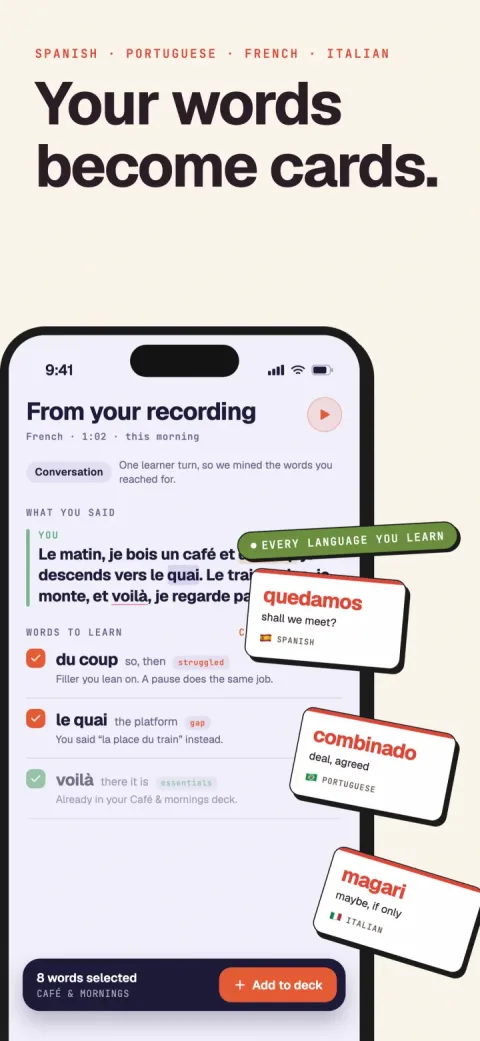
Verbamor turns the words from your own lessons and recordings into flashcards, and brings each one back before you’d forget it.

If you want to choose the words, use a flashcard app: Anki, Quizlet or Memrise's word lists. If you want a course with a choice of lesson order, use Babbel or Busuu Premium.
One disclosure first: Verbamor, which I build, is one of the 11 apps below. Every other app's row comes from that company's own pages, and the sources list gives each read date.
Choosing what you learn means 3 separate controls: the words, the lesson order, and how much you study each day. Each app gives you a different mix of them.
I pulled 13,183 low-star App Store reviews of language apps from Apple's review feed on 17 Oct 2026. A model reader, an AI that checks each review against a fixed definition, read 2,409 of them.
It found 79 reviews where the learner says they can't choose what or how much to study. They came from 16 apps, led by Duolingo (20), Memrise (13) and Babbel (10).
Which apps let you choose what to learn?
Here are 11 apps, split by the 3 controls. "Not stated" means the company's own pages I read don't say.
| App | Your own words | Lesson order | How much a day |
|---|---|---|---|
| Duolingo | Not stated. Practice is built into the path. | One path for every learner since 1 Nov 2022. Skip with a placement test, or 1 unit at a time. You can reopen finished units. | Not stated. |
| Babbel | Babbel's Review holds only words from lessons you've done. | Any course or lesson, in any order. You can skip lessons. | Not stated. |
| Busuu | Words enter Vocabulary Review when you finish a lesson. You can delete words from that list. | Premium: skip lessons or chapters. Free: pass a Checkpoint to open more lessons. | Study Plan: 5 to 30 minutes a day, on Premium Plus only. |
| Mondly | Not stated. | 33 topic categories, plus Daily Lessons, Weekly Quizzes and Monthly Challenges. | Not stated. |
| LingoDeer | Not stated. | Structured lessons on a "clear learning path", per its App Store listing. | Not stated. |
| Rosetta Stone | Not stated. | Flashcard sets on 500+ topics, per its App Store listing. | Not stated. |
| Memrise | Yes. Word lists you make returned to the app in 2026. Community courses had left the app on 31 Mar 2024. | Not stated. | Not stated. |
| Anki | Yes. You make or download every deck. Anki ships no language content. | You decide what goes in each deck. | New cards/day (default 20) and Maximum reviews/day (default 200). |
| Quizlet | Yes. You can create your own flashcard sets. | You pick which sets to study: search millions of them, or make your own. | "New cards per day" since 21 Aug 2026, on the website only. |
| Clozemaster | Not stated. Sentences come from the Tatoeba dataset. | Fluency Fast Track: 10,000 sentences in 10 levels, roughly by word frequency. Only some languages have it. | Not stated. Pro lets you change the review intervals (default 1, 10, 30 and 180 days). |
| Verbamor | Yes. You save words from your recordings, pasted text or the Translate tab. | The Essentials deck (about 650 words) has a fixed order. Verbamor has no course beyond it. | Reviews a day: 5 to 60. New words a day: 5 to 30. |
Which apps let you pick your own words?
Anki gives you the most control over words. It ships no language content of its own, so every card in it is one you made or downloaded.
Quizlet lets you create your own flashcard sets, or search millions of other people's sets. Memrise removed its community courses from the app on 31 Mar 2024.
In 2026, Memrise returned about 800 of those courses to the app as word lists. You can also make your own word list there.
A 1-star App Store review of Memrise from Feb 2024 said: "I want to learn my own way and through my own choices."
The course apps mostly pick the words for you. Babbel's help centre says it's "not possible to manually add random words or phrases to your review."
Busuu adds words to its Vocabulary Review when you finish a lesson. Its help centre says it doesn't "support manual changes or additions" to those words. You can delete a word from that list.
In Verbamor, you save the words you want from your own material. That can be a recorded class or conversation, an audio file, pasted text, or a Translate look-up. Ask the other people before you record them.
Which apps let you pick the lesson order?
Babbel does. With a subscription, you can open any course or lesson for your language, in any order, and repeat any of them.
Babbel's own FAQ says its lessons build on each other, and you can skip one if you already know the material. Its courses are grouped by topic.
Busuu Premium lets you skip lessons or chapters "as you wish". On a free account, you pass a Checkpoint to open the rest of a chapter.
Mondly sorts its main app into 33 topic categories. Its FAQ says they give you "the freedom to choose what you need most".
Duolingo teaches each language as a single path. Since 1 Nov 2022, its home screen has been "a path that you'll follow step by step".
Duolingo sets the lesson order, and it mixes new concepts with practice of old ones. A 2-star App Store review of Duolingo from Aug 2022 said: "You no longer get the choice of what you study."
Duolingo does give you 2 ways to skip: a placement test when you start a new language, or 1 unit at a time. Duolingo says a placement can't be undone.
Verbamor has no course, so there's no lesson order to pick. Essentials, its starter deck of about 650 common words per language, has a fixed order.
Which apps let you set how much you study each day?
Anki has the 2 classic controls: "New cards/day" (default 20) and "Maximum reviews/day" (default 200). Its manual says 20 new cards a day leads to roughly 200 reviews a day.
If you enable FSRS, Anki also lets you set desired retention, which defaults to 90%. FSRS is opt-in, and Anki uses SM-2 by default.
Busuu's Study Plan lets you choose 5 to 30 minutes a day, and Busuu suggests at least 10. It needs a Premium Plus subscription.
Quizlet added spaced repetition on 21 Aug 2026, with a "New cards per day" setting. Quizlet's help centre says the feature is only on its website, so the phone apps don't have it.
A 1-star App Store review of Lingvist asked for this control directly: "giving an option to select how many new words I want to see."
Verbamor has 2 numbers you set: reviews a day (5 to 60) and new words a day (5 to 30). If you finish early, there's a "study 20 more" top-up.
Each new word becomes 2 cards, so 10 new words a day is 20 new cards.
For a starting number, read how many flashcards a day. It shows the review load each new card adds. For the scheduling itself, read spaced repetition for language learners.
How do you set your own daily limits?
In Anki on a computer
- Select your deck on the Decks screen.
- Click Options at the bottom of the screen.
- Set New cards/day.
- Set Maximum reviews/day.
- Click Save.
In Busuu (Premium Plus)
- Tap the Me tab.
- Tap Settings at the top right.
- Tap Study Plan.
- Choose how many minutes a day, from 5 to 30.
In Verbamor
- Open the profile sheet from the Today screen.
- Tap Study.
- Set Reviews a day, from 5 to 60.
- Set New words a day, from 5 to 30.
Remove a card in Verbamor
- Open the Library tab.
- Tap the card.
- Tap Remove from study.
- Tap Remove from study again to confirm.
When is a fixed path the better choice?
If you're a true beginner, a path is probably better for you. You don't yet know which words you need, and a course app tells you what comes next.
Duolingo built its path for that reason. Its blog says learners told it they weren't sure they were using Duolingo the "correct" or "best" way.
Verbamor has no course, no curriculum, no grammar lessons and no placement test. Its grammar cards come only from your own mistakes in your recordings or pasted text.
If you want control of every field on a card, use Anki. In Verbamor you can't edit the card text or write a fully custom card, and there's no desired-retention setting.
You can add a personal note to a Verbamor card as a memory hook, and replace its picture with your own photo. That's the limit of editing.
AI models write each Verbamor card's text, sentence and picture. Automated checks run on every card, and no person checks it.
Verbamor is an iPhone and iPad app, with no Android version, so on Android you'll need something else. It costs US$19.99 a month, or US$129.99 a year (US prices).
Questions people actually ask
Which language learning app lets you choose what to learn?
Anki, Quizlet and Memrise's word lists let you choose the words you study. Babbel lets you open any course or lesson in any order, and Busuu Premium lets you skip lessons. Mondly groups its main app into 33 topic categories. Duolingo has used one fixed path for every learner since 1 Nov 2022.
Can you skip lessons on Duolingo?
Yes, in 2 ways. You can take a placement test when you start a new language, or skip one unit at a time. Duolingo says a placement can't be undone. You can also reopen any unit you've finished.
Can you skip lessons on Busuu?
Yes, with Premium. Busuu's help centre says Premium learners can skip lessons or chapters as they wish. On a free account, you pass a Checkpoint to open the rest of a chapter.
Can you add your own words to Babbel?
No. Babbel's help centre says it's not possible to add your own words or phrases to your review. Babbel does let you open any course or lesson for your language, in any order.
How many new words a day should I learn?
About 10 new cards a day is a sensible start if you have roughly 20 minutes a day. Anki's manual says 20 new cards a day leads to roughly 200 reviews a day. In Verbamor, each new word becomes 2 cards, so 5 new words a day is 10 new cards.
Is a fixed path better for beginners?
For a true beginner, probably yes. A path tells you what to learn next before you know enough to choose. Duolingo says it built its path because learners weren't sure they were using the app the best way.
Sources
Duolingo's path, skipping and review
- Duolingo blog. The new Duolingo home screen design, with the note that it launched to all learners on 1 Nov 2022. Read 17 Oct 2026.
- Duolingo blog. Duolingo 101: how to learn a language on Duolingo, 2 Dec 2024 (placement test and skipping 1 unit at a time). Read 17 Oct 2026.
- Duolingo blog. How to review lessons on Duolingo, 1 Oct 2026. Read 17 Oct 2026.
Babbel's lesson order and review
- Babbel support. Change or repeat a course or lesson, updated 17 Oct 2026. Read 17 Oct 2026.
- Babbel Magazine. Babbel FAQ: common questions (lessons can be skipped; courses grouped by topic). Read 17 Oct 2026.
- Babbel support. Vocab workout: Review (no adding your own words). Read 5 Sep 2026.
Busuu's lessons, review and study plan
- Busuu help centre. Can I skip lessons or chapters? Read 18 Oct 2026.
- Busuu help centre. What is a Placement Test? Read 18 Oct 2026.
- Busuu help centre. How do I add words to my Vocabulary Review? and Can I save or remove words from Vocabulary Review? Read 18 Oct 2026.
- Busuu help centre. What's a Study Plan? How do I make one? (5 to 30 minutes; Premium Plus only). Read 18 Oct 2026.
Mondly, LingoDeer and Rosetta Stone
- Mondly. How is the Mondly main app structured? (33 topic categories). Read 18 Oct 2026.
- Mondly's App Store listing. Mondly: Learn 41 Languages (Daily Lessons, Weekly Quizzes and Monthly Challenges). Read 18 Oct 2026.
- LingoDeer's App Store listing. LingoDeer - Learn Languages ("Clear learning path"). Read 18 Oct 2026.
- Rosetta Stone's App Store listing. Rosetta Stone Sapphire (flashcard sets on 500+ topics). Read 18 Oct 2026.
Memrise community courses and word lists
- Memrise. Community courses (removed from the app on 31 Mar 2024; word lists back in the app in 2026). Read 17 Oct 2026.
Anki's daily limits
- Anki manual. Deck options (New cards/day, Maximum reviews/day, 20 new a day as roughly 200 reviews, FSRS and desired retention). Read 17 Oct 2026.
- Anki source code. Default deck settings (new_per_day 20, reviews_per_day 200). Read 17 Oct 2026.
Quizlet and Clozemaster
- Quizlet help centre. Studying with Spaced Repetition ("New cards per day"; website only). Read 21 Sep 2026.
- Quizlet help centre. What are flashcard sets? Read 18 Oct 2026.
- Clozemaster. FAQ (Tatoeba sentences, review intervals, Pro settings). Read 13 Oct 2026.
The reviews I counted
- Apple App Store customer reviews: 13,183 low-star reviews of language apps, fetched from Apple's review feed on 17 Oct 2026. A model reader checked 2,409 of them against fixed definitions and labelled 79, from 16 apps, as "can't choose what or how much to study". A separate keyword search, with no reading, matched 163 reviews from 25 apps. Quotes are verbatim; reviewers are not named.
Your words, at the pace you set.
Verbamor makes review cards from the words you save. You set reviews a day and new words a day.
Start 7 days freeThe 7-day free trial is on the yearly plan.