 Verbamor
BaseLang reviews, and the break-even nobody calculates
Unlimited Spanish is $179 a month. Whether that's cheap or expensive depends entirely on a number none of the ranking reviews prints: how many hours you will actually book. Here is the table, using BaseLang's own comparison rate.
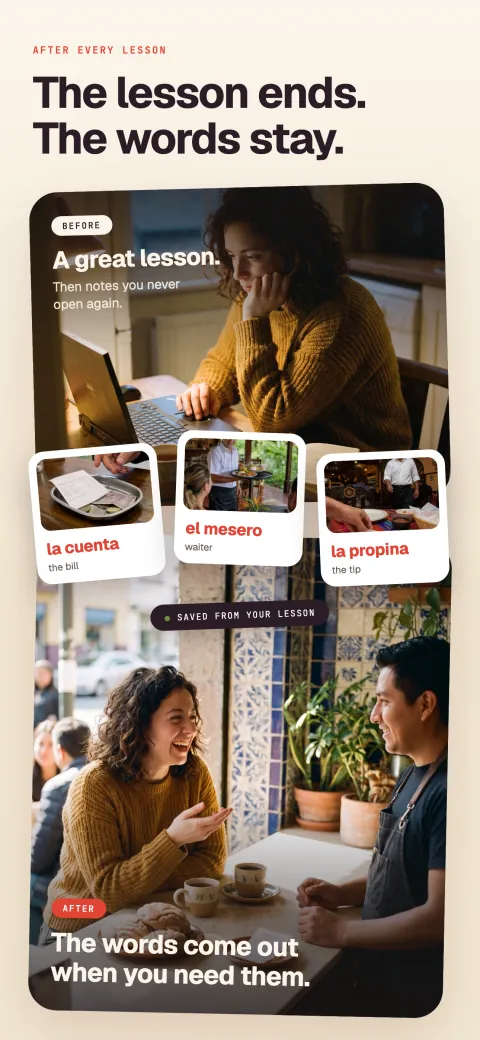
Verbamor records your lesson and turns what your tutor taught into cards that come back on schedule.

Three reviews rank for "baselang reviews" today. One says $149 a month, one says "around $180," one says $179.
They can't all be right, and the cheapest one is wrong.
I opened baselang.com on 21 September 2026 and read the prices out of the raw HTML. The page title itself is "BaseLang - Unlimited Spanish Tutoring for $179 a Month."
So Mezzoguild's $149 is stale. That matters, because that page's whole affordability argument is built on it.
Here's the answer before the evidence. At $179 a month, BaseLang beats hiring an online Spanish tutor by the hour once you book about 3 hours a week.
Past 5 it becomes absurd value. Below 2 hours a week you're paying a premium for the privilege of not booking classes.
I earn nothing from BaseLang, and I checked its own pages
I build a vocabulary app. I make no money if you buy BaseLang, I'm not in their affiliate program, and there's no discount code anywhere on this page. I mention that because the two best-ranked reviews both carry a discount code next to a 4.5-star score and neither says so near the top.
I haven't taken a BaseLang class. Everything below about how the product works comes from BaseLang's own live pages, read on 21 September 2026 and quoted. Where a competitor reviewer did something I couldn't, I'll say so, because one of them plainly did the work.
That one is All Language Resources, and it's the best page on this query by a distance. The author took classes, worked through the curriculum, and raised something no other page touches: what BaseLang's pay means for teachers in Venezuela.
Read it for the field report. It just never does the arithmetic its own verdict depends on.
BaseLang beats hourly tutoring past about 3 hours a week
The useful question is what an hour costs you at the rate you'll really book, against what that same hour costs somewhere else.
For the comparison rate I'm using BaseLang's own. Its homepage runs a savings calculator that compares itself to an "Online tutor $15/hour" and an "In-person tutor $50/hour."
The $15 is the honest one to argue with, and it sits close to what I measured on italki. The median (middle) standing rate across 20 Spanish teachers on one italki directory page, read on 23 August 2026, was $19 an hour.
So, $179 divided by the hours you book. Classes are 30 minutes, so an hour is 2 classes.
Read the first row again, because it's the one the search results hide. A learner doing one hour a week is paying $41 an hour for tutoring they could buy for $19. Unlimited is the most expensive plan on the market for a light user.
Now compare that with what the ranking reviews tell you. All Language Resources suggests 2 to 3 hours weekly as the minimum for cost-effectiveness and gives the thing 4.5 out of 5.
At 2 hours the maths says you're breaking even at best. TestPrepInsight recommends 8 to 10 hours a week, which is a genuinely useful rule, wrapped in an "around $180" that it never pins down.
Unlimited is priced on the assumption you won't use it. At 1 hour a week you pay $41 for a $19 hour.
The $99 plan none of them mention
BaseLang sells three things, and every review I read covers two.
Sitting beside Real World at $179 is Real World Lite at $99 a month, described on the homepage as "Up to one 30min class a day." Same 300+ teachers, same ten-level curriculum, same $1 first week.
The catch is in BaseLang's own words: "Credits don't accumulate if you skip days."
For the light user this changes the answer completely. One 30-minute class a day is 3.5 hours a week if you never miss, which at $99 is about $6.50 an hour. Half that, 1.75 hours a week, is $13 an hour and still beats the italki median.
So the honest recommendation for most people searching this query is the plan none of the three reviews prints. If you're weighing $179 against nothing, weigh $99 first.
Bootcamp is the third: $1,200, "Or, four monthly payments of $325," an "80-hour accelerated program" run as 4 hours a day for a month or 2 hours a day for two, on a fixed schedule. That's $15 an hour flat, which is exactly BaseLang's benchmark rate and not a discount on it.
Count your real free slots before you pay
Every number above rests on a forecast of your own behaviour, and people are bad at that forecast in one direction.
The gym-membership shape applies here and BaseLang's pricing plainly anticipates it. A flat fee for unlimited anything is profitable because the average buyer books far less than they imagined at checkout.
Mezzoguild calls the model disingenuous for this. I'd put it differently: it's a bet, and BaseLang is offering you fair odds on your own discipline.
So take the test before you take the trial. Open your calendar for next week and find the actual 30-minute slots. Count only the ones where you're at a desk, alone, able to talk out loud.
Classes run 24 hours a day, 7 days a week, so timezone isn't your excuse. Write down the real number.
If that number is 6 slots or more, BaseLang at $179 is the cheapest serious tutoring available anywhere. If it's 3 or 4, take Lite. If it's 1 or 2, book an italki teacher by the hour and keep your $100.
And use the trial as a measurement. It's $1 for the first week, and there's a 35-day guarantee: "we'll not only give you a full refund, but we'll send you $20 for wasting your time." The week's job is to produce your real booking count.
What $179 buys, and why to discount the hour estimates
What the $179 buys, from BaseLang's own pages on 21 September 2026:
- "300+ teachers from 7 countries," classes on Zoom, 30 minutes each.
- "Book classes literally last minute, or up to five days in advance."
- A ten-level curriculum "from absolute beginner to conversational," plus "664 lessons on 19 topics" of electives and a DELE track from A2 to C2.
- A placement test in your first class, and teachers who leave notes so the next one continues where you stopped.
- Its own estimate of "roughly 120 hours" to conversational and "roughly 350 hours" to highly fluent, which BaseLang labels an estimate and not a guarantee.
Treat those hour figures as marketing. They're unvalidated by anyone outside the company.
For scale, the State Department's Foreign Service Institute puts Spanish at 552 to 690 class hours to reach professional working proficiency. That assumes 23 hours of class plus 17 of homework a week.
Those measure different endpoints, so they don't directly contradict. But 120 hours is a number to discount rather than plan around.
One thing the teacher-notes feature doesn't do is give you the vocabulary afterward. That's the gap I care about, and the next section is where I have a horse in the race.
Buy by your weekly slots, and plan for forgetting
Buy Real World at $179 if you have 6 or more real 30-minute slots a week and a reason to move fast: a move, a job, a deadline. At that volume nothing else is close on price.
Buy Lite at $99 if you have 3 or 4. Buy neither if you have 1 or 2, because paying by the hour is cheaper and you keep the flexibility.
The failure I'd actually worry about at high volume is different from price. Book 10 hours a week and you'll meet more Spanish in a month than you can possibly retain, and most of it leaves within days.
That's ordinary forgetting, and volume makes it worse rather than better. The words arrive faster than any review habit you've built.
That gap is what I build for. Verbamor is an iOS app that turns the words from a lesson you already paid for into fill-in-the-blank cards with spoken audio. FSRS, an open-source algorithm that predicts when you're about to forget each card, schedules them so you still have them next month.
Past a starter set of about 650 everyday words, it teaches you nothing new, and it won't find you a teacher. Six languages, $19.99 a month or $129.99 a year with a 7-day trial on the annual plan.
Both are US prices, read off the app's own plan definitions on 21 September 2026. The App Store sets a different number in other countries. No free tier, which is a fair reason to skip it.
The honest version: you might need none of this. If you'll write your lesson words in a notebook on the way home and actually test yourself on them, that beats every app including mine and costs nothing.
Anki is free on desktop and Android and runs a serious scheduler, and people who'll build their own cards should use it. And if your real answer to the calendar question was 1 slot a week, the thing to fix isn't which app you buy.
Sources
BaseLang's prices and mechanics
- BaseLang. baselang.com, read 21 September 2026 from the raw HTML. Source for every BaseLang figure here: the page title "Unlimited Spanish Tutoring for $179 a Month"; Real World at "$179 /month"; Real World Lite at "$99 /month" with "Up to one 30min class a day" and "Credits don't accumulate if you skip days"; Bootcamp at "$1200 Or, four monthly payments of $325" as an "80-hour" program at "2 to 4 hours a day"; "One week trial for just $1"; the 35-day guarantee wording; "300+ teachers from 7 countries"; "Classes are available 24 hours per day, 7 days a week"; "Book classes literally last minute, or up to five days in advance"; Zoom delivery and the placement test; the ten-level curriculum and "664 lessons on 19 topics"; and the "roughly 120 hours" and "roughly 350 hours" estimates, which the page itself footnotes as "an estimation based on our experience teaching Spanish and not a guarantee."
- BaseLang's homepage savings calculator, same read. Source for the "Online tutor $15/hour" and "In-person tutor $50/hour" comparison rates used in the table above. The $15 figure is BaseLang's own choice of benchmark, which is why I argued against it with its own number.
The rate I compared against
- italki standing hourly rates: my own observation of 20 Spanish teachers listed on one italki directory page, 23 August 2026, extracted from the schema.org data embedded in the page. Median $19, range $6 to $85. That's one page of italki's default ranking rather than a sample of the whole marketplace, so read it as the shape of the middle, not a market average.
- US Department of State, Foreign Service Institute, foreign language training. Category I languages including Spanish: 24 to 30 weeks, 552 to 690 class hours, on "23 hours per week in class and 17 hours of self-study," targeting an ILR integrated score of 3. Used only for scale against BaseLang's 120-hour estimate; the two measure different endpoints.
The reviews this one is arguing with
- All Language Resources. Baselang Review. The only one of the three built on real use of the product, and the only page anywhere raising the ethics of the Venezuelan teacher economy. Rates BaseLang 4.5/5 and recommends 2 to 3 hours weekly for cost-effectiveness without converting that into a dollar figure. Carries a reader discount code.
- TestPrepInsight. BaseLang Review (Is It Worth It?). Scores it 9.1/10 beside its own discount code. Gives prices as "around $180" and "around $1,200," and lists Duolingo, Memrise and Rosetta Stone as alternatives to unlimited one-on-one tutoring, which they are not.
- Mezzoguild. Baselang Review: Frankly Overpriced And Hyped Spanish School. The only page to convert the flat fee into an hourly range ("It could cost anywhere from $4 to $25 per hour depending on your usage"), and right about the model. Its headline price of "$149 per month" is stale against the $179 on BaseLang's live page, checked the same day I read Mezzoguild, which undercuts the affordability argument it's making.
What I could not verify
- Teacher counts. BaseLang says "300+" and one ranking review says "450+". I have no way to count them, so I quote BaseLang's own figure and flag the disagreement.
- The "roughly 120 hours to conversational" estimate. It's BaseLang's own, footnoted by BaseLang as an estimate, and no independent validation exists. Quoted as a company claim, never used as a planning figure.
- Teaching quality, teacher consistency, and whether a given teacher is good. I have not taken a class. Reviews reporting inconsistent instructor quality may well be right; I can't confirm or deny it, and a page built from pricing pages should not pretend otherwise.
- Anything about BaseLang's teacher pay. All Language Resources raises it and I have no independent source, so I've pointed at their reporting rather than repeating it.
Keep the words you already paid a tutor for.
Verbamor turns your lesson vocabulary into fill-in-the-blank cards with spoken audio, scheduled so they're still there next month.
Start 7 days freeThe 7-day free trial is on the yearly plan.