 Verbamor
The best way to learn Russian, priced honestly
The best way to learn Russian is to learn the Cyrillic alphabet first, then pair a tutor for cases and speaking with one cheap app for daily review. Russian takes 1,012 FSI class hours, nearly 3 years at an hour a day, so over that span the tutor is a four-figure cost and the app choice barely matters. For what the first 1,000 words take on cards, see Russian flashcards.
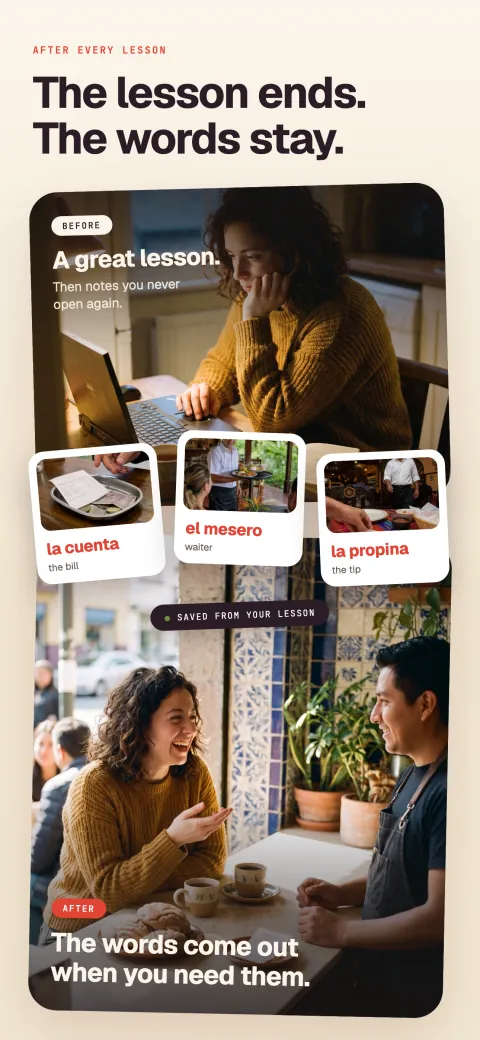
Verbamor records your lesson and turns what your tutor taught into cards that come back on schedule.

Why Russian takes nearly twice as long as Italian
The alphabet scares people, and it’s the easy part. Cyrillic has 33 letters, several of which look like English letters and sound like different ones. The Cyrillic guide takes them in the order that makes them quick to learn.
The hard part comes after. Russian nouns change their endings across 6 cases, so one word has many written forms. Most verbs come in pairs for finished and unfinished actions. And stress moves around without being marked in ordinary text, so you can read a word correctly and still say it wrong.
That’s why the State Department puts Russian in a different category from French or Spanish. The money advice changes with it: on a 3-year project, the tutor matters even more.
What I sell
I build Verbamor, an iPhone and iPad app that turns Russian from your own lessons and conversations into flashcards. It’s $19.99 a month or $129.99 a year, US prices from the app’s own plan definitions on 21 September 2026, and the App Store may show a different number where you are. It’s in the table on the same terms as the rest.
I haven’t used Rocket Russian, RussianPod101, Pimsleur or Babbel myself. Every figure below was read on the company’s own page or App Store listing, mostly on 13 October 2026.
What Russian costs, route by route
| Route | Cost per year | What you’re buying |
|---|---|---|
| Duolingo | Free tier. Super Duolingo runs $9.99 to $119.99 on the US App Store | A Russian course. Russian isn’t among the 9 courses Duolingo said in April 2026 now teach through CEFR B2 |
| Anki | US$24.99 once on iPhone and iPad. Free on desktop, Android and sync | A scheduler with no Russian in it, plus free shared decks. Good for cases, because you can make a card for every ending |
| Babbel | $107.40 for 12 months, or $299.99 lifetime | Structured lessons. The 12 months are set against a $215.40 reference, 12 monthly payments of $17.95 |
| Rocket Russian | $149.95 Level 1, $299.90 Levels 1-2, $449.85 all three. Paid once | 146, 231 or 312 hours of lesson time, lifetime access, a 60-day guarantee |
| RussianPod101 | Basic $2.20/mo, Premium $5.50/mo, Premium PLUS $12.58/mo in a 45% sale ending 23 October. List $4, $10, $23 | Audio and video lessons by level. The monthly rate assumes a 24-month subscription |
| Pimsleur | Premium $19.95 a month or $149.95 a year in its own plan data. Every Pimsleur price | 5 levels of 30-minute audio lessons, plus about 100 reading lessons for Cyrillic |
| italki tutoring | $10 to $60 an hour, by italki’s own Russian page | A person who hears your case endings and your stress, and corrects both |
| Verbamor (mine) | $129.99 a year or $19.99 a month. 7-day trial on the yearly plan only | Cards from your own lessons, plus about 650 starter words. No course, no grammar lessons, no free tier, iPhone and iPad only |
Not priced: Memrise, Busuu, Clozemaster and Duolingo Max, because none of them showed me a price on their own page. Memrise and Busuu do print prices on their US App Store listings, with no language named: on 18 October 2026, Memrise's "Monthly Language Learning Plan" at $24.99 and "Annual Language Learning Plan" at $61.99, and Busuu's purchases from $6.99 to $139.99. I’d rather point you there than borrow a figure.
How long does it take to learn Russian?
Russian takes about 1,012 class hours. The Foreign Service Institute’s current page lists it in Category III, “Hard languages”, at approximately 44 weeks. French takes 690 and Italian 552, so Russian is close to double Italian.
You’ll often see 1,100 hours quoted. That’s from the State Department’s older, archived page, whose figures work out to a 25-hour class week; the current page states 23. The FSI number everyone quotes is the old one has the comparison.
And the class hours aren’t the whole load. FSI’s week adds 17 hours of self-study, so over 44 weeks a diplomat also does about 748 hours of homework, aiming at professional working proficiency, level 3 on the ILR scale.
So price it over 3 years. Babbel’s annual plan three times is $322.20. Rocket Russian’s full set is $449.85 once, and Pimsleur Premium on the annual plan comes to the same $449.85 over 3 years. Anki is $24.99 once. Verbamor is $389.97.
Tutoring, again, is the real decision. At italki’s published $10 to $60 an hour, two lessons a week for 3 years is 312 hours: $3,120 to $18,720. Even one $20 lesson a week is $3,120 over the same span.
Over 3 years, the most expensive app here costs about what a year of weekly $10 lessons does. Pick the tutor carefully and the app cheaply.
What you’re paying for is the same short list as any language. Russian you can mostly follow, so cases and stress sink in through use. Recall over rereading: in Karpicke and Roediger’s 2008 study, testing left about 80% of word pairs remembered after a week, against 36% for restudying. Spaced sessions over massed ones. And a person who corrects you, which in Saito and Akiyama’s 2017 video-call study improved comprehensibility in the group that got feedback.
Which route fits which learner
Starting from zero, nothing spent yet. Learn Cyrillic first with the alphabet guide, then take Duolingo’s free course and free Anki on a computer. Spend nothing for 3 months and find out if Russian is for you.
Want a syllabus, paid once. Rocket Russian Level 1 at $149.95 with a 60-day guarantee and 146 hours of lesson time. That’s a reasonable first year on its own.
Mostly listening, often in the car. Pimsleur, at $149.95 a year on the annual plan. You answer out loud, which is where stress gets fixed, and its reading lessons cover Cyrillic.
Stuck on cases. A tutor. An app can tell you an ending is wrong; a person can tell you why you keep picking it. Two lessons a month at $15 is $360 a year, and it’s the best money on this page.
You like making things. Anki, free on a computer, with FSRS turned on in the deck options (Anki still ships the older SM-2 by default). Russian rewards custom cards, one per case form that trips you. For this learner Anki beats my app on price by $129.99 a year, and I’d recommend it.
What the courses leave behind
Courses teach the Russian their authors picked. That’s how you should get the alphabet and the first thousand words.
What they don’t keep is the Russian you heard yourself. Your tutor says ничего страшного (“no big deal”), you understand it, and by the weekend you remember the meaning but not the case it was in.
Verbamor is built for that. Record the lesson or paste the transcript, and it picks out the words and phrases and turns each into a card with the word blanked out of the sentence you heard, with native-accent audio and an image. FSRS schedules the reviews. It covers Russian, Spanish, French, Italian and Portuguese.
The honest limit: Verbamor has no course and won’t teach you cases. Past a starter deck of about 650 common words, it holds what you’ve already met. From zero, the alphabet guide and Duolingo’s free course will do more for your first months than my app will.
Questions people actually ask
How long does it take to learn Russian?
About 1,012 class hours, by the Foreign Service Institute’s current page, which puts Russian in Category III at approximately 44 weeks. FSI students add 17 hours of self-study a week, aiming at professional working proficiency. At an hour a day, 1,012 hours is about 34 months; at 30 minutes a day it’s more than 5 years. The 1,100-hour figure you’ll see is from the older archived page.
Is Russian hard to learn for English speakers?
Russian is hard for English speakers, and FSI lists it among its “Hard languages” at about 1,012 class hours, close to double Italian’s 552. The Cyrillic alphabet is quick; the slow parts are 6 noun cases, paired verbs for finished and unfinished actions, and stress that isn’t marked in normal text.
What does it cost to learn Russian?
Over 3 years the apps here run from $24.99 (Anki on iPhone, once) to $449.85 (all three Rocket Russian levels, or Pimsleur Premium annual for 3 years), with Babbel at $322.20 and Verbamor at $389.97. Tutoring dominates: at italki’s published $10 to $60 an hour, two lessons a week for 3 years is $3,120 to $18,720.
Is Duolingo enough to learn Russian?
Duolingo is a good free start for Russian, but its Russian course isn’t among the 9 courses it said in April 2026 now teach through CEFR B2. Use it for the alphabet and basics, then add a tutor for cases and speaking.
Should I learn the Cyrillic alphabet first?
Yes, learn Cyrillic first, because every Russian resource past the first lesson assumes you can read it. It’s 33 letters, and studying Russian in Latin letters is a habit you’d only have to unlearn.
Sources
Hours
- U.S. Department of State, Foreign Service Institute. Foreign Language Training. Read 13 October 2026: Category III “Approximately 44 weeks (1,012 class hours)”, “Hard languages”, with Russian on the list, and “A typical week is 23 hours per week in class and 17 hours of self-study.” The archived 2017-2021 page gave Category III as 1,100 hours.
What builds memory and speech
- Karpicke, J. D., & Roediger, H. L. (2008). The critical importance of retrieval for learning. Science, 319(5865), 966–968.
- Cepeda, N. J., Pashler, H., Vul, E., Wixted, J. T., & Rohrer, D. (2006). Distributed practice in verbal recall tasks. Psychological Bulletin, 132(3), 354–380.
- Saito, K., & Akiyama, Y. (2017). Video-based interaction, negotiation for comprehensibility, and second language speech learning. Language Learning, 67(1), 43–74.
Prices, each read on its own page
- Rocket Languages. Rocket Russian pricing. Read 13 October 2026: $149.95, $299.90 and $449.85, one-time, with 146, 231 and 312 hours of lesson time and a 60-day guarantee.
- RussianPod101. Pricing. Read 13 October 2026: $2.20, $5.50 and $12.58 a month in a 45% sale ending October 23, list $4, $10 and $23, based on a 24-month subscription.
- Pimsleur. Learn Russian, read 13 October 2026: 5 levels, 30-minute lessons, “about 100 Russian reading lessons”, with $19.95 and $149.95 in the page’s plan data.
- Babbel. Prices, read in a browser 13 October 2026: 12 months $107.40 against a $215.40 reference, lifetime $299.99.
- italki. Russian teachers, read 13 October 2026: “the cost ranges from $10 to $60 per hour”.
- Apple App Store, US. AnkiMobile $24.99, and Duolingo Super entries from $9.99 to $119.99 with no term attached, read 13 October 2026.
- Duolingo. Duolingo course content can take you to B2, 22 April 2026: English, Spanish, French, German, Italian, Portuguese, Japanese, Korean and Chinese. Russian isn’t listed.
The Russian from your own lessons, kept.
Verbamor turns the words your tutor used into fill-in-the-blank cards from the sentence you heard, scheduled so they’re still there next month.
Start 7 days freeThe 7-day free trial is on the yearly plan.