 Verbamor
The best Russian Anki decks, checked 13 October 2026
Start with the free Cyrillic mnemonics deck, then Russian: 3000 Most Frequently Used Words, which gives most words 1 to 6 example sentences and audio. Add Russian Sentences once you can read, and expect to look up stress yourself, because no deck I checked marks it on its sample cards. If you’d rather build cards from your own lessons, see Russian flashcards.
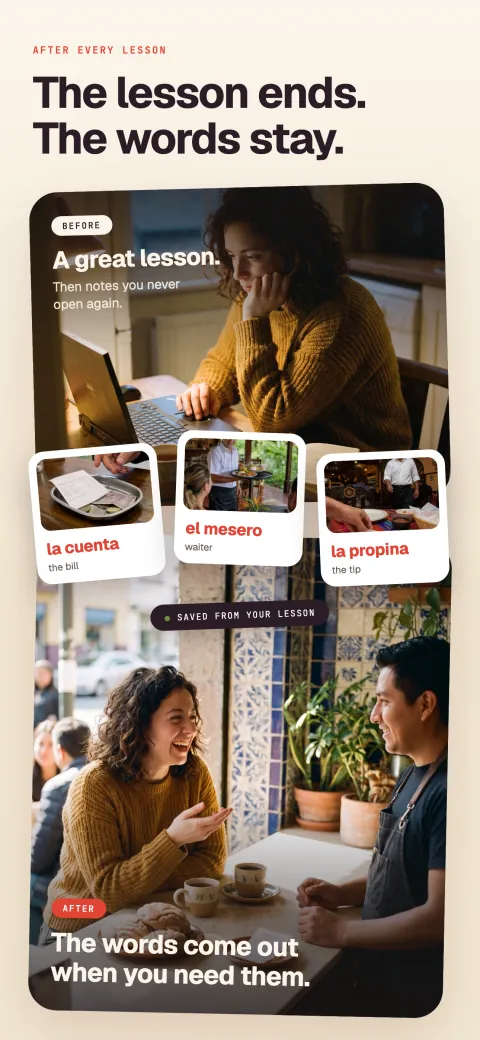
Verbamor records your lesson and turns what your tutor taught into cards that come back on schedule.

No sample card on these 8 decks marks the stress
Russian stress can fall on any syllable, it moves when a word changes form, and ordinary Russian text doesn’t mark it. Learners’ materials often add an accent mark to show it. So I checked the sample cards printed on each deck’s AnkiWeb page for one.
None of the 8 decks below shows a single stress mark in its samples.
The reviewers notice. On Russian Sentences: “Really great but I am missing stress marks.” On the Languages on Fire trial, from someone who bought the full course: “None of the vocab has the stressed syllables marked.” The author’s reply is honest about the trade-off. They “chose not to include stress markings to avoid visual clutter in sentence-focused cards, relying instead on native audio for stress.”
That’s a fair choice if the audio is good and you play it every time. It does mean the audio carries the stress on every card in this list, so pick decks with audio and don’t turn it off.
A handful of sample cards isn’t the whole deck, so a mark could be hiding somewhere inside. But if a deck marked stress, I’d expect its author to say so in the description, and none does.
Eight free decks, read on 13 October 2026
For each one I wrote down what AnkiWeb prints: the update date, the real note count, the audio files and the votes. There are no download counts to compare, because AnkiWeb doesn’t publish them.
The 3,000-word deck has 6,000 notes, so expect about 2 per word. A reviewer in January 2026 warns that “The translations are automatic” and the order isn’t strictly by frequency, so check a card that looks odd. Another says the hover-to-show sentences are awkward on iPhone and unreadable in dark mode; the author’s reply explains how to change the font colour.
The same author made Russian Sentences, and also the most-voted French deck I found. Its 110 upvotes are the most of any Russian deck I found.
The two newest decks open a paid course
Both decks updated on 9 September 2026 come from the same publisher, and both say what they are.
The Cyrillic deck is 97 notes and works on its own. Its description adds that it’s “the opening of our complete Russian course: 7,000+ cards across 100 lessons”. The Languages on Fire trial is that Cyrillic deck plus the first 5 lessons, 336 notes in all. The full course, by the description, covers grammar to B2 with “Every sentence recorded by native speakers”.
I’m fine with that. The free alphabet deck is complete, a reviewer says they “mastered the alphabet in a week” with it, and the trial is labelled [Trial] in its title. The AnkiWeb page doesn’t give the course price, so I can’t tell you if it’s worth it. If you’d rather learn the letters from a page, the Cyrillic guide takes them in a sensible order.
Should you pay for a Russian deck?
Possibly, if you want grammar in order. Read the hours first.
Language Atlas sells a Russian bundle of 9,020 flashcards in 32 chapters and 106 lessons. On 13 October 2026 its page showed €149.99 struck through to €99.99, with a 14-day money-back guarantee, and claimed “over 100 downloads and only 5-star reviews”.
Its hours to each level are 30 to 40 for A1, then 80 to 100, 180 to 200 and 280 to 325 cumulative for A2, B1 and B2. Those are the same numbers, to the hour, as its Italian and Portuguese pages.
The State Department’s page disagrees sharply. It lists Russian with the “Hard languages” at about 44 weeks and 1,012 class hours, against 24 weeks and 552 for Italian and Portuguese. Identical hours for three languages that FSI puts 460 class hours apart look copied between pages to me, and the Portuguese page still calls itself “the best German Anki Decks!” in one sentence. I’d plan on close to double.
The buyer: someone who wants Russian laid out in order, lesson by lesson, and will pay €99.99 to skip assembling it. Everyone else can start with the free alphabet deck and the 3,000 words.
A big deck costs you 200 reviews a day
Anki is free on Windows, macOS, Linux, Android and the web. AnkiMobile for iPhone and iPad is US$24.99 once (App Store, read 13 October 2026). The full cost breakdown is its own post.
The review load is the bigger cost. Anki’s manual expects roughly 200 reviews a day at 20 new cards a day. The 6,000-note word deck takes 300 days to introduce at that pace, which is 10 months of daily sessions. For Russian, say every answer out loud so you practise the stress with it. It’s slower, and the audio is the only place these decks give you the stress.
Then add the Russian you hear yourself. That’s what Verbamor does: an iPhone and iPad app that turns words from a lesson you record, or a phrase you look up, into fill-in-the-blank cards from the sentence they came in, with an image and native-accent audio. FSRS, an open-source scheduler that predicts when you’re about to forget a card, decides when each one comes back. It starts you with roughly 650 common words.
$19.99 a month, or $129.99 a year with a 7-day trial on the yearly plan only. US prices; the App Store sets its own in other countries. No free tier, and no grammar course, so it won’t teach you cases.
And if you’ll make your own cards, especially one card per case ending that trips you, free Anki is the better deal by $129.99 a year. My app is for people who wanted to do that and haven’t.
Sources
The decks, read on 13 October 2026
- Russian (Cyrillic) alphabet: Learn it easily with mnemonics. 97 notes, 97 audio and 29 images, updated 2026-09-09, 21 up / 0 down. Source for “the opening of our complete Russian course: 7,000+ cards across 100 lessons” and the review dated 2024-10-04 (“mastered the alphabet in a week”).
- Russian: 3000 Most Frequently Used Words [v. 1.2]. 6,000 notes, 2,992 audio, updated 2020-10-18, 54 up / 8 down. Source for “Almost every word in this deck has 1 to 6 example sentences” and the reviews dated 2026-01-11 and 2024-10-16.
- Russian Sentences. 7,798 notes, 5,240 audio, updated 2024-03-08, 110 up / 13 down. Source for “Really great but I am missing stress marks.” Part 2: 1,998 notes, no audio, 2021-06-21. Part 3: 53,093 notes, no audio, 2021-06-21. The same author’s list on AnkiWeb also holds 5000 most frequently used French words.
- All Russian sentences with audio from Tatoeba. 4,690 notes and audio, updated 2019-12-19, 13 up / 0 down.
- Russian Core 100: Basic words. 202 notes, 107 audio and 115 images, updated 2015-07-15, 9 up / 1 down.
- The Ultimate Russian Deck: Languages on Fire [Trial]. 336 notes, 281 audio and 30 images, updated 2026-09-09, 62 up / 2 down. Source for the course description, “Every sentence recorded by native speakers”, the review “None of the vocab has the stressed syllables marked” and the author’s reply.
- Stress marks: I searched the text of each page, sample cards included, for the combining accent Russian learners’ materials use to mark stress, and found none on any of the 8.
Anki itself
- Anki manual, Deck Options. Source for about 200 reviews a day at 20 new cards a day.
- AnkiMobile Flashcards, US App Store, US$24.99, read 13 October 2026.
Hours and the paid option
- U.S. Department of State, Foreign Language Training, read 13 October 2026. Category III, “Approximately 44 weeks (1,012 class hours)”, “Hard languages”, Russian listed; Italian and Portuguese at 24 weeks in Category I.
- Language Atlas, Best Russian Anki decks, read 13 October 2026, with its Italian and Portuguese pages for the matching hours. Source for 9,020 flashcards, 32 chapters, 106 lessons, €149.99 struck to €99.99, the 14-day guarantee and “over 100 downloads and only 5-star reviews”.
What I could not verify
- Download counts. AnkiWeb doesn’t publish them.
- Whether stress is marked anywhere past the sample cards each page shows.
- AnkiWeb’s own search, which stopped answering after a few searches without an account, so this list was built from the deck pages and their authors’ lists. There may be good Russian decks it doesn’t include.
- The price of the full Languages on Fire course, which its AnkiWeb pages don’t print.
Russian cards from the lesson you just had.
Verbamor turns the words your tutor used into fill-in-the-blank cards from the sentence you heard, and brings each one back before it fades.
Start 7 days freeThe 7-day free trial is on the yearly plan.