Verbamor
Subtitles: target language, native, or none
Use target-language subtitles, then none, and your own language dead last. In Mitterer and McQueen's 2009 study, native-language subtitles made new speech 17% harder to hear than no subtitles, while target-language subtitles made it 19% better. Your own language earns one use: replaying a clip you've already heard.
Turn on subtitles in the language you're learning, and put your own language dead last. In Mitterer and McQueen's 2009 study, native-language subtitles made new speech 17% harder to hear than no subtitles at all, and target-language subtitles made it 19% better. No subtitles sits between the two.
You're on episode 3. The show is Spanish. The subtitles are English, because you turned them on during episode 1 and never thought about it again.
You followed the plot. You laughed at the right places. And when the credits rolled you couldn't name one word you'd learned, because you read a novel for 45 minutes with a soundtrack under it.
01 / 05Native subtitles made new speech 17% harder to hear
Your eyes are fast. Faster than your ears, by a lot. Give them a line of English at the bottom of the screen and they'll take it before the Spanish audio arrives. Your ears get the night off.
Mitterer and McQueen ran the subtitle test in 2009 and got a number for it. On sentences the listeners had never heard before, native-language subtitles made speech perception 17% worse than no subtitles at all. Target-language subtitles made it 19% better. Same show, same 25 minutes, opposite direction: Foreign subtitles help but native-language subtitles harm foreign speech perception.
Mitterer and McQueen's listeners were Dutch, already fluent in English, tuning their ears to a Scottish or Australian accent. That's a smaller job than learning Spanish from scratch, so take 19% as the direction and expect a different size.
English subtitles have one honest use, and Mitterer and McQueen's paper found it: they helped on clips the listeners had already heard. If you've watched a scene and still can't work out what somebody said, replay it with English on, then switch back.
English subtitles are for repairing a line you've already heard.
Spanish subtitles at native speed are unreadable when you're new. Half a sentence flashes past and you've caught 2 words of it. So shrink the material: pick a 10-minute scene where 2 people talk in one room, and watch it twice. 20 minutes on one scene beats 45 minutes of English-subtitled plot.
Note the timecode of every line you replayed and still couldn't hear, capped at 3. Open Thursday's lesson with this:
"I've got 3 lines from a show I couldn't hear. Here's the first, at 14:22. Can you say it at normal speed, then break it into separate words, then say it at normal speed again? And tell me which word I'm losing."
The last question, which word you're losing, is why you bring the lines to a person. Usually it's a swallowed syllable, or 2 words that ran together, and your tutor hears which in 3 seconds.
Write your tutor's answer next to the timecode, in 3 words or fewer. "Swallowed the -ado." "Se lo ran together." That phrase is the repair, worth more than the translation of the line.
02 / 05Why it backfires: your eye finishes the sentence your ear was still carving
Holger Mitterer and James McQueen sat 121 Dutch speakers in front of Trainspotting and Kath & Kim, accents that shred a listener who learned English from textbooks. Each group watched with English subtitles, Dutch subtitles, or nothing, then took a test on 160 short audio clips, some from the episodes, some brand new. The new clips carry the result: they test whether your ear can handle a voice it has never met.
A Scottish actor says something fast and slurred. Your ear is mid-guess, carving that blur into words. Then your eye hands it a finished Dutch sentence. Your brain takes the answer and stops carving, so the next time an unfamiliar voice says something similar, you've built nothing to catch it with.
Target-language subtitles do the reverse: your eye confirms what your ear guessed. It's the same reason hearing a word before you read it changes how well it sticks.
Swap in your own pair: if you're an English speaker learning Spanish, Spanish subtitles gave people the 19% and English subtitles cost them the 17%.
What to do on Thursday
Sometimes the target-language subtitle track isn't in the menu. On Netflix it's usually on the file, hidden: switch your profile language to Spanish in account settings, then reload the title.
YouTube auto-captions drop words and mangle the rest, so look for channels that write their own. When it still fails, the order is target-language subtitles, then none, then your native language dead last.
Give target-language subtitles 25 minutes, the dose that moved perception in Mitterer and McQueen's study. Bring the 3 worst timestamps to your tutor.
Then check the tutor's work: play each line with your eyes off the screen. If you catch it by ear now, delete the timestamp. If you still can't, bring it back next week.
Your version of the study's test is a line you failed on Tuesday and can hear on Saturday.
Keep the deleted timestamps: a month of them is a list of accents your ear used to lose to, the same reason watching and drilling do different jobs.
03 / 05Does the famous 17% mean subtitles grow your vocabulary?
No, the famous 17% came off a listening test, in a study that's 60 people and 1 hour of an English TV drama. It's Birulés-Muntané and Soto-Faraco (2016) in PLOS ONE. Spanish-Catalan bilinguals at B2, ages 21 to 28, in 3 groups watching the same episode.
The English subtitle group improved 17% on listening. The no-subtitle group improved 7%. The Spanish subtitle group improved by roughly nothing.
L2 subtitles (in the language being learned) beat no subtitles at p < .01, Cohen's d of 1.01. L2 beat L1 (native-language) subtitles at p < .01, d of 1.73. Cohen's d measures how big a difference is, and p < .01 means chance alone would rarely produce it. In a field where d = 0.4 gets a press release, 1.73 is enormous.
Sit with how small the Birulés-Muntané study was. 60 young B2 bilinguals watched once, and the test came the same afternoon. Whether the gain survives a month is open. I lean toward some of it surviving, and my leaning isn't evidence.
Birulés-Muntané and Soto-Faraco also tested vocabulary, and found no reliable difference between the 3 groups. The 17% came off a listening test. Go read the blog posts that quote it and watch how many attach it to "vocabulary" or "comprehension" instead.
The miscitation sends you to the wrong tool. Believe 60 minutes of subtitled TV grows your vocabulary 17% and you'll watch more TV, then wonder why Tuesday's words are gone by Friday. You met them once, with no second meeting scheduled.
You can run the study's shape on yourself in 1 paid hour, if you measure your ear while it's cold. Book the tutor first: "Read me 5 lines from an episode I haven't watched, at normal speed, no text in front of me. Count every word I miss." Write that number down.
Then press play. Pause 8 times and copy the whole line each unknown word sat in. The line turns a word into a card you can study, and 8 is small enough to put into retrieval practice the same night. The episode gave you the sound first, which is the right order.
Next lesson, ask for the same test off a different episode. Reusing the first hands you a number that flatters you.
You're 1 person with no control group, so a 2 or 3 word improvement is noise. I'd want 5 fewer missed words before calling anything real.
04 / 05Target language on, your own language dead last
- Target-language subtitles, on, by default. Mitterer and McQueen found +19% on unheard speech. Birulés-Muntané and Soto-Faraco found +17% on listening. Same direction, 7 years apart, different labs.
- Native-language subtitles, off. They cost 17% in the Dutch study and produced roughly zero listening gain in the Spanish one.
- Real subtitles only. Set audio to Spanish and subtitles to Spanish, and check the entry says plain "Spanish". If it says auto-generated, CC-translated, or the language name sits behind a robot label, back out.
- Captions on the first viewing. Winke, Gass and Sydorenko ran 150 second- and fourth-year learners through both orders. First-viewing captions won on aural vocabulary, d=.36. Small, and free.
- Watch the same scene twice. Sutton and Webb pooled 75 effect sizes: watching plus an activity afterward hit g=1.09, watching alone g=.76. Rewatching isn't quite the activity they pooled, so treat it as a nudge rather than proof.
- Go bare when you stop reading anyway. Pick a 2-minute scene you've never seen and watch it with no subtitles. If you can say what happened, in order, without guessing, drop the captions for that show. If not, keep them on and stop feeling bad about it.
Run the 2-minute self-test. The learners in these studies were mostly second- and fourth-year university students, or B2 bilinguals. If you're 3 weeks in, the self-test will fail you into "keep them on," and that's the right answer for you today.
When the menu check fails, switch to a Netflix original made in the language you're learning: La Casa de Papel, Élite, Lupin. Netflix produced them, so the subtitle track is the shooting script.
The crutch problem is real: in Winke's interviews, 26 learners described captions as a crutch. Reading is easier than listening, so your eyes drift to the text and stay.
On pass 1, the moment a word lands on screen that you'd have missed by ear, pause and type it into one note with the 3 words on either side. Your tutor can say ay, perdona, se me olvidó el bolso back at full speed, and that's the version your ears have to survive. Cap the list at 6 to 8.
05 / 05Watching plus follow-up work beat watching alone, g = 1.09 to .76
Sutton and Webb pooled 75 effect sizes from 56 experiments, 1,954 learners, in their 2026 meta-analysis of audiovisual input. Watching works: pooled g = .89, a big number in this field. (Like Cohen's d, g measures how big a difference is.)
Then they split it. Viewing plus a follow-up activity came out at g = 1.09. Viewing alone, g = .76.
The sofa hour leaks. That gap is the argument between input and cards. Input builds your ear, but a word you heard once on Sunday is mostly gone by Wednesday, and the forgetting curve doesn't care how good the show was.
So keep a tally as you watch. More than one pause a minute and you're below the level where target-language subtitles pay off: run pass 1 in your own language, then rewatch with them on.
The rewatch has to run without your native language. Keep the 8 or 10 phrases you paused on. The ones you walk away from are the g = .76 half of the meta-analysis.
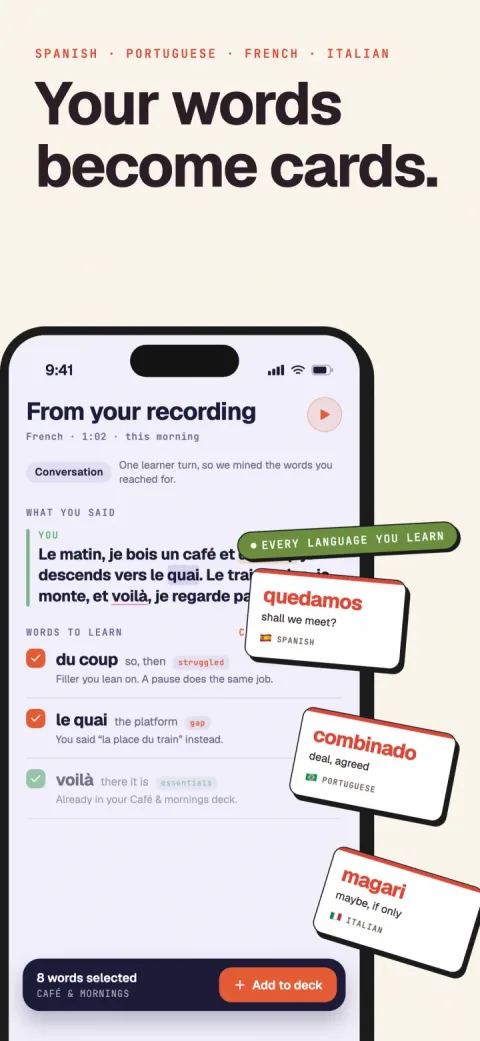
A notebook does the capture-and-review job. So does Verbamor, which is why I built it.
It hides the word you missed and reads the sentence back in a native accent before you see it spelled (sound before spelling). Then FSRS, an open-source scheduling algorithm, brings each one back on the day you're about to lose it.
Now hand the list to your tutor: "I paused on these 8. Say each one at normal speed, then tell me which ones you'd actually use." Delete the ones they'd never use that same night, before FSRS schedules them for the next 6 months.
Sources
Native-language subtitles make you worse at hearing new speech
- Mitterer, H., & McQueen, J. M. (2009). Foreign subtitles help but native-language subtitles harm foreign speech perception. PLOS ONE, 4(11), e7785.
The famous 17% is a listening result, and vocabulary didn't move
- Birulés-Muntané, J., & Soto-Faraco, S. (2016). Watching subtitled films can help learning foreign languages. PLOS ONE, 11(6), e0158409.
Captions belong on the first viewing, and learners know they lean on them
- Winke, P., Gass, S., & Sydorenko, T. (2010). The effects of captioning videos used for foreign language listening activities. Language Learning & Technology, 14(1), 65-86.
Watching plus follow-up work beats watching alone
- Sutton, D., & Webb, S. (2026). The effects of audiovisual input on second language learning: A meta-analysis. Studies in Second Language Acquisition, 48(2), 571-595.
The phrase you paused on, kept.
Verbamor turns the language from your lesson into cloze cards with native audio, so the words you meet survive the week.
Start 7 days free