 Verbamor
What happens to a Spanish word between Tuesday and next Tuesday
The roundups I read for this query mention FSRS in one clause and link no benchmark. Here is what the actual benchmark says, including the part where the winning model isn't in any app I can find.
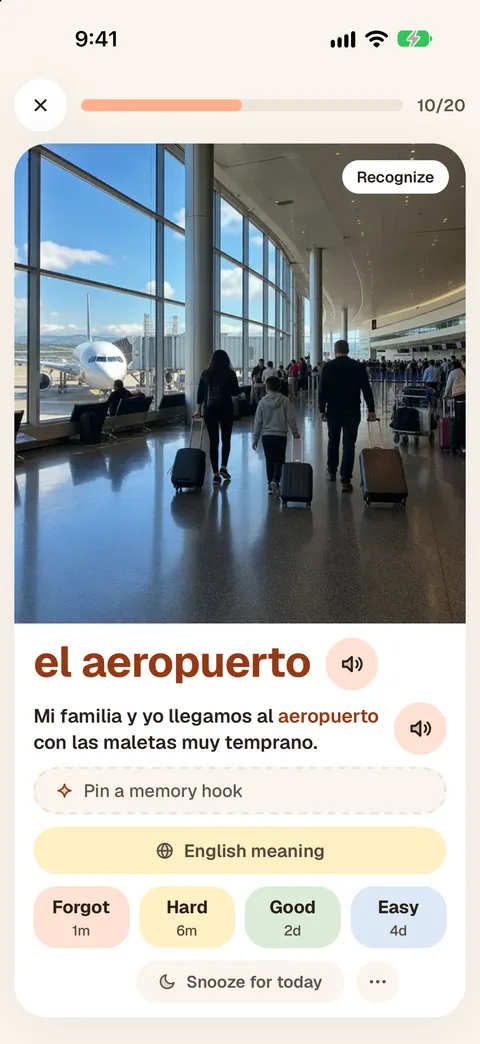
Verbamor turns the words from your own lessons and recordings into flashcards, and brings each one back before you’d forget it.

Your tutor said me da igual on a Tuesday. You wrote it down.
It meant something like "I don't mind," and for about 40 minutes you owned it.
Nine days later, a waiter asks whether you'd rather sit inside or out. The phrase is somewhere in your head, unreachable, filed behind me da la gana and a vague memory of writing something in a notebook.
Everything a spaced repetition app does happens in the gap between those two moments. So the only question worth asking about one is how well it predicts where in that gap you are.
A scheduler brings a word back at your shakiest point
Here's the mechanic, stripped of branding. A scheduler holds a guess about your odds of recalling me da igual right now, and it decays every day you don't touch it.
When the guess drops to a target you set, the card comes back. Anki's default target is 90%, and the manual is precise about what that means: "a 90% chance of remembering them when they come up for review again."
You either produce the word or you don't, and either way the model re-times the next visit.
So reviews always feel slightly uncomfortable, because you're being shown each word at the shakiest point the system will tolerate.
And the interval is a claim about you: your difficulty, stability and retrievability on this one card. I've written those up separately, so I don't have to redo the machinery here.
An interval is a prediction. Which means it can be scored against what actually happened, and somebody has been scoring them.
That last bit is where this category gets strange. Schedulers make falsifiable predictions at enormous volume, and a public repo grades them. Almost none of the "best spaced repetition app" pages I read has looked at it.
A public benchmark grades schedulers, and SM-2 isn’t in it
The Open Spaced Repetition project maintains srs-benchmark, which runs schedulers against real Anki review logs and reports how well each predicted recall. I first read it on 22 August 2026, and I checked every figure below against the README again on 19 November 2026.
The size of it, verbatim from the repo: "Total number of collections (each from one Anki user): 9,999" and "Total number of reviews for evaluation: 349,923,850." That's the evaluation set excluding same-day reviews.
A third of a billion little experiments in forgetting, donated by strangers.
Two metrics. Both lower-is-better, and the repo says plainly what they're for: "Log Loss and RMSE (bins) measure calibration: how well predicted probabilities of recall match the real data."
Calibration is the right thing to measure. A scheduler that promises 90% and delivers 6 in 10 is writing fiction, and your deck rots quietly while the review count keeps looking healthy.
FSRS is an open-source algorithm that predicts when you're about to forget each card. The version Anki ships is FSRS-6, and it scores 0.3460 Log Loss and 0.0653 RMSE(bins) on that set, from 21 fitted parameters per user.
FSRS-7 is the newest version in the table, at 0.3401 and 0.0634 from 34 parameters. It isn't scheduling your deck yet: Anki's source, at version 26.09.4 when I checked, still depends on fsrs 6.6.2, the FSRS-6 line of the library.
Train FSRS-7 with recent reviews weighted more heavily and it does a little better again, 0.3370 and 0.0593, by discounting your reviews from three years ago.
Now the thing I keep not finding on any competitor page.
There is no SM-2 row in that table. None. Zero.
The models compared are FSRS versions 1 through 7, a set of neural networks, and logistic regression. Then DASH variants, ACT-R, SBD, HLR (Duolingo's own), Ebisu, and a few baselines.
One baseline deserves a mention, because it's awkward for my side. A moving average of your recent answers scores 0.3369 Log Loss, ahead of FSRS-6 and plain FSRS-7. It can't tell you when to review a card, and I went through what that means in the benchmark post.
So when a roundup tells you FSRS beats SM-2 by some percentage and links this README as proof, the table it's pointing at has no such row. SuperMemo comparisons live in separate projects, and the README says so.
I'd rather make the smaller true claim. FSRS is the best-scoring scheduler in this table that I can find shipping in an app, measured on a third of a billion reviews. And SM-2, the rival it supposedly beat here, was never in the room.
A research model beats FSRS, and it isn’t in Anki
Here's the number a vendor is not supposed to publish.
RWKV-Instant has the best Log Loss in that table, at 0.2773, with 0.02502 RMSE(bins). It's a neural sequence model, it beats every FSRS version on both metrics, and it isn't close on either.
There's a catch the README states itself: RWKV-Instant "does not have a forgetting curve in the traditional sense." It predicts your answer just before a review, so it can't say when the next one should be. Its sibling that can, RWKV-Curve, scores 0.3193 and 0.0540, still ahead of FSRS-6 on both.
I can't find a flashcard app that ships either one. They're 2,762,884-parameter networks that read your whole review history, and running that is a different engineering problem from fitting 21 parameters on a phone while the user waits.
Until someone solves it, the model that wins the leaderboard isn't the model in your pocket.
I'm telling you this because a page that wins on every axis is a page selling you something. FSRS is very good, and there's documented headroom above it. Both true, at once.
What the benchmark can't tell you is how much any of that matters to your Spanish. A card scheduled at 14 days that should have come at 11 costs you one extra lapse, sometimes. Small, next to the gap between using a scheduler and not using one.
So the usual closing line, that consistency matters more than the algorithm, is about half right. It's right that no scheduler saves a deck you don't open.
It's wrong as a reason to stop asking. The same logic would excuse a fixed daily reminder, which never learns a thing about you.
For Spanish, the scheduler is generic and the card does the work
Honest answer first: scheduling is language-agnostic. Nothing in FSRS knows what bosque means, and no scheduler has a Spanish mode.
The Spanish-specific part is the card, and that turns out to be where the whole thing is won or lost.
Because Spanish has a particular failure mode. The words that beat you are the ones you half-know.
Quedar against quedarse. Por against para. The fistful of phrases like me da igual that mean one thing inside a sentence and nothing at all in isolation.
Those items fail and pass a recognition test at the same time. Show me da igual next to "I don't mind" and of course you know it.
That's the card lying to the scheduler, and your intervals stretching out over a memory that was never there.
Grading yourself honestly is the whole defence, and it's harder than it sounds.
So the fix lives in the card format: a blank you have to fill from your own head, in a sentence long enough that por and para can't both fit.
Here's the same phrase in both formats, which is the whole argument in one picture.
The testing effect is the most reliable finding in this literature and it's a claim about retrieval.
The scheduler picks the moment. The card decides whether a retrieval happens at that moment at all.
One more Spanish quirk worth pricing in: cognates hand you a free head start and a matching trap, since embarazada and realizar cost more reviews than their spelling promises. I've written about which ones to trust.
Where I lose: just use Anki
I'll do the part a vendor's roundup usually skips.
If you'll build your own cards, use Anki and stop reading. Free on desktop and Android, US$24.99 once on iOS against my $19.99 a month.
FSRS is in there: the manual calls it "an alternative to Anki's legacy SuperMemo 2 (SM-2) algorithm". You turn it on in deck options, because SM-2 is still the default, and plenty of blogs get that backwards.
Enable it and you're running the same algorithm family as anything I could sell you, for a one-off price, with export freedom and close to 2 decades of development behind it.
A disciplined Anki user has no reason to pay me anything. I'd rather say that here than have you find out in month two.
That word "disciplined" is carrying the sentence, though. People don't leave Anki because the scheduler failed them.
They leave because cards take time to build, and the time adds up. Migaku, teaching people to make them, assumes about 30 seconds a card, which puts 1,500 cards at 12.5 hours of typing.
If you've bounced off Anki twice, what broke was card-making. I compared this category on their actual schedulers, with sources, on the roundup page.
Verbamor builds the cards you won't type yourself
Verbamor is for the other case. You're paying a tutor, and the vocabulary that matters is whatever came up in Tuesday's lesson. And you won't sit down afterwards and type 15 cards.
You record or type what came up, it builds the fill-in-the-blank cards with native audio and an image, and FSRS schedules them.
It's iOS only, there's no free tier, and it's $19.99 a month or $129.99 a year with a 7-day trial on the annual plan.
If your vocabulary comes from a textbook or a frequency list rather than a conversation, a premade deck beats it, and I'd tell you that in person too.
Which leaves the part no one's scoring. The benchmark can rank 32 models on 349,923,850 reviews and still have nothing to say about whether me da igual ever made it onto a card at all.
Sources
Benchmark size, metrics and scores
- Open Spaced Repetition (2026). srs-benchmark: a benchmark for spaced repetition scheduling algorithms. GitHub. Read 19 November 2026: 9,999 collections, 349,923,850 evaluation reviews, FSRS-6 at 0.3460 Log Loss and 0.0653 RMSE(bins), FSRS-7 at 0.3401 and 0.0634, RWKV-Instant at 0.2773 and 0.02502. The scores move as the repo is updated, so check the README before quoting them.
- Anki (2026). Cargo.toml, workspace dependencies. GitHub. Read 19 November 2026: Anki 26.09.4 depends on fsrs 6.6.2, the FSRS-6 line.
- Ye, J., Su, J., & Cao, Y. (2022). A stochastic shortest path algorithm for optimizing spaced repetition scheduling. Proceedings of KDD '22, 4381–4390.
Anki ships SM-2 by default, FSRS is opt-in
- Anki (2026). Deck options: FSRS. Anki Manual. "The Free Spaced Repetition Scheduler (FSRS) is an alternative to Anki's legacy SuperMemo 2 (SM-2) algorithm."
- Apple (2026). AnkiMobile Flashcards. App Store listing, US$24.99 one-time. Read 17 October 2026.
- Migaku. How to make Anki cards. "If you spend 30 seconds per card," about 12.5 hours for 1,500 cards. Read 13 October 2026.
Why the card format decides whether scheduling helps
- Roediger, H. L., & Karpicke, J. D. (2006). Test-enhanced learning: Taking memory tests improves long-term retention. Psychological Science, 17(3), 249–255.
- Karpicke, J. D., & Roediger, H. L. (2008). The critical importance of retrieval for learning. Science, 319(5865), 966–968.
The scheduler is solved. The cards are the work.
Verbamor turns what your tutor actually said into fill-in-the-blank Spanish cards, scheduled by FSRS, without the typing.
Start 7 days freeThe 7-day free trial is on the yearly plan.