 Verbamor
The six lines that make a language routine copyable (and the two everyone leaves out)
You say "twenty minutes a day, mostly flashcards from my lessons." Two weeks later your friend has done nothing, because what you handed them was a summary, not a routine. Six lines fix that, and two of them are the ones everyone leaves out.
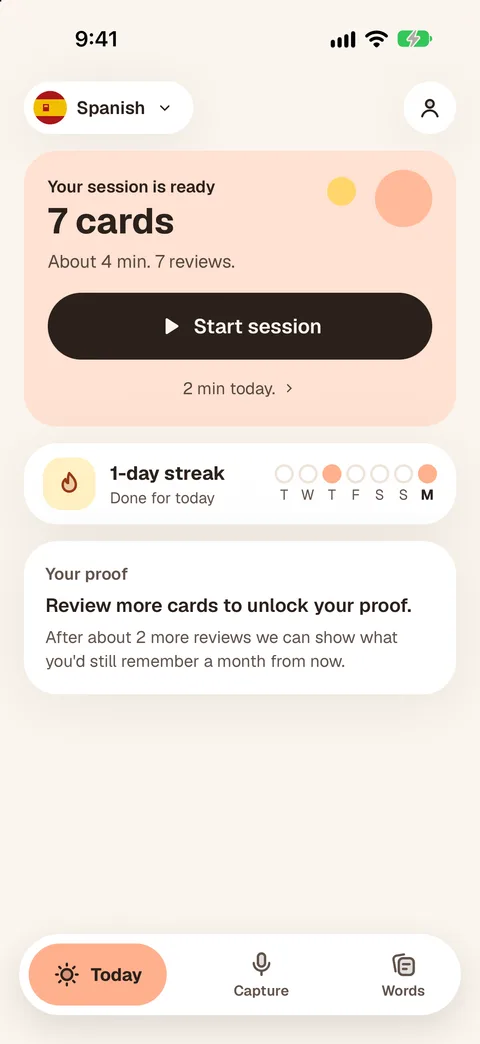
Verbamor opens on one short session a day: the words that are due, and about how long they’ll take.

Someone asks how you're learning Spanish. You say "twenty minutes a day, mostly flashcards from my lessons." They say that sounds good.
Two weeks later they've done nothing. What you handed them was a summary of a routine.
The gap is in the detail. You know what day of the week you record, how many new words you keep, what you do when you miss three days. None of that came out of your mouth.
What came out was the shape of the routine with all the operating instructions removed. Written down properly, the same routine fits on one screen. Someone can start it on a Tuesday without asking you a single follow-up question.
Six lines do it. Four are the ones people remember to say out loud. Two are the ones that decide whether the routine survives its first bad week.
Line one: write the trigger that starts the session
Most routines get written as "20 minutes a day." That line fails on contact with a real week, because it doesn't say when.
Write the trigger instead. A trigger is the thing that already happens every day, and your study sits immediately after it.
"After I put the kettle on." "After I sit down on the 8:14 train." "After I brush my teeth at night."
The person copying you doesn't invent a slot in their day. They attach yours to something already there.
Two rules make triggers hold up. The trigger has to happen whether or not you're motivated, so "after my run" is weak and "after I get in bed" is strong.
And put the session late in the day rather than after breakfast, at least on the days it adds new words. Gais, Lucas and Born (2006) taught high-school students English-German vocabulary and tested them 48 hours later. The group that slept within a few hours of learning recalled more than the group kept awake that first night.
The gap was still there after a recovery night, which rules out simple tiredness. The study tested sleep after learning new words, not after reviewing old ones, so it won't settle every slot. But it's a fair tiebreaker. If your friend has to pick a slot, tell them to pick the late one.
Line one of the template is a sentence with the word "after" in it, and no clock time.
Line two: give the numbers, and show the arithmetic behind them
The second failure is vagueness about volume. "Some new words" gives the person nothing to copy. Write the number you personally run.
The number matters because of a multiplier most beginners have never seen. The Anki manual states it plainly: "If you are consistently learning 20 new cards a day, you can expect your daily reviews to be roughly about 200 cards/day."
That's ten reviews a day, once the deck settles, for every one new card you add per day. That ratio makes volume a matter of arithmetic.
Run it forward. Ten new cards a day settles at roughly 100 reviews a day. Forty new cards a day settles at roughly 400.
A person who finishes 100 cards in twenty minutes can't finish 400, so at forty new a day the queue outgrows the session within weeks. Anki's own manual describes where that ends: users who studied hundreds of new cards in their first few days "become overwhelmed by the reviews required."
So fill in four numbers. Write the review figure after multiplying, however hopeful you feel:
- New cards you add per lesson or per recording, and that number times ten, which is the daily review load it settles into.
- Reviews per day you're actually willing to finish. If this is smaller than the number above, your new-card number is too high.
- Days per week you record something new.
- Minutes per session, including the days it runs short.
I run ten new cards a day, which gives me a queue of roughly 100 reviews and about twenty minutes. Those are my numbers, and yours may differ.
The point of writing them down: the person copying you will otherwise pick their own. And the multiplier means a wrong guess doesn't show up for a month.
If you use Verbamor, you're writing down two numbers. One is how many words and phrases you keep from a recording. The other is roughly how many cards a day the queue gives you back.
The app schedules with FSRS, which sets each card's next review from your own grades. You still choose the volume going in.
Line three: say what the loop is, in four steps
The heart of the template is the loop. Write it as four numbered steps in your own words, then check that each step names a specific action.
Here's the one I'd hand over, as an example to write against:
- Record the lesson or the podcast episode. Press record before it starts, not when something interesting happens.
- Same day, review the transcript and keep ten words or phrases. Keep phrases over single words where you can.
- Study the queue the next evening. Grade honestly. If the word arrived after you flipped the card, that's a miss.
- On Sunday, look at what is failing repeatedly and delete or rewrite those cards.
Four steps, each one a command. Compare that to "record lessons and review flashcards," which is the same routine with everything checkable removed.
Step 3 carries the most weight, and you should tell your friend why. Adesope, Trevisan and Sundararajan pooled the research on practice testing in the Review of Educational Research in 2017.
Their conclusion is that practice tests beat restudying, and beat every other comparison condition they examined. The size of the benefit shifted with the format of the test, the people taking it, and what the test measured. The direction didn't.
That's why step 3 is a test.
The gaps between those tests matter too, and they should widen. Cepeda, Vul, Rohrer, Wixted and Pashler (2008) taught more than 1,350 people a set of facts. Then they gave them a review after a gap of up to 3.5 months, and a final test up to a year later.
They measured the best gap between study and review as a proportion of the test delay. It declined from about 20 to 40% of a one-week delay to about 5 to 10% of a one-year delay.
The longer you want to hold something, the wider the gaps should get. A scheduler does that widening for you, which is why the loop has a queue in it instead of a weekly cram.
Line four: write the recovery rule before you need it
Here's the first line people leave out. Every routine breaks.
Yours has already broken and you've already recovered, probably without noticing what you did. Write down what you did.
A recovery rule has three parts: what counts as broken, what you do about it, and what you explicitly don't do.
Mine reads: broken is three missed days in a row. On day four, open the app, clear only the reviews due that day, and add nothing new for a week.
Don't delete the deck. Don't start a new language. Don't try to clear the whole backlog in one session.
That last part matters more than it looks, and the arithmetic from line two says why. A ten-new-cards-a-day routine runs at about 100 reviews a day.
Miss a week and those days stack. You open the app to something in the region of several hundred due cards, against a session built for a hundred. You can't finish that queue in one sitting by construction, no matter how motivated you feel when you open it.
The Anki manual describes the same trap from the other end. It says a maximum reviews per day setting "can save you from a heart attack when returning to Anki after taking a week off."
The rule removes the choice in advance. A backlog gets cleared over a week at your normal daily size, or it gets capped.
Write your version. Two sentences is enough.
Line five: tell them how long this really takes
The second line people leave out is how long this takes. Leaving it out is how a friend concludes, after six weeks, that it isn't working.
The Foreign Service Institute, the US State Department's language school, publishes the honest anchor. For Category I languages (Spanish, French, Italian and Portuguese among them), FSI lists 24 to 30 weeks of training and 552 to 690 class hours. Spanish and French sit at 30 weeks.
That's full-time immersion with a typical week of 23 class hours plus 17 hours of self-study, and the target is professional working proficiency, well past holiday conversation. Twenty minutes a day is a different schedule, and it helps to say so before your friend measures themselves against it.
Skip the invented milestone and hand over the instrument. Write the line so it asks them to record what they notice and when: "In week one, write down one thing you could not do yet. Check the same thing in week six."
A friend who has their own dated before-and-after will keep going on evidence. A friend given your timetable will quit the week they fall behind it.
Some friends should skip the template
Some people shouldn't get this at all. A friend taking a class with a fixed syllabus and weekly tests already has a routine imposed on them. A second one will just compete for the same twenty minutes.
Someone learning a language you don't learn, with a different script, will need different steps for writing. And someone who has told you three times they want to learn Spanish and never started has a problem a routine won't fix.
The template, six lines to fill in
Copy these six lines, fill them in, send them:
- Trigger: after I ______, I do ______.
- Volume: ______ new cards per lesson, which settles at about ______ reviews a day, ______ recording days a week, ______ minutes a session.
- Loop: four numbered steps, each starting with a verb.
- Recovery: broken means ______. I then ______. I do not ______.
- Time expectation: in week one, note ______. Check it again in week ______.
- What I use and what it costs: ______.
Line six is a plain fact. Name the app or the notebook and the price, so the person isn't surprised later.
If you use Verbamor, that's US$19.99 a month for Explorer or US$129.99 a year for Native, about $10.83 a month, with a 7-day free trial on the annual plan. If you use Anki, say that the iPhone app is US$24.99 once, that FSRS is opt-in and off by default, and that you have to build every card yourself.
Send it tonight, while the details are still in your hands: one message, six lines, no preamble, no paragraph explaining what it is. The test is whether the person on the other end can start on Tuesday without sending you a single question.
If they'd have to ask what "broken" means, or how many cards a day that works out to, the line isn't filled in yet.
A routine only travels if it's copyable.
Verbamor turns your lessons into cards scheduled by FSRS, so the numbers you hand a friend, new cards a day and the review load they settle into, are the real ones your own queue runs on.
Start 7 days freeThe 7-day free trial is on the yearly plan.