 Verbamor
Recommending a learning method without overselling it
Someone hears you order in Spanish and asks what you used. You name the app. They see US$19.99 a month, put their phone away, and say "I'll look into it." You just spent your one moment of credibility on a price tag, before they ever heard what the method actually does.
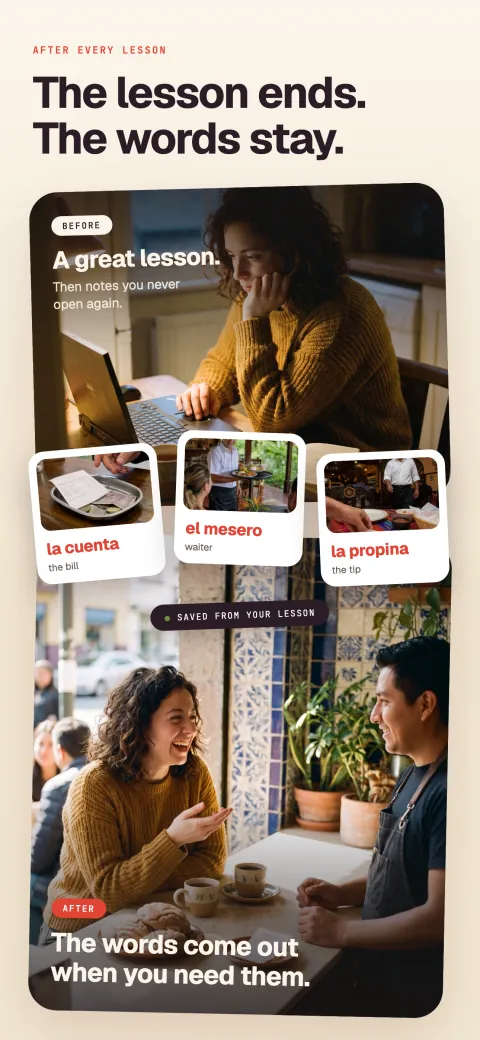
Verbamor records your lesson and turns what your tutor taught into cards that come back on schedule.

Someone hears you order in Spanish and asks what you used. You say the name of an app.
They open the App Store, see US$19.99 a month, put their phone away, and say "nice, I'll look into it." You've now spent your one moment of credibility on a price tag.
A useful recommendation carries the method in plain words, the real cost, and what the person does on their first Tuesday. Below are four scripts, one per question people actually ask, each ending in words you can send tonight.
Lead with the work, then the price
Say this out loud, or paste it:
"Short version: I record my actual lessons and conversations, and the app pulls out the words and phrases I met. I pick maybe ten to keep. It turns those into flashcards with a sentence and audio, then tests me on them at growing gaps. About fifteen minutes a day. The recording and the picking is the part I do. The scheduling is the part it does."
That's the method in four sentences, and they can now repeat it. Say the limit in the same breath, because hiding it costs you later.
Cards build recall of specific words and phrases. They don't build conversation. Someone with 400 well-scheduled words and no speaking practice has 400 well-scheduled words.
Skip this and your friend blames the app for a gap it never claimed to fill.
Give the cost next, without softening it:
"It's $19.99 a month, or $129.99 a year, which works out at about $10.83 a month. The annual one has a 7-day free trial. There's no free version. If a free thing is what you want, this is the wrong recommendation and I'd point you at Anki instead."
The two blocks above are 114 words. Keep yours under 120: six paragraphs reads as a pitch, and the person starts hunting for what you get out of it. Send them as one message, then stop typing.
Answer "is it worth it" with a number they can check
Start with a tutor, the comparison most people reach for. italki's own Spanish tutor page states that "Spanish tutors on italki cost between $4 to $60 per hour."
On 22 August 2026 I opened that directory in its default sort, no filters, and wrote down the listed trial price of the first 21 teachers. They ran from $5 to $25, median (the middle value) $12. Trials undercut standing rates, so call an hour $15.
Send the arithmetic instead of describing it:
"A tutor near me runs about $15 an hour. So the $19.99 month is about eighty minutes of tutoring, and the $129.99 year is about nine hours, roughly one lesson a month. A year of the app costs less than ten conversations, and it does not replace one of them. It's the thing that makes the words from those conversations stick."
Against Anki the comparison is sharper. Anki is free on desktop, Android and the web, and $24.99 one time on iOS.
It ships no language content, so every card is yours to build. It runs SM-2 by default, and the newer FSRS scheduler is opt-in, at the bottom of the deck options page.
Be exact about what turning FSRS on changes, because this sentence sends your friend away from a paid product. SM-2 applies a fixed formula to every card, nudging one ease number up or down as you pass or fail. FSRS fits its parameters to your own history instead.
The Anki manual says the optimizer "uses machine learning to learn your memory patterns and find parameters that best fit your review history." It also says that "by more accurately determining how much information you are likely to forget, it can help you remember more material in the same amount of time."
A real scheduling difference, free, and one checkbox.
So the deciding question is the card-making, and it has a number on it. I timed my own: a card with a sentence I wrote and audio I found took about six minutes. Hand them that number and a test they run themselves:
"Anki's scheduler is genuinely good once you turn FSRS on, and it's free. The catch is you build every card yourself, and it ships with no content. Mine took about six minutes each with a sentence and audio, so ten a week was an hour of admin. Before you decide, build fifteen cards from your own lessons by Sunday, using the Basic and Cloze note types Anki ships with. If you finish, use Anki and keep your money. If you stop on Wednesday, you're me. I made eleven in two weeks and quit, which is why I pay."
Fifteen is deliberate. At six minutes a card that's ninety minutes, and roughly one week of new material at this method's real rate. So finishing proves they can sustain the queue beyond one enthusiastic evening.
The Foreign Service Institute publishes how long its students take to reach a score of 3 in speaking and listening on the Interagency Language Roundtable scale. Spanish, French, Italian and Portuguese all sit in Category I, listed at 552 to 690 class hours, with Spanish at 30 weeks.
These are full-time students with teachers. So the figure measures the scale of the task and promises nothing about evenings: a typical FSI week is 23 hours in class plus 17 of self-study.
Convert it into your friend's unit before they do it themselves and panic. At the fifteen minutes a day from the first script, 552 hours is about six years and 690 is about seven and a half. Fifteen minutes a day is a maintenance habit, and a professional score is a full-time job.
Give them a plan for the seven-day trial
Seven days tests one thing. If they don't know which, they open the app twice and let it renew or lapse.
Peter Gollwitzer and Paschal Sheeran call the fix an implementation intention: an if-then plan naming when, where and how you'll act, formed in advance. Their 2006 review pooled 94 independent tests and found a medium-to-large effect on goal attainment, d = .65. (d is an effect size, a standard measure of how big a difference is.)
On failing to get started, taken alone, it scored d = .61. The review also covers getting derailed once you've begun. Those are exactly the two things a 7-day trial fails at.
So send the plan. Copy this and change the days:
"If you want to actually test it: start the trial on a Sunday. Record one lesson or one podcast episode Sunday night and keep ten words. Then do the review queue Monday to Saturday, first thing, with your coffee. With ten words it's a few minutes a day. On Saturday, say five of the ten out loud without looking. If you can't, cancel. That's a real test."
Put the cancel mechanics in the same message, because this is where people get burned and blame whoever recommended it. Apple's support page, If you want to cancel a subscription from Apple, is explicit: if you signed up for a free or discounted trial and don't want to renew, cancel at least 24 hours before it ends.
"Cancel in Settings, your name, Subscriptions. Apple says do it at least 24 hours before the trial ends, so set the reminder for day 5, not day 7."
Say who shouldn't buy it
Four people should ignore this recommendation. A polite nod means you're probably talking to one of them, and naming which is your last honest move.
Someone flying to Mexico in nine days. They need forty phrases and a phrasebook. A schedule that pays off over months lands after their flight home.
Someone who has had no lessons or conversations yet. This method mines real material rather than supplying it. With nothing recorded, the app sits empty.
Someone on Android. The app is iOS only for now. There's no Android version yet, and I can't promise them a date.
Someone who wants points and streaks. They'll find the review queue dull, because it is dull, the way a set of squats is dull.
Send the first three as one message the moment they seem keen but wrong-fit:
"Before you pay: it's iOS only, there's no free tier, and you need something real to record, so it's no use until you're having lessons or conversations. If you're travelling in under two weeks, buy a phrasebook instead."
Say the fourth out loud instead. It protects your credibility later:
"It's boring on purpose. There's no streak to protect and nothing congratulates you. If the animations are what keep you going right now, you'll hate this."
Offer to do the first one with them
Run it like this. Have them record ten minutes of something real: a lesson, a call with a relative, a podcast they half understand. Sit with them while the transcript comes back.
Then make the judgement call new people always get wrong, and say it as a rule: keep ten, not fifty. Point at each word and ask "would you actually say this?" If they wouldn't, skip it.
Show them the arithmetic, because that makes the rule stick. The Anki manual publishes the ratio: "If you are consistently learning 20 new cards a day, you can expect your daily reviews to be roughly about 200 cards/day."
That's ten reviews per new card, at the 90% retention these schedulers use by default. Ten words a week is under two new cards a day, settling at about fourteen reviews a day. Eighty words a week is over eleven, settling at about a hundred and fourteen.
At eight seconds a card, that's two minutes against fifteen. The person who kept eighty signed up for a daily obligation eight times the size, and quits in week three. Over-adding is the standard way this method fails.
Show them one card, front and back, and let them fail it. Watching it come back three days later is when the method stops being an explanation.
Don't check on them afterwards. If they want to keep going, agree on one thing: each Sunday you send each other three words you kept, in a sentence rather than a bare list.
One message a week, two extra retrievals per word (times you pull it from memory), and it doesn't make you somebody's accountability system.
The most common reply is "can't I just use ChatGPT for this?" Send them this:
"Yes for translating and explaining, and it's better than the app at both. No for the scheduling. A chat window has no memory of what you got wrong on Tuesday and no reason to ask you again on Friday. That asking again is the whole product."
Pick your script by the question you were asked. "What do you use?" gets the first, method then price. "Is it worth it?" gets the second, the tutor hours and the six minutes a card.
"I'll try the free trial" gets the third, the Sunday plan and the day-5 reminder. A polite nod gets the fourth, who shouldn't buy it.
Send it tonight, with the words in the message instead of a link.
Lead with the method, not the price.
Verbamor turns lessons you already recorded into flashcards with a sentence and audio, then schedules them at growing gaps, which is worth describing in full before anyone hears the number attached to it.
Start 7 days freeThe 7-day free trial is on the yearly plan.