 Verbamor
Should you learn phrases or single words?
You know cuenta. Account. You know dar. To give. At dinner you still can't say "I noticed," because that's me di cuenta, and knowing the two words separately never hands you the phrase. About 55% of ordinary language arrives pre-built like that, not assembled word by word.
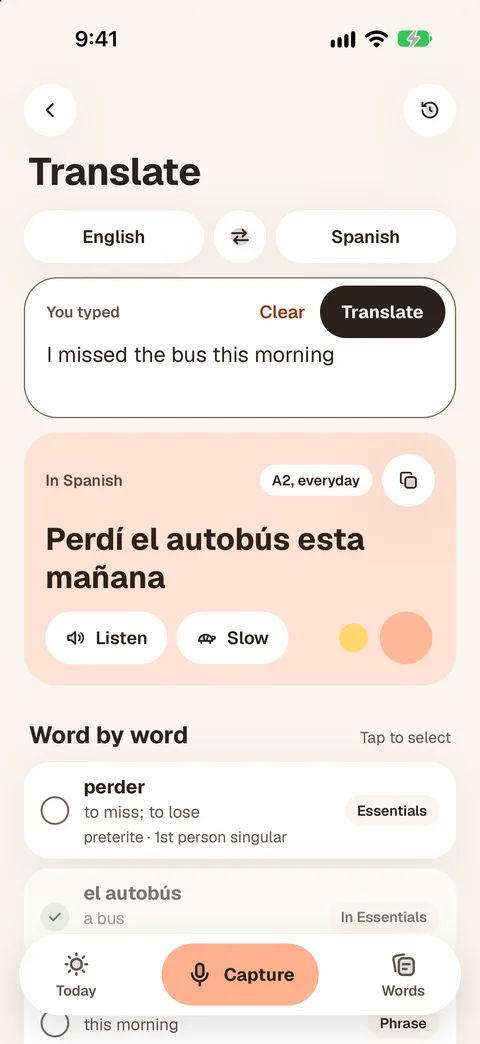
Verbamor translates a phrase, breaks it down word by word, and saves the words you tap as cards.

You learn the Spanish word cuenta. Account. You learn dar. To give.
Two clean cards, two clean answers, and at dinner you still can't say "I noticed." That sentence is me di cuenta, and no amount of knowing the two words separately hands it to you.
That gap is the whole argument. Britt Erman and Beatrice Warren, in a 2000 paper in the journal Text, analyzed 10,246 word slots from the London-Lund corpus of spoken English and the Lancaster-Oslo-Bergen corpus of written English. (A corpus is a large collection of real text.) They marked which slots were filled by prefabricated multi-word units, as opposed to being assembled word by word.
Their count: 58.6% of the spoken sample and 52.3% of the written sample, about 55% overall. Roughly half of ordinary language arrives in pre-built pieces.
Single-word study means one item, one meaning. Front cuenta, back "account". You collect items and trust grammar to combine them later.
Phrase study means the unit you learn is longer than one word: me di cuenta, hace falta, por si acaso. You learn it whole, the way you learned "as a matter of fact" in English, without ever parsing it.
The technical name for the second kind is a formulaic sequence. That means a word combination that speakers store and retrieve as a single chunk, instead of building it from parts each time.
Erman and Warren call it a prefab. Both names point at one property: the whole thing comes out of memory together.
Single words win on cheapness, and phrases win on speaking
Single words win on cheapness. One card holds one item, that item shows up in every sentence containing it, and you either produced it or you didn't.
Ventana is window in every context you'll ever meet, a single card buys you all of them, and grading it takes no judgement. A three-word phrase gives you more ways to be half-right, and half-right is the state that ruins a review log.
Words like ventana are the cheap item on both counts, and they compound.
Phrases win on production. Boers, Eyckmans, Kappel, Stengers and Demecheleer (2006, Language Teaching Research) ran 32 college English majors through 22 teaching hours of authentic listening and reading.
The 17 in the experimental group were made aware of standardized word combinations in the material. The 15 controls worked the same material under the usual split between grammar and vocabulary.
Two judges then rated everyone's oral proficiency from an interview, without knowing which group each student was in. Both rated the experimental group higher.
Thirty-two students, one interview, subjective ratings from judges. It supports the idea that a repertoire of phrases makes a speaker sound more proficient.
It doesn't prove phrases beat words for building vocabulary size, and I haven't found a study that shows it.
You can see the shape of that win in one Spanish pair. Falta is a lack, hacer is to make, and knowing both leaves you unable to say "I need a chair."
Hace falta una silla is four words you already own in an order you'd never have chosen, and one card hands it over intact.
If you can predict the whole from the parts, learn the word
Here's the question to ask about any candidate item, and it takes four seconds.
Can you predict the whole from the parts?
If yes, learn the word. La ventana está abierta is window, is, open. You know all three, the sentence assembles itself, and a phrase card would just be a word card carrying passengers.
If no, learn the phrase. Me di cuenta is "to me I gave account", which tells you nothing about noticing. The meaning lives in the combination, so the combination is the item.
Collocation errors last because listeners still understand you
The interesting cases fail the test in a quieter way. Hacer una pregunta is make a question, and every part is predictable except the choice of verb.
English makes you ask. French makes you poser, to place. Nothing about pregunta tells you which verb Spanish picked.
That arbitrary pairing is a collocation, meaning two words that habitually go together for no reason you can derive.
Spanish age is the same. The language uses tener: tengo treinta años, I have thirty years. Knowing tener and año separately gives you two correct words and one wrong sentence, because you'll reach for ser.
Collocations pass the meaning half of the test and fail the pairing half. They're where intermediate learners quietly leak errors for years.
Say preguntar una pregunta and every listener understands you, so no one corrects it, and you repeat it for a decade.
Errors that block comprehension get fixed by the conversation itself. Errors that only sound foreign survive as long as you let them.
The size of that leak has been measured. Thi My Hang Nguyen and Stuart Webb, in a 2017 study, tested Vietnamese learners of English on verb-noun and adjective-noun collocations from the first three 1,000-word frequency bands. (A band is a block of 1,000 words ranked by how common they are.) They also tested single words from those same bands.
The learners knew under 50% of each collocation type overall, and their collocation scores dropped again at each step down the frequency list.
Collocation scores rose and fell with single-word scores, so knowing more words does help. It didn't close the gap. These were pairings built on some of the most common words in English, the ask and question tier, and the learners still knew fewer than half of them.
This is also the category that decides whether phrase study is worth anything to you. If people already understand you, single words have stopped being your problem.
Your remaining errors are mostly pairing errors, and a pairing error is invisible to a word card, because the word on the card is correct.
One move covers both halves. When you meet a new noun, record the verb it came with. Pregunta costs one card either way. Hacer una pregunta costs the same card and closes the pairing too.
Phrases cost a little more to recall, and more to grade
Elke Peters, in a 2014 study, put the two item types through the same treatment to find out how much harder phrases are. She taught EFL learners (people learning English as a foreign language) 12 single words and 12 collocations. Each appeared in the lesson once, three times or five times, and she tested form recall straight away for one group and a week later for the other, then again at two weeks for both.
Repetition helped both types, and the help lasted. The collocations still came back harder than the single words.
Her abstract gives the direction and no recall percentage per item type. So the size of that penalty isn't a number I can give you.
A second study points the other way on form. Chen Wang and Jingjing Yang, in a 2020 paper, taught 101 Chinese learners of English new items in paired-associate format. Two groups got collocations and one got single words.
They report that the item type had "little effect on the retention of form." On meaning, the collocation groups did better than the single-word group.
Two studies, the penalty real in one and close to absent in the other. So it's small enough to be swamped by how you teach the item.
Whatever penalty there is, a spaced-repetition scheduler turns it into extra work. A card you fail comes back sooner and more often. So a lower recall rate on your phrase cards means a bigger daily review count for the same number of items.
A three-word phrase is also one retrieval attempt with three chances to fail. If you produce me doy cuenta when the card wants me di cuenta, you have to decide what grade that is, and either answer is defensible. Ambiguous grades feed the scheduler bad data, and the scheduler has no other channel into your memory.
There's a failure mode with a name. Anki's manual calls a card you keep forgetting a leech, and suspends it once the lapse counter (the count of times you've forgotten it) reaches 8.
Its advice for items you confuse with each other is to master one before adding the next. Phrase cards produce confusable items generously: darse cuenta, tener en cuenta and a fin de cuentas share a word and mean unrelated things.
Phrases also have a shelf-life problem that single words don't. Ventana will be useful for the rest of your life. Se me ha ido el santo al cielo is a real Spanish idiom, and you may go three years without a moment where it fits. A card earns its place by how often it comes back.
The honest count on a phrase card: taught the same way as a word, it's recalled about as often or somewhat less often. When it works, it hands you something you couldn't have assembled.
When Verbamor transcribes a lesson you recorded, it mines both single words and multi-word phrases from what you actually said. You choose which ones become cards.
Every card carries two recordings of its example sentence: one with the answer replaced by a tone, one complete. The tone version leaves a gap for you to say the phrase out loud instead of letting recognition pass for recall, which is the failure a phrase card is most prone to.
It does nothing about the tense-versus-tense grading problem above. It doesn't decide the word-versus-phrase question for you, and it'll happily let you save a phrase you'll never use.
Run the test on your next lesson
Try this on your next lesson or your next chapter.
- Write down every item you want to keep, exactly as you met it, with the full sentence around it.
- For each one, cover the meaning and try to build it from its parts. If you can, cut it back to the single word.
- If you can't, keep the phrase, and keep it at its natural boundary. Me di cuenta de que is a phrase. The whole sentence it appeared in isn't.
- Cap the phrases. Two or three per lesson is plenty next to ten or twelve single words. Phrases are the expensive item, so buy fewer.
- Put the phrase in a sentence you'd actually say this week. If you can't write that sentence, skip the card and let the phrase stay passive.
Step 5 is the one people skip. A phrase you can't place is a phrase you won't recall.
Beginners, exam takers and settled decks can skip this
Three groups, honestly.
If you're in your first month, learn words. You need several hundred concrete nouns and a few dozen verbs before phrases have anything to attach to. A phrase card at week two is four unknowns pretending to be one.
If you're preparing for a written exam with a vocabulary list, follow the list. The list is what gets tested.
If you already have a deck that works, don't rebuild it. Those cards carry months of review history, and the scheduler's intervals are built from it.
Replacing a card with a new one throws that history away and sends a mature item back to the start of the queue. Apply the test to new items only.
Open whatever you learned from most recently. Find one item you've been treating as a single word that fails the prediction test, and add the phrase it belongs to as a new card.
Sources
About half of ordinary language comes in pre-built chunks
- Erman, B., & Warren, B. (2000). The idiom principle and the open choice principle. Text, 20(1), 29–62.
Phrase-aware students were rated more proficient speakers
- Boers, F., Eyckmans, J., Kappel, J., Stengers, H., & Demecheleer, M. (2006). Formulaic sequences and perceived oral proficiency: putting a Lexical Approach to the test. Language Teaching Research, 10(3), 245–261.
Learners knew under half of common collocations
- Nguyen, T. M. H., & Webb, S. (2017). Examining second language receptive knowledge of collocation and factors that affect learning. Language Teaching Research, 21(3), 298–320.
What a collocation costs next to a single word
- Peters, E. (2014). The effects of repetition and time of post-test administration on EFL learners' form recall of single words and collocations. Language Teaching Research, 18(1), 75–94.
- Wang, C., & Yang, J. (2020). Revisiting the explicit learning of vocabulary of Chinese EFL learners. English Language Teaching, 13(2), 86.
Leeches and confusable cards
- Anki. Leeches. Anki Manual, read 22 Nov 2026.
Some things you have to say whole.
When Verbamor transcribes a lesson you recorded, it mines both single words and full phrases from what you actually said, then asks you to say each one out loud before it shows you the answer.
Start 7 days freeThe 7-day free trial is on the yearly plan.