 Verbamor
Memrise review: the price nobody agrees on
The three pages ranking above this one quote three different lifetime prices, and a fourth says the number can't be given at all. Here is what Apple's listing and Memrise's own help centre actually say, checked on 21 September 2026.
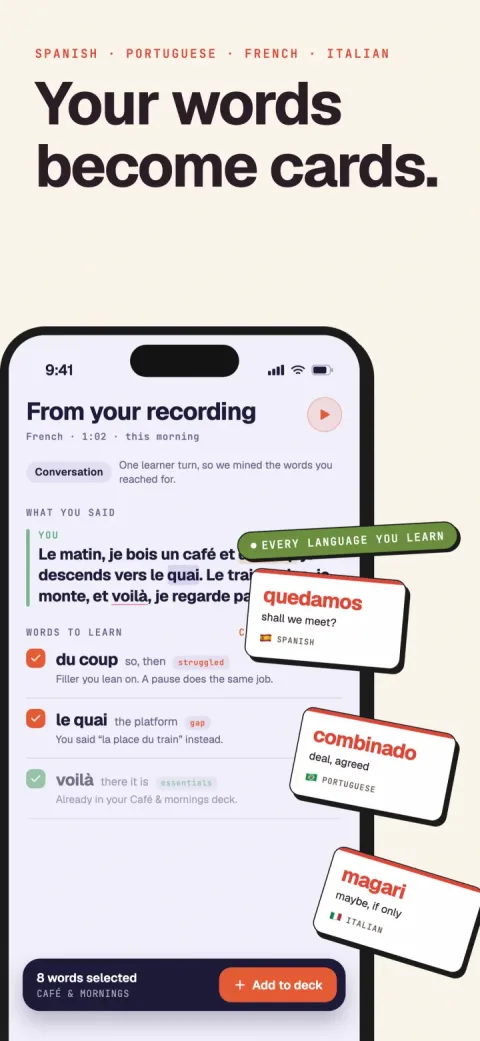
Verbamor turns the words from your own lessons and recordings into flashcards, and brings each one back before you’d forget it.

I haven't used Memrise. Everything below comes from Apple's own App Store listing, Memrise's homepage, and 217 articles in Memrise's own help centre, all read on 21 September 2026. Where I couldn't verify something, I say so rather than rounding it off.
That matters here more than on most reviews, because the money question has no settled answer. On the same day, the page ranking first for "memrise review" said lifetime access is $119.99. The third said "about $330." The second refused to name a figure at all, calling it "a few dollars to over a hundred dollars," in a review whose whole argument is that you shouldn't pay.
So the verdict first. Memrise is worth paying for if you want native-speaker video in a widely-taught language and you'll accept a review schedule you can't influence.
Use the free plan if you mainly want to sample a language. Skip it if you're past the beginner stage or learning something outside its main lineup.
The price depends on your country, so four pages give four answers
Memrise explains the disagreement itself. Its help centre says you can see "all the available subscriptions, prices and payment methods for your country" only "by tapping the Upgrade button on the Android or iOS app or by visiting memrise.com/premium while logged in."
A price behind a login and varying by country is a price no reviewer can quote flatly. Twelve currencies are listed on the web checkout, and the help centre adds that if yours is missing, "the price will appear in USD."
What is public is Apple's listing, which prints the US in-app purchases by name. On 21 September 2026 it showed ten of them:
Now the contradictions resolve. The "$330 lifetime" figure is close to Apple's standing $329.99, and the "$119.99" is in the neighbourhood of the discounted $131.99 offer. Both reviewers probably saw a real price; neither said which one, or when.
The three-month plan carrying the same $24.99 as the one-month plan is the detail I'd want before tapping anything.
Two things are flat-out confirmed, and both are unusually good terms. Memrise runs a 30-day money-back guarantee, with monthly plans narrowed to 14 days, and Apple purchases routed through Apple. And lifetime is "a one-off upfront payment without any renewals."
None of the three reviews above mentions the refund window, which is the most useful fact for someone hovering over a $329.99 button.
A price that lives behind a login and changes by country is not a price a review can state. Say which one you saw, and when.
Every learner gets the same eight rungs
Memrise publishes its review schedule, which most apps don't, and it's the most important thing on this page after the money.
From the help centre, updated 17 September 2026: "When reviewing a word or sentence correctly, the item will be moved to a longer interval. The review schedule is as follows: 4 hours > 12 hours > 24 hours > 6 days > 12 days > 48 days > 96 days > 6 months." Get one wrong and "it will be moved back to the first interval."
Eight rungs, identical for every user and every word. The word you've fumbled nine times and the word you got instantly sit on the same ladder, and nothing you do moves a rung. Compare that to a scheduler that fits a memory model per card, where a word you keep missing comes back sooner because you keep missing it.
Walk the rungs and the cost shows up. Four correct answers put you at about day 8 (4 hours + 12 hours + 24 hours + 6 days). Miss once then and you're back to 4 hours, re-climbing the whole thing. Meanwhile a word you've never missed jumps from 12 days to 48.
Memrise does adapt in one place, and credit where it's due: how many times you're drilled before a word enters review. The default is 6, but items drop to 4 or 3 based on "the accuracy scores of everyone that learned the course before you." That's adaptation based on the crowd rather than on you, and it ends once the word reaches the ladder.
A fixed ladder is predictable and needs no setup, which is a real virtue if the thing stopping you is fiddling with settings. It's the trade every scheduler makes, and Memrise picked one end of it deliberately.
The free plan is a real sample, and the AI chat partners are paid
Memrise states the split in its own App Store copy, so this needs no inference. Pro opens up all vocab lessons and "all native speaker videos," gives "unlimited speaking practice" and removes ads. The free plan gets "limited vocab lessons," "limited videos and conversations," and ads.
In the app the boundary is visible: scenarios with stars are Pro, and on mobile "free scenarios have a blue outline whereas Pro scenarios have an orange outline and stars."
So the free tier is a genuine sample rather than a crippled shell, and it never expires. Word Information, the screen with translations and real-world clips, is free too: "You can currently access Word Information for free."
The AI chat partners are the clearest paid line. Grammar Buddy, Role Play Buddy, Conjugation Buddy and the rest: "you require a Pro subscription to access this feature."
One thing the free plan can't get back at any price. Community-made courses, the user-generated library that was Memrise's original draw, left the apps on 31 March 2024 and now live only at a separate site.
Memrise's reasoning is published and blunt: the courses "were of hugely varied quality," support "comes at a significant cost," and keeping them "hinders the development of the main Memrise experience." The community forum closed in December 2023.
If you're returning to Memrise after a few years because you remember a particular community deck, that's the sentence to read twice.
Your language probably isn't the one they demoed
Every Memrise review I read is really a review of one language. The top result is a Chinese school's page, and most of its criticism is about Chinese characters. Which is useless to you if you're learning Portuguese.
Memrise's own help centre is specific where the reviews are vague, so here's the per-language picture for the five languages I know best.
The "Learn, Immerse, Communicate" rebuild covers Spanish (both Spain and Mexico), French, Italian, Portuguese (both Portugal and Brazil) and Russian. All five are in. So far so even.
The AI Buddies are where it splits. For English speakers, Memrise lists them for Spanish, French, Italian and both Portuguese variants. Russian is not on that list. Neither is it on the second list covering other interface languages.
So a Russian learner paying the same subscription gets the vocabulary and the videos, and not the conversation practice that the homepage sells.
Memrise says a rollout is ongoing, so this may change. It hadn't on 21 September 2026, and no review I found mentions it.
There's a second Russian-shaped hole. Memrise's Romanisation toggle, which lets you learn a script language in Latin letters, is documented with Korean, Japanese and Arabic as the examples. Cyrillic is a small alphabet and most learners get through it in a week, so this matters less than it would for Japanese.
But a vocabulary app with a fixed ladder has no mechanism at all for Russian case endings, and six cases across three genders is where Russian learners actually stall. Drilling stol as a single item never teaches you stolom.
Portuguese learners get a genuinely good deal here, incidentally: Memrise splits European and Brazilian Portuguese as separate courses with separate video, which most apps don't bother to do.
Beginners in four languages should buy it, and most others shouldn't
The three reviews above this one each give a score that argues with their own prose. One scores it 8/10 and says "money is better spent elsewhere." One scores 7.4/10 and concludes "we do not believe Memrise is worth it."
One gives 2/5 with no rubric. A buyer can't act on any of that, so no score here, just who it fits.
Buy Pro if you're a beginner or early intermediate in Spanish, French, Italian or Portuguese. It fits if you want to hear real people rather than a synthetic voice, and a fixed schedule you never think about is the kind you'll actually stick to.
The 30-day guarantee makes this cheap to test properly.
Stay free if you're sampling a language or you mainly want the video clips. The free tier is real and permanent.
Skip it if you're past intermediate, if you're learning Russian and wanted the speaking practice, or if what you need is to hold on to words from somewhere else. Memrise teaches its own curriculum, and no plan lets you push your own vocabulary into it the way the old community courses did.
Where Memrise genuinely beats what I build: it's free to start, it covers far more languages, and the native-speaker video is the real thing rather than a marketing line. Verbamor has none of that.
What it can't do is the reason I built something. Memrise drills its words, in its order, on its ladder.
If you had a tutor session on Tuesday and a phrase came up that you keep fumbling, Memrise has no idea. And that's the vocabulary that goes missing by Friday.
Verbamor is an iOS app that records a lesson and turns what you said into fill-in-the-blank cards. FSRS schedules them (it's an open-source algorithm that predicts when you're about to forget each card).
It covers six languages, at $19.99 a month or $129.99 a year with a 7-day trial on the annual plan. Both are US prices, read off the app's own plan definitions on 21 September 2026. The App Store sets a different number in other countries. No free tier, which is a real reason to pick Memrise instead.
And the honest version: plenty of people need neither. If you'll write your lesson words in a notebook and actually test yourself cold, that beats both apps and costs nothing.
Anki is free on desktop and Android, runs a serious scheduler, and will take any card you can build. It's the better choice for anyone willing to make their own cards. Memrise exists for people who won't, and that's a large and reasonable group.
I'll re-check the prices in three months and date the change here.
Sources
What Memrise costs
- Apple. Memrise: Language Learning App on the US App Store. Read 21 September 2026. Source for all ten in-app purchase names and prices, for version 2026.9.4 released 7 September 2026, and for the free-versus-Pro feature split quoted verbatim from the listing description. App free to download; rated 4.8 from about 217,000 ratings.
- Memrise Help Centre (updated 25 May 2026). What kind of subscription plans are available? Source for prices being country-specific and visible only when logged in, and for the Monthly, Annual and Lifetime plan names.
- Memrise Help Centre (updated 7 September 2026). How do I request a refund under the 30-day money back guarantee? Source for the 30-day window, the 14-day limit on monthly plans, and Apple purchases being refunded by Apple.
- Memrise Help Centre (updated 19 April 2024). How does the Lifetime plan work? Source for lifetime being "a one-off upfront payment without any renewals."
The interval ladder
- Memrise Help Centre (updated 17 September 2026). How does the spaced repetition system work? Source for the eight rungs and the reset to 4 hours, both quoted verbatim. The same text appears in Memrise's newer help centre, updated 4 September 2026.
- Memrise Help Centre (updated 16 October 2024). Why am I only tested 3 or 4 times instead of 6 on some items? Source for the 6 / 4 / 3 buckets before an item reaches review, for those buckets being set by previous learners' accuracy, and for there being no way to disable it.
Free tier, languages and what was removed
- Memrise Help Centre (updated 24 March 2025). What do the stars next to the Scenario titles mean? Source for the free and Pro scenario markings.
- Memrise Help Centre (updated 16 May 2025). Introducing: AI buddies! Source for the Buddy lineup, for Pro being required, and for the per-language availability list. Russian appears on neither list on the page as read.
- Memrise Help Centre (updated 27 August 2026). The New Memrise Experience. Source for the language list covered by Learn, Immerse, Communicate, including both Spanish and both Portuguese variants and Russian.
- Memrise Help Centre (updated 9 July 2026). What is Word Information? Source for that screen being free.
- Memrise Help Centre (updated 3 September 2026). Why can I no longer get to my community courses in the app? Source for the removal of community courses and for Memrise's stated reasons, quoted verbatim. The 31 March 2024 date and the separate site come from the companion article, Will Memrise delete Community Courses? (updated 28 July 2026), and the forum closure from Closure of the Memrise Community Forum.
- Memrise Help Centre (updated 22 July 2026). What is the Romanisation toggle? Source for the toggle and for Korean, Japanese and Arabic being the documented examples.
The pages this one is arguing with
- LTL Language School (published 1 February 2025). Memrise Review. Read 21 September 2026. Rates Memrise 8/10 while saying "the paid version isn't really worth it" and that "money is better spent elsewhere." Quotes lifetime at $119.99 and 16 official languages. LTL sells its own Chinese courses, and most of the critique concerns Chinese characters.
- TestPrepInsight (updated 1 April 2026). Memrise Review. Read 21 September 2026. Scores 7.4/10 while concluding "we do not believe Memrise is worth it." Gives "a little over $60 for an annual plan; or about $330 for an unlimited, lifetime pass," and 34+ languages.
- StudyFrenchSpanish (dated 6 January 2026). My Honest Memrise Review. Read 21 September 2026. Scores 2/5 and declines to name a price, giving only "a few dollars to over a hundred dollars."
What I could not verify
- Which price you personally will be shown. Memrise says prices are per-country and visible only behind a login, and Apple lists ten in-app purchases including five unlabelled "offer" entries with no billing term attached. The figures above are the US App Store's published names and prices on 21 September 2026, which is a different claim from "this is what you will pay."
- GBP and EUR figures. Memrise supports both currencies at checkout, but publishes no figure for either outside a logged-in session, so none is given here.
- Whether the ladder in the help centre is what the app runs today. The article is Memrise's own and was updated on 17 September 2026, which is the strongest evidence available without using the app. I have not observed a review queue.
- The language count. Memrise's homepage says over 150, its App Store description says 139, and the reviews above say 16 and 34. These are counting different things (official courses, interface pairs, community content) and no page defines its terms, so no single number is stated above.
- Learner counts. Memrise's App Store description claims "80 million learners." It's a self-reported all-time registration figure with no breakdown, so it appears here as a claim rather than a fact.
Keep the words you already paid a tutor for.
Verbamor turns your lesson vocabulary into fill-in-the-blank cards with native audio, scheduled so they're still there next month.
Start 7 days freeThe 7-day free trial is on the yearly plan.