 Verbamor
Lingoda review: what a CEFR level actually costs
I haven't taken a Lingoda class. So I read the binding Sprint rules PDF instead, and it contradicts the reviews ranking above it. Prices below were read in USD on 21 September 2026.
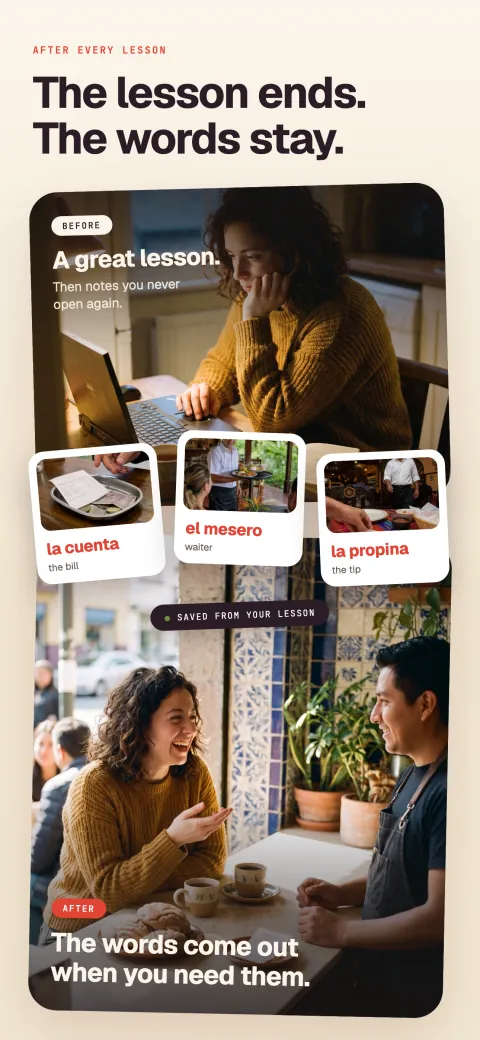
Verbamor records your lesson and turns what your tutor taught into cards that come back on schedule.

Lingoda's own Sprint rules run to 6 pages. Section 5.8 says you may cancel a booked class "no later than 7 days (168 hours) before the start date/time of a class."
The review I read that states a cancellation window gives it as 72 hours. That number is real and it's in Lingoda's general terms, but it doesn't apply to the Sprint. If you sign up for the intensive on a 72-hour assumption, you'll lose class credits in week one.
That's the shape of this whole category. The product is documented in detail by the company, and reviewed by people working from the marketing pages.
This review reads Lingoda's own documents, since I haven't taken a class
I haven't taken a Lingoda class. I'm not going to write 3,000 words implying otherwise, which is roughly what the pages ranking for this query do.
Everything below comes from Lingoda's own pages, read on 21 September 2026.
They are the pricing page with the currency switched to USD, the Sprint prices page, the general terms, and the Sprint rules PDF linked from the Sprint page.
So I can't tell you whether your teacher will be good. Jen Ambrose, who took 50+ classes and wrote it up honestly, can, and her answer is that it varies. I can tell you what the contract says, which is the part that costs money.
At standing prices, 20 classes cost more per class than 12
First problem: the price you see isn't the price. A countdown clock was running when I opened the page.
Its own FAQ says the discount "applies to your first two months only" and is limited to students who have never held a subscription.
So there are two numbers per plan, and the struck-through one is what a year of study costs. Group classes, 60 minutes, 3 to 5 students, billed every 4 weeks:
Now divide the standing prices yourself. The 12-class plan works out to $10.83 a class. The 20-class plan works out to $11.00.
Buying more classes makes each one cost more at that step. It reverses again at 40. None of the three reviews I read mentions it, because the displayed per-class number is computed against the sale price, where the ladder descends properly.
The prices also change by language, and mine were read while "Learn English" was selected. Check your own before budgeting.
Lingoda's per-class figure is the sale price divided by the classes. Its standing 12-class plan is cheaper per class than its standing 20-class plan.
Reaching B1 takes 150 classes and about $1,275 to $2,100
The reviews price a month. None prices a destination, which is the actual question.
Lingoda gives the conversion factor on its own pricing FAQ: "one level has 50 classes, so if you take a class a day, you could move up a level in just over 7 weeks."
So A1 to B1, on Europe's six-level CEFR scale, is 3 levels and 150 classes. At the cheapest standing rate, the 40-class plan at $8.50, that's about $1,275.
At the 20-class plan's $11.00, about $1,650. At the 5-class plan's $14.00, about $2,100.
Pace matters here. 150 classes at 3 a week is 50 weeks, near enough a year. At 5 a week it's 30.
Those figures assume 50 classes per level converts to a level, which is a claim about syllabus coverage and not about your ability. Two people can attend all 150 and end up in different places.
The Foreign Service Institute puts Spanish at 30 weeks of 23 class hours plus 17 self-study hours a week. That's roughly 1,200 hours to a working proficiency well above B1.
150 hours of group class is a fraction of that, and the gap gets filled by what you do between classes or it doesn't get filled.
The Sprint's refund rules are strict, and cancelling takes 7 days
The Sprint is why most people search for Lingoda. Two months, and you get money back for finishing.
The sources genuinely conflict here, so start with what Lingoda charges. Its Sprint prices page, in USD, on 21 September 2026: Sprint, $420 total, 30 group classes, paid as a $55 deposit then $155 then $210.
Super Sprint, $740 total, 60 group classes, paid as $55 then $315 then $370. Both arithmetic checks out against the totals.
The reward differs by tier, and this is where the reviews go wrong in both directions. The rules PDF, section 3.4: "For the Super Sprint: 100% of the paid Fees. For the regular Sprint: 50% of the paid Fees."
Test Prep Insight reports a flat 50% refund. That's right for the Sprint and wrong for the Super Sprint.
Multilingual Mastery reports "50% for Sprint, 100% for Super Sprint," which matches the rules exactly. It's the one page of the three that got this right, and it publishes no prices at all to attach it to.
Lingoda's own Sprint marketing FAQ muddies it further. It says the cashback is "50% of the total amount you paid for the Sprint or the Super Sprint," contradicting its own binding rules two clicks away.
So the honest version: finish the Super Sprint clean and 60 classes cost you nothing. Finish the Sprint clean and 30 classes cost $210, which is $7.00 a class, the cheapest group rate Lingoda sells.
Then read section 5, which is the part that decides whether you see any of it.
- "The Customer must attend classes in full," from the beginning, without leaving early, measured "based on system information from the class log."
- Absence never counts, "regardless of the reason for the absence (e.g., health, job, technical [e.g., bad internet connection, microphone, speaker, or webcam issues], personal, weather-related issues, or any other), unless Lingoda is responsible."
- "Customers may only attend one class per day. Attending more than one class per day disqualifies you from the Reward." So you cannot catch up.
- Regular Sprint only: a cap of 5 classes a week, Monday to Sunday. Exceeding it also disqualifies you.
- Private classes don't count. Only group classes do.
- Cancellation is 7 days, not 72 hours, plus a 30-minute window straight after booking.
Put those together and the Super Sprint asks for 30 classes in each of two roughly 30-day months. That's one per day maximum, no substitutions, with a week's notice required to move any of them.
One bad flu, one work trip you didn't book around, and the entire $740 reward is gone while the $740 charge stays.
There's a rollover too, in section 7. The subscription continues automatically after the Sprint ends, into a "Keep Running" pack of 20 classes a month after the Super Sprint or 12 after the Sprint. And section 7.3 says the 14-day withdrawal right "shall not apply to the Rollover."
You can cancel it, but you have to do it during the second month, before the Sprint's end date, which is exactly when you're busiest.
The certificate is an attendance record
Lingoda issues a certificate per level. Be precise about what it certifies.
Jen Ambrose earned a B1.1 certificate for $900.75 of classes between September 2023 and May 2024. Then she said plainly that Lingoda's certification "is based on class completion, not a formal evaluation of fluency." She didn't feel B1 when she had it, and credits her actual gains to travel.
That's the most useful sentence written about this company, and it sits on a blog with no prices next to it.
Maybe you need a credential that an employer or an immigration office will accept. The exams that do that job are the Goethe-Zertifikat, telc, DELE and their equivalents, and they test you rather than count your attendance.
Live classes are still worth buying. Buy them for the speaking practice rather than the certificate.
Buy it for a predictable calendar, and skip the Sprint if your schedule moves
Lingoda is a reasonable buy for a specific person. You have a predictable calendar, you want scheduled speaking practice with a teacher rather than an app, and a deadline does some of the motivational work.
A group of 3 to 5 gets more talking time than a classroom at less than one-to-one prices.
Skip the Sprint if your schedule moves. The reward is built to be forfeited, and the rules spell out exactly how. Paying $740 for a 100% refund you then miss by one class is the worst outcome in this whole post.
Take the monthly plan and cancel when life gets loud.
And skip it entirely if you're above B1 in a smaller language. Class availability thins out at higher levels, the one criticism all three reviews agree on and the one I can't verify from outside.
The bigger thing is what happens between classes. 150 classes over a year is about 3 hours a week of contact time. The vocabulary from each of them decays on its own schedule whether you come back or not.
Most of the loss happens in the first days. Jen credited travel rather than the platform, and immersion is doing the same job: more encounters with the same words, spread out.
That gap is what I built. Verbamor is an iOS app that takes the vocabulary from a lesson you already paid for, whether that's a Lingoda class or a tutor. It turns the words into fill-in-the-blank cards with spoken audio, scheduled so you're still using them next month.
Other than the 650 or so starter words it ships with, it teaches you nothing new, and it won't find you a class. Spanish, French, Italian, Portuguese, Russian and German.
$19.99 a month, or $129.99 a year with a 7-day trial on the annual plan, and no free tier, which is a fair reason to pass.
The honest alternative is cheaper than both of us. If you'll write your class vocabulary into a notebook afterwards and actually test yourself on it, that beats every app here, mine included, for the price of a notebook.
Anki is free on desktop and Android and runs a serious scheduler if you'll build the cards. People who have tried that twice and stopped are the ones I'm for.
Sources
Prices and plan mechanics
- Lingoda. Prices: how much do Lingoda classes cost. Read 21 September 2026 with the currency selector set to $ USD and "Learn English" selected. Source for the four group tiers and both the standing and promotional totals, the "60-minute live online classes" and "3-5 students" descriptions, four-week renewal with credits rolling over, the per-class rounding footnote, the 7-day free trial (3 group classes or 1 private class), the 14-day money-back guarantee "minus any classes taken", the 4-week pause, the 3-day class cancellation on monthly plans, the promotion's "first two months only" and new-student limits, and the "one level has 50 classes" line. The USD figures required clicking the currency control in a browser; the server returns EUR to automated fetching.
- Lingoda. General terms and conditions. Read 21 September 2026. Source for the standard 72-hour class cancellation window and the 14-day right of withdrawal, both of which apply outside the Sprint.
The Sprint, from the binding rules
- Lingoda GmbH. Language Sprint rules, October 2026 start (PDF, 6 pages). Downloaded 21 September 2026 from the link on the Sprint page. Source for the 100%/50% reward split (3.4), the 30-and-30 and 15-and-15 attendance requirements (3.2, 3.3), full attendance measured from the class log (5.1), absence never counting regardless of reason (5.5), one class per day (5.2), the 5-per-week cap on the regular Sprint (5.3), group classes only (5.4), the 7-day/168-hour cancellation window and 30-minute immediate-cancel (5.8), the disqualification list (section 4), and the automatic Rollover with its excluded 14-day withdrawal right (7.1 to 7.4).
- Lingoda. Sprint prices. Read 21 September 2026 in USD. Source for $420 total / 30 classes with a $55 deposit then $155 then $210, and $740 total / 60 classes with $55 then $315 then $370, plus the marketing FAQ line describing the cashback as "50% of the total amount you paid for the Sprint or the Super Sprint", which contradicts section 3.4 of the rules above.
The reviews this one is checking
- Jen Ambrose. I took 50 classes on Lingoda: my very honest Lingoda review. Read 21 September 2026. Source for $900.75 spent between September 2023 and May 2024, the B1.1 certificate, and the line that Lingoda's certification "is based on class completion, not a formal evaluation of fluency." Her stated 72-hour cancellation window matches the general terms but not the Sprint rules.
- Test Prep Insight. Lingoda review. Read 21 September 2026, page dated 24 May 2026, carrying an affiliate disclosure and a 9.5/10 score. Reports a flat 50% Sprint refund, which section 3.4 of the rules contradicts for the Super Sprint.
- Multilingual Mastery. Lingoda review. Read 21 September 2026. Reports "50% for Sprint, 100% for Super Sprint", which matches the rules PDF. Publishes no prices and carries no publication or update date.
What I could not verify
- Teacher quality, class availability at higher levels, and what a class feels like. I have not taken one. All three reviews above report availability thinning at higher levels; I have no way to check it.
- Prices in languages other than English, and outside USD. The selector changes both, and I read one combination.
- Whether 50 classes reliably moves a learner up a CEFR level. That is Lingoda's own syllabus claim, quoted as such, not an outcome measured by anyone.
- Trustpilot scores, student counts and annual class volumes quoted by other reviews. Lingoda's pages display a 4.3 rating widget; I did not audit the underlying reviews and have not repeated the other figures.
Keep the words from the class you already paid for.
Verbamor turns your lesson vocabulary into fill-in-the-blank cards with spoken audio, scheduled so they're still there next month.
Start 7 days freeThe 7-day free trial is on the yearly plan.